Riding to Gypsum City the Short Way
It’s a classic weekend dilemma for any Iowa ATV or UTV owner: you’re ready to hit the incredible trails at Gypsum City OHV Park, but the thought of loading up the trailer, battling highway traffic, and then unloading at the staging area just feels like a chore. You look at your machine and wonder, "Can't I just hop on and ride 'the short way' to the park?" It's a completely understandable desire, but navigating Iowa's specific off-highway vehicle (OHV) road laws can feel like a maze. This comprehensive guide is here to untangle those rules and show you exactly what it takes to legally and safely pilot your ATV or UTV on Iowa roads, especially when your destination is a fantastic riding spot like Gypsum City.
Understanding Iowa's Road Rules for OHVs
Iowa has distinct rules about where and how you can operate an ATV or UTV on public roads. It's not a free-for-all, and simply having a machine doesn't automatically grant you road access. The state's primary goal is to maintain safety for all road users, and that means specific regulations are in place for these powerful off-road machines when they venture onto pavement or gravel.
The "Most Direct Route" Rule
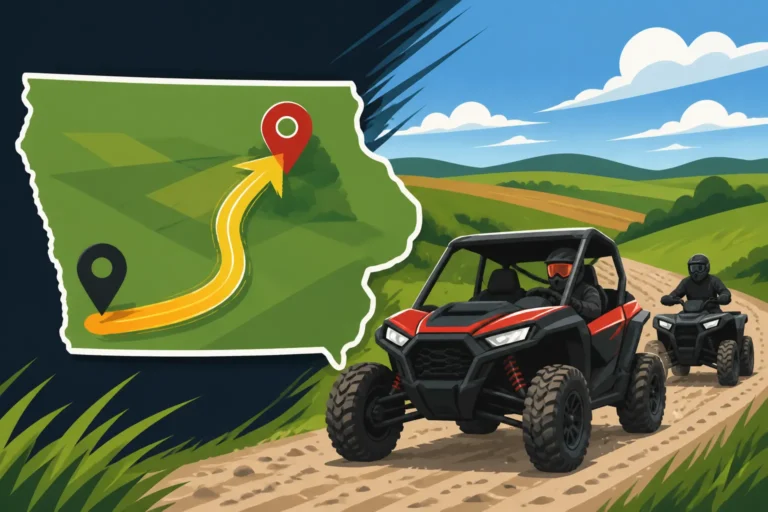
One of the most crucial concepts for anyone considering riding their ATV or UTV to a trail or park in Iowa is the "most direct route" rule. This isn't just about convenience; it's a legal requirement designed to limit the amount of time and distance your off-highway vehicle spends on public roadways. Essentially, if you're using a public road to get to a legal riding area—like an OHV park or privately owned land where you have permission to ride—you are obligated to take the shortest, most direct path available.
This means you can't just meander down scenic routes or take a joyride through town on your way to Gypsum City. You must plan your journey to minimize your road exposure. This rule often applies when you're moving from your home or a staging area to an authorized trail system. It's about connecting point A (your starting point) to point B (the legal riding area) with the least amount of public road travel. Failure to adhere to this can lead to citations, even if you meet all other equipment and operator requirements. [The Most Direct Route to an Iowa OHV Park] is a principle that law enforcement takes seriously, as it ensures ATVs and UTVs are primarily used in their intended off-road environments.
Permitted Road Types and Local Authority
Iowa distinguishes between different types of roads when it comes to OHV use. Generally, the easiest roads to legally ride are unpaved county secondary roads. These are your rural gravel and dirt roads, often maintained by the county. For these, state law generally allows ATV and UTV use, provided you meet all other requirements.
However, things get more complex with paved roads and city streets. Paved secondary roads—those blacktop or concrete roads often connecting small towns or serving rural residences—are generally closed to OHVs unless the county board of supervisors has passed an ordinance specifically opening them. This means you can't assume a paved county road is open. You must check with the specific county's recorder or sheriff's office. Similarly, city streets are closed unless the city council has passed an ordinance to open them. Some cities, particularly those near popular riding areas, have done this for portions of their street systems, but it's never a given. [Iowa Rules for Riding a Paved Secondary Road] and [Iowa Cities That Allow ATVs on Streets] are critical resources for understanding these local variations. You could use an aftermarket GPS system from a company like SuperATV that has pre-loaded trail maps, but always cross-reference with official county and city ordinances for road legality.
| Road Type | Default State Law Status (without local action) | Local Authority Required to Open? | Key Consideration |
|---|---|---|---|
| Unpaved Secondary Roads | Generally Open | No (unless specifically closed) | Adhere to "Most Direct Route" rule, 35 mph speed limit |
| Paved Secondary Roads | Closed | Yes (County Board of Supervisors) | Always check county ordinances; assume closed until confirmed |
| City Streets & Alleys | Closed | Yes (City Council) | Always check city ordinances; assume closed until confirmed |
| Primary Highways (State Hwys) | Closed | No (remain closed) | May only cross at intersections, cannot ride along them |
| Interstates | Closed | No (remain closed) | Never permitted |
Age, License, and Speed Limits
Operating an ATV or UTV on any public road in Iowa comes with strict operator requirements. First, the driver must be at least 18 years old. This isn't just a suggestion; it's law. No one under the age of 18 may operate an OHV on a public road in Iowa. [Iowa Minimum Age to Ride a Road] is a fundamental rule that cannot be overlooked.
Second, the operator must possess a valid driver's license. Your ATV or UTV isn't a substitute for a car when it comes to road use; it's an extension that requires the same foundational driving privilege. Simply having a state ID or an ATV safety certificate isn't enough for road operation.
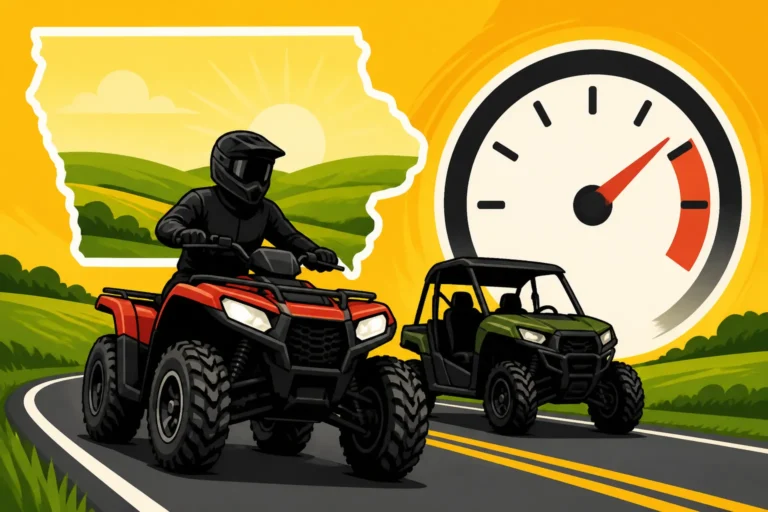
Finally, a speed limit is imposed. When riding an ATV or UTV on any public road where it's permitted, you must not exceed 35 miles per hour. This speed limit is in place for safety, recognizing the different handling characteristics of off-road machines compared to traditional vehicles. Exceeding this limit is a violation, regardless of the posted speed limit for cars. [Iowa ATV Speed Limit on Roads] is a separate restriction from the general vehicular speed limits.
Equipping Your Machine for Iowa Roads
Beyond knowing where you can ride, it's equally important to know how your machine must be equipped to be street legal in Iowa. Riding without the proper gear is not only dangerous but can also result in fines and citations.
Essential Safety Gear and Equipment
When you're riding your ATV or UTV on Iowa's public roads, even just "the short way" to Gypsum City, your machine must meet certain safety equipment standards. These requirements are in place to make your OHV visible and communicative to other drivers, significantly reducing the risk of accidents.
- Headlights: You need at least one, but usually two, working headlights that are on and visible at all times, day or night. This isn't just for seeing where you're going; it's crucial for being seen by oncoming traffic.
- Taillights: At least one working taillight is required, visible from the rear. This is equally important for preventing rear-end collisions.
- Brakes: Your machine must have fully functional brakes, as you'd expect for any road-going vehicle.
- Horn: A working horn is necessary for signaling and alerting other drivers or pedestrians to your presence.
- Mirror: You must have at least one rearview mirror, properly adjusted, so you can see traffic approaching from behind. Many riders choose a robust aftermarket mirror, perhaps from SuperATV, that can withstand the vibrations of off-road use but still provide clear visibility on the road.
- Slow-Moving Vehicle (SMV) Triangle: This reflective orange triangle with a red border must be displayed on the rear of your ATV or UTV. It signals to other motorists that your vehicle is traveling at 25 mph or less. Even though the OHV speed limit is 35 mph, the SMV triangle is still a requirement for these slower-moving vehicles on public roads.
- Muffler and Spark Arrestor: Your machine must be equipped with a muffler that is in good working order, preventing excessive noise. Additionally, a spark arrester is required to prevent sparks from escaping the exhaust, which is a fire hazard, especially in dry conditions.
- Iowa Registration Decal: Your machine must be properly registered with the Iowa DNR and display the current year's decal on the rear. This proves your machine is legally allowed to operate in Iowa. [What Iowa Requires of an ATV on a Public Road] details these specific items.
Insurance and Its Importance
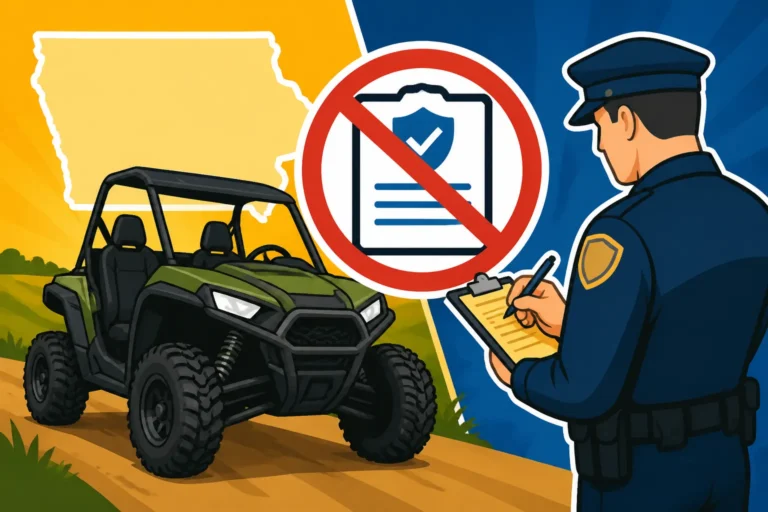
Beyond physical equipment, one of the most critical requirements for riding your ATV or UTV on Iowa public roads is carrying adequate insurance. This isn't optional; it's the law. Just like a car, your OHV must be insured to protect you and others in the event of an accident.
Iowa law mandates specific minimum liability coverage for ATVs and UTVs operated on public roads. These minimums are often referred to as 20/40/15:
- $20,000 for bodily injury to one person in an accident.
- $40,000 for bodily injury to two or more people in an accident.
- $15,000 for property damage in an accident.
Carrying this insurance is paramount. If you're stopped by law enforcement and cannot provide proof of insurance that meets these minimums, you can face significant fines and penalties. Furthermore, if you're involved in an accident without proper insurance, you could be held personally liable for damages, which can be financially devastating. [Iowa ATV Insurance Requirement] cannot be stressed enough; it’s not just a legal hurdle but a vital safety net. Many choose robust aftermarket protection from companies like SuperATV, but that doesn't replace the need for proper insurance coverage.
Planning Your "Short Way" to Gypsum City
Riding to Gypsum City OHV Park, or any other authorized riding area, requires more than just meeting the basic legal requirements. It demands careful planning and an understanding of local specifics to ensure your journey is safe and compliant.
Mapping Your Route Legally
Before you even turn the key, you need a map—and not just any map. You need to identify a route that strictly adheres to Iowa's "most direct route" rule and utilizes only legally open roads. This means pulling out county maps, checking online resources, and possibly even calling the county recorder or sheriff's office for clarification.
Start by locating Gypsum City OHV Park on a map. Then, pinpoint your starting location. Now, look for the shortest route between these two points that primarily uses unpaved secondary roads. Be extremely cautious about paved roads. Unless you have definitive information that a specific paved county road has been opened by local ordinance, assume it's closed. The same goes for any city streets you might consider. Don't rely on assumptions or what "everyone else does." Take the time to confirm the legality of every segment of your planned route. This might mean adding a few extra miles on gravel to avoid a short stretch of questionable pavement, but it's worth it to avoid a citation. [Riding to Gypsum City the Short Way] isn't about cutting corners on legality, but about optimizing your path.
Local Ordinances and County Pavement
This is where the rubber meets the road, quite literally. While state law provides a general framework, Iowa grants significant authority to individual counties and cities to decide whether to open their paved secondary roads and city streets to OHV traffic. This leads to a patchwork of rules across the state. What's legal in Webster County, where Gypsum City is located, might be illegal in an adjacent county.
To ensure you're riding legally, especially on any paved segment, you absolutely must check the local ordinances for each county and city your route traverses.
- For County Roads (Paved Secondary): Contact the county recorder's office or the county sheriff's department. They should be able to tell you if there are any specific ordinances opening paved roads to OHVs.
- For City Streets: Contact the city clerk's office for any municipalities your route might enter. They can inform you if specific streets, or even all streets and alleys, have been opened.
- Online Resources: Many counties and cities now publish their ordinances online. A quick search for "[County Name] ATV ordinance" or "[City Name] UTV street legal" might yield the information you need.
Remember, the absence of a "No ATVs" sign doesn't mean it's permitted. The default assumption for paved county roads and city streets is "closed" unless an ordinance explicitly opens them. This due diligence is a critical step in [Planning Fuel for a Northern Iowa Loop] or any other ride that takes you on public roads.
What to Expect Roadside
Even with all your ducks in a row – the right equipment, proper insurance, and a meticulously planned, legal route – you should still be prepared for the possibility of a roadside stop by law enforcement. Conservation officers with the Iowa DNR, county sheriff's deputies, and city police officers all have the authority to enforce OHV laws.
When stopped, an officer will likely check several things:
- Driver's License and Age: They will ask for your valid driver's license to confirm you are 18 or older and properly licensed.
- Proof of Insurance: Have your insurance card handy, showing current minimum liability coverage.
- Registration Decal and Certificate: They will check for the current Iowa DNR registration decal on your machine and may ask to see your registration certificate, which you should carry on your person or on the machine.
- Equipment Compliance: The officer will quickly assess your machine for required equipment: working headlights, taillights, horn, mirror, and the slow-moving vehicle triangle. They may also check for proper muffler and spark arrester.
- Route and Purpose: While not always explicitly asked, if you are stopped on a road, be prepared to explain your route and your purpose for being on that road – for example, "I'm taking the most direct route to Gypsum City OHV Park."
Being polite, cooperative, and having all your paperwork and equipment in order will make any roadside interaction much smoother. Trying to explain that you were "just riding a short way to the park" without meeting these requirements won't get you far. [A Deputy at an Iowa Roadside Stop] is simply doing their job to ensure everyone's safety.
Common Misconceptions and Risks
Even with the best intentions, there are a few areas where riders often misunderstand Iowa's OHV road laws, leading to potential fines or dangerous situations.
The Dangers of Unauthorized Road Use
One of the biggest misconceptions is that if you "just ride a short distance" on an illegal road, you won't get caught or that the consequences will be minor. This is simply not true. Riding an ATV or UTV on a road where it's not permitted carries significant risks and penalties.
- Fines and Citations: Iowa law enforcement takes illegal road use seriously. Fines for operating an unregistered or improperly equipped OHV, or riding on a closed road, can be substantial. These aren't just slaps on the wrist; they can hit your wallet hard. [Iowa Fines for Illegal ATV Road Use] are designed to deter unauthorized operation.
- Accident Liability: If you are involved in an accident while operating your OHV illegally on a public road, your liability could be astronomical. Your insurance policy might not cover incidents that occur during illegal operation, leaving you personally responsible for damages, medical bills, and legal fees.
- Safety Risks: ATVs and UTVs are designed for off-road terrain, not high-speed pavement or interaction with cars and trucks. Their handling characteristics, narrow track width (for ATVs), and lack of crumple zones make them highly vulnerable in collisions with larger vehicles. The consequences of such an accident can be severe, including serious injury or fatality. Even a simple aftermarket windshield from a company like SuperATV won't protect you from the force of an impact with a car.
- Loss of Riding Privileges: Repeated or severe violations could potentially impact your ability to register an OHV in the future or lead to other legal consequences.
It's tempting to think you can sneak by, but the risks far outweigh any perceived convenience of bypassing legal requirements.
Why Helmets Are Optional but Recommended
Iowa has a unique stance on helmets for ATV and UTV operators on public roads, and it often surprises riders. Unlike many states that mandate helmets for all OHV riders, Iowa does not require helmets for operators aged 18 and older when riding on public roads. For riders under 18, helmets are generally required when operating an OHV, regardless of location, unless on private property with landowner permission.
While the law doesn't require you to wear a helmet if you're an adult riding on a public road, it is highly recommended. Helmets are proven to significantly reduce the risk of head injury in an accident. Given the inherent risks of operating an OHV, especially when sharing the road with other vehicles, choosing to wear a helmet is a smart, proactive safety measure. You wouldn't think twice about wearing one at Gypsum City OHV Park, and the risks on a public road, particularly from other traffic, are arguably even greater. Don't let the lack of a legal mandate override common sense when it comes to personal safety.
Disclaimer
This article is for general informational purposes only and does not constitute professional advice. Laws, prices and regulations vary by location and change over time. Consult a qualified professional for guidance on your specific situation.