Taking the Most Direct Route to Gravel
Navigating Iowa's roads with your ATV or UTV can feel like deciphering an ancient riddle, especially when you just want to get to the nearest gravel trail or even back to your own property. It’s a common frustration for riders who see miles of open road but aren’t sure where they’re legally allowed to be. This guide is here to untangle the complexities of Iowa's off-highway vehicle (OHV) road use laws, focusing specifically on the crucial "most direct route" rule, so you can ride confidently and within the bounds of the law.
Understanding Iowa's "Most Direct Route" Rule for OHVs
Iowa's regulations around ATV and UTV use on public roads can be a real head-scratcher. It’s not a free-for-all, and it’s definitely not a total ban, which leaves many riders scratching their heads. The key concept that trips up many enthusiasts is the "most direct route" rule. This isn't just a suggestion; it's a specific legal parameter that dictates how and when you can use certain public roads to connect riding areas or access private land. It's designed to allow necessary transit while limiting recreational road riding, keeping safety for all road users a top priority.
What "Most Direct Route" Actually Means
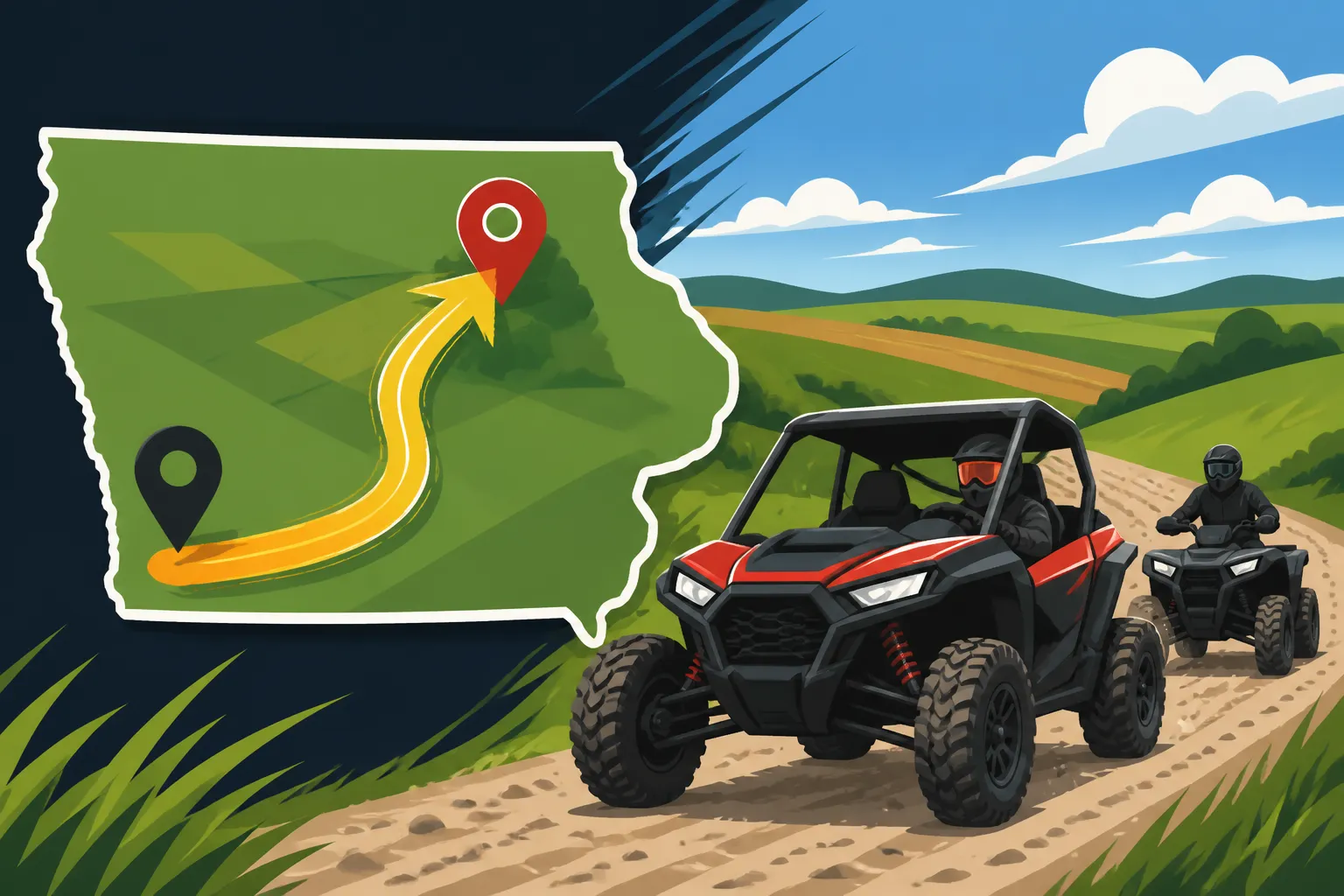
When the law talks about the "most direct route," it's not giving you permission to take the scenic way around or cruise through town to show off your new SuperATV accessories. It means exactly what it sounds like: the shortest, most efficient path from point A to point B. Imagine you're drawing a straight line on a map between your starting point and your destination – that's the ideal. If you're leaving your home to get to a specific gravel road or an OHV park, you must take the most direct path possible using only the types of roads that are legally permissible for OHV use. This implies avoiding detours, unnecessary turns, or traveling parallel to a more direct route just because it looks like more fun. It's about necessity, not leisure.
For example, if you live off a paved county road and the nearest authorized gravel road is two miles north, you can't decide to ride five miles east just to visit a friend before heading north. Your "most direct route" is that two-mile stretch north. The law is quite strict on this, and deputies are often on the lookout for riders who might be stretching the interpretation of "direct." The intent is to connect you to legal riding areas, not to open up every road for joyrides.
Where the Rule Applies: Connecting and Accessing
The "most direct route" rule primarily applies when you are using an ATV or UTV to:
- Access an OHV Park or Trail: This is perhaps the most common scenario. You might live a few miles from a designated OHV park like Gypsum City OHV Park or Bluff Creek OHV Park. The "most direct route" rule allows you to ride your machine from your home to the park entrance using legal road types.
- Connect Permitted Riding Areas: Sometimes, legal gravel roads might be separated by a short stretch of paved secondary road or even a primary highway crossing. The "most direct route" rule enables you to legally traverse these connecting segments, provided they meet other criteria.
- Access Private Land: If your hunting grounds or private timber are located a short distance down an authorized road, you can use the most direct route to get your machine there. This is particularly relevant for farmers or landowners who use their machines for agricultural purposes, though specific exemptions exist for [The Implement of Husbandry Exemption in Iowa].
It's critical to remember that this permission isn't a blanket statement for all roads. It specifies which roads you can use for your "most direct route." You're generally looking at unpaved secondary roads, and in some cases, specific paved secondary roads or city streets that have been explicitly opened by local ordinances. Never assume that because a road is "direct," you're automatically allowed on it. Always verify the road type and local authorizations.
Where Can You Actually Ride Your ATV/UTV on Iowa Roads?
Iowa's road system is a patchwork of different classifications, and each has its own set of rules for OHV use. It’s not just about rural versus urban; it's about paved versus unpaved, county versus state, and local city ordinances. This can make planning a route incredibly confusing, and the wrong turn could lead to a citation. Knowing the specific types of roads you are allowed on is just as important as understanding the "most direct route" principle itself.
Unpaved County Secondary Roads in Iowa
This is often where the magic happens for Iowa ATV and UTV riders. Unpaved county secondary roads, commonly known as gravel roads, are generally open to OHV use in Iowa. This is a significant distinction because it provides riders with vast networks of trails and connectors, especially in rural areas. Many riders consider these gravel roads their "local trails" outside of dedicated OHV parks. The state law provides a general allowance for these roads, meaning individual counties don't typically need to pass an ordinance to open them up.
However, even on gravel roads, there are still rules to follow. You must operate your machine safely, adhere to posted speed limits (or the statewide OHV limit of [Iowa's 35 mph Cap], whichever is lower), and ensure your machine is properly equipped and registered. While these roads offer great freedom, they are still public roadways shared with cars, trucks, and farm equipment. Dust, visibility, and shared right-of-way are always considerations. It's easy to get complacent on a long stretch of gravel, but vigilance is always key.
Paved Secondary Roads and County Authorization
Here's where it gets a little more complex. Paved county secondary roads are not automatically open to OHV use. For an ATV or UTV to be legally ridden on a paved secondary road, the specific county board of supervisors must pass an ordinance explicitly authorizing such use. This means that what's legal in one county might be illegal just across the county line. There is no statewide list of which paved roads are open, so it's incumbent upon the rider to check with each county recorder's office or the county sheriff's department for their specific ordinances.
When a county does authorize paved secondary roads for OHV use, they often do so with additional restrictions. These might include limitations on specific routes, times of day, or types of machines. The purpose of these authorizations is usually to allow residents to access trailheads or connect to existing gravel road networks, always keeping the "most direct route" in mind. For example, [How an Iowa County Authorizes a Paved Road] typically involves public hearings and careful consideration of safety impacts before a vote by the board of supervisors. Always assume paved roads are closed unless you have confirmed they are open by local ordinance.
City Streets and Iowa Council Authorization
Riding your ATV or UTV on city streets is even more restricted than on county paved roads. Generally, city streets are closed to OHV traffic. However, a city council can pass an ordinance to allow ATVs and UTVs on specific streets or all streets within city limits, often with significant restrictions. This is a rare occurrence, but it does happen in some smaller communities, usually to facilitate access to local businesses or connect to adjacent trail systems.
Just like with county paved roads, you cannot assume a city's streets are open. You must check with the individual city clerk's office for their specific ordinances. If a city does open its streets, it's typically for "most direct route" purposes – getting from a residence to a trail, or from a trail to a gas station. You'll often find strict hours of operation, speed limits, and requirements for machines to be fully street-legal equipped, including proper lighting, mirrors, and a horn. Communities like [Waukon's Open Streets and Alleys] have specific rules, such as [Waukon's Midnight to Five Ban], illustrating how granular these local regulations can become. Without explicit authorization, city streets are a no-go for recreational ATV/UTV use.
Essential Gear and Rules for Road Riding in Iowa
So, you've identified a legal route using the "most direct" path on an authorized road. Great! But simply being on the right road isn't enough. Iowa has specific requirements for ATVs and UTVs operated on public roads, designed to ensure the safety of the OHV operator and other motorists. These aren't suggestions; they are legal mandates, and failing to comply can result in fines and a ruined ride. This means more than just having a shiny new SuperATV light bar; it means having the right equipment.
Iowa's Registration, Insurance, and Age Requirements
Before you even think about putting a tire on an Iowa public road, your machine needs to be properly registered with the state. This means your ATV or UTV must have a current [Registering an ATV in Iowa] decal affixed in the proper location, usually the rear fender. This registration process is handled by your county recorder's office and is crucial for legal operation on any public land or authorized road.
Beyond registration, Iowa mandates that any ATV or UTV operated on a public road must carry liability insurance. This isn't optional. The minimum coverage limits are typically set at $20,000 for bodily injury to one person, $40,000 for bodily injury to two or more people, and $15,000 for property damage. Always carry proof of insurance with you when riding on public roads. A law enforcement officer can ask to see it, and riding without it can lead to significant fines. You can learn more about these requirements and potential costs by checking out [Iowa ATV Insurance Requirement].
Finally, age matters a lot. To operate an ATV or UTV on any public road in Iowa, the operator must be at least [Iowa Minimum Age to Ride a Road]. This means no 16-year-olds on the public roads, even with a driver's license for a car. This rule is in place for safety, recognizing the different dynamics of an OHV compared to a traditional vehicle.
Lighting, Mirrors, and Safety Triangles
Operating an OHV on a public road demands certain safety equipment to ensure you're visible to others and can see your surroundings effectively.
- Headlights and Taillights: Your machine must have at least one headlight that emits a white light and is visible for 500 feet, and at least one taillight emitting a red light visible for 500 feet. If you're riding after sunset or before sunrise, these lights must be on. Many riders simply keep their [Headlights On All Day in Iowa] for maximum visibility, regardless of the time of day.
- Brake Lights: A red brake light must be visible from the rear, illuminating when the brake is applied.
- Mirrors: You must have at least one mirror, mounted to allow the operator to see 200 feet to the rear. Many choose to install a SuperATV rear-view mirror for this purpose, ensuring it meets the visibility criteria.
- Horn: A horn is mandatory for signaling. It must be audible under normal conditions for 200 feet.
- Slow-Moving Vehicle (SMV) Triangle: Because ATVs and UTVs typically travel slower than other road traffic, a slow-moving vehicle triangle must be displayed on the rear of your machine. This bright orange and red reflective triangle alerts drivers approaching from behind that you are moving at a reduced speed. You can find detailed information on [Iowa's Slow-Moving Vehicle Triangle] rules.
Here's a quick reference table for road-legal equipment:
| Requirement | Description |
|---|---|
| Registration | Current Iowa OHV decal affixed to the rear. |
| Insurance | Liability coverage meeting state minimums (e.g., 20/40/15). Proof must be carried. |
| Operator Age | Must be 18 years of age or older. |
| Headlights | At least one white headlight, visible 500 ft. |
| Taillights | At least one red taillight, visible 500 ft. |
| Brake Lights | Red, visible from the rear when brake is applied. |
| Mirror | At least one rear-view mirror, allowing view 200 ft to the rear. |
| Horn | Audible for 200 ft under normal conditions. |
| SMV Triangle | Displayed on the rear of the machine. |
| Speed Limit | [Iowa's 35 mph Cap] or posted limit, whichever is lower. |
| Driver's License | Valid driver's license required for the operator. |
| Spark Arrestor | Required for fire safety, especially near dry vegetation. |
Other Important Road Use Restrictions
Beyond equipment, there are crucial operational rules that dictate how you can behave on Iowa roads:
- Speed Limit: No matter the posted speed limit, you cannot exceed [Iowa's 35 mph Cap] when operating an ATV or UTV on a public road. This is a hard limit designed to enhance safety.
- Driver's License: The operator of an ATV or UTV on a public road must possess a valid driver's license. This goes hand-in-hand with the 18-year-old age requirement.
- Helmet Law: Interestingly, Iowa does not mandate helmet use for adults riding ATVs or UTVs on public roads. While not required by law, wearing a helmet is always strongly recommended for your safety.
- Passengers: If your machine is designed to carry a passenger, they must be seated in a designated passenger seat. Overloading your machine or allowing passengers to ride in unsafe positions is illegal and extremely dangerous. Some UTVs with multiple seats are built for passengers, and a company like SuperATV offers accessories to enhance passenger comfort and safety.
- Road Etiquette: Always yield to larger vehicles, stay to the right side of the road, and use hand signals or turn signals if your machine is equipped. Be especially cautious of farm machinery, which can be slow-moving and take up a lot of road space.
Penalties and Pitfalls to Avoid on Iowa Roads
Ignoring Iowa's OHV road use laws isn't just a matter of "getting caught"; it can lead to significant financial penalties, legal trouble, and even the loss of your riding privileges. The authorities, from county sheriffs to DNR conservation officers, are well-versed in these regulations and will enforce them. Understanding the consequences can help you avoid making costly mistakes.
Common Violations and Their Fines
Riding outside the permitted framework can result in various citations, each carrying its own fine. Some of the most common violations observed on Iowa roads include:
- Riding on an Unauthorized Road: This is probably the most frequent violation. If you're caught on a paved county road not authorized by ordinance, a state highway, or a city street without specific permission, you're looking at a citation for illegal road use. This is particularly true if you are clearly not on the [The Most Direct Route to an Iowa OHV Park].
- No Registration or Expired Registration: Operating an unregistered or expired machine on a public road is a straightforward violation. [Iowa Fines for an Unregistered ATV] can be substantial, and you might even have your machine impounded.
- No Proof of Insurance: As mentioned, insurance is mandatory. Failing to provide proof can lead to significant fines, as detailed in [Iowa Fines for No Proof of Insurance].
- Underage Operator: Allowing someone under 18 to operate an ATV or UTV on a public road is a serious offense, often impacting the supervising adult as well.
- Speeding: Exceeding [Iowa's 35 mph Cap] on public roads is a clear violation, even if the road itself is legally open.
- Missing Equipment: Being stopped without a required headlight, taillight, mirror, horn, or SMV triangle can also result in fines for equipment violations. A deputy at an [A Deputy at an Iowa Roadside Stop] will check all these items.
These fines can quickly add up, easily surpassing the cost of proper registration and equipment. Beyond monetary penalties, repeat offenses could lead to a suspension of your OHV registration or even driving privileges.
The Dangers of Unauthorized Road Use
Beyond legal penalties, the real danger of riding an ATV or UTV on unauthorized roads, especially high-speed paved roads or busy city streets, is the inherent safety risk.
- Speed Differential: ATVs and UTVs are not designed for sustained high-speed road travel. Their suspension, tires, and steering are optimized for off-road conditions, making them less stable and predictable at higher speeds on pavement. The significant speed difference between an OHV and typical road traffic drastically increases the risk of serious accidents.
- Visibility: While you're required to have lights and an SMV triangle, ATVs and UTVs are smaller and less visible than cars, especially at dusk or dawn. Other drivers might not expect to see an OHV on a particular road, leading to a higher chance of a collision.
- Tire Wear and Traction: Off-road tires wear down quickly on pavement, reducing their grip and effectiveness. This can compromise braking and handling, particularly in wet conditions.
- Driver Fatigue: Long stretches on pavement can be jarring and uncomfortable on an OHV, leading to driver fatigue and reduced concentration, which is especially dangerous on roads not meant for these machines.
It's tempting to take a shortcut or push the limits, but the potential for severe injury or even fatality, combined with the legal consequences, simply isn't worth it. Respecting these laws isn't just about avoiding a ticket; it's about staying safe and preserving the future of OHV riding in Iowa.
Why These Rules Exist: Safety and Conservation
It’s easy to feel frustrated by the seemingly endless rules and restrictions when all you want to do is ride. But these laws aren't arbitrary; they are the result of careful consideration of public safety, environmental protection, and the desire to maintain harmonious coexistence between OHV riders, landowners, and other road users. Understanding the "why" behind the regulations can help foster a greater appreciation for the importance of compliance.
Protecting Riders and Other Motorists
The primary reason for many of Iowa's OHV road use laws is safety. ATVs and UTVs handle very differently from cars and trucks, and mixing them on high-speed roadways creates significant risks.
- Vehicle Dynamics: OHVs have a higher center of gravity, narrower track widths (compared to cars), and suspension systems designed for rough terrain, not smooth pavement. This makes them more prone to rollovers, especially during sharp turns or sudden maneuvers on asphalt.
- Operator Skill and Experience: While many OHV riders are highly skilled off-road, navigating traffic, intersections, and varied road conditions requires a different set of skills and awareness. The age restriction of [Iowa Minimum Age to Ride a Road] for road use acknowledges the increased responsibility required.
- Collision Severity: In the event of a collision between an ATV/UTV and a larger vehicle, the OHV operator and any passengers are at a severe disadvantage due to the lack of an enclosed cabin and crumple zones. The safety equipment requirements, like mirrors and horns, are direct responses to mitigate these risks by improving visibility and communication between vehicles. This is also why [Iowa's 35 mph Cap] is strictly enforced on roads.
These rules aim to reduce accidents, serious injuries, and fatalities for everyone on Iowa's roads, not just those on OHVs.
Maintaining Public Support and Access
The ability to ride ATVs and UTVs on certain public roads in Iowa is a privilege that depends heavily on public support and responsible riding. Reckless or illegal road use can quickly erode that support, leading to stricter laws or outright bans.
- Nuisance Concerns: Excessive noise, dust, and careless operation on or near private property can create significant friction with rural residents and landowners. When riders disrespect property lines or create disturbances, it often leads to complaints to local authorities, which can then result in enforcement crackdowns or pressure to close roads.
- Environmental Impact: While less direct for road use, the broader OHV community's actions impact environmental perceptions. Staying on designated routes, whether they're trails or authorized roads, helps prevent erosion, protect sensitive habitats, and maintain the natural beauty of Iowa's landscapes.
- Preserving Existing Access: Every time an OHV rider is cited for illegal road use, it provides ammunition for those who advocate for closing all roads to OHVs. By diligently following the "most direct route" rule and adhering to all equipment and operational requirements, riders help demonstrate that they can be responsible road users. This, in turn, helps preserve the existing access they currently enjoy and can even pave the way for future expansions of legal riding areas. Think of it as a social contract: follow the rules, and the privilege of access continues.
In essence, Iowa's road use laws for ATVs and UTVs strike a delicate balance. They provide practical routes for riders to connect to trails and private land, while simultaneously safeguarding public safety and ensuring that the OHV community continues to be viewed as responsible recreationalists. By understanding and respecting these rules, every rider contributes to the long-term health and accessibility of OHV recreation in Iowa.
Disclaimer
This article is for general informational purposes only and does not constitute professional advice. Laws, prices and regulations vary by location and change over time. Consult a qualified professional for guidance on your specific situation.