Riding Home the Short Way
We've all been there: you're out riding your ATV or UTV, enjoying the trails or working on the back forty, and then it's time to head home. The long way, sticking strictly to trails or private property, can sometimes add significant time and mileage to your trip, making that warm supper or quick errand feel endlessly far away. That's when the thought creeps in: "Can't I just take the short way home on the road?" In Iowa, figuring out when and how you can legally do exactly that can feel like navigating a maze, filled with specific rules about what roads are open, what equipment you need, and even how old you have to be. This guide is here to break down those complexities, helping you understand how to ride your ATV or UTV on Iowa roads safely and legally, especially when you just want to take the most direct route.
Understanding Iowa's "Most Direct Route" Rule
The concept of taking the "short way home" often runs straight into Iowa's specific regulations regarding off-highway vehicle (OHV) use on public roads. It’s not simply a matter of convenience; there are strict guidelines designed to balance rider access with public safety and road preservation. Many riders feel frustrated by rules that seem to restrict common-sense travel, but understanding the intent behind these laws can help you stay compliant and avoid a ticket.
What "Most Direct" Actually Means for Riders
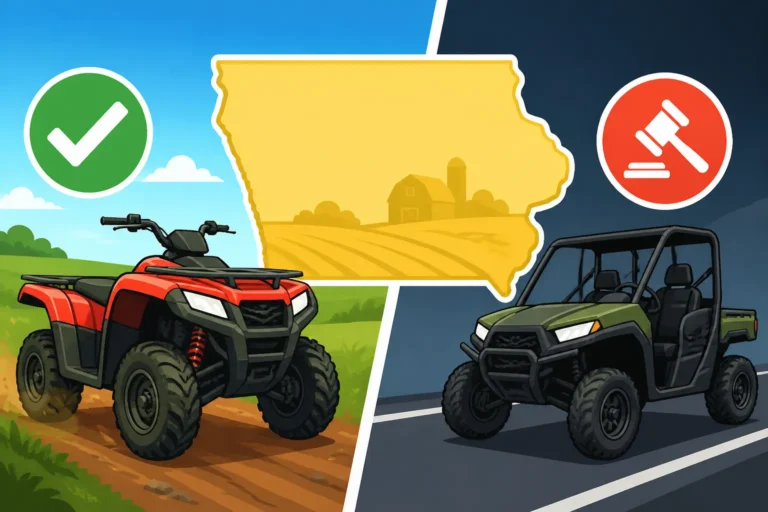
Iowa law permits ATVs and UTVs on certain public roads only for the purpose of getting to and from a designated riding area, your home, a place of business, or agricultural land. The key phrase here is [The Most Direct Route Home in Iowa]. This isn't just a suggestion; it's a legal requirement. It means you can't just take your machine for a leisurely cruise down a paved county road if there's a more direct route on a gravel road or an alternative that avoids public roads entirely. For instance, if you're leaving Bluff Creek OHV Park and your house is five miles north, the "most direct route" would likely be the shortest path on permissible roads to get you there, not a scenic detour through a neighboring town. This rule is designed to prevent joyriding on public roads and to minimize the impact of OHVs on traffic flow and road surfaces. It ensures that road use is functional and purposeful, not recreational.
When planning your journey, imagine drawing a straight line from your current location to your destination. While you can't always follow a literal straight line, your chosen path should be the most logical, efficient, and shortest possible legal route. This often means sticking to [Iowa's Unpaved Secondary Road Rule] whenever possible, as paved roads typically have more restrictions. You might be tempted to cut through a few blocks on a paved street to avoid a longer gravel section, but if that paved route isn't explicitly authorized for OHV use and there's a legal, albeit slightly longer, gravel alternative, you could be in violation. Always err on the side of caution and directness.
The Fine Line Between Convenience and Violation
It's easy to blur the lines between what feels convenient and what is legally permissible. Many riders get caught because they assume that since one gravel road is open, all roads are fair game, or that a short jaunt on a paved street won't hurt. However, deputies and DNR officers are well aware of the common temptations. Taking a slightly longer route that strictly adheres to the legal framework is always better than risking a citation for illegal road use. For example, if your home is just off a primary highway, Iowa law does not permit you to ride along that highway for miles just because it's technically "direct." You'd need to find the most direct route on permissible roads, which often means an initial trip down a gravel county road before getting onto a designated trail or private land.
Consider the common scenario of needing to cross a paved road to get from one section of gravel road to another, or from a trail to your farm. Iowa law often allows for perpendicular crossings of paved roads at intersections, but it does not typically allow for continuous travel along them, especially multi-lane or state highways. The rules around [Iowa's Most Direct Route Rule] are about minimizing your time on restricted roadways. If you could have taken a less convenient but fully legal route, and instead chose a path that involved unauthorized road segments, you've crossed that fine line. It's a matter of choosing the most direct legal route, not just the shortest one you can find on a map. Always think about what alternative routes exist and if your chosen path truly minimizes your exposure to higher-traffic or restricted roads.
Planning Your Short Way Home Responsibly
Responsible planning is paramount to staying legal and safe when using your ATV or UTV on Iowa roads. Before you even head out for a ride, especially if you anticipate needing to use public roads, you should map out your potential routes. This isn't just about knowing the roads; it's about knowing which roads are permissible. You can often find maps or information from your county's secondary roads department or local city councils that designate which roads are open to OHV traffic. This pre-ride homework can save you a lot of headaches later on.
Furthermore, consider the time of day and visibility. Even if a road is open, riding during peak traffic hours or in low visibility conditions (like dusk or dawn) increases your risk and can make you more noticeable to law enforcement. Carrying your registration and insurance documentation is also critical, as any roadside stop will involve verifying these items. Think about your machine's condition too; ensure all your lights, turn signals, and horn are functional. Aftermarket accessories from companies like SuperATV can help you equip your machine with all the necessary road-legal items, such as mirrors or turn signal kits, ensuring you meet compliance while enhancing your ride's functionality. Having your machine properly equipped and your route thoroughly planned is the best way to ensure your "short way home" is a smooth, legal, and safe one.
Key Requirements for Road-Legal ATV/UTV Use in Iowa
Riding your ATV or UTV on Iowa's public roads isn't just about knowing which roads you can use; it's also about ensuring you and your machine meet specific legal requirements. These rules are in place for the safety of everyone on the road, not just OHV riders. Failing to meet even one of these conditions can lead to fines, citations, or even more serious consequences if an accident occurs. It can be a hassle to keep track of all the details, but it's a non-negotiable part of riding responsibly in Iowa.
Age, License, and Rider Supervision
Iowa has clear rules about who can operate an ATV or UTV on public roads. First and foremost, you must be at least [Iowa Minimum Age to Ride a Road]. This isn't a suggestion; it's a hard rule. So, if you're thinking about letting your capable 16-year-old take the side-by-side a couple of miles down the gravel to a friend's house, think again – it's illegal. This means that if you're heading down [The Most Direct Route to an Iowa OHV Park] or simply making a quick trip, the driver must be 18 years or older.
Beyond age, the operator must possess a valid Iowa driver's license. This isn't specific to OHVs; it's the standard requirement for operating any motor vehicle on public roads. Carrying that license with you is just as important as having it. For riders under 18 who are not yet permitted on public roads, strict supervision rules apply when riding on designated trails or private land, but these do not extend to public road use for anyone under the age of 18. It’s a common misconception that if a child can legally operate a machine off-road, they can do so on the road with adult supervision. On Iowa public roads, the 18-year-old age limit and a valid driver's license are absolute. Understanding these age and license rules is critical for any ATV or UTV owner in Iowa to avoid legal trouble.
Essential Equipment for Public Road Travel
Your ATV or UTV needs to be properly equipped to be street legal in Iowa, and this goes beyond just having a working engine. These requirements are in place to ensure your machine is visible and controllable, integrating safely with other traffic. Ignoring these items can not only lead to a ticket but also significantly increase your risk of an accident. It's a pain to install some of these, but they are absolutely mandatory for your safety and the safety of others.
Here’s a breakdown of the key equipment:
| Requirement | Description | Why It's Important |
|---|---|---|
| Headlights | Must be on whenever the machine is operating on a public road, regardless of the time of day. | Increases your visibility to other motorists, especially at dusk, dawn, or on dusty gravel roads. |
| Tail Lights | Must be visible from a specific distance (e.g., 500 feet) to indicate your presence from the rear. | Crucial for preventing rear-end collisions, particularly when stopping or riding on roads with varying speeds. |
| Brake Lights | Must activate when the brake pedal/lever is applied, clearly signaling deceleration. | Warns following drivers that you are slowing down or stopping, giving them time to react. |
| Horn | A functional horn capable of emitting sound audible from at least 200 feet away. | Essential for alerting other vehicles, pedestrians, or animals to your presence or in emergency situations. [A Horn and a Mirror for Iowa Road Use] is a good article for more details. |
| Mirrors | At least one rearview mirror, typically on the left side, providing a clear view of the road to the rear. | Allows you to see traffic behind you without turning your head, enhancing situational awareness and safe lane changes or turns. |
| Slow-Moving Vehicle Sign | A reflective orange and red triangle mounted on the rear of the machine, visible from a certain distance. | Clearly indicates that your vehicle operates at speeds typically lower than surrounding traffic, prompting other drivers to exercise caution and pass safely. |
| Spark Arrestor | Required on the exhaust system to prevent the emission of sparks. | Reduces the risk of wildfires, especially in dry conditions along roadsides or agricultural areas. |
| Muffler | A functional muffler to prevent excessive or unusual noise. | Ensures noise levels are within acceptable limits, reducing disturbance to residents and other road users. |
Many of these items, like mirrors, horns, and turn signal kits, are readily available from aftermarket suppliers like SuperATV, allowing you to easily upgrade your machine for road legality. It’s not just about bolting them on; they must be functional and meet visibility standards. For instance, your headlight might be great for the trail, but if it doesn't adequately illuminate the road and make you visible, it might not pass muster for road use. Always check that all lights are clean and working before you head out, and that your slow-moving vehicle sign isn't obscured by cargo or mud.
The Critical Role of Insurance Coverage
Just like any other vehicle operating on Iowa's public roads, your ATV or UTV absolutely must have liability insurance. This isn't optional, and it's not just a recommendation; it's a legal requirement designed to protect everyone involved in the event of an accident. Many riders are surprised by this, especially if they only typically ride on private land, but the moment your wheels touch public asphalt or gravel, this requirement kicks in.
The minimum liability coverage amounts in Iowa are often referred to as "20/40/15," which stands for:
- $20,000 for bodily injury to one person in an accident.
- $40,000 for bodily injury to two or more people in an accident.
- $15,000 for property damage in an accident.
This means that if you're involved in an accident while riding on an Iowa road and you're found to be at fault, your insurance would cover up to these amounts for the damages and injuries sustained by others. Without this coverage, you could be personally liable for massive expenses, not to mention facing fines for driving uninsured. [Iowa ATV Insurance Requirement] is a very clear law.
It's crucial to understand that your homeowner's policy or general vehicle insurance might not automatically cover your ATV or UTV for road use. You'll likely need a specific off-road vehicle (ORV) policy or an endorsement that explicitly states coverage for public road operation. Always check with your insurance provider to ensure you have the correct type and amount of coverage before you ever think about taking [The Most Direct Route Home in Iowa] on public roads. Carrying proof of insurance, whether a physical card or digital copy, is also mandatory and will be requested during any roadside stop. For more on the numbers, see [Iowa's Twenty, Forty and Fifteen Thousand Minimums].
Navigating Different Iowa Road Types on Your Machine
Iowa's landscape is a patchwork of paved highways, winding gravel roads, and city streets, and each type comes with its own set of rules for ATV and UTV riders. The ability to take the "short way home" often hinges on understanding these distinctions, as what's legal on one type of road might be strictly prohibited on another. It's easy to get confused, especially when crossing county lines where local ordinances might differ slightly.
Gravel Roads: The Most Common "Short Way"
For most ATV and UTV riders in Iowa, gravel roads are the most accessible and frequently used option for taking the "short way home" or connecting to trails. Iowa law generally permits OHVs on unpaved secondary roads, which are primarily the gravel roads managed by county governments. This is a huge relief for many riders, as these roads often crisscross rural areas, providing convenient access to homes, farms, and trailheads. [Iowa Rules for Riding a Gravel Road] are generally more permissive than those for paved surfaces, making these roads the default choice for quick transit.
However, "permissive" doesn't mean "unregulated." You still need to adhere to all the equipment, age, and licensing requirements discussed earlier. Speed limits on gravel roads in Iowa are typically 55 mph, but for ATVs and UTVs, there's an additional [Iowa's 35 mph Cap]. This lower speed limit is critical for safety, given the nature of the vehicles and the often unpredictable conditions of gravel roads (dust, loose aggregate, blind corners, etc.). You must also remember the "most direct route" rule still applies; you can't just cruise endlessly on gravel roads for recreation. Their use is intended for functional travel, such as riding [The Most Direct Route Home in Iowa] or [The Most Direct Route to an Iowa OHV Park]. Always be mindful of other traffic, including farm machinery, and be prepared for dust and limited visibility, especially when passing or being passed.
Paved Secondary Roads and the Authorization Puzzle
This is where things can get a bit trickier. While most gravel roads are generally open to OHVs in Iowa, paved secondary roads – those paved roads managed by county governments – are not automatically open. Instead, counties must specifically authorize the use of ATVs and UTVs on their paved secondary road systems through a formal resolution or ordinance. This means that a paved road that's legal for OHV use in one county might be strictly forbidden just across the county line in another.
The "authorization puzzle" stems from the decentralized decision-making process. Each of Iowa's 99 counties can decide for itself which, if any, of its paved secondary roads are open. This makes taking a "short way" that involves pavement a bit of a gamble if you haven't done your homework. You can't just assume a paved road is open because you saw someone else on it, or because it connects two gravel sections. It's highly recommended to check with the specific county recorder's office or secondary roads department website to see if they have an ordinance in place. Without explicit authorization, riding on a paved secondary road is illegal. This situation often leads to frustration for riders who want to connect two areas efficiently but are blocked by a short stretch of unauthorized pavement. For a deeper dive, check out [Iowa Rules for Riding a Paved Secondary Road]. It's a key distinction that can make or break your road-legal journey.
City Streets: When Your "Short Way" Runs Through Town
If navigating county roads can be complicated, riding through city streets adds another layer of complexity. Just like paved secondary roads, city streets are generally closed to ATVs and UTVs unless a city council has passed a specific ordinance to open them. And even when a city opens its streets, those ordinances often come with their own unique set of restrictions, such as specific hours of operation, designated routes, or even bans on certain types of OHVs. For example, some towns might allow UTVs but not ATVs, or limit hours to daylight only.
The most direct route might, at times, necessitate traversing a short section of city street. In such cases, you absolutely must verify that the specific city has an ordinance allowing OHV use and that your planned route complies with its terms. You cannot ride on state highways or interstates, even if they pass through a city, and crossing these types of roads is usually only permitted at designated intersections. Without a city ordinance, using city streets is strictly prohibited and will likely result in a citation. It’s always best to call the city clerk or police department ahead of time if you plan to incorporate any city streets into your "short way" route. This situation often surprises riders who live in or near small towns, thinking their local streets might be more lenient. Unfortunately, without a specific local law, city streets remain off-limits, requiring you to find an alternative, even if it's the long way around.
Avoiding Common Pitfalls When Taking the Short Way
The desire to take the "short way home" is perfectly understandable, but it's also where many riders inadvertently run into trouble. Iowa's rules for ATV and UTV road use are specific, and overlooking even a minor detail can lead to fines, inconvenience, or even serious accidents. Being prepared and cautious is your best defense against these common pitfalls.
The Danger of Assuming All Roads Are Open
Perhaps the most frequent mistake riders make is assuming that if one gravel road is open to OHVs, all roads are. This simply isn't the case in Iowa. As we've discussed, paved county roads and city streets require explicit authorization from their respective governing bodies (county supervisors or city councils) before they can be legally ridden. The lack of a "No ATVs Allowed" sign does not mean a road is open. In fact, the general rule is quite the opposite: if a road isn't explicitly designated as open, assume it's closed.
This assumption can lead to riders venturing onto roads that are illegal for their machines, only to encounter law enforcement. Imagine you're on a long gravel road ride, and you see a paved section that would shave off a couple of miles. Without checking, you might assume it's okay because it's a county road. However, if that specific county hasn't passed an ordinance opening that paved road, you're riding illegally. This is a common point of frustration for riders who just want to get where they're going efficiently. However, the onus is on the rider to know the rules for the specific roads they intend to use. Always do your research beforehand, especially when planning a route that crosses different jurisdictions or involves any paved surfaces. A quick phone call to a county recorder or city clerk can save you a lot of grief.
Understanding Speed Limits and Enforcement
While the general speed limit on most Iowa gravel roads is 55 mph, ATVs and UTVs are subject to a strict [Iowa's 35 mph Cap] on all public roads, even if the posted limit for cars is higher. This lower speed limit is a critical safety measure, acknowledging the different handling characteristics of OHVs compared to traditional automobiles. It can feel slow, especially on a long, straight stretch of gravel, but adhering to this limit is non-negotiable.
Enforcement of this speed limit, and other road-use regulations, is typically handled by county sheriff's deputies and Iowa DNR conservation officers. They are well-versed in OHV laws and often patrol areas known for ATV and UTV activity, particularly roads leading to popular riding spots or rural communities. They aren't just looking for speeders; they're checking for proper registration, insurance, age compliance, and required equipment. Getting pulled over for speeding on your OHV can quickly escalate into a check of all these other requirements, potentially leading to multiple citations if your machine or rider doesn't meet all the legal standards. Remember that even if you have upgraded your machine with high-performance parts from companies like SuperATV, the speed limit still applies. It's better to arrive a few minutes late than to receive a costly ticket or, worse, be involved in an accident due to excessive speed.
What to Expect from a Roadside Stop
Getting pulled over can be a nerve-wracking experience, but knowing what to expect can help you handle it calmly and efficiently. If a law enforcement officer signals you to stop while you're on your ATV or UTV, pull over safely to the right side of the road, turn off your engine, and keep your hands visible. Fumbling for documents or making sudden movements can be misinterpreted.
The officer will typically ask for your driver's license, proof of ATV/UTV registration, and proof of insurance. This is why it's crucial to have these documents readily accessible and up-to-date, preferably in a waterproof bag that you carry on your person or securely on your machine. They'll also likely check your machine for all the required road-legal equipment, such as headlights, tail lights, horn, mirrors, and the slow-moving vehicle sign. If you're riding with passengers, especially minors, they might ask about their age and whether you're supervising them appropriately (though minors aren't permitted on public roads to begin with). Be polite, answer truthfully, and avoid arguing. If you believe there's been a mistake, you'll have the opportunity to address it in court. A smooth roadside stop comes down to preparation: having your documentation in order, your machine properly equipped, and knowing the rules of the road. For more details on what to expect when riding back from a trail, see [Iowa Rules for Riding Home From a Trail].
Disclaimer
This article is for general informational purposes only and does not constitute professional advice. Laws, prices and regulations vary by location and change over time. Consult a qualified professional for guidance on your specific situation.