Earning a DNR Safety Certificate at Age 12
An Iowa rider turning twelve may be ready for public trails, but age alone is not enough: the ATV education certificate is part of the requirement. Here’s how to earn it, what the course involves, when the certificate must be carried, and why it does not make a young rider eligible for public-road use.
Who needs the certificate at age twelve
According to the Iowa Department of Natural Resources, ATV operators ages 12 through 17 must take and pass an ATV education course. The certificate must be in the operator’s possession while riding on public land, public ice, and designated riding areas. The requirement also applies on registration-funded land, according to the Fiscal Services Division.
Turning twelve is the first point at which a rider can earn the Iowa ATV education certificate through ATVCourse.com, according to the Iowa DNR. A rider who has not yet earned it should not assume that being accompanied by an adult makes the certificate unnecessary: the supervision rule for children under twelve is a separate rule from the education requirement for riders ages 12 through 17.
| Rider or riding situation | What the Iowa DNR says to do |
|---|---|
| ATV operator ages 12 through 17 | Complete and pass an approved ATV education course; carry the certificate in the places where it is required. |
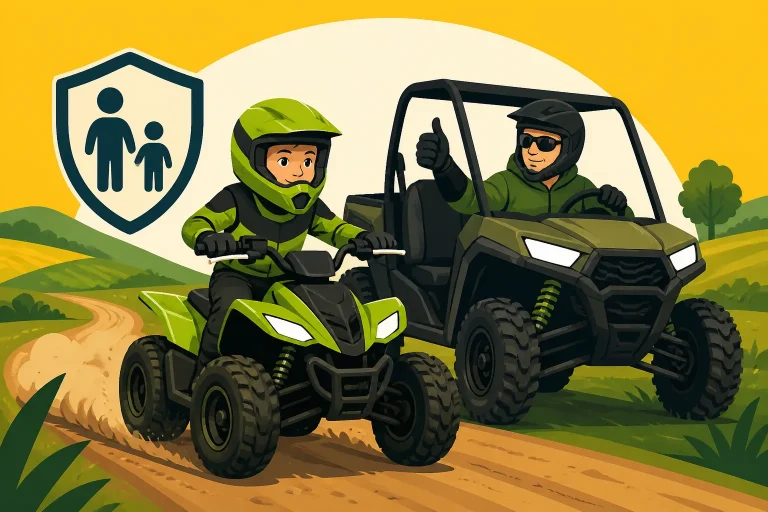
| Rider under age 12 on public land or public ice | Do not operate there unless directly supervised by an experienced, licensed parent or guardian who is at least 18 years old. |
| Rider age 18 or older | The age-based ATV education requirement described by the Iowa DNR applies to riders through age 17. |
| ATV on privately owned land | The Fiscal Services Division says an ATV does not need to be registered when operated on privately owned land. That registration exception does not change the course rule for the public riding situations listed above. |
| ATV on a public road | The education certificate does not replace the separate road-use requirements. The Fiscal Services Division says drivers must be at least 18 years old and have a valid driver’s license. |
The table focuses on ATV education and registration rules, not every rule that may apply to a particular trail, event, or property. For the broader certificate rules, see Iowa ATV Safety Certificate Requirements. For details about younger riders, Iowa Supervision Rules for Riders Under 12 explains the separate supervision requirement.
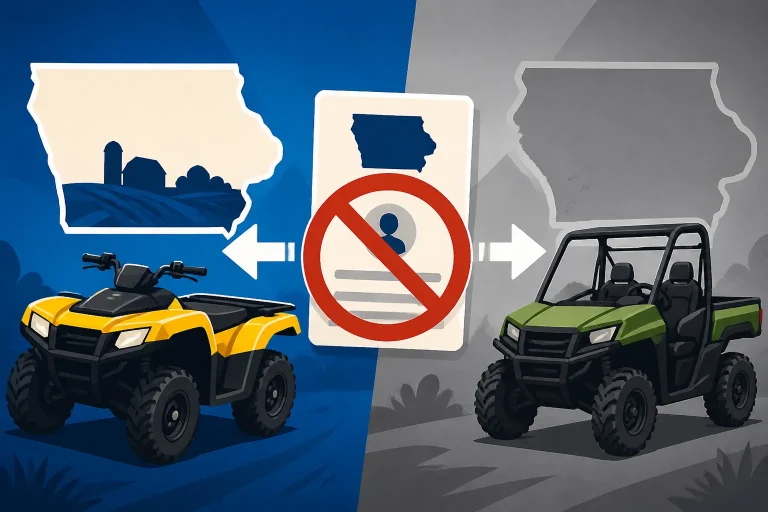
The certificate is a riding qualification for certain places, not a general license to ride anywhere. An ATV on private property, a designated riding area, public ice, or a public road can be subject to different requirements. Before a ride, check the rules for the specific place and machine rather than treating the certificate as a substitute for registration, permission, or other applicable conditions.
There is also an important distinction between an ATV education certificate and permission to ride a public road. According to the Fiscal Services Division, public-road ATV drivers must be at least 18 years old and hold a valid driver’s license. A twelve-year-old with a certificate therefore does not qualify to operate an ATV on an Iowa public road. Roadway use also has equipment and operating requirements, and local rules may be more restrictive.
How to earn the certificate
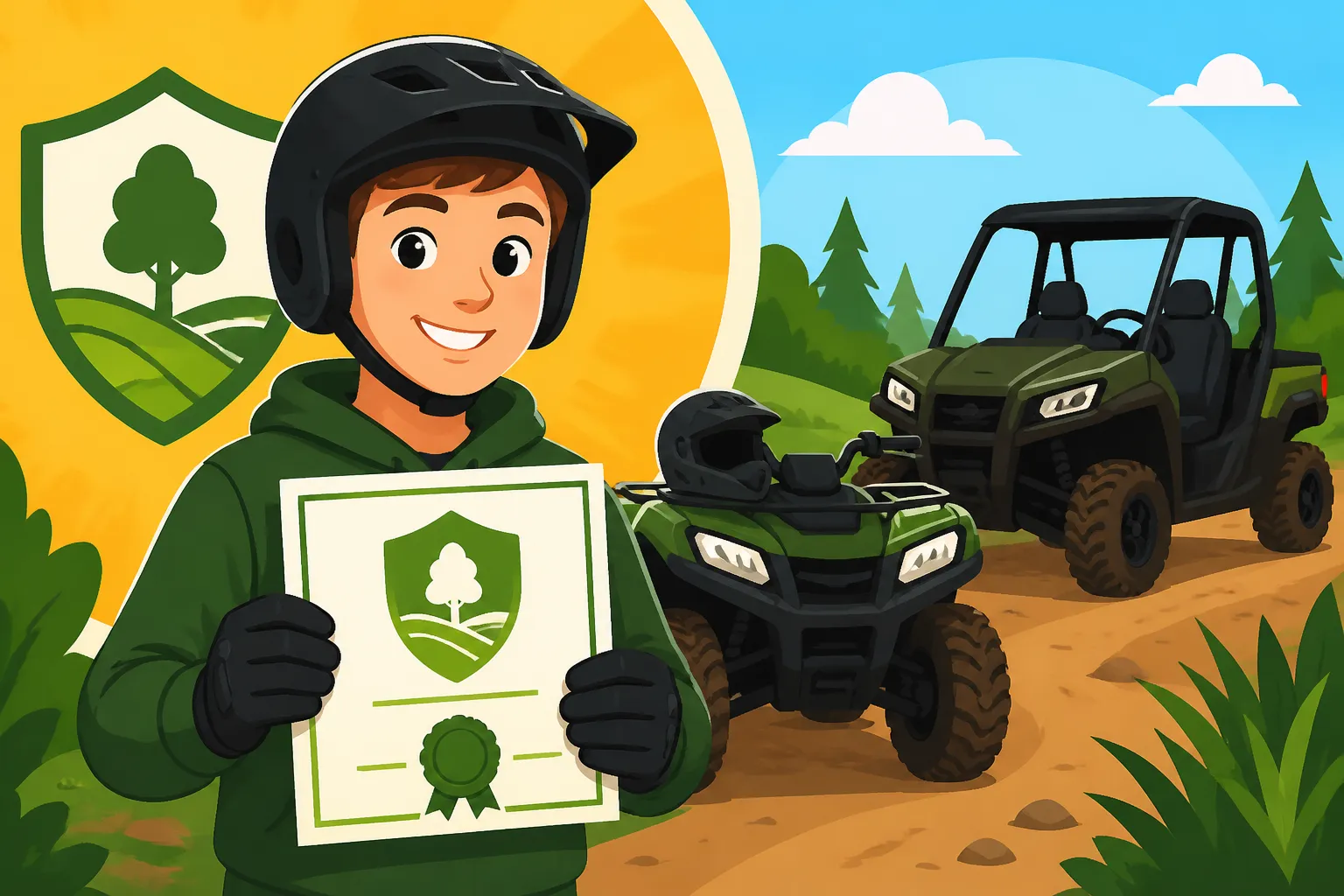
The Iowa DNR collaborated with Fresh Air Educators to provide an online certification option for its ATV Education Program. Students who are at least twelve can earn their certificate through ATVCourse.com, according to the Department. The course has no riding component, so students do not need to complete an on-machine practice session as part of the course.
The basic process is straightforward:
- Check that the rider is eligible. The Iowa DNR says students must be at least twelve to earn the certificate through ATVCourse.com. If the rider is younger, the certificate route is not available yet.
- Enroll in the approved course. The online option is the offering identified by the Iowa DNR. Follow the course provider’s current instructions for access and account setup.
- Complete the course material. The course is educational rather than a riding test; the Iowa DNR says there is no riding component.
- Pass the final exam. The Iowa DNR requires a score of 80% accuracy on the final exam to earn the certificate.
- Keep the certificate available for rides. The Iowa DNR says riders ages 12 through 17 must have the education certificate in their possession in the places where it is required.
The course fee is $34.95, including the $5 DNR education certificate fee, according to the Iowa DNR as of November 2026. Because the course is provided online through a separate offering, check the provider’s current checkout and certificate instructions before enrolling. For a closer look at the fee, see Iowa ATV Safety Course Cost; for course options, see Where to Take an Iowa ATV Safety Course.
A passing exam is the key completion step specified by the Iowa DNR. The facts available for the program do not establish a required in-person riding test, a minimum number of practice hours, or a separate road test. Don’t add those steps to your plan unless the course provider or DNR gives you a current instruction that requires them.
It can help to handle the certificate before a planned outing rather than at the trailhead. That gives the rider time to complete the course and exam and gives the family time to confirm where the certificate will be kept. The Iowa DNR requires the certificate to be in the operator’s possession while riding in the covered places; having an adult’s copy in a vehicle is not the same as the young operator carrying it.
Parents and guardians can also check that the rider understands the limits of what passing means. The certificate satisfies the education requirement for the covered age group and riding locations. It does not by itself register the ATV, grant permission to use private property, or authorize riding on public roads. For registration and decals, start with Iowa ATV Registration Paperwork.
Carrying and using the certificate
The certificate should be part of the rider’s pre-ride check. According to the Iowa DNR, riders ages 12 through 17 must have it in their possession on public land, public ice, and designated riding areas. The Fiscal Services Division also identifies trails and registration-funded land as places where riders in that age range must possess a DNR-approved education certificate.
A practical routine is to keep the certificate with the young rider’s ride-day items and confirm it is present before leaving home. If the family keeps documents in a tow vehicle or trailer, check that the operator—not only the supervising adult—has the required certificate. The Iowa DNR’s rule is about possession while operating, so a certificate left at home does not help during the ride.
The certificate is only one part of getting ready. For off-highway vehicles operated on public land, public ice, or a designated riding area, the Iowa DNR requires registration. The operator must also have the registration certificate either in the vehicle or on their person while it is in use. Resident machines must display a current Iowa DNR registration decal, while nonresident machines are subject to the Iowa nonresident user permit requirement. Details on where a certificate is checked and what else riders need at a park are covered in Carrying the Card at Bluff Creek and Iowa Rules for Riding a Designated Riding Area.
Registration is not required for an ATV operated on privately owned land, according to the Fiscal Services Division. That does not mean a rider can use someone else’s property without permission; confirm access directly with the landowner. Public land, public ice, designated riding areas, and private property are not interchangeable categories, so be clear about where the planned ride takes place.
A family with a newly acquired machine should sort out registration as well as education. The Iowa DNR says new machines, and machines not yet entered into its recreational vehicle and vessel registration system, must be registered through a County Recorder’s Office. New registrations require a Bill of Sale and a Manufacturer’s Statement of Origin; a used vehicle requires a title, if applicable, and/or registration along with a Bill of Sale, according to the Department. See Registering an ATV in Iowa for the registration process.
The certificate also does not replace the parent or guardian’s role in deciding whether a young rider is ready for a particular machine or trail. The course has no riding component, according to the Iowa DNR, so earning the certificate does not show that a student has completed a practical riding evaluation. Families should make their own careful choices about supervision, terrain, weather, and the rider’s experience, and follow posted rules at the riding location.
What the certificate does not allow
The most consequential misunderstanding is assuming that a certificate earned at age twelve opens public roads to a young rider. It does not. The Fiscal Services Division says an ATV driver on public roads must be at least 18 years old and possess a valid driver’s license. The Iowa DNR also states that an off-highway vehicle driver on a public road must be 18 or older and hold a valid license.
The road rules remain separate even for an adult who has completed an education course. The Iowa Department of Transportation says the maximum speed for an ATV or UTV/ORV on Iowa public roads is 35 miles per hour, and drivers must have proof of insurance. It also lists equipment and decal requirements, including headlights, a rear registration sticker, and a slow-moving vehicle sign. Cities and counties may be more restrictive than state law, according to the Department of Transportation, so road access depends on the route and local rules as well as the driver’s eligibility.
A certificate also should not be confused with an ATV registration or a nonresident permit. The education certificate relates to the rider; registration and user permits relate to the machine and where it is operated. A resident who meets the education requirement still needs the required current registration for covered public riding locations. A visitor should check the Iowa nonresident user permit rules, and whether their home-state registration must also be displayed. Iowa’s Permit for a Visiting Machine explains that separate issue.
For riders approaching age eighteen, the age boundary matters: the Iowa DNR’s course requirement applies to ATV operators ages 12 through 17. The certificate is not a public-road credential, and the road-use minimum age remains 18 with a valid driver’s license. For more on that distinction, see Why the Iowa Certificate Stops at Eighteen.
In short, a rider who is twelve or older can work toward the certificate through the approved education course, pass the exam, and carry the certificate on covered rides. Before each outing, confirm the machine’s registration status, the land or trail rules, and the rider’s eligibility for that location. Keeping those requirements separate makes it much easier to know what the certificate does—and what it does not do.
Sources
- Department of Natural Resources — OHV Safety & Education | Department of Natural Resources (checked November 3, 2026)
- Fiscal Services Division — 1543036.pdf (checked November 3, 2026)
- Department of Transportation — Driving Your ATV or UTV/ORV on Iowa Public Roads | Department of Transportation (checked November 3, 2026)
- IOWA DEPARTMENT OF NATURAL RESOURCES — download?inline (checked November 3, 2026)
- Department of Natural Resources — OHV Dealers | Department of Natural Resources (checked November 3, 2026)
- Iowa Department of Natural Resources — Snowmobile Dealers | Department of Natural Resources (checked November 3, 2026)
- Department of Natural Resources — Snowmobile Education & Safety | Department of Natural Resources (checked November 3, 2026)
- Iowa Department of Natural Resources — download?inline (checked November 3, 2026)
Disclaimer
This article is for general informational purposes only and does not constitute professional advice. Laws, prices and regulations vary by location and change over time. Consult a qualified professional for guidance on your specific situation.