Iowa Rules for an Electric Machine on Trails
An electric ATV or UTV may be quiet and have no exhaust, but that does not automatically give it different trail access in Iowa. The rules depend mainly on what kind of off-road machine it is, where you plan to ride, and whether its registration or permit is valid. Here’s how to sort those questions out before hauling an electric machine to a trail.
Does electric power change Iowa trail rules?
Usually, the first question is not whether the machine runs on electricity. It is how Iowa classifies the machine. An electric quad may still be treated as an ATV, while an electric side-by-side may fall under a different machine category. The number of wheels, seating, design and intended use can matter more than the power source.
That distinction affects registration and some operator requirements. An electric drivetrain does not, by itself, make a machine exempt from Iowa’s off-highway vehicle rules. Nor does it automatically qualify a machine for every trail. A vehicle that is built for off-road use should not be assumed to have the same status as a bicycle or a small electric mobility device.
If you are unsure how your machine fits Iowa’s categories, check the paperwork and identifying information before riding. The manufacturer’s description, title or certificate of origin, and machine specifications can help a county recorder or the Iowa DNR determine the applicable category. For more on the general system, see Which Machines Iowa’s Off-Road Vehicle Law Covers.
The electric motor can still matter in practical ways. A quieter machine may be easier to hear only when it is close, so other riders might not notice it approaching. Battery range can also change substantially with terrain, speed, temperature, tire choice and load. Those are ride-planning concerns rather than a substitute for registration or permission to use a trail.
Check the machine category, not just the badge
A manufacturer may describe a vehicle as an electric ATV, electric UTV, utility vehicle or recreational machine. Those labels are useful, but do not assume they settle the state classification. Two machines that look similar may have different seating, dimensions or intended uses.
When asking about the rules, provide the make and model, vehicle identification number, number of seats and wheels, and any title or manufacturer paperwork you have. If the machine has been modified, mention that too. A machine’s width or configuration may affect whether it is suitable for a particular trail even when its registration is in order.
Do not rely on the fact that an electric machine lacks an exhaust system to conclude that it is exempt from every equipment rule. Some requirements may not apply in the same way to an electric vehicle, while other requirements—such as registration, trail permission, or limits on machine size—may still apply. Ask about the specific requirement rather than assuming the entire rulebook disappears.
Registration, permits and out-of-state machines
For Iowa residents, an electric machine that falls within a category requiring off-highway registration generally needs the appropriate Iowa registration before it is used where registration is required. The process and documents depend on the machine and its ownership history. See Registering an Electric Machine in Iowa for the registration questions to resolve, and Iowa ATV Paperwork for the documents that may be relevant when applying.
Visitors should not assume that an electric machine is free to ride just because it is registered in another state. Whether an Iowa nonresident permit is needed can depend on the machine’s classification and the registration or permit it carries at home. Check the applicable reciprocity rules for your home state and the specific machine. The overview at Does Iowa Honor Out-of-State Registration? can help you identify what to verify.
If Iowa requires a nonresident permit for your machine, get it before riding in a place where the permit is required. The permit is associated with the machine, not simply with the person operating it. Do not move a permit sticker from one vehicle to another or treat one machine’s paperwork as coverage for a second machine. Details on the permit are covered in Iowa’s Permit for a Visiting Machine and Where to Buy an Iowa Nonresident Permit.
| Situation | What to check before riding |
|---|---|
| Iowa resident with an electric ATV | Confirm the machine’s classification and whether it needs Iowa registration and a decal |
| Iowa resident with an electric side-by-side | Confirm its category and registration requirements rather than applying ATV rules automatically |
| Visitor with an out-of-state registration | Check whether Iowa recognizes that registration for this machine and whether a nonresident permit is still required |
| Visitor without qualifying home-state credentials | Confirm whether an Iowa nonresident permit is required and obtain it before riding |
| Machine borrowed or rented | Verify that the machine’s registration or permit is valid and that the place you plan to ride allows it |
A sticker or registration document does not grant universal access. It does not make a closed trail open, override a landowner’s restrictions, or authorize riding on a road where off-highway vehicles are prohibited. Registration is one part of being prepared; location rules are another. For a broader explanation of the permit system, see Iowa ORV Permits Explained.
When traveling across state lines, keep the machine’s registration and permit information available. If a decal is attached to the machine, make sure it is displayed as required and remains readable. Carry any required certificate or supporting paperwork as well. If the machine’s paperwork does not clearly show its type, bring manufacturer documentation so you can explain what it is.
Trail access depends on the place, not just the power source
Iowa does not give every electric off-road machine automatic access to every trail. A designated riding area, private trail, club route or other public riding location may have its own operating rules. Those can cover eligible machine types, width, passengers, equipment, hours and trail closures. A valid state registration or permit does not cancel those site-specific restrictions.
Before you leave, check the current rules for the exact place you intend to ride. Confirm that electric machines are allowed, whether the site distinguishes between ATVs and side-by-sides, and whether there are limits on vehicle width or other dimensions. If the information is unclear, contact the park or managing organization directly. The general rules for locations are discussed in Iowa Rules for Riding a Designated Riding Area.
Wet-weather closures are especially important. Electric torque may make a machine feel capable in mud, but that does not mean a closed trail can be used or that riding in soft ground is harmless. Heavy machines can rut a trail, damage its surface and create hazards for the next riders. Check alerts before loading up, and respect a closure even if the route looks passable.
Verify restrictions that matter to electric machines
Some operating rules are written around equipment such as exhaust or spark-control systems. An electric machine has no exhaust in the usual sense, but that does not answer every question about trail access. The site may have separate requirements, or a rule may apply based on the machine category. Ask the managing organization how a requirement applies to your particular model.
Also consider the practical limits of the battery. Range estimates are not guarantees, especially on steep or muddy terrain, in cold conditions, or when carrying passengers and cargo. Plan a conservative route with enough range to return to the staging area. Do not assume that a public charging outlet will be available, and do not charge at a site unless the facility allows it.
| Trail or machine issue | Why to check it |
|---|---|
| Machine category | Rules may differ for an ATV, side-by-side, motorcycle or other class |
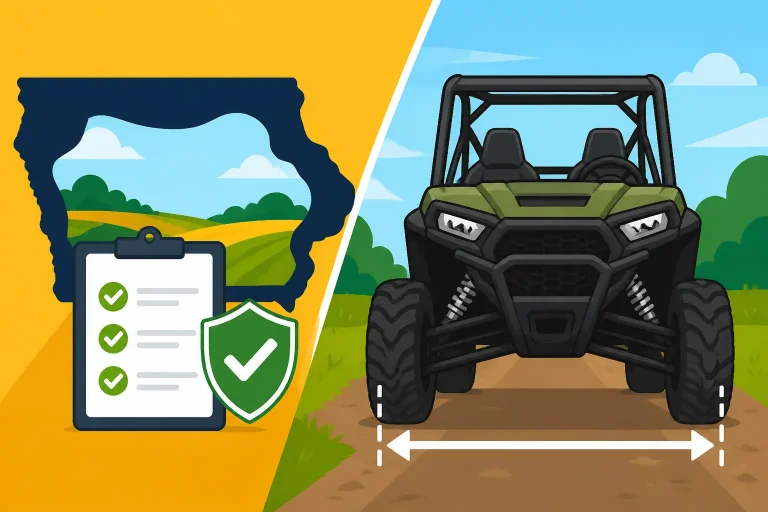
| Width and dimensions | A machine may be registered but too wide for a particular route |
| Closure status | A wet or damaged trail may be temporarily closed to protect the surface |
| Equipment requirements | A rule may apply differently to electric and combustion machines |
| Charging access | A riding area may not provide charging or permit charging on site |
| Range and recovery | Low battery can leave the machine stranded far from the staging area |
Where riding on private ground, get permission from the landowner and follow any conditions they set. A permit does not replace permission, and permission for one parcel does not extend to neighboring land. For more, see Iowa Landowner Permission Rules.
A practical checklist before your first Iowa trail ride
Electric machines can be a good fit for some riders, but their quiet operation and battery limits call for a little extra planning. Use this checklist before you load the machine.
- Identify the machine accurately. Record the make, model, vehicle identification number, seat count, wheel configuration and dimensions. Use the title or manufacturer paperwork to support the classification.
- Confirm registration or permit needs. If you live in Iowa, check whether the machine must be registered. If you are visiting, check the rules for your home-state credentials and whether an Iowa nonresident permit is required.
- Check the exact riding location. Verify that the trail is open and accepts your machine type and size. Do not rely on a general statement that a site allows “ATVs” if you have a side-by-side or another less common configuration.
- Ask about electric-specific conditions. If a posted rule mentions exhaust, spark control, sound or charging, ask the site operator how it applies to your model. Get clarification before the ride, not at the gate.
- Plan for battery range. Account for elevation, mud, cold, speed and cargo. Keep a margin for the return trip and avoid routes that leave no practical way to get back if the battery drops faster than expected.
- Carry the right information. Keep registration or permit records and any required certificate or documentation with you. Make sure the decal is displayed correctly if one is required.
- Ride in a way others can anticipate. Because an electric machine may approach quietly, slow down near blind corners, staging areas and groups. Give other riders room and make your presence clear before passing.
- Follow closures and land access rules. Do not ride a closed trail, leave a marked route or enter private land without permission, even if the machine is registered and has sufficient range.
If the rules are unclear, resolve the uncertainty with the agency or site manager responsible for the trail. Ask a specific question: provide the machine’s model and type, describe the paperwork it carries, and name the location where you want to ride. That is more useful than asking whether “electric ATVs” are allowed in Iowa as a whole, because access can depend on both the machine and the place.
The key point is straightforward: electric power changes how a machine operates, but it does not automatically change its legal category or grant trail access. Confirm the machine’s classification, meet the registration or permit requirements that apply, and check the rules of the specific riding area before setting out.
Disclaimer
This article is for general informational purposes only and does not constitute professional advice. Laws, prices and regulations vary by location and change over time. Consult a qualified professional for guidance on your specific situation.