Iowa ATV Safety Certificate Requirements
Iowa’s ATV safety-certificate rules can be confusing because they depend on the rider’s age, the machine being operated, and where it is ridden. The key point is that the requirement is aimed mainly at ATV operators ages 12 through 17 on public riding areas. Knowing whether a certificate applies—and what it does not replace—helps you prepare before heading out.
Who needs an Iowa ATV safety certificate
In general, an ATV operator who is at least 12 and under 18 must have completed an approved safety course to ride an ATV on public land. The age range matters: the rule is not a blanket certificate requirement for every rider, and it does not apply in the same way to every kind of off-highway vehicle.
A rider who is 18 or older does not need the youth ATV safety certificate solely because they are operating an ATV. A rider who is younger than 12 is not simply covered by getting a certificate early; supervision and other age-related restrictions may apply instead. Review Iowa Safety Certificate Age Range and [Iowa Supervision Rules for Riders Under 12] if you are sorting out the rules for a young rider.
The requirement is specific to the machine category. Iowa treats ATVs, side-by-sides, and off-road motorcycles differently for this purpose. A side-by-side operator is generally not subject to the ATV certificate requirement, and off-road motorcycle operators are also treated separately. That does not make those machines exempt from all other riding rules. Registration, land access, supervision, equipment, and trail requirements can still matter. For the machine distinction, see [Does an Iowa UTV Operator Need a Certificate?].
| Rider and machine | General certificate rule | What to check next |
|---|---|---|
| ATV operator ages 12–17 | Certificate generally required on public land | Approved course, proof of completion, and other age rules |
| ATV operator under 12 | The certificate alone does not settle whether the child may ride | Supervision and age-related operating restrictions |
| ATV operator 18 or older | Youth certificate requirement generally does not apply | Registration, land access, and riding rules |
| Side-by-side operator | ATV certificate requirement generally does not apply | UTV-specific rules and site requirements |
| Off-road motorcycle operator | ATV certificate requirement generally does not apply | Motorcycle-specific rules and site requirements |
Treat the table as a starting point, not as permission to ride anywhere. A park or event can have additional conditions, and the machine category used by a seller may not match the category used in Iowa’s rules. If you are unsure whether your vehicle is an ATV or a side-by-side for regulatory purposes, check its documentation and confirm with the Iowa Department of Natural Resources or the riding area before you go.
The certificate rule also does not set the minimum age for every kind of riding. An under-12 rider may face supervision conditions, and a parent’s or guardian’s presence does not automatically remove every restriction. Check [Iowa Minimum Age to Ride Public Land] along with the supervision rules before taking a child to a public riding area.
Where the certificate rule applies
The main distinction is public land versus private property. Iowa’s ATV safety certificate requirement generally concerns operating an ATV on public land. That can include a designated public riding area, so do not assume that a certificate is unnecessary just because a trail is managed locally or requires a separate registration decal.
On private property, the state certificate requirement generally does not apply in the same way. But “private” does not mean “no rules.” The landowner’s permission matters, and the rider still needs to follow any applicable safety, age, and property restrictions. A private club trail or commercial riding area may also set its own conditions for access. See [Iowa Rules for Riding Private Property] and Iowa Rules for Riding a Designated Riding Area before relying on the location alone to decide whether a certificate is needed.
Public ice and other public riding settings can raise separate questions. The safest approach is to verify the specific location’s current access rules, rather than assume that a certificate rule applies only to a conventional dirt trail. Public land may also have boundaries, seasonal limits, or closures that affect whether riding is allowed at all.
A safety certificate is not a registration, decal, or visitor permit. It documents completion of a safety course; it does not authorize the rider to use public land or make an otherwise ineligible machine legal to operate there. Registration and permit requirements are separate, and they can vary depending on whether the machine is registered in Iowa or visiting from another state. Nonresidents can review Iowa’s Nonresident User Permit to understand that separate issue.
Similarly, having the certificate does not make road riding legal. Rules for public roads are different from rules for off-road riding areas. A rider should not treat a course card as a substitute for checking road authorization, age restrictions, insurance, or equipment requirements.
Taking the course and keeping proof
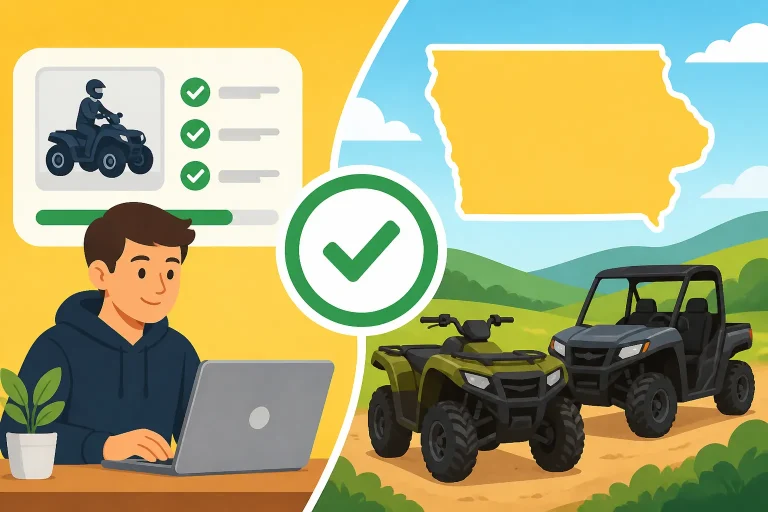
If the rider falls within the age and machine category covered by the rule, the practical next step is to complete an Iowa-approved ATV safety course. Course availability, delivery options, and the process for receiving a certificate can change, so use the Iowa DNR’s current course information rather than relying on an old printout or a third-party description. Where to Take an Iowa ATV Safety Course is a useful next stop for finding the approved route.
A simple process helps avoid arriving at a park with the wrong paperwork:
- Confirm the vehicle is an ATV for purposes of Iowa’s rules. Check the owner’s documents if the vehicle’s classification is unclear.
- Confirm the rider’s age and the type of land where the machine will be used.
- Find a course recognized for Iowa ATV safety certification and review its current completion instructions.
- Complete the course and follow the provider’s steps to obtain proof of completion.
- Keep the certificate information available when riding, and check whether the site expects riders to carry or show it.
Online instruction may be available, but the exact course format and completion process should be confirmed with the official course provider. Do not assume that any general ATV video, manufacturer tutorial, or safety class from another jurisdiction automatically satisfies Iowa’s requirement.
Keep the certificate in a condition that can be read, and make sure the rider knows where it is. A parent may want a photo or other backup record, but a backup image should not be assumed to replace whatever proof an officer or riding site requires. For what to do if the card is misplaced, see Replacing a Lost Iowa Safety Certificate.
The certificate is evidence of course completion, not a guarantee that the rider knows every rule for a particular park. A course cannot replace supervision where it is required, permission to enter private land, or compliance with a trail’s posted rules. It also does not make a vehicle suitable for a child. Match the machine to the rider’s size and ability, and follow the operating limits in the owner’s manual.
Checks to make before a ride
Before leaving home, check the requirement against the rider, machine, and destination together. A rider can have a valid certificate and still be turned away for a separate registration or access issue. Conversely, the absence of an ATV certificate does not automatically mean the rider is breaking the certificate rule; the vehicle and land type matter.
Use this quick checklist:
- Rider’s age: Is the operator between 12 and 17, younger than 12, or an adult? Age determines whether the youth certificate rule or other restrictions may apply.
- Machine type: Is it an ATV, side-by-side, or off-road motorcycle? Do not assume the same certificate rule covers all three.
- Riding location: Is the destination public land, private property, a designated riding area, or public ice? Confirm the site’s current conditions.
- Course proof: If a certificate is required, has the rider completed an approved course, and can they produce the expected proof?
- Other requirements: Are registration, a decal or visitor permit, supervision, and site-specific rules also satisfied?
A common mistake is to focus on only one part of the question. For example, a 15-year-old’s certificate may address the course requirement for an ATV on public land, but it does not answer whether the machine has the required registration or whether the trail is open. Likewise, a side-by-side may not trigger the ATV certificate rule, but its operator still needs to follow all requirements that apply to that vehicle and location.
Another frequent misunderstanding is that an adult’s presence automatically covers a young rider. Supervision rules and certificate rules are related to youth riding but are not interchangeable. Check the rules for the child’s exact age and riding situation instead of relying on a general assumption about parental supervision.
If a law-enforcement officer or park staff member asks for proof, stay calm and provide the document or information requested. If you are uncertain about a requirement before a trip, confirm it with the Iowa DNR or the riding area directly. For possible consequences of riding without a required certificate, review Iowa Penalties for Riding Without a Safety Certificate and confirm the current rule with an official source.
The clearest rule of thumb is straightforward: an ATV rider ages 12 through 17 should plan to have an approved safety certificate when riding on public land. Then check the exceptions and related requirements rather than treating the certificate as an all-purpose riding pass.
Disclaimer
This article is for general informational purposes only and does not constitute professional advice. Laws, prices and regulations vary by location and change over time. Consult a qualified professional for guidance on your specific situation.