Why the Iowa Certificate Stops at Eighteen
Iowa’s off-highway safety certificate is required for some young riders, but not for adults. The age cutoff can be confusing because it depends on the rider’s age, machine type and where the machine is being operated. Here’s what changes at 18, what doesn’t, and how families can check the rules before riding.
What changes when an Iowa rider turns 18
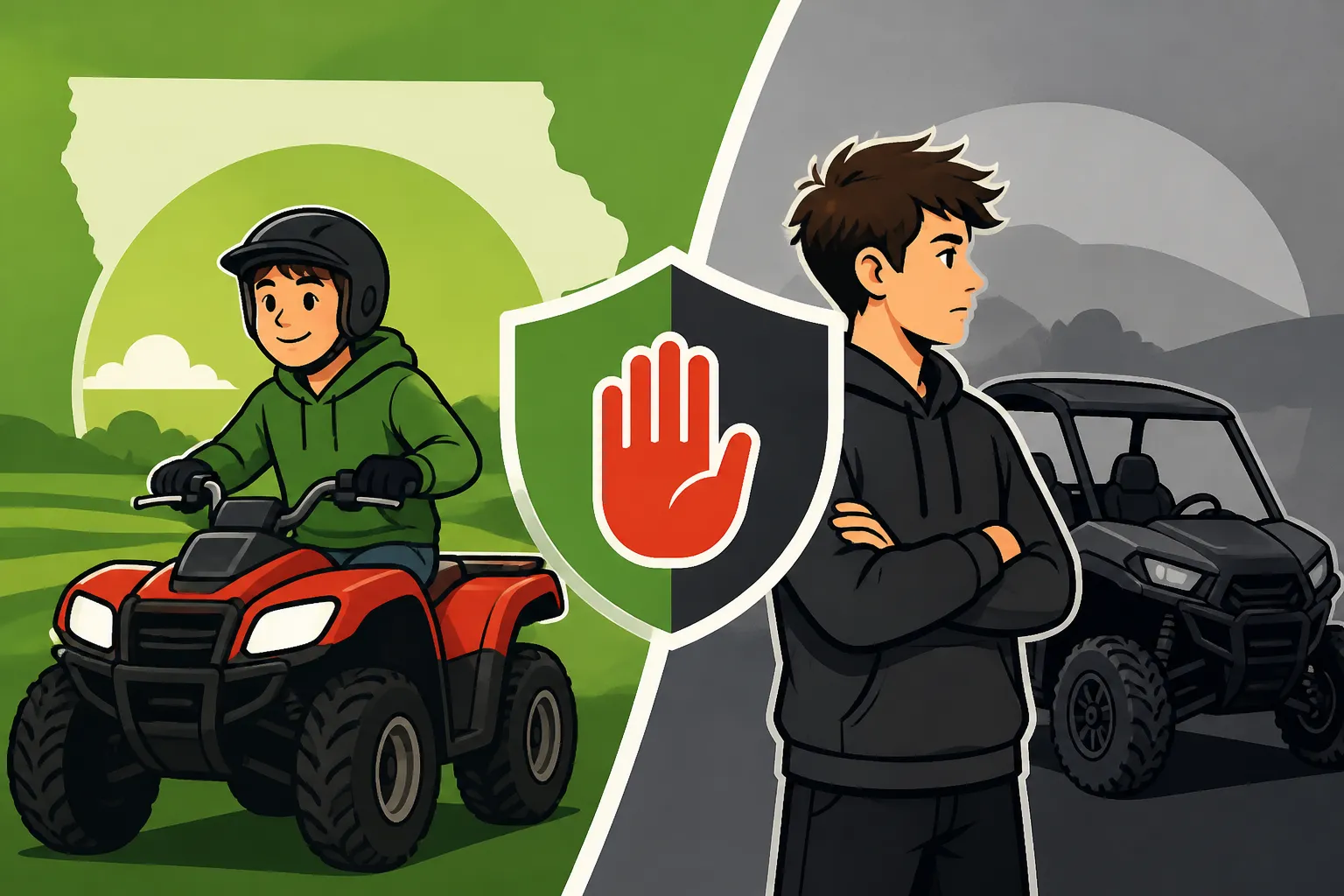
The Iowa safety certificate requirement is an age-based rule for covered off-highway vehicle riders. In general, riders ages 12 through 17 must have the required safety certificate when operating a covered machine in a setting where the rule applies. At 18, the rider no longer needs the certificate solely because of age.
That distinction matters: turning 18 removes one requirement; it does not grant blanket permission to ride anywhere or on any machine. Adults still need to follow applicable registration, permit, land-access, trail, equipment and operating rules. A rider may also need to meet separate conditions for using public roads, which are different from the certificate requirement for off-highway riding.
The rule is easier to understand if you separate three questions:
- How old is the operator? The certificate requirement applies to a specified youth age range, not to adults simply because they ride an ATV.
- What kind of machine is it? The certificate rule does not apply identically to every vehicle called an ATV, UTV or off-road vehicle.
- Where is it being operated? Rules for public land and designated riding areas may differ from rules on private property or roads.
| Rider or machine situation | What to keep in mind |
|---|---|
| Covered machine, rider age 12 through 17 | A safety certificate may be required in settings covered by Iowa’s rule. |
| Covered machine, rider age 18 or older | The age-based certificate requirement no longer applies, but other riding rules remain. |
| Rider younger than 12 | A certificate is not a substitute for age-related supervision requirements. |
| Side-by-side or another excluded machine type | Do not assume ATV certificate rules apply; confirm the classification and applicable rules. |
| Out-of-state rider | Check Iowa’s permit and reciprocity rules as well as any certificate requirements. |
A certificate earned as a teenager does not need to be treated as a license that expires on the rider’s 18th birthday. The point is that the age-based requirement stops applying to an adult. Keeping the certificate can still be useful as a record of training, but the rider does not become an adult operator by passing a course alone; age, machine classification and riding location all matter.
For the related age range and course requirement, see Iowa ATV Safety Certificate Requirements and Iowa Safety Certificate Age Range. Those topics help distinguish the certificate rule from the other rules that govern a ride.
Why the certificate requirement has an age cutoff
The certificate rule is designed around youth operation. It sets a training requirement for riders in the covered age group rather than making every adult ATV operator complete the same course. When a covered rider turns 18, Iowa’s age-based certificate requirement no longer applies to that person.
That does not mean the law assumes adults are automatically skilled riders. It means the certificate rule uses age as its dividing line. A new adult rider may still benefit from training, especially when learning to handle a machine on unfamiliar terrain, ride with a group or use a public riding area. The legal requirement and the safety value of training are separate questions.
The cutoff also helps explain why a certificate is not a general riding permit. A certificate confirms that a rider has met a training requirement where that requirement applies. It does not, by itself:
- Register a machine.
- Replace a nonresident permit when one is required.
- Give permission to ride on someone else’s property.
- Authorize operation on a closed trail.
- Make a machine legal for road use.
- Override age or supervision rules for a younger child.
- Guarantee that a park or event has no additional conditions.
For an adult, the practical takeaway is simple: do not spend time trying to renew or obtain an age-based youth certificate just because you are riding an ATV. Instead, confirm the requirements that apply to the machine and the place you plan to ride. For a teenager who will continue riding, the certificate may be a necessary part of meeting the youth rule, but it is only one part of being allowed to operate.
A change in age also does not change the machine’s registration status. If the registration has expired, the operator’s birthday does not fix it. If the machine needs a decal or a visiting-machine permit, the adult operator may still need to address that before riding. Iowa’s registration rules are covered in Registering an ATV in Iowa, while visitor requirements are explained in Iowa’s Nonresident User Permit.
Families sometimes assume that the certificate follows the machine, or that one person’s training covers everyone who uses the ATV. It does not work that way. The certificate concerns the operator. A machine can be used by different riders, and each rider’s age and circumstances must be considered separately. An adult taking over a teenager’s ATV does not need the youth certificate merely because the machine was used by someone under 18. A teenager riding an adult’s machine may still be subject to the youth requirement.
Which riders, machines and places the rule covers
The phrase “ATV safety certificate” can sound broader than the actual rule. It is important to identify the specific vehicle and riding location instead of relying on the model name, the seller’s description or a casual label such as “four-wheeler.”
Start with the machine type
Iowa’s certificate requirements are not the same for every off-highway machine. A side-by-side is treated differently from a covered ATV for this certificate question, and off-road motorcycles have their own treatment. A machine’s seating arrangement, design and legal classification can matter more than the name used in an advertisement.
That is why a family should not assume that a youth who needs a certificate on one machine needs the same certificate on every machine. Nor should a rider assume that a machine is exempt merely because its owner calls it a UTV. If the vehicle’s classification is unclear, check with the appropriate Iowa authority or the riding area before operating it.
See Why Iowa Exempts Side-by-Side Operators for the side-by-side distinction and Why an Iowa Off-Road Motorcycle Operator Is Exempt for the motorcycle issue. These exemptions concern the certificate rule, not a general exemption from registration, trail, land-access or safety rules.
Then check where the ride takes place
The certificate requirement is associated with covered operation in settings such as public land and designated riding areas. That does not make every place open to riding, and it does not mean all land is governed by the same set of rules. A public riding area may have rules about permitted vehicles, trail direction, helmets, hours, noise or other conditions. A county or other public land manager may also impose site-specific restrictions.
Private property creates a different set of questions. The landowner’s permission is essential, but permission does not automatically answer every issue about the machine, operator or applicable state requirements. Avoid assuming that a private address or farm setting means no rules apply. Check the specific circumstances, particularly if the ride involves a leased property, organized event, commercial activity or access to a trail that crosses more than one kind of land.
The general permission rules are covered in Iowa Landowner Permission Rules, and the distinction between riding settings is discussed in Iowa Rules for Riding Public Land and [Iowa Rules for Riding Private Property]. Those rules matter whether the operator is 17 or 18.
Keep road use separate
An ATV safety certificate is not a driver’s license and does not authorize road use. If a rider intends to travel on a public road, separate road-use rules may apply, including requirements related to the operator, machine equipment, insurance and the type of road. Turning 18 may affect some age-based road conditions, but it does not make every road open to ATVs or UTVs.
A rider planning a route from home to a trail should check the road rules for each segment rather than treating a certificate, registration decal or trail permit as permission to use the road. The rules can vary with road type and local authorization. Start with Iowa Rules for Riding a Gravel Road or Are ATVs Street Legal in Iowa? if road travel is part of the plan.
What parents and teen riders should do before age 18
For a rider in the covered youth age range, the certificate question should be settled before the machine is unloaded at a riding area. The first step is to confirm the vehicle classification and the riding location. Then check whether the certificate is required for that combination.
If it is required, the operator should complete the applicable safety course and have proof available when riding. Do not rely on a parent’s certificate, a sibling’s card or the fact that the rider has operated the machine many times. The requirement is tied to the individual rider, and informal experience does not replace the certificate where one is required.
A practical pre-ride check for a family is:
- Confirm the rider’s age. The youth certificate question changes at 18, but younger riders may have additional age-related rules.
- Identify the machine. Use the vehicle’s actual classification, not only its nickname or the way it was listed for sale.
- Check the riding location. Confirm whether it is public land, a designated riding area, private property or a road.
- Verify the certificate requirement. If it applies, make sure the rider has completed the required course and can show proof.
- Check supervision rules separately. A certificate does not cancel a supervision requirement for a younger child.
- Check registration or permit status. Certificate status does not replace the machine’s decal or a visitor permit.
- Review the site’s own rules. A riding area may have requirements beyond the state certificate rule.
A rider under 12 needs particular care. The fact that a child is too young for the certificate age range does not mean the child can ride without restrictions. Iowa has separate supervision rules for young riders, and the details can depend on the situation. A parent should not interpret “no certificate required at this age” as “no adult oversight required.” See [Iowa Supervision Rules for Riders Under 12] and Iowa Rules for Riders Under 12 for that separate issue.
At 12, the certificate question can begin for a covered youth rider. The birthday does not make every machine or location subject to the same requirements, so families should verify the exact combination before riding. The requirements may also differ between a covered ATV, a side-by-side and an off-road motorcycle.
When the rider reaches 18, update the family’s pre-ride checklist rather than assuming the whole checklist disappears. The certificate requirement may end for that adult, but the machine still needs to be properly registered or permitted, the route must be legal, and the rider must follow the riding area’s rules. If younger family members share the same machine, their own certificate and supervision requirements still matter.
How adults and visitors should check their obligations
An adult Iowa resident should focus on the rules that remain after the certificate cutoff. A visiting rider should do the same, while also checking whether Iowa requires a nonresident permit or recognizes the rider’s home-state registration in the relevant circumstances.
Do not treat an out-of-state card or registration as a universal substitute for Iowa requirements. Reciprocity can depend on the home state, vehicle and place of operation. A visitor riding at an Iowa designated area should confirm what is required for that specific trip, especially if the machine is not registered in Iowa. Does Iowa Honor Out-of-State Registration? and Iowa ATV Registration for a Nonresident address those questions.
Adults may still choose to complete a safety course even when it is not required by the age-based rule. Training can help with safe handling, passenger decisions, riding on slopes, trail etiquette and responding to changing conditions. But course completion should not be confused with legal access. An adult with a certificate still needs the correct registration or permit, landowner consent where applicable, and permission to use the route or trail.
Before a ride, it can help to keep three separate records or checks:
- Operator qualification: age, certificate if required, and any applicable supervision.
- Machine status: registration, decal, nonresident permit or other required documentation.
- Ride authorization: land access, trail status, site rules and any road-use permission.
This separation prevents a common mix-up: having one valid item does not prove that the other two are covered. A certificate is not a decal, a decal is not permission to cross private land, and a trail permit is not authorization to use a public road.
If a rider is unsure whether a certificate applies, ask about the machine’s legal classification and the exact location where it will be used. A dealership’s description may help identify the model, but the seller is not necessarily the authority on how Iowa’s riding rules apply. For a public park, check the park’s posted requirements or contact the managing agency. For a private property ride, confirm permission and clarify any relevant restrictions with the landowner.
Frequently Asked Questions
Does an Iowa safety certificate expire when a rider turns 18?
The age-based requirement stops applying when the rider is 18. That does not mean the rider should think of the certificate as a license that must be renewed on the birthday. Keep the certificate as a training record if useful, and check the separate rules for the machine and riding location.
Does an 18-year-old need a certificate to ride an ATV in Iowa?
An adult does not need the certificate solely because of the youth age-based requirement. Registration, nonresident permits, land access, trail rules and road-use requirements may still apply.
Does a teenager need a certificate for every off-highway machine?
Not necessarily. Machine classification matters. The certificate treatment can differ for a covered ATV, side-by-side and off-road motorcycle, so confirm the vehicle type rather than relying on a general label.
Does a certificate allow a rider to use any Iowa trail?
No. A certificate does not grant land access, replace registration or a permit, or override trail closures and site rules. It addresses only the training requirement where that requirement applies.
Disclaimer
This article is for general informational purposes only and does not constitute professional advice. Laws, prices and regulations vary by location and change over time. Consult a qualified professional for guidance on your specific situation.