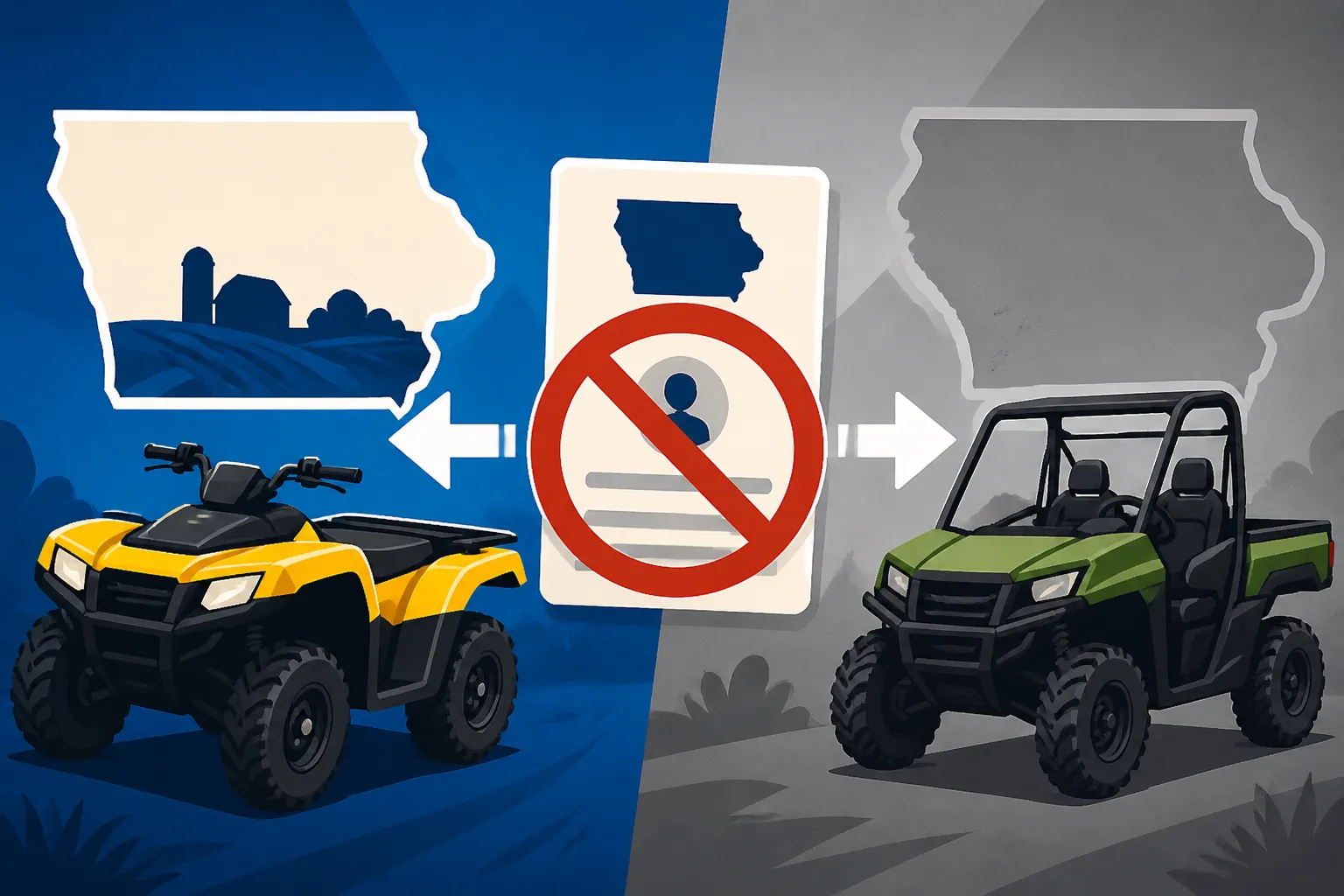
Why an Iowa Nonresident Permit Cannot Transfer
A nonresident permit is easy to mistake for a pass that follows the rider, especially when you own several machines or borrow one for a trip. In Iowa, the permit is tied to the particular machine it was issued for, so moving its decal or paperwork to another ATV or UTV can leave that second machine without the required authorization. Here’s how to handle common changes and avoid a roadside problem.
What “Cannot Transfer” Means
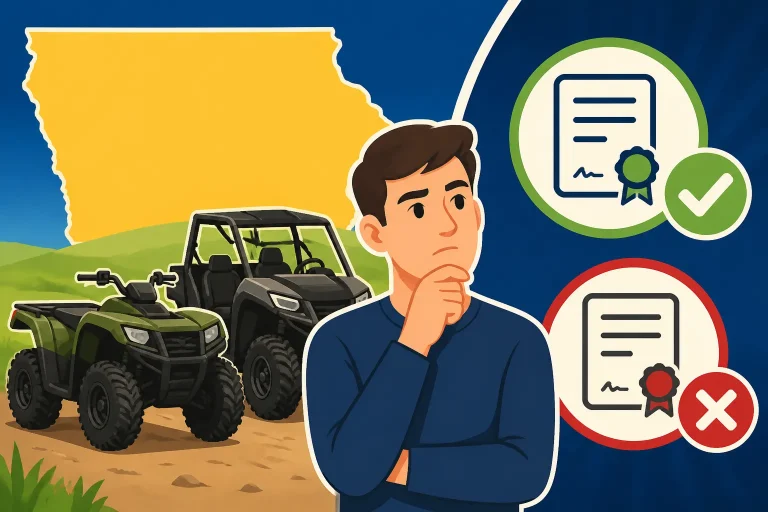
An Iowa nonresident permit is not a general pass for a person, household, trailer, or riding group. It applies to the specific machine covered by that permit. If you have a permit for one ATV, you cannot move it to another ATV just because you own both, ride them on the same trip, or only use one at a time.
That distinction matters because the rider and the machine are separate parts of the compliance question. One person may operate different machines during a visit, but each machine must have the authorization required for it. Likewise, several people may take turns riding one permitted machine without turning the permit into a different machine’s permit.
The most practical way to think about it is this: the permit belongs with the machine it identifies, not with the person who paid for it. If the machine changes, stop and check whether the permit requirement changes too. Don’t assume that a decal, receipt, or online record can simply be reassigned.
| Situation | Can you move the existing permit to another machine? | Practical next step |
|---|---|---|
| You switch from your ATV to a second ATV | No | Check whether the second machine needs its own permit |
| You bring two machines on one trailer | No | Confirm the requirements for each machine before riding |
| You borrow a friend’s machine | No | Check that the borrowed machine has the required authorization |
| You sell the machine with the decal attached | Not to a different machine | Ask the Iowa DNR what applies to the sale and new owner |
| Your machine is repaired or replaced | Don’t assume the permit follows | Confirm what to do before putting a different machine on the trail |
| Your home-state registration may qualify for reciprocity | The permit may not be needed, depending on the rules | Check the current rule for your machine and home-state status |
The table is a planning aid, not a substitute for confirming the current rule. Permit and reciprocity requirements can depend on the type of machine, the machine’s registration status, and where you plan to ride. For a fuller overview of who needs a permit, see Iowa’s Permit for a Visiting Machine and Iowa’s Nonresident User Permit.
It is not a rider pass
A rider may have the permit receipt or purchase account on their phone, but that does not make the permit valid for every machine they operate. The machine-specific connection is the key point. If a group brings several machines, one rider’s permit does not cover the whole group.
This can catch people out when they travel with family. For example, a parent may buy the nonresident permit for the ATV they plan to ride, then let a teenager use a different ATV. The teenager’s age or safety-course status is a separate issue; it does not extend the permit to the second machine. Check the machine’s permit status and the rider’s separate requirements.
It is not a group or trailer pass
The number of machines on your trailer doesn’t determine the number of permits you need. Nor does taking only one machine off the trailer at a time make one permit cover the others. If a machine might be ridden, treat its eligibility as its own checklist item.
Before you leave, write down each machine’s make, model, and identifying information, then match that list to the registration and permit records. This simple step makes it easier to catch a mismatch while you are still at home rather than at a staging area.
Why the Permit Is Tied to a Particular Machine
A machine-specific permit gives the state and the rider a way to connect the authorization to the vehicle being used. In practice, that means the permit record and the displayed decal or other required evidence need to correspond to the particular ATV or UTV. Moving the permit to another machine breaks that connection, even if both machines are owned by the same person.
This is also why “I paid for a permit” is not enough by itself if the machine in front of an officer is not the one covered by that permit. A receipt can help you document a purchase, but it does not turn a permit for Machine A into authorization for Machine B.
The rule is especially easy to overlook when a machine is replaced. You might sell one ATV, buy another, and plan to use the same trip schedule and riding locations. Those plans do not automatically carry the old machine’s permit over. Before riding the replacement, find out whether it needs a new permit or whether a different registration or reciprocity rule applies.
The decal and paperwork need to match the machine
Keep the permit record and any required decal with the machine they apply to. Don’t peel off a decal and save it for another ATV, even if the first machine is no longer being used. Don’t rely on a photo of a permit or a screenshot as proof that a different machine is covered.
For guidance on the one-machine rule, see Why an Iowa Nonresident Permit Covers One Machine. For the distinction between a permit and a home-state registration, Riding Iowa With an Out-of-State Registration may help you identify the separate questions to check.
If the decal is damaged, missing, or no longer readable, treat that as a problem with the permit for that machine. Don’t solve it by taking a decal from another machine. Ask the issuing system or the Iowa DNR how to replace or correct it, and wait for clear instructions before riding.
Reciprocity is a separate question
Some visitors may have a home-state registration or permit that Iowa recognizes under its reciprocity rules. That is different from transferring an Iowa nonresident permit between machines.
For instance, if your home-state registration is recognized, you may have a different basis for riding than a visitor whose machine has no qualifying registration. But the recognition applies according to the rules for the machine and its documentation. It does not mean one machine’s Iowa permit can be moved to another machine.
Before concluding that you do not need an Iowa permit, confirm whether Iowa recognizes your machine’s current registration and whether the recognition applies to the type of riding you plan to do. The topic is covered in more detail in Does Iowa Honor Out-of-State Registration?. If your situation involves a neighboring state, check the relevant reciprocity details rather than assuming every state is treated the same way.
Machine type still matters
An ATV, side-by-side, dirt bike, or other off-highway machine may be subject to different requirements. Don’t assume that because a permit was issued for one machine type, the same permit will cover a different type. Check the requirements for the exact machine you plan to ride.
The same caution applies to special situations such as a rental, a dealer demo, or a machine brought in from another state. The person who owns or rents the machine may not be the person who completes every registration or permit step. Confirm who is responsible and what documentation must be on the machine before you ride.
Common Situations Where Riders Assume a Permit Moves
Most permit mix-ups happen during a change in plans rather than a deliberate attempt to avoid the rules. A machine breaks down, a friend offers a spare, a family member wants to switch, or a purchase happens just before a riding weekend. Each change is a reason to recheck the machine’s status.
You brought a spare machine
If you haul two ATVs but originally planned to ride only one, don’t assume that the permit for the first covers the spare. The spare needs whatever authorization applies to it before it is ridden. If it is staying on the trailer and never enters a riding area, that may change what you need to do, but don’t treat that as a blanket exemption. Check the applicable rule for the place you intend to ride.
A useful pre-trip habit is to list every machine that could be unloaded. Next to each one, note its registration or permit status and where its proof is stored. If you change which machine you ride after arriving, consult that list rather than relying on memory.
You borrow a friend’s machine
The permit on your friend’s ATV does not transfer to your ATV, and your permit does not transfer to your friend’s. But if you borrow the friend’s exact permitted machine, that is a different question: whether the permit remains valid for that same machine and whether other rules apply to you as the operator.
Don’t guess at the answer based only on whose name is on a receipt or who is riding. Ask the issuing authority if there has been a change in ownership, registration, or permit record. Keep in mind that age, supervision, and safety-certificate requirements can apply separately from the permit. The permit does not automatically satisfy those rider requirements.
You bought or sold a machine
A permit that cannot move from one machine to another should never be treated as a transferable accessory in a private sale. When selling, tell the buyer what records and decals are on the machine, but don’t promise that the permit will remain valid for them unless the issuing authority confirms that. When buying, ask the seller what documentation is available and verify the machine’s status before riding.
If you are buying a used machine, match its serial number and paperwork rather than relying on the decal alone. A decal left on the fender is not, by itself, proof that the permit is current or valid for the person and machine in the new situation. See Iowa ATV Registration for a Nonresident for broader registration considerations.
Your machine is replaced after damage or theft
If your ATV is stolen, badly damaged, or replaced under an insurance claim, do not assume that the permit follows the replacement. A replacement may have a different serial number, and the permit record may identify the original machine. Contact the relevant Iowa office or permit system and ask what process applies.
Keep the report, purchase documentation, and permit details together. If the original machine is recovered or repaired later, do not assume that its previous permit status is automatically restored. Confirm the status for the exact machine you intend to ride.
You switch machines partway through a trip
A permit does not become a two-machine permit because you start the day on one ATV and finish on another. If a mechanical problem forces a switch, pause before riding the replacement. Check whether that machine already has the required authorization or whether you need to obtain one.
This is where carrying a small trip record helps. Record which machine has which permit, and keep a copy of the purchase confirmation in a place you can access without mixing up the machines. A waterproof document pouch from Amazon or a local outdoor retailer can keep paper records together in your tow vehicle. A color-coded key tag, which is easy to find through Amazon or a hardware store, can help match the keys to the correct machine and paperwork.
How to Keep Each Machine Compliant Before You Ride
A short check before travel is easier than sorting out a permit issue at a trailhead. Make the permit review part of loading, alongside checking tie-downs, fuel, and safety gear.
- List every machine you may ride. Include the make, model, and serial or vehicle identification number when available. Don’t write only “two quads”; record enough detail to distinguish them.
- Check the machine’s home-state status. Note whether it has current registration or other documentation, and confirm whether Iowa recognizes it for the riding you intend to do.
- Confirm whether an Iowa nonresident permit is required. Check the current Iowa DNR information for the machine type and your circumstances. Don’t rely on what a friend bought for a different machine or a prior trip.
- Match each permit to its machine. Compare the identifying details on the permit record with the machine. If anything does not match, resolve it before riding.
- Check the decal and required documents. Make sure any required decal is properly displayed and legible, and know what proof you need to carry or keep available.
- Check rider-specific requirements separately. Age, supervision, training, equipment, and riding-area rules are not replaced by a machine permit.
- Recheck after a change. A borrowed, rented, newly purchased, or replacement machine deserves a fresh check, even if the original plan was compliant.
If you use an online permit system, save the confirmation where you can retrieve it without depending on a mobile signal. A printed copy in a folder can be useful as a record, though it does not replace any required decal. If you use Amazon to source a document sleeve, treat it only as storage; the sleeve itself has no legal effect.
Keep records separate for each machine
For a family with multiple machines, one folder per machine or one clearly organized digital record can prevent mix-ups. Include the permit confirmation, registration information, serial number, and the date you last checked the requirements. Put the documents in a labeled envelope or use a separate phone folder for each machine.
Avoid putting a paper record loose in a shared gear bag where it can be mistaken for another machine’s paperwork. You can use a small label maker or waterproof labels from Amazon to mark a storage pouch with the machine’s name or last few identifying characters. The point is simply to keep the records matched; a label is not a permit and should not be used to alter an official decal.
Don’t wait until the trailhead to resolve a mismatch
If the permit record shows one serial number and the machine shows another, stop and contact the permit provider or Iowa DNR. The same is true if a seller says the permit is transferable, a decal is peeling, or an online account lists a machine you no longer own.
A trailhead is a poor place to troubleshoot because you may have limited cell service, no convenient way to print or update records, and a group waiting to ride. If you cannot confirm that a machine is authorized, leave it unloaded until you have a clear answer.
What to Do When Your Plans or Machine Change
The right next step depends on what changed. A different rider on the same machine, a replacement machine, a sale, and a move across state lines are not interchangeable situations. Be specific when asking for help: give the machine type, serial number, current registration state, permit record details, and the change that occurred.
Ask about the specific event
Instead of asking only, “Can I transfer my permit?” explain whether you are replacing a stolen machine, selling an ATV, borrowing another person’s machine, or changing the machine’s registration. The answer may differ because the permit’s machine-specific nature is only one part of the situation.
Ask whether the permit can remain associated with the same machine after an ownership change, whether a replacement requires a new permit, and what to do with an old decal. Don’t assume that permission to update a record means permission to move the decal to a different vehicle. Get instructions for both the record and the physical decal.
For details about buying, selling, or bringing a machine into Iowa, start with Where to Buy an Iowa Nonresident Permit and What a Visitor Pays to Ride Iowa, then confirm any situation-specific steps with the official provider. Fees and purchasing processes can change, so check the current amount and method directly rather than relying on an old receipt or an online discussion.
If the machine is borrowed or rented
Before accepting a borrowed or rented ATV, ask who is responsible for confirming its permit status. A rental agreement or verbal assurance is not a substitute for checking that the exact machine is authorized for the intended ride. If the provider says the machine is covered, confirm what proof should accompany it and whether the permit applies to the riding area you plan to use.
For rentals, also check the operator’s age and any safety requirements. Those are separate from whether the machine has a permit. If you are unsure whether a rental has the required authorization, resolve that before leaving the rental location.
If the home-state registration is involved
Visitors sometimes focus on the Iowa permit when the real question is whether Iowa recognizes the machine’s existing registration. Check current reciprocity requirements for the machine and its home state. If reciprocity applies, keep the required home-state documentation available. If it does not, find out what Iowa permit or registration step is necessary.
Do not use one machine’s paperwork to prove another machine’s status, even if both are registered in the same home state. Reciprocity is assessed in relation to the machine and its documentation. For background, see Does Iowa Honor Out-of-State Registration? and check any state-specific details that apply to your visit.
Keep the distinction simple
The safest rule is straightforward: an Iowa nonresident permit for one machine does not transfer to another. If you change machines, verify the new machine’s status before riding. If ownership or registration changes but the machine stays the same, ask the Iowa DNR or permit provider how that change affects the existing record. That small check can prevent a wasted trip and an avoidable citation.
Disclaimer
This article is for general informational purposes only and does not constitute professional advice. Laws, prices and regulations vary by location and change over time. Consult a qualified professional for guidance on your specific situation.