Your Registration Decal Is the Park Admission
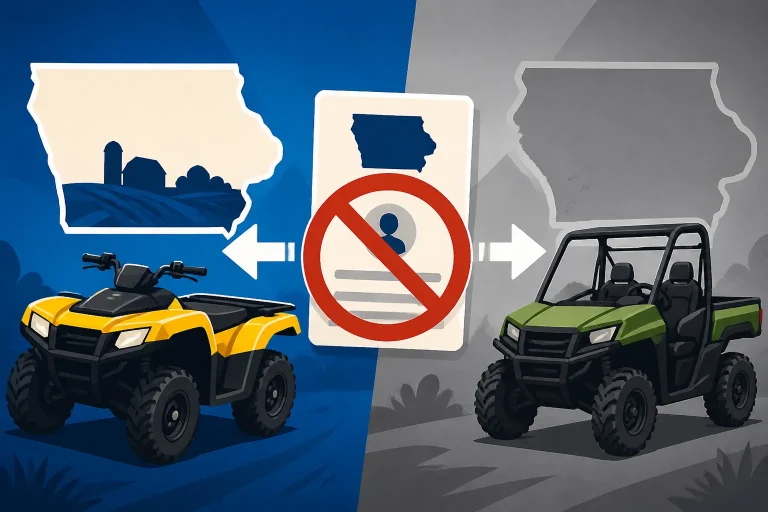
A current Iowa registration decal can be the key credential for riding at a designated OHV area, but it is not a universal ticket that overrides every park rule. The important distinction is whether you are a resident or visitor, where you plan to ride, and whether your paperwork is current. Here is how to use the decal correctly and what else to check before loading up.
What the decal means at an Iowa riding area
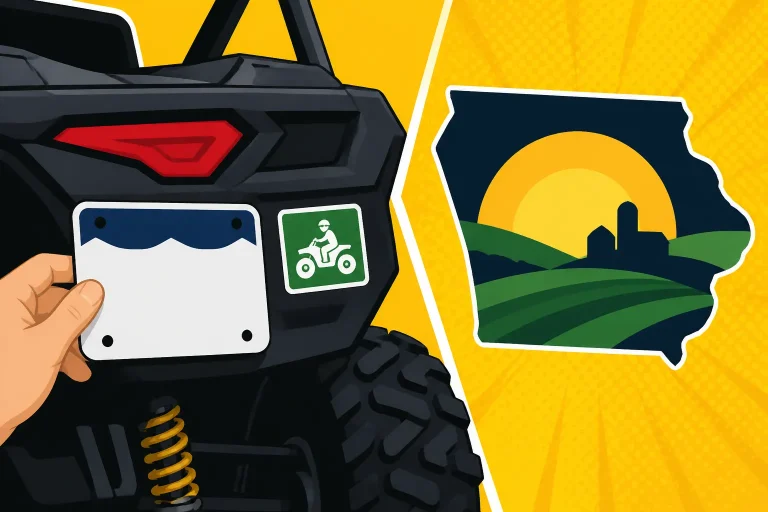
For an Iowa resident, the registration decal is more than proof that a machine has been recorded. According to the Department of Natural Resources, off-highway vehicles operated on public land, public ice, or at a designated riding area must be registered, and a registered ATV may operate in those places when it displays a current registration sticker. The Fiscal Services Division likewise says ATVs operating on public land, public ice, or designated riding trails must be registered through the county recorder’s office.
That is why riders often describe the decal as park admission: it is the required registration credential for using designated riding areas. It is not a separate statewide pass to buy in addition to the resident registration. For more on that distinction, see Why the Iowa Decal Is the Only Pass.
Still, a decal does not promise that every riding area is open, that every trail is suitable for your machine, or that you can ignore local conditions. The registration requirement and the park’s own operating rules are separate. A current sticker does not turn a closed trail into an open one or grant permission to ride outside the area’s designated routes. Before you leave, check the park’s current conditions and instructions. Iowa Trails Closed After Rain explains why trail status can change even when your paperwork is in order.
The registration certificate matters too. The Department of Natural Resources requires the operator to have it either in the vehicle or on their person while the vehicle is being used. The decal is the visible proof on the machine; the certificate is the document the operator must be able to produce. Keep both available rather than treating the sticker as a replacement for the certificate. See Carrying the Certificate on an Iowa Ride for a closer look at that requirement.
| Situation | What the machine needs | What to keep in mind |
|---|---|---|
| Iowa resident riding public land, public ice, or a designated riding area | Current Iowa DNR registration decal | Carry the registration certificate in the vehicle or on your person |
| Nonresident riding a designated area | Valid Iowa DNR nonresident user permit sticker | If your home state requires registration, display that registration too |
| Riding only on privately owned land | Iowa registration is not required solely for that use | Landowner permission and other applicable rules still matter |
| Riding a public road | Road-use requirements in addition to registration | Road eligibility, equipment, age, license, and insurance rules apply |
The basic takeaway is simple: the decal satisfies an important registration condition, but the ride still has to comply with the rules for the particular land and the type of use. If you are looking for a riding destination, Where to Ride an ATV in Iowa is a useful next step; check the individual area’s current information before heading out.
Resident registration: getting the decal and keeping it current
If your machine is new to you or has not yet been entered in Iowa’s recreational vehicle and vessel registration system, the Department of Natural Resources says you must register it through the County Recorder’s Office. A new machine requires a Bill of Sale and a Manufacturer’s Statement of Origin. For a used machine, the DNR lists a Bill of Sale along with the Vehicle Title, if applicable, and/or registration.
Those documents help establish the machine’s ownership and registration record. If you are buying used, it is worth sorting out the paperwork before the sale is final rather than assuming that a decal currently attached to the machine will be enough for your next ride. The seller’s sticker does not replace the buyer’s registration process. For the steps involved, see Buying a Used ATV in Iowa and Iowa ATV Registration Paperwork.
Registrations must be renewed annually, according to the Department of Natural Resources. The renewal period without penalty runs from September 1 through December 31. The DNR allows ATV, ORV, and ORM registration renewals through its online license system, as well as through the applicable county recorder process. If online renewal is the best fit, see Renewing an Iowa Registration Online.
Do not leave renewal until the day you plan to ride. The Department of Natural Resources says registration and decals sent through USPS can take up to 14 business days or more to arrive. A renewal that has been submitted is not the same thing as having the current sticker in hand and displayed. Plan around delivery time, especially if you have a particular riding weekend in mind.
Once the decal arrives, display it as required and keep the certificate accessible. If the sticker is damaged, missing, or unreadable, do not assume that the old decal or a confirmation screen will meet the display requirement. Check the replacement process before riding. Iowa ATV Decal Replacement covers that issue.
For current fees or questions about a specific machine’s paperwork, verify the requirements with the DNR or the county recorder handling the registration. Registration, title, and other paperwork costs are separate considerations; the decal’s role as a riding credential does not mean that every ownership or transaction requirement has been completed.
Visitors need an Iowa permit, and sometimes home-state registration too
A nonresident should not assume that a home-state sticker alone is enough for riding on Iowa public land or at a designated riding area. The Department of Natural Resources says nonresident machines must display a valid Iowa DNR nonresident user permit on the machine. If the rider’s home state requires the machine to be registered, the DNR also requires that home-state registration to be displayed.
The Iowa nonresident permit is available through the Iowa DNR Online License System, a statewide network of agents, and County Recorder’s Offices, according to the Department of Natural Resources. The main practical point is to obtain the permit before riding and make sure its sticker is attached to the machine as required. Carrying only a purchase confirmation does not change the stated display requirement.
For the differences between visitor permits and resident registration, see Iowa’s Nonresident User Permit and Iowa’s Permit for a Visiting Machine. If you are unsure whether your home-state registration is required, check the rules that apply to your machine and confirm what Iowa requires before the trip. Reciprocity questions can be especially easy to misread: a home-state credential and an Iowa nonresident permit serve different purposes under the DNR’s requirements.
The same caution applies if you are trailering across the state line with more than one machine. Make sure each machine has the credential that applies to it, rather than assuming one permit covers the whole group. A permit or registration attached to one vehicle does not automatically satisfy the requirement for another.
What the decal does not replace
The decal is not a substitute for the registration certificate, a youth education certificate, or road-use equipment. It is also not permission to ride wherever you see a trail or open ground. Keep these separate requirements in mind.
Carry the registration certificate
The Department of Natural Resources requires the registration certificate to be in the vehicle or on the operator while the machine is in use. Place it somewhere it can be found if requested, and make sure it stays with the machine when riders change. This is a simple detail that is easy to overlook when the decal is plainly visible on the rear.
Check education rules for young ATV operators
According to the Department of Natural Resources, ATV operators ages 12 through 17 must take and pass an ATV education course. The education certificate must be in the operator’s possession when riding on public land, public ice, or designated riding areas. The DNR says its online education offering was developed in collaboration with Fresh Air Educators, and the course has no riding component. Students must pass the final exam with 80% accuracy to earn the certificate.
The DNR also says a person under 12 cannot operate an ATV on public land or public ice unless directly supervised by an experienced, licensed parent or guardian who is at least 18 years old. These age and supervision requirements are distinct from machine registration: a valid decal does not stand in for a required education certificate or supervision. See Iowa ATV Safety Certificate Requirements for more detail.
Treat road riding as a separate use
A registration decal for off-road use does not automatically make a machine legal on every public road. According to the Department of Transportation, ATV and UTV roadway use is subject to separate requirements, including a minimum driver age of 18, a valid driver’s license, proof of insurance, headlights on at all times, and a maximum speed of 35 miles per hour. The DOT also says the vehicle must display its sticker on the rear and have required working equipment, including a horn, mirrors, headlights, taillights, and brake lights, as well as a slow-moving vehicle sign.
Road access also depends on the kind of road and local restrictions. The Department of Transportation says roadway use is allowed on roads except interstates and four-lane roads, and crossing a multi-lane highway is restricted to intersections coming from authorized roads. Cities and counties may be more restrictive than the state rules. For a route-specific explanation, see Iowa Rules for Riding a Gravel Road and Iowa Rules for Riding a Paved Secondary Road.
Confirm the riding area’s current conditions
Before you leave, verify that the destination is open and that its rules fit your machine and plans. A registration decal does not guarantee trail access during poor conditions or authorize travel beyond the designated area. Check for closures, permitted vehicle types, and any park-specific instructions.
A practical pre-ride check is:
- Confirm that the destination is open and that your vehicle is allowed there.
- Make sure the resident decal or nonresident permit is current and displayed on the correct machine.
- Put the registration certificate in the vehicle or carry it on your person.
- Check that any required youth education certificate is with the operator.
- If you will use public roads, verify the separate road-use rules and required equipment.
- For a nonresident machine, display the Iowa permit and any home-state registration required by Iowa.
The registration decal is the essential entry credential for many Iowa riding situations, but it works as part of a larger set of requirements. Treat it as proof of registration—not as a replacement for the certificate, permit, safety credentials, road equipment, or a check of current trail conditions.
Sources
- Department of Natural Resources — OHV Registration & Fees | Department of Natural Resources (checked November 3, 2026)
- Department of Natural Resources — OHV Safety & Education | Department of Natural Resources (checked November 3, 2026)
- Fiscal Services Division — 1543036.pdf (checked November 3, 2026)
- Department of Transportation — Driving Your ATV or UTV/ORV on Iowa Public Roads | Department of Transportation (checked November 3, 2026)
- IOWA DEPARTMENT OF NATURAL RESOURCES — download?inline (checked November 3, 2026)
- Department of Natural Resources — OHV Dealers | Department of Natural Resources (checked November 3, 2026)
- Department of Natural Resources — Snowmobile Education & Safety | Department of Natural Resources (checked November 3, 2026)
- Iowa Department of Natural Resources — download?inline (checked November 3, 2026)
Disclaimer
This article is for general informational purposes only and does not constitute professional advice. Laws, prices and regulations vary by location and change over time. Consult a qualified professional for guidance on your specific situation.