Why the Supervising Adult Must Hold a License
Iowa’s supervision rule can be confusing when a child is ready to ride but is not old enough to ride independently under the applicable rules. For a rider under 12, the supervising adult must meet more than an age threshold: the adult must hold a valid driver’s license and have experience operating the machine. Here’s what that means, and what it does not allow.
Why Iowa requires a licensed supervising adult
For covered off-road riding, Iowa requires a child under 12 to ride under the direct supervision of an adult who is licensed and experienced. A supervising adult’s valid driver’s license is therefore a condition of meeting the supervision rule, not simply a helpful credential. The adult also needs experience operating the type of off-road machine involved.
The rule makes a distinction between an adult who is merely present and an adult who can responsibly supervise the ride. Watching from a parked vehicle or staying somewhere else in the riding area may not amount to direct supervision. The adult should be able to observe the child, communicate with them, and respond promptly if the machine stalls, tips, or enters an unsafe situation.
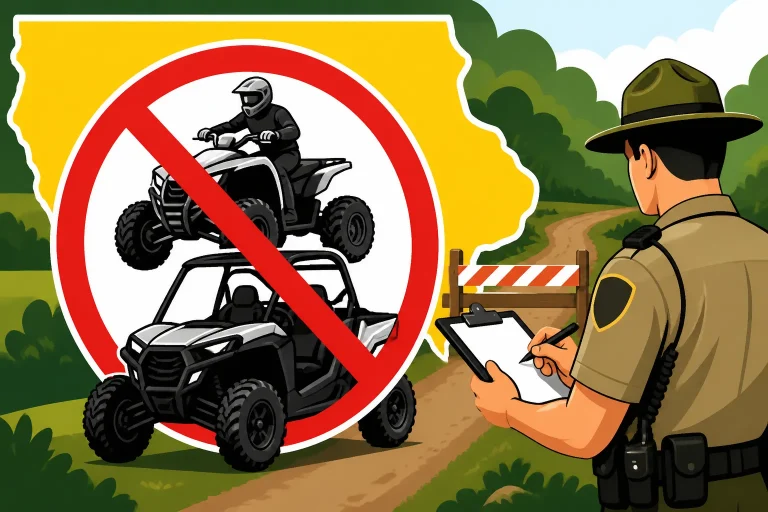
The license requirement does not mean that an ATV or UTV becomes legal to drive on public roads. A driver’s license qualifies the adult for the supervision role; it does not grant road access to the child or make an off-road machine street legal. Road riding has separate requirements, and the rules for riding a road are different from those for using a designated riding area.
It also does not mean that any licensed adult automatically meets every part of the rule. The adult must have relevant operating experience, and the child still needs to follow the rules that apply to the child’s age, machine, and riding location. For a broader overview of the age-specific requirement, see Iowa Supervision for Riders Under Twelve.
What “licensed and experienced” means in practice
The supervising adult should be able to meet both parts of the standard: hold a valid driver’s license and have experience operating the off-road machine. The license requirement is not a substitute for experience, and experience alone does not replace the license.
| Requirement | What the adult should be able to show or do | What it does not establish |
|---|---|---|
| Valid driver’s license | The adult holds a current license that meets the applicable requirement | Permission for the child to ride on public roads |
| Operating experience | The adult has practical experience with the relevant kind of off-road machine | That the child is ready to operate a particular machine |
| Direct supervision | The adult can monitor the child and intervene promptly | That being somewhere on the property is enough |
| Compliance with site rules | The adult and child follow the riding area’s rules | Permission to use a closed trail or ride beyond marked areas |
A driver’s license is a qualification, not a riding permit
The rule concerns the adult’s role. It does not give the child the adult’s driving privileges, and it does not let a child ride anywhere a licensed driver can go. A child riding under supervision remains subject to the rules for young operators.
Do not treat an adult’s license as proof that a child can ride on an Iowa road. Public-road operation is governed by separate requirements concerning the road, operator, machine, equipment, and insurance. An ATV or UTV being registered or used legally off-road does not, by itself, make it road legal.
Experience matters too
A license alone does not show that an adult knows how to supervise a young rider on a trail. The adult should understand the machine’s controls and stopping distance, recognize terrain that could cause a rollover, and be able to judge whether the child can manage the route.
Experience should be relevant to the machine. Having driven a passenger car does not automatically demonstrate familiarity with the handling and hazards of an ATV. A UTV also has different controls and dimensions from a quad. Iowa’s requirements vary by machine type, so check Why the Rule Follows the Machine Type if the child will operate something other than a standard ATV.
Direct supervision takes attention
Direct supervision works best when the adult stays close enough to keep the child in view and provide timely help. A long distance between adult and child, a route that separates them, or an adult focused on their own ride can make effective supervision difficult.
Before riding, agree on simple instructions: where the child may go, how far ahead they may travel, what to do if they lose sight of the adult, and where to stop if the adult signals. The adult should also consider whether the route and pace match the child’s ability. Meeting the legal supervision condition is a minimum; it does not guarantee that a machine or trail is appropriate for a particular child.
How the rule fits with age, machine, and location
The supervision requirement is only one part of Iowa’s off-road rules. Age-based safety certificate requirements, machine-specific exceptions, and location rules can apply as well. Check Iowa ATV Safety Certificate Requirements and Iowa Minimum Age to Ride Public Land when deciding whether a young rider may operate a particular machine in a particular place.
A safety certificate and adult supervision are not interchangeable. A certificate requirement that applies to an older youth does not cancel the supervision rules that apply to a younger child. Likewise, having an adult present does not automatically satisfy a separate certificate requirement. For a rider approaching the age threshold, see [Iowa Rules for a Rider Aged 12].
The machine matters. Requirements can differ for an ATV, UTV, and off-road motorcycle. A rule that applies to one type should not be assumed to cover another. Verify the machine classification and its applicable requirements before a child operates it, especially when the vehicle is a side-by-side or a dirt bike.
The riding location matters too. Rules for a designated riding area are not necessarily the same as rules for private property, public land, public ice, or a road. The adult should confirm that the site is open to the machine and that riding is permitted there. The location-specific details are covered in Iowa Rules for Riding a Designated Riding Area and Iowa Rules for Riding Private Property.
| Situation | What to check before the child rides |
|---|---|
| Child under 12 at a covered off-road riding location | Adult’s license, relevant operating experience, and direct supervision |
| Rider at or above the age when a certificate may apply | Whether the machine and location require a safety certificate |
| UTV or off-road motorcycle | Whether the machine type has different requirements |
| Private property | Landowner permission and any rules that apply to that property |
| Public road | Separate road-use, operator, equipment, and insurance requirements |
Supervision does not replace permission or site rules
A licensed adult cannot make an unauthorized ride permissible simply by accompanying the child. The owner or managing authority must allow the ride, and the machine must be permitted at that location. Trails may also close because of weather, maintenance, or other site conditions.
Before loading the machine, confirm that the riding area is open and check its posted rules. Keep the child on permitted routes and within the area the adult can supervise. If the route is too difficult to manage together, choose a shorter or easier route rather than relying on the license requirement as a substitute for judgment.
Private property is not a blanket exception
A family riding on private land should not assume that every public-land rule works in the same way there, or that private property makes all restrictions disappear. Property permission, registration or other machine requirements, and the setting of the ride can affect which rules apply. Check the conditions for the specific location and machine rather than relying on a general assumption. Iowa Rules for Riding Private Property explains the private-property context.
A practical check before a child rides
Use this quick process before each ride, particularly when the child is using a different machine or riding at a new location:
- Confirm the child’s age and machine type. Identify whether the vehicle is an ATV, UTV, or off-road motorcycle, then check the rules that apply to that combination.
- Confirm the adult qualifies. Make sure the supervising adult holds a valid driver’s license and has experience operating the relevant kind of machine.
- Plan for direct supervision. Choose a route and pace that let the adult keep the child in view and respond quickly. Set clear instructions for stopping and regrouping.
- Check the location. Verify that riding is allowed, the area is open, and the child’s machine may use the route.
- Check any additional requirements. Determine whether registration, a safety certificate, or other rules apply. The supervision rule does not replace them.
- Match the ride to the child. Consider the child’s size, judgment, and operating skill as well as the machine’s power and handling.
This checklist is useful, but it is not a substitute for checking current official requirements. When a child’s age, machine classification, or riding location makes the answer uncertain, confirm the applicable rule with the relevant Iowa agency or the operator of the riding area before the ride.
The central point is straightforward: for a child under 12 in a covered riding situation, the supervising adult must be both licensed and experienced. The adult’s license qualifies them for the supervision role; it does not authorize road use, remove other requirements, or make every machine and trail suitable for a child.
Disclaimer
This article is for general informational purposes only and does not constitute professional advice. Laws, prices and regulations vary by location and change over time. Consult a qualified professional for guidance on your specific situation.