Iowa Fines for Riding a Closed Trail
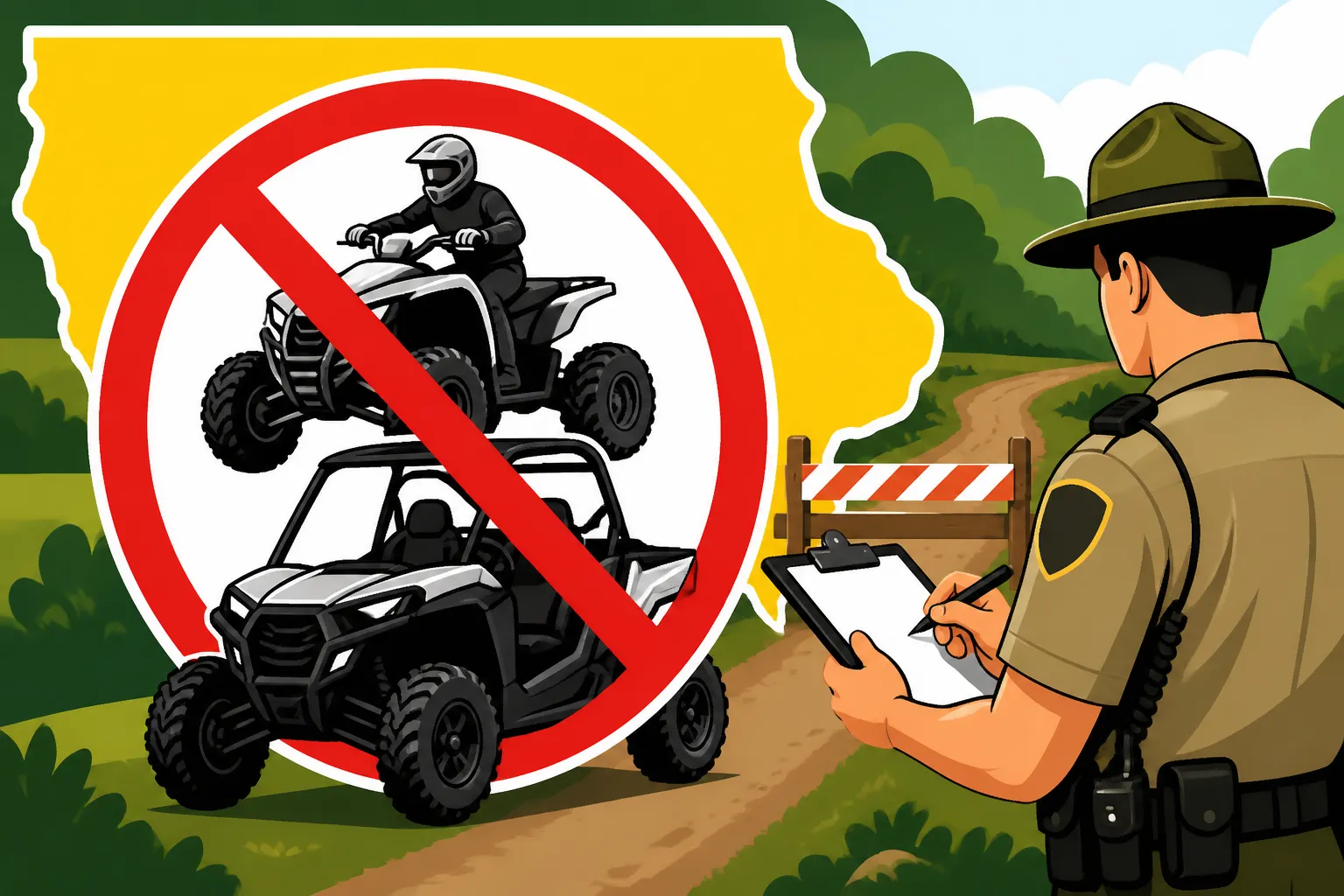
Seeing a gate open or another rider on the trail does not necessarily mean the route is legal to use. In Iowa, the consequences of riding a closed trail depend on who manages the land, what restriction was in place, and what conduct an officer or land manager observes. Here’s how to assess the risk, avoid a preventable citation, and respond if you’re stopped.
What counts as riding a closed trail
A trail may be closed for a full season, temporarily shut after rain, restricted to certain vehicles, or closed only in a particular area. The notice might be posted at a gate, on a sign, at a trailhead, or through an official park or land-manager alert. A closure can apply even if the route looks passable and your machine is properly registered.
Closures have different causes. Wet ground can be damaged by tires, while maintenance, flooding, fire risk, hunting activity, or a safety issue may also lead a manager to restrict access. Some routes close to all motorized use; others may remain open to particular users or vehicle types. Read the notice rather than assuming that a closure is only a recommendation.
It also matters who manages the land. A state-designated riding area, a county property, a club-operated park, and private ground may have different posted rules and enforcement arrangements. A property manager can restrict access under the conditions of use, and a closure notice may be enforced even when the trail connects to a public road or another open route.
The phrase “closed trail” can cover more than one situation:
- Riding past a gate or closure sign.
- Entering a park or riding area while it is closed.
- Using a trail that has been closed temporarily because of weather or damage.
- Continuing onto a route marked for a different vehicle type.
- Leaving an open route to ride around a barrier or closed section.
These actions may not all lead to the same citation. Riding beyond a barrier could involve a posted site rule, a land-access restriction, or a separate violation if the rider also damages property or leaves the marked trail. The specific facts and the authority managing the land matter.
A closure is also different from riding off a marked trail. A trail can be open while off-trail travel is prohibited, or an entire area can be closed even if you stay on the designated route. For related details, see Iowa Rules for Riding a Closed Trail and [Iowa Rules for Riding Off the Trail].
What fines or other consequences may apply
There is not one single statewide fine that can safely be quoted for every Iowa closed-trail situation. The amount and possible consequences depend on the law or rule cited, the property involved, the circumstances, and how the matter is handled. If you receive a citation, the exact charge and instructions on the citation are more useful than a general online estimate.
| Situation | What may affect the outcome |
|---|---|
| Riding into a signed, temporarily closed area | The posted restriction, the land manager’s rules, and whether the rider had notice |
| Going around a gate or barrier | Whether the route was clearly restricted and whether the conduct caused damage |
| Riding off an open trail | The area’s rules and any separate restriction on leaving marked routes |
| Damaging a trail or property | The extent of damage and whether repair or restoration costs are sought |
| Entering private land without permission | The property owner’s access rules and the circumstances of entry |
| Riding without valid registration or required permit | A separate registration or permit issue, apart from the closure |
A citation may include a fine or other court costs, but don’t assume every case is processed the same way. If a ride causes ruts, breaks a barrier, damages signs, or harms property, there may also be a claim for repair or restoration costs. That possibility is separate from any citation and depends on the facts.
A closed-trail citation is not automatically the same as a registration violation. Iowa registration, a nonresident permit, and a land manager’s permission serve different purposes. A valid decal or permit does not grant permission to ride a route that is closed. Likewise, an out-of-state registration or permit does not override a closure. You can read more about registration-related consequences in Iowa Fines for Riding Without Registration and Iowa Fines for No Registration.
For visitors, check both whether your machine needs the appropriate Iowa authorization and whether the specific riding area is open. A permit that allows a nonresident to ride where riding is otherwise permitted does not make a closed trail available. The distinction is explained in Iowa’s Permit for a Visiting Machine and Does Iowa Honor Out-of-State Registration?.
How to check a closure before you ride
Check the status of the exact park or property on the day you plan to ride. A trail that was open during your last visit may close after rain or a maintenance notice. A general map, old social media post, or previous rider’s report may not reflect a new restriction.
Before loading your machine:
- Identify who manages the riding area. Look for the park, county, club, or landowner responsible for the property. Their current notice is more relevant than a general trail listing.
- Check current closure information. Look for an alert, closure notice, or operating update from the manager. For state-related notices, Reading the Iowa DNR Alert Feed can help you know what to look for.
- Read signs at the entrance and along the route. A closure may apply only to a section, loop, or type of machine. Follow the sign as posted instead of relying on a map that may be out of date.
- Call before making a long trip if the status is unclear. Ask whether the trail is open to your type of machine and whether any temporary restrictions apply.
- Choose a backup riding area. If your destination is closed, do not assume a nearby route is an acceptable substitute. Confirm that the alternative is open and that you’re allowed to ride there.
Weather-related closures deserve particular attention. Iowa trails can become vulnerable to damage when the ground is wet, and riding a closed route can worsen ruts or erosion. A closure may remain in place after rain even when the surface looks dry from the parking area. See Iowa’s Weather-Driven Trail Closures and Iowa Trail Closures to Check First for more on checking conditions before departure.
Treat barriers and signs as instructions, not obstacles to work around. If a gate is shut, do not ride around it, through the ditch, or onto an adjacent parcel to reach the trail. A route that appears to continue beyond the barrier is not proof that access is allowed. The manager may have closed only that section, or may have prohibited entry to the whole property.
Keep the closure check separate from your permit check. Iowa registration, a nonresident permit, and the land manager’s current access status are three different questions:
- Is the machine properly registered or otherwise authorized for the rider?
- Does the rider need an Iowa nonresident permit or another form of authorization?
- Is the particular area and route open to that machine today?
A “yes” to the first two does not answer the third. For a broader explanation of the state’s authorization system, see Iowa ORV Permits Explained.
What to do if you are stopped or cited
If an officer or property representative stops you, stay calm, bring the machine to a safe stop, and follow lawful instructions. Do not argue on the trail, move a barrier, or continue riding while the situation is being addressed. Ask what restriction or rule applies and whether the route is closed entirely or only to certain vehicles.
If you receive a citation, read it carefully. Note the alleged violation, the location, the issuing authority, and any response or payment instructions. Keep the citation and any related documents. If you believe the sign was missing, the route was open, or the location was incorrectly identified, write down what you remember while the details are fresh. Photographs of signs, gates, trail maps, and the location may help explain the circumstances, but do not trespass or return to a closed area to collect them.
Do not assume that paying a citation is the only option or that ignoring it will make it go away. Follow the directions and deadlines on the paperwork, and contact the court or issuing agency if you need clarification about the process. If the charge could have broader consequences, or if property damage is alleged, consider getting advice from a qualified professional.
If you were stopped for more than one issue, separate them. For example, a rider could be questioned about both a closed route and registration. Each allegation has its own facts and requirements. A valid registration does not cancel a closure violation, and an open trail does not excuse riding without required authorization.
The simplest way to prevent a closed-trail fine is to confirm access before leaving home, check again at the trailhead, and turn back when a closure is posted. If the route’s status is uncertain, contact the manager rather than relying on an assumption or another rider’s judgment.
Disclaimer
This article is for general informational purposes only and does not constitute professional advice. Laws, prices and regulations vary by location and change over time. Consult a qualified professional for guidance on your specific situation.