Why Iowa Sells No Statewide Trail Pass
Why Iowa Sells No Statewide Trail Pass
If you’re planning an Iowa ATV or UTV ride, the lack of a single statewide trail pass can seem confusing. You may need a registration decal or visitor permit, but neither automatically gives you permission to ride every trail, road, or piece of public land. Here’s how Iowa’s system works, why it’s structured this way, and what to check before you unload.
What “Statewide Trail Pass” Would Mean
A statewide trail pass usually suggests one purchase that gives a rider access to all participating trails across a state. It can be a useful model where a large, connected trail network has a central system for collecting fees and distributing access. Iowa’s off-highway riding is organized differently.
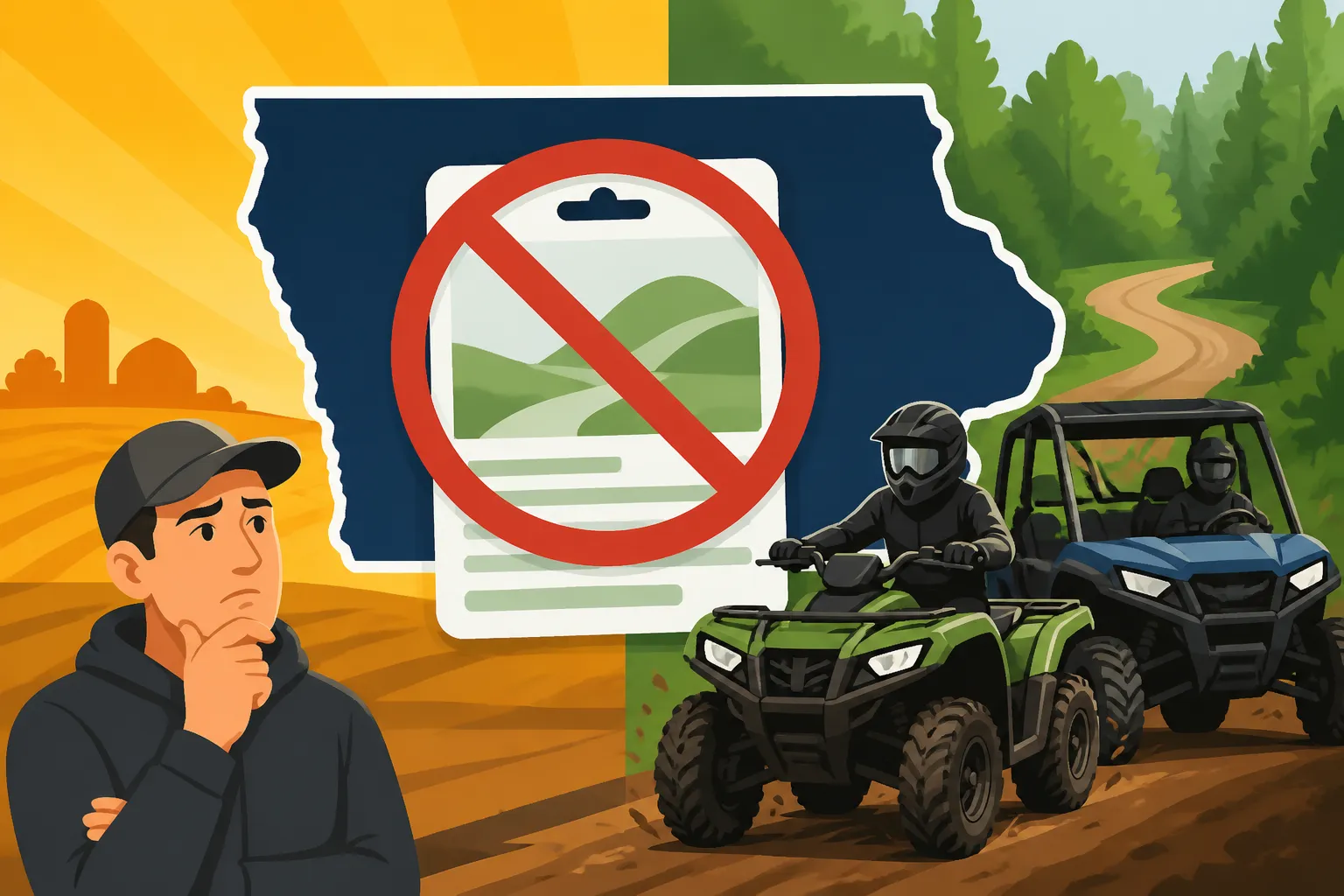
Iowa does not sell a single pass that grants general access to every place where an ATV or UTV might be ridden. Access depends on the particular location and who manages it. A designated riding area, a private trail, a club-managed property, a wildlife area, and a county road can all have different rules. A registration decal or nonresident permit may meet an important statewide requirement, but it does not replace the permission, land-use rules, or local requirements that apply at a specific place.
That distinction is the key to understanding the system:
- Registration or a visitor permit addresses the machine’s Iowa off-highway requirements.
- A park’s rules address how and where you can ride at that park.
- Landowner permission addresses whether you may ride on private property.
- Road-use rules address whether you may operate the machine on a road.
Those are separate questions. A rider can have the right decal and still be somewhere riding is not allowed. A rider can also have permission to use a private trail but still need to meet applicable registration or permit requirements.
Iowa riders often call the state registration decal the pass because it serves as the credential used at designated riding areas. That shorthand can be practical, but it can also lead visitors to assume the decal works like an all-access trail ticket. It does not. Why the Iowa Decal Is the Only Pass explains the role the decal plays, while Iowa Rules for Riding a Designated Riding Area covers why the location’s own rules still matter.
A better way to think about it is as a statewide machine credential, not a statewide trail pass. It helps show that the machine has met an applicable Iowa requirement. It does not create trail access where no access has been granted.
How Iowa’s System Works
Iowa’s model links off-highway vehicle requirements with access to certain designated riding areas. For Iowa machines, registration and the associated decal are central parts of that system. For visiting machines, an Iowa nonresident user permit may apply, depending on the visitor’s home-state registration and whether Iowa recognizes it under its reciprocity rules.
The decal is not simply a ticket sold at every trailhead. It is tied to the machine and its registration status. This is one reason a separate statewide day-use pass is not the central product: Iowa uses machine credentials as part of its access framework at designated riding areas. Why No Gate Charges You Twice describes why a rider may not encounter a separate admission charge at those locations.
That doesn’t mean every riding area is free in every sense. A park may have its own operating arrangements, services, camping rules, event requirements, or limits. “No separate day-use pass” is not the same as “every activity and amenity is free.” Always check the park’s current rules before traveling.
The state’s designated riding areas are not all managed as one uniform trail system. Local organizations, clubs, counties, and other managers may be involved in maintaining particular properties. Conditions, open dates, permitted machine types, trail layouts, and closure decisions can differ from one area to another. Iowa’s Eight Designated OHV Parks gives the broader picture of designated areas, but you still need to check the specific place you intend to visit.
The division of responsibilities looks something like this:
| Question | What to check |
|---|---|
| Does my machine meet Iowa’s registration or visitor-permit requirement? | Iowa registration rules, your home-state status, and reciprocity |
| May I ride at this specific park? | The park’s current operating rules, closures, and machine restrictions |
| May I ride on private property? | Permission from the landowner or the person authorized to grant it |
| May I use this road to reach a trail or destination? | The road’s classification and the applicable state, county, and city rules |
| Does camping or an organized event require anything extra? | The campground, land manager, event organizer, or relevant agency |
The practical result is a layered system. You first determine what credential applies to your machine, then confirm that the riding area is open and that your machine and planned activity are allowed there. If your ride includes a road segment, that segment has its own rules; the park decal alone does not make road use legal.
For Iowa residents, the registration decal is part of the ordinary process for a covered machine. For nonresidents, the right answer can depend on the home-state registration and Iowa’s reciprocity treatment. A visitor shouldn’t assume that an out-of-state plate or sticker is automatically accepted everywhere in Iowa. Review Does Iowa Honor Out-of-State Registration? and Iowa’s Permit for a Visiting Machine before the trip if you’re bringing a machine from another state.
Why Iowa Does Not Use One All-Access Pass
A single pass sounds simpler, but it would not solve every access question in Iowa. It would tell a rider that a payment was made; it would not automatically establish that every landowner, park manager, or local authority had opened a property or route to riding.
Access is distributed among different managers
Iowa riding opportunities are not one continuous state-owned trail network. Some locations are designated riding areas; others may be managed locally or by a club, and some riding takes place on private land with permission. A statewide access pass would require a shared system for deciding which places participate, how money is divided, who maintains the land, and how local rules are communicated.
That kind of arrangement can be valuable where it fits the land and management structure. But it is not a substitute for the actual agreement that makes a trail available. A state cannot sell access to private ground on behalf of an owner who has not agreed to open it.
That’s why Where Iowa Lets You Ride Beyond the Eight Parks should be read as a question about specific places and permissions, not as a directory of land covered automatically by one payment. For private ground, start with Iowa Landowner Permission Rules. A registration credential does not grant permission to cross a neighbor’s field or timber.
A single pass could imply more access than exists
The phrase “statewide trail pass” may lead riders to expect that every public trail, conservation area, and road is open to motorized riding. That is not a safe assumption. Public ownership does not necessarily mean motorized access, and a trail open to one type of recreation may not be open to ATVs or UTVs.
A statewide pass could also blur the difference between riding on a designated route and traveling over land wherever a rider chooses. Land managers need to be able to close routes, restrict machine types, limit group size, or protect an area during poor conditions. A credential that is valid statewide should not be mistaken for permission to ignore those limits.
Conditions and operations vary by location
Iowa’s soils and weather can make trail conditions change quickly. Rain can turn a rideable route into a muddy, easily damaged surface. Local managers may close a trail or park to prevent damage, even if the machine’s registration is current and the rider has already planned a trip.
A pass that appears to guarantee entry can create frustration when a gate is closed for safety, maintenance, weather, or another management reason. With a credential-based system, riders still need to confirm the park is open. Check Iowa Trail Closures to Check First and Iowa Trail Conditions Before You Ride before loading.
The machine credential is useful across more than one kind of ride
Registration rules apply to the machine, not just to one ticketed park visit. Riders may use their machines in different settings, subject to the rules for each one. Tying an Iowa decal to the machine’s status gives the state a way to administer that requirement without treating every park visit as a separate purchase.
The trade-off is that riders need to understand what the decal does and does not cover. It can be convenient when there is no separate day-use transaction at a designated area. It is less intuitive for visitors who expect a distinct admission ticket, or who assume that one sticker covers every riding opportunity in the state.
What Iowa Residents and Visitors Should Check
The right credential depends on the machine and the rider’s circumstances. The table below is a starting point, not a substitute for checking the current rules for your machine and destination.
| Your situation | What to verify before riding |
|---|---|
| Iowa resident riding a covered ATV or UTV | Whether the machine is properly registered and displays the required decal |
| Visitor with an out-of-state registration | Whether Iowa recognizes the home-state credential for the planned use |
| Visitor who does not qualify under reciprocity | Whether an Iowa nonresident user permit is required and how to obtain it |
| Rider planning to use a designated riding area | The credential requirement, operating status, allowed machine types, and park rules |
| Rider planning to use private property | Permission from the owner or authorized manager, plus any applicable machine requirements |
| Rider traveling on public roads | Road-specific authorization and equipment, age, licensing, and insurance requirements |
| Rider attending a race or organized event | Whether the organizer or land manager requires an additional permit or documentation |
Iowa residents
If you live in Iowa and own a covered off-highway machine, do not treat the absence of a day-use ticket as a reason to skip registration. The registration and decal rules apply independently of whether you expect to visit a particular designated park. If you are unsure whether your machine is covered or whether an exemption applies, confirm that issue before riding.
For registration details, see Registering an ATV in Iowa. For a side-by-side, use Registering a Side-by-Side in Iowa as a starting point, because vehicle type can affect which requirements apply.
Visitors from other states
A visitor should check reciprocity rather than guessing from the sticker or paperwork used at home. Iowa may recognize some out-of-state registrations under particular circumstances, but the answer depends on the rules that apply to the visitor’s home jurisdiction and machine. If your home credential does not satisfy Iowa’s requirements, an Iowa nonresident permit may be needed.
The permit question is separate from park access. Even with the right visitor credential, you still need to confirm the destination is open and that your planned riding is allowed. See Iowa ATV Registration for a Nonresident and Iowa Reciprocity With Minnesota or the relevant reciprocity page for your home state.
A permit or registration also belongs to a particular machine or has other conditions. Don’t assume you can buy one credential and move it between machines in a group. Check the current permit instructions and make sure each machine has whatever documentation it needs.
Riders using roads
A trail credential does not turn an ATV or UTV into a road-legal vehicle. Iowa road access is governed separately, and permission to ride a designated off-highway trail says nothing by itself about whether a road segment is open to your machine.
This matters when a route requires riding between a staging area and a trail, crossing a road, or using a road to connect to another destination. Check the road classification and local authorization before setting out. Are ATVs Street Legal in Iowa? is a useful overview; for a particular type of road, consult the matching Iowa road-rules article rather than relying on a general trail permit.
How to Plan a Ride Without a Statewide Pass
Because there is no universal trail pass that answers every access question, use a short pre-ride routine. It prevents the most common mistake: arriving with the right machine and paperwork but the wrong assumption about where you can ride.
- Identify your machine and credential. Confirm whether it is covered by Iowa registration rules, whether it is registered correctly, and whether the decal or visitor permit applies to that specific machine.
- Check reciprocity if you are visiting. Do not assume your home-state registration is enough. Confirm the current Iowa rule for your state and machine type.
- Choose a specific destination. “Riding in Iowa” is too broad to confirm access. Pick the park, property, route, or event you intend to use.
- Check the destination’s status and rules. Look for closures, seasonal restrictions, machine-width or type limits, hours, sound requirements, and any special event or camping rules.
- Confirm permission for non-park land. For private property, get permission from someone authorized to give it. For public land, confirm motorized riding is allowed in the specific area and on the specific route.
- Review any road segments separately. If your route includes public roads, check whether those roads are open to your machine and what equipment and operator requirements apply.
- Carry the necessary documents. Have your registration or permit information available, along with any other documentation the rules require.
- Recheck conditions before you leave. A trail can close after you have planned the trip. Weather, maintenance, and local decisions can change what is open.
If you organize a group ride, make sure each participant understands the difference between a machine credential and permission to enter a property. One person’s permit does not necessarily cover every machine in the group, and a leader’s permission to use a private property does not necessarily remove the need for each rider to meet applicable state requirements.
The same principle applies to equipment and trip prep. A map holder, a way to keep your phone charged, and basic recovery or safety supplies can make it easier to follow a route and respond to a change in conditions. If you use Amazon to source items such as a waterproof map sleeve, check that the item fits your setup and treat it as gear—not as proof of access. A reflective vest or compact first-aid kit found through Amazon may be useful on a ride, but neither changes the legal requirements for the machine. If you buy a charging cable from Amazon, test it before the trip; a dead phone is a poor way to discover you needed to check a closure.
The official destination information remains more important than gear listings, old forum posts, or a map that does not show current closures. Use purchase sites for equipment, and use the responsible agency or land manager for access and operating rules.
Common Misunderstandings About Iowa Trail Access
“I paid for a decal, so I can ride anywhere.”
No. The decal or permit addresses a machine-related requirement; it does not grant access to every parcel or trail. You still need a location where riding is allowed and must follow its rules.
“A public park must be open to ATVs.”
Not necessarily. Public ownership does not automatically authorize motorized use. A manager may allow some activities and prohibit others. Confirm that ATV or UTV riding is permitted on the specific route or property.
“There’s no gate fee, so I don’t need to check anything.”
The lack of a separate day-use charge does not remove registration, permit, closure, or land-use requirements. Check the park’s instructions even if you do not expect to pay at the gate.
“My home-state sticker is enough.”
Maybe, but don’t rely on assumption. Reciprocity is a specific rule, not a general courtesy. Verify whether Iowa accepts your credential for your machine and planned activity. If not, determine whether you need an Iowa nonresident permit.
“A trail pass would cover road riding too.”
No. Trail access and road access are different issues. A decal or visitor permit does not authorize road use where it is otherwise prohibited.
“A friend has permission, so the whole group can ride.”
Permission may have limits. Ask whether it covers your group, the number and type of machines, the route, and the date. Each rider must still meet applicable registration and safety requirements.
Iowa’s system asks riders to verify more than one thing, but that is also its main strength: the credential, the property permission, and the local operating rules are not confused with one another. Before you ride, confirm the machine requirement, the destination’s access rules, and the current trail status. That is more reliable than looking for a single pass to settle every question.
Disclaimer
This article is for general informational purposes only and does not constitute professional advice. Laws, prices and regulations vary by location and change over time. Consult a qualified professional for guidance on your specific situation.