Iowa Rules for Riding Private Property
Riding an ATV or UTV on private property in Iowa can seem simpler than using a public trail, but “private” does not automatically mean unrestricted. The key questions are whether you have permission, whether the land is open to other riders, and whether you are crossing a road or entering a designated riding area. Here is how to sort out the rules before you ride.
Permission comes first
If you own the land, you can generally ride there subject to other applicable laws and any restrictions on the property. If you do not own it, get permission from the landowner or someone authorized to grant it before riding. A nearby trail, an open gate, or a past invitation is not reliable proof that you have permission today.
Permission should cover the actual places and activities involved. For example, a landowner might allow riding in one field but not through a crop, timber stand, yard, or access lane. They might also set conditions about dates, hours, passengers, machine types, parking, or where you may cross a fence. If a group is coming, confirm that the permission extends to everyone in the group rather than only the person who asked.
A lease or other arrangement does not necessarily include permission to ride. A farm lease, hunting agreement, or permission to use a lane may be limited to a particular purpose. Check the terms rather than assuming one kind of access allows another. Iowa Landowner Permission Rules and A Farm Lease and Riding Rights in Iowa explain why the landowner’s actual consent matters.
Be especially careful where property lines are hard to see. A trail may pass through several parcels, and permission from one owner does not cover the next parcel. If you are unsure where a boundary runs, ask before riding across it. Do not treat a neighbor’s land as an extension of the property where you have permission.
Written permission is useful when the arrangement is not obvious, when several riders are involved, or when permission comes with conditions. It can be a text or another clear record; the important thing is that it identifies who may ride and where. A written note does not replace any permit or registration required for the type of riding area.
When private land can still require registration or a permit
A major distinction is whether the property is genuinely private ground being used privately or a riding area open to the public. Ownership alone does not answer the question. Some riding areas are on private land but are open for public recreational use, and those can be treated differently from a landowner’s closed property.
For private ground that is not open to the public, Iowa’s ATV registration rules are generally focused on operation on public land, public ice, or a designated riding area, rather than simply on riding across your own or a consenting landowner’s closed property. But if a private property functions as a public riding area, do not assume that private ownership removes the registration requirement. Check how the site is classified and what the operator requires. Do You Need to Register an ATV on Private Land in Iowa? covers the distinction between closed private ground and riding areas open to riders.
| Where you are riding | What to check before riding |
|---|---|
| Your own closed property | Other applicable laws, safe boundaries, and any conditions affecting the property |
| Someone else’s closed property | The owner’s permission and any limits they set |
| A private site open to public riding | Whether it is a designated riding area and what registration, permit, or site rules apply |
| Public land or a public riding area | Applicable Iowa registration or permit requirements and site rules |
| A public road between private parcels | Road-use rules; private-property permission does not authorize road use |
Visitors should also distinguish a private-land ride from a visit to a public riding area. Iowa’s nonresident permit rules concern riding in places where the permit applies; they are not a general substitute for the landowner’s permission. Likewise, an out-of-state registration does not grant access to private property. Iowa’s Permit for a Visiting Machine and Iowa Reciprocity With Minnesota may help visitors work through those separate questions.
If a private riding site welcomes the public, ask the owner or operator what documentation is needed before unloading. Requirements may depend on the site’s status, your machine, and your residency. For a group ride, event, or paid activity, ordinary permission to use the land may not be the only requirement. Iowa Rules for Riding a Designated Riding Area and Iowa Rules for an Organized Ride address situations that go beyond a private owner and a few invited riders.
Roads, boundaries, and other rules still matter
Permission to ride on private land does not give you permission to ride on a public road, public trail, or a neighbor’s property. It also does not turn a public road into private land just because it crosses a farm or runs beside a field. If your route leaves the property, check the rules for the place you are entering before riding there.
A road may look like a farm lane but still be open to public traffic, or a private lane may connect to a public road. Do not use a road, ditch, shoulder, or trail as a shortcut without confirming who controls it and what rules apply. Iowa Rules for Riding a Farm Lane and Iowa Rules for Riding a Gravel Road cover the difference between private access and road riding.
If your ride involves crossing a public road, treat the crossing as a separate legal question. A landowner’s permission cannot authorize an ATV or UTV to travel along a road that is not open to it. Iowa has specific rules for road use, and local authorization can matter. See What Iowa Requires of an ATV on a Public Road before planning a route that uses public roads.
Other laws and practical restrictions can apply even when the ride stays on private ground. Avoid damaging crops, fences, drainage features, trees, or waterways. Respect posted restrictions, quiet hours, and any limits set by the owner. Keep riders within the permitted area, and stop if the owner withdraws permission or asks the group to leave.
Safety requirements can depend on the machine, the rider’s age, and where the ride takes place. Do not assume that private property makes age-related or safety rules irrelevant in every situation. Check the requirements for the particular rider and machine, especially for children and teenagers. Iowa ATV Safety Certificate Requirements explains the certificate rules for situations where they apply.
A practical check before you unload
A short check beforehand can prevent a disagreement, an unsafe route, or a surprise requirement at the entrance. Work through these questions before the machine is started:
- Who controls the land? Confirm the owner or authorized manager, and identify the parcel or area where riding is allowed.
- Is permission current and specific? Ask about the route, dates, hours, riders, passengers, and any no-go areas.
- Is the site open to the public? If other riders can use the property, ask whether it is treated as a designated riding area and what documentation is required.
- Does the planned route leave the property? Check every road, lane, trail, and boundary crossing separately.
- Do the riders have any age-related requirements? Verify safety certificate and supervision rules for the specific machine and location.
- Are there local or site rules? Ask about parking, noise, speed, fire restrictions, and whether riding is temporarily prohibited because of conditions.
- Can you show that permission was granted? Keep a clear record of the owner’s instructions, particularly for a group or a recurring ride.
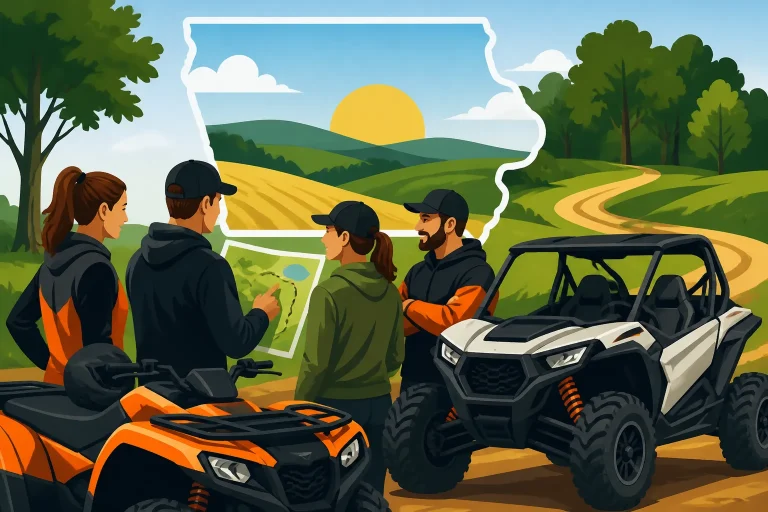
For regular access, it can help to agree on the route and boundaries with the landowner in advance. A marked map or a walk-through can make “stay out of the creek bottom” or “use only the north field” much clearer. If the owner allows a group, agree on who is responsible for communicating the rules and keeping riders together.
The simplest rule is that private-property riding depends on both permission and the land’s actual use. Closed private ground is different from a private site open to the public, and neither one grants access to public roads or neighboring parcels. When the status of a site is unclear, confirm its requirements with the owner or the appropriate Iowa authority before the ride.
Disclaimer
This article is for general informational purposes only and does not constitute professional advice. Laws, prices and regulations vary by location and change over time. Consult a qualified professional for guidance on your specific situation.