Iowa Rules for Agricultural Road Use
Many Iowa farmers and rural residents find themselves scratching their heads when it comes to using their ATVs and UTVs for agricultural purposes on public roads. It feels like you should be able to zip down the road a mile or two to check fences or move equipment without jumping through a million hoops, right? But the rules can be a real maze. This guide is here to untangle those specific regulations, helping you understand when and how your machine can legitimately operate on Iowa roads for farm work, and what exemptions you might be eligible for.
The Basics of Agricultural Road Use in Iowa
Using your ATV or UTV for farm-related tasks on public roads in Iowa isn't as straightforward as just pointing your machine down the lane. There are specific definitions and understandings you need to have to avoid misunderstandings with law enforcement. It’s all about the purpose and the context of your travel.
What "Agricultural Road Use" Actually Means
This isn't about joyriding or heading to the nearest fishing hole on your ATV. Agricultural road use in Iowa specifically refers to using an off-highway vehicle (OHV) like an ATV or UTV for tasks directly related to farming, ranching, or other agricultural operations. Think about those urgent trips: hauling tools to a field where equipment just broke down, checking on livestock in a distant pasture, moving between crop fields, or transporting seed and feed for short distances. The absolute key here is the purpose of the journey. If you're on a public road, even a gravel one, and your intent isn't agricultural, then these specific exemptions likely don't apply.
Many folks mistakenly believe that simply owning a farm exempts their machine from all road rules. Unfortunately, it's not that simple. The law differentiates between a vehicle used on the farm and one used for farming on public roads. This distinction is critical because while a machine might be essential for your daily operations, taking it onto a county road for anything other than a bona fide agricultural purpose could land you in trouble. It’s about more than just having a bale spear on the back; it's about the activity you're undertaking at that moment you put tires to pavement or gravel.
The state recognizes that these machines are invaluable tools for farmers, providing efficiency and access that larger equipment sometimes can't. Because of this, certain provisions are made. However, these provisions aren't a blanket pass. They are carefully defined to ensure safety for everyone on the road and to prevent the misuse of these exemptions for recreational riding. Understanding this foundational principle is the first step in legally using your ATV or UTV on Iowa's roadways for agricultural tasks.
Key Exemptions and Their Nuances
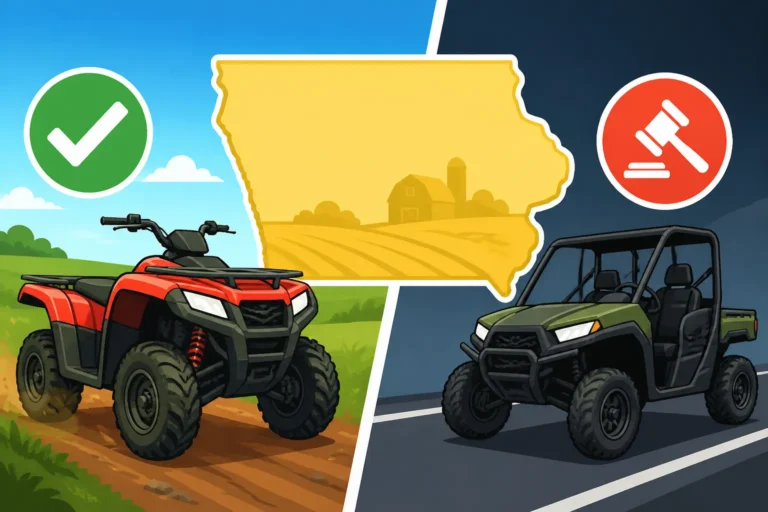
Iowa law provides some specific exemptions for ATVs and UTVs when they are used as "implements of husbandry." This is a crucial term to understand. An implement of husbandry is defined as a vehicle that is "used exclusively in the actual production of agricultural or horticultural products." This means the machine's primary role must be tied directly to farming. For instance, a UTV used to spray weeds in a cornfield or to shuttle feed to cattle in a remote pen would likely qualify. However, that same UTV, if primarily used for weekend trail riding with friends, would not suddenly become an implement of husbandry just because it occasionally hauls a bucket of feed.
One of the most significant exemptions is related to registration. Typically, any ATV or UTV used on public land in Iowa, including public roads where allowed, must be registered with the county recorder. However, machines that strictly meet the definition of an implement of husbandry are often exempt from this registration requirement. This can save farmers the yearly hassle and cost of renewal, but it hinges entirely on the exclusive use clause. You can read more about standard registration rules in [Registering an ATV in Iowa] to understand what you're being exempted from.
It's not just about the type of machine, but how it's equipped and operated. Even with these exemptions, there are still basic safety and operational requirements that you can't ignore. For example, while you might not need an official registration decal, your machine still needs to be safe for road travel, especially if you're out there during dawn, dusk, or night hours. The nuances really depend on how far you're traveling and what kind of road you're on, making it a topic that deserves careful attention and no casual assumptions.
Navigating Iowa's Farm Vehicle Exemptions
Understanding the core definitions is one thing, but knowing the specific rules that apply to implements of husbandry and short-distance travel is where the rubber meets the road. These exemptions are your best friends when moving machines for farm work, but they come with strict boundaries.
The Implement of Husbandry Exemption in Iowa
Let's dive deeper into [The Implement of Husbandry Exemption in Iowa]. This exemption is the cornerstone of agricultural road use for ATVs and UTVs. For your machine to qualify, it must be used primarily and almost exclusively for agricultural purposes. Imagine a farmer using their UTV to haul fence posts across a gravel road to repair a broken fence line, or perhaps to transport a small sprayer between fields. These are classic examples of the implement of husbandry in action because the machine is serving a direct, vital farm function.
However, it's vital to recognize that this exemption doesn't grant you carte blanche to cruise rural roads. It’s a privilege tied to specific usage. If you take that same UTV, after a day of hauling feed, and decide to drive it into town for groceries, or to visit a friend down the road for a social call, you've stepped outside the bounds of the implement of husbandry exemption. At that point, your machine would typically be subject to the full suite of ATV and UTV road rules, including registration and possibly even insurance requirements if on paved roads. Even machines with durable parts and accessories from companies like SuperATV, built for tough farm work, still need to follow these usage guidelines.
The "primarily and exclusively" part is what often trips people up. A good rule of thumb is to ask yourself: "Is the sole purpose of this trip directly related to my farming operation?" If the answer is anything but a resounding "yes," then you should err on the side of caution and ensure your machine is fully registered and equipped for general road use, or simply avoid public roads altogether for that trip.
The "Two Miles From the Farm" Rule
Another vital part of Iowa's agricultural road use rules is often referred to as the [2 Miles From the Farm in Iowa] rule. This provision allows an ATV or UTV, when operated as an implement of husbandry, to travel on a public highway for distances not exceeding two miles from the point of origin (which is typically your farmstead or field entrance). This specific distance is crucial and often misunderstood. It's designed to facilitate short movements between fields, to a neighboring farm you're leasing, or to access a barn slightly down the road, without the full burden of standard registration.
Think of a scenario where your main farm is on one side of a county road, and you have a pasture or another crop field exactly 1.5 miles away on the same road. The two-mile rule allows you to operate your ATV or UTV to get to that field for agricultural work, even without a standard registration, provided it still meets the implement of husbandry definition. This makes practical sense for farmers who need to efficiently manage contiguous or nearly contiguous land parcels, allowing them to save valuable time compared to loading and unloading on a trailer.
Exceeding this two-mile limit, however, immediately places your machine outside this specific exemption. If your destination for agricultural work is, say, three miles away, then the two-mile rule no longer applies, and your ATV or UTV would require standard registration to be legally on that public road. This is a common point of confusion, and enforcement officers will look for adherence to this distance limit. Always be mindful of your route and distance when relying on this particular exemption, as stretching it "just a little bit further" can lead to unexpected consequences.
Essential Requirements for Farm-Used Machines on Iowa Roads
Just because your machine is working for the farm doesn't mean it's invisible or immune to all safety standards. Even with exemptions, there are critical pieces of equipment and operational rules you absolutely must follow to stay safe and legal.
Equipment You'll Still Need
Even if your ATV or UTV qualifies as an implement of husbandry and you're within the two-mile limit, Iowa law still mandates certain safety equipment when operating on public roads. These requirements are in place to ensure your visibility and safety, as well as the safety of other motorists. A critical piece of equipment is the slow-moving vehicle (SMV) triangle. This bright orange triangle must be displayed on the rear of your machine, clearly visible to vehicles approaching from behind. It signals to others that you're traveling at speeds significantly lower than typical road traffic, allowing them to adjust their driving accordingly. You can learn more about this in [Iowa's Slow-Moving Vehicle Triangle].
Beyond the SMV sign, adequate lighting is non-negotiable, especially during low-light conditions. If you're operating your machine on a public road between sunset and sunrise, or at any other time when visibility is poor (like heavy fog or heavy rain), you must have working headlights and taillights. Many agricultural machines, particularly UTVs, come equipped with these as standard. If yours doesn't, or if the lights are damaged, they need to be repaired or installed before you venture onto the road during those times. Remember, even in daytime, it's often a good practice to have your [Headlights On All Day in Iowa] for increased visibility.
While you might not need to bolt on every accessory available from SuperATV, features like a robust horn and a mirror are often considered good practice for any road use, even if not explicitly mandated for all agricultural exemptions. A horn allows you to alert other drivers to your presence, and a mirror helps you monitor traffic behind you. Think of these as common-sense safety measures that enhance your ability to share the road responsibly, regardless of your vehicle's specific legal status. Many accessories from SuperATV, like full windshields or heavy-duty winches, can further enhance safety and utility for farm applications.
Operator Requirements and Restrictions
Just like with the machine itself, there are also rules that apply to the person behind the handlebars or wheel when operating an ATV or UTV for agricultural purposes on Iowa roads. One significant aspect is age. Iowa law generally requires an operator to be 18 years of age or older to operate an ATV or UTV on a public road, even when using it for agricultural purposes. This minimum age is in place for safety reasons, recognizing the judgment and experience typically associated with adult drivers.
Interestingly, for agricultural use, Iowa offers what is often referred to as [Iowa's Farm License Exemption], meaning a standard driver's license isn't always required if the machine is strictly an implement of husbandry and you're within the prescribed distance limits. However, this is a very specific exemption and should not be confused with general road use. If you are operating an ATV or UTV on a public road for any other reason, or outside the agricultural exemptions, a valid driver's license would be necessary. Always carry proof of your license if you're not absolutely sure your specific situation falls under the farm exemption.
Another crucial point is the speed limit. Even on gravel roads, where agricultural machines often travel, you must adhere to [Iowa's 35 mph Cap] for ATVs and UTVs. While farm tasks might sometimes require quick movement, public roads demand a cautious approach. It's not a race; it's about getting from point A to point B safely and legally. Exceeding this speed limit, even if you meet all other agricultural exemptions, could still result in a citation. Additionally, while Iowa does not typically require a helmet for adults on roads (see [Why Iowa Requires No Helmet on a Road]), it's always a smart personal safety choice, especially on less stable ATV platforms.
Avoiding Common Pitfalls and Misunderstandings
The agricultural exemptions are incredibly helpful, but they're also a common source of confusion. Knowing where the boundaries are can save you a lot of headache and potential legal trouble. It's about being informed and honest about your intentions.
When "Farm Use" Becomes Recreational Use
This is perhaps the biggest gray area and the source of most confusion and citations for ATV and UTV owners. The line between legitimate agricultural use and recreational use can sometimes feel blurry, but from a legal standpoint, it's quite distinct. If you're driving your UTV to a neighbor's farm not for agricultural work but for a visit or to attend a social gathering, you've crossed that line. Similarly, taking your quad on a gravel road simply to "test it out" or "blow off steam" after a day of work, even if it's otherwise used exclusively for farming, is considered recreational use.
The crucial test is intent. What is the purpose of your travel on the public road? An enforcement officer will look at this closely. Are you carrying tools, supplies, feed, or equipment related to farming? Are you traveling directly between two points for agricultural tasks? Or are you simply enjoying a ride? If the latter, your machine needs to be fully registered (understanding [Iowa ATV Registration Cost]), insured (if on paved roads), and you must meet all standard [Iowa Rules for Riding a Gravel Road] or other applicable road rules. An unregistered machine used recreationally on a public road, even a seldom-used one, can lead to significant fines.
Many farmers also own a dedicated recreational ATV or UTV in addition to their farm workhorse. This helps to keep the two uses distinct. If you have a machine purely for farm work, outfit it with practical accessories like SuperATV cargo beds or plows. If you have a machine for fun, make sure it’s registered and ready for trail riding at a designated park. Never assume that because your property taxes are agricultural, every machine on your land is automatically exempt on public roads. The law is focused on the action and intent of the specific trip.
Local Ordinances and Agricultural Road Use
While Iowa state law provides the general framework for agricultural road use, it's absolutely vital to remember that local jurisdictions — counties and even individual cities — can have their own specific ordinances that further regulate or restrict ATV and UTV use on public roads. Even if state law grants an exemption for agricultural purposes, a county board of supervisors or a city council might have adopted an ordinance that imposes additional requirements or even prohibits certain types of machines on specific roads.
This means that while the two-mile rule or the implement of husbandry exemption might apply statewide, your specific county or township could have additional stipulations. For example, some counties might require more stringent lighting for [Iowa Rules for Riding After Dark], or perhaps have specific designations for "Level B" roads where certain rules apply. It's your responsibility as an operator to be aware of these local rules. Before you start regularly using your ATV or UTV on roads for farm work, especially if you've recently moved or are operating in a new area, it's wise to check with your county recorder's office or sheriff's department.
A quick phone call or a visit to the county website can save you a lot of grief and potential fines. Don't rely solely on word-of-mouth from neighbors, as ordinances can change, and interpretations vary. Ignorance of local law is rarely a valid defense. By being proactive and informed, you can confidently use your ATV or UTV as the essential farm tool it is, without accidentally falling afoul of state or local regulations.
Agricultural vs. Standard ATV/UTV Road Use in Iowa
To help clarify the differences, here's a quick comparison of the rules that often apply to standard OHV road use versus those for agricultural purposes:
| Feature | Standard ATV/UTV Road Use in Iowa | Agricultural Road Use (Implement of Husbandry) |
|---|---|---|
| Registration | Required for public road use | Exempt if strictly implement of husbandry within 2 miles |
| Driver's License | Required (18+ for OHV on road) | Not always required if strictly implement of husbandry |
| Age of Operator | 18+ for public road use | 18+ for public road use |
| Insurance | Required for paved roads; recommended for gravel roads (Iowa's 20/40/15 minimums) | Not explicitly required by law for implement of husbandry, but highly recommended |
| Speed Limit | 35 mph maximum | 35 mph maximum |
| SMV Triangle | Required if traveling under typical road speeds | Required |
| Head/Taillights | Required during low visibility, dawn/dusk, night | Required during low visibility, dawn/dusk, night |
| Purpose | Recreational, transportation, etc. | Directly related to farming/agricultural operations |
| Distance Limit | None (if registered/licensed/insured) | 2 miles from point of origin |
Disclaimer
This article is for general informational purposes only and does not constitute professional advice. Laws, prices and regulations vary by location and change over time. Consult a qualified professional for guidance on your specific situation.