Iowa Low-Speed Vehicle Rules
It's a common frustration, isn't it? You see all sorts of interesting vehicles on Iowa roads these days – golf carts, customized utility vehicles, even some smaller electric cars that seem a bit different. This often leads ATV and UTV owners to wonder, "Can my machine qualify as a low-speed vehicle in Iowa and hit the pavement?" The answer isn't always straightforward, and trying to decipher the state's rules can feel like navigating a muddy trail blindfolded. This guide is here to clear up the confusion, explaining exactly what Iowa considers a low-speed vehicle and why your trusty ATV or UTV might not fit that particular definition, even if you’ve added some bells and whistles.
Understanding Iowa's Low-Speed Vehicle (LSV) Definition
The state of Iowa has a very specific idea of what constitutes a Low-Speed Vehicle, and it’s critical for riders to understand this definition. Many people mistakenly believe that if their ATV or UTV can travel at a lower speed, or if they add certain road-legal accessories, it automatically transforms into an LSV. Unfortunately, it’s not that simple, and misunderstanding these nuances can lead to citations and headaches.
What Makes a Vehicle "Low-Speed" in Iowa?
In Iowa, a Low-Speed Vehicle is a specific classification of motor vehicle, distinct from your typical car, motorcycle, ATV, or UTV. To qualify as an LSV, a vehicle must meet several key criteria. First and foremost, it must be a four-wheeled electric vehicle. This immediately rules out the vast majority of gasoline-powered ATVs and UTVs right off the bat. It's not just about the number of wheels; the power source is a fundamental part of the definition.
Beyond being electric and having four wheels, an LSV in Iowa also has very specific speed limitations. It's designed to have a maximum speed capability of not more than 25 miles per hour (mph), but it must also be capable of achieving a speed of at least 20 mph on a paved level surface. This tight window ensures that LSVs integrate safely with slower local traffic without becoming a hazard by being too slow, nor by being too fast for their intended design. Think of those small, neighborhood electric vehicles you might see in master-planned communities or around large campuses – those are often designed to be LSVs.
Finally, Iowa LSVs must come equipped from the manufacturer with a range of safety features that are standard on passenger cars. This includes headlamps, taillamps, stop lamps, turn signal lamps, an exterior mirror on the driver's side (or both sides), a parking brake, a vehicle identification number (VIN), and safety belts for all designated seating positions. They also need a windshield. It’s a comprehensive list of equipment designed for road readiness, not just off-road capability.
The Critical Distinction: LSVs vs. ATVs/UTVs
This is where the rubber meets the road, so to speak, for ATV and UTV owners. The core difference between an LSV and an ATV or UTV lies in their fundamental design, purpose, and the regulations they are built to meet. Low-Speed Vehicles are primarily designed for paved road use in specific, low-speed environments. Their engineering focuses on on-road stability, pedestrian safety, and integration with existing traffic laws at lower speeds.
ATVs and UTVs, on the other hand, are explicitly defined as Off-Highway Vehicles (OHVs) in Iowa. Their very nature is geared towards tackling challenging terrain, carrying loads across unpaved surfaces, and providing recreation on trails. While a UTV might look somewhat like a small utility truck, and many people use them for tasks that mimic an LSV, its underlying design is for off-road durability, not street certification. This distinction is paramount because the rules governing OHVs on Iowa roads are entirely separate and different from those for LSVs.
One cannot simply "convert" an ATV or UTV into an LSV by adding accessories. The classification is largely determined by its original manufacturing and adherence to federal and state LSV standards at the point of sale, especially concerning its electric powertrain and restricted speed. Your powerful gasoline engine and high-performance suspension, while great for the trails, actually work against it being an LSV.
Why This Definition Matters for Road Use
Understanding Iowa's strict definition of an LSV isn't just an academic exercise; it has real-world consequences for ATV and UTV owners who wish to use public roads. If your machine doesn't meet the precise criteria for an LSV, attempting to operate it as one on paved streets where LSVs are permitted can lead to serious legal issues. This includes fines for operating an unregistered vehicle, fines for riding on roads where your machine isn't permitted, and even potential insurance complications if an accident occurs.
The legal framework for [Iowa Rules for Riding an ATV on Iowa Roads] is separate and distinct from LSV regulations. You can't just pick and choose which set of rules you want to follow. Your machine is either an OHV or an LSV, and in almost all cases for an ATV or UTV, it falls squarely into the OHV category. This means you must adhere to the specific guidelines Iowa has established for off-highway vehicles on public roadways, which are generally much more restrictive than those for LSVs. It's all about ensuring safety and maintaining order on the state's diverse network of roads.
Why ATVs and UTVs Aren't Typically LSVs in Iowa
The vast majority of ATVs and UTVs simply do not meet Iowa's Low-Speed Vehicle definition. It’s a common misconception, often fueled by the growing popularity of UTVs that sometimes resemble small, street-legal utility vehicles in other states. However, Iowa's framework is clear, and it largely excludes the machines we love to ride off-road.
Design and Intent Differences
When you look at a purpose-built LSV, you'll notice a distinct difference in its construction compared to an ATV or UTV. LSVs are engineered with road surfaces in mind. They often have tighter turning radii, smoother suspension tuned for pavement, and sometimes even enclosed cabs for weather protection and enhanced safety in traffic. Their tires are typically street-oriented, designed for grip on asphalt rather than traction in mud or over rocks.
Your ATV or UTV, by contrast, is a beast built for the backcountry. It features aggressive tires with deep treads designed to dig into loose soil, sand, or snow. The suspension is typically long-travel and robust, designed to absorb bumps, jumps, and uneven terrain, not to provide a smooth ride on pavement. Many ATVs are open-air with no cab, and even UTVs, while offering more protection, rarely come with fully sealed, crash-tested enclosures like an LSV might. The ground clearance on an ATV or UTV is often much higher than an LSV, which is fantastic for clearing obstacles on a trail but not necessarily a design feature for urban low-speed use. These fundamental design philosophies mean that the vehicles are inherently different in their intended capabilities and how they interact with different environments.
Safety Equipment and Road Readiness
This is another area where ATVs and UTVs fall short of LSV requirements as manufactured. While many modern UTVs, and even some ATVs, come with basic lighting, horns, and seatbelts, they rarely meet the full suite of safety equipment mandated for an LSV in Iowa. An LSV must have proper headlamps, taillamps, stop lamps, turn signal lamps, and typically a windshield from the factory. Many ATVs lack turn signals entirely, and while UTVs often have them, they might not be standard on all models.
Mirrors are another key component. LSVs require an exterior mirror on the driver's side, and often one on the passenger side too. While you can certainly buy aftermarket mirrors for your ATV or UTV, it’s not always a standard feature. What about a windshield? Most ATVs don't have one, and while UTVs often have roofs and half-windshields, a full, automotive-grade windshield that meets safety standards for an LSV might not be present. Even if you purchase an aftermarket windshield or a full cab enclosure from a brand like SuperATV, these additions, while enhancing rider comfort and protection, don't retroactively qualify your OHV as an LSV under Iowa law. The law is looking for how the vehicle was originally manufactured and certified to LSV standards.
| Feature | Iowa Low-Speed Vehicle (LSV) Requirements | Typical ATV/UTV Features |
|---|---|---|
| Number of Wheels | 4 wheels | 4 wheels (ATV), 4+ wheels (UTV) |
| Power Source | Electric | Gasoline (most common), some electric models |
| Max Speed | Not more than 25 mph | Often capable of exceeding 25 mph |
| Min Speed | At least 20 mph | Not specified, often has very low gear ratios |
| Headlamps | Yes | Yes (for most models) |
| Taillamps | Yes | Yes (for most models) |
| Stop Lamps | Yes | Yes (often integrated with taillamps) |
| Turn Signal Lamps | Yes | Often absent on ATVs, common on UTVs (sometimes optional) |
| Reflex Reflectors | Yes | Often present |
| Exterior Mirror | Yes (on driver side or both) | Often absent on ATVs, common on UTVs (sometimes optional) |
| Parking Brake | Yes | Yes |
| VIN | Yes | Yes |
| Safety Belts | Yes (for all seating positions) | Often absent on ATVs, common on UTVs (sometimes optional) |
| Windshield | Yes | Often absent on ATVs, common on UTVs (sometimes optional) |
This table clearly highlights the gaps between what an LSV must have and what an ATV/UTV typically has.
Speed Capabilities and Limitations
Perhaps the most definitive aspect that separates ATVs and UTVs from LSVs is speed. Iowa's LSV definition strictly states a maximum speed of 25 mph and a minimum speed of 20 mph. Most ATVs are designed to go well beyond 25 mph, often hitting 40, 50, or even 70 mph depending on the model. Similarly, the vast majority of UTVs easily exceed the 25 mph maximum.
Even if you promise to drive your UTV slowly, the machine's inherent capability to exceed the 25 mph limit disqualifies it from being an LSV. It's about what the vehicle can do, not just what you choose to do with it. While you might install a speed limiter on your UTV, this isn't typically recognized as changing the vehicle's original manufactured classification. This speed differential is a critical safety consideration on public roads, as vehicles operating outside their designed speed parameters can pose risks to themselves and other motorists.
Navigating Iowa's ATV/UTV Road Use Rules (Since They Aren't LSVs)
Since your ATV or UTV likely won't qualify as an LSV, it's crucial to understand the rules that do apply to operating these off-highway vehicles on Iowa's public roads. This is where most riders will find the practical information they need to stay legal and safe. Iowa's approach is designed to balance recreational opportunities with public safety, recognizing the unique characteristics of OHVs.
The "Unpaved Secondary Road" Rule and Its Exceptions
Iowa law generally restricts ATVs and UTVs from paved roads, but there’s a significant exception for unpaved county secondary roads. You can typically ride your ATV or UTV on these gravel roads, but there are important conditions. For instance, the operator must be at least [Iowa Minimum Age to Ride a Road], which is 18 years old. Also, you must adhere to [Iowa's 35 mph Cap] – no going faster than 35 miles per hour, even if the road is clear and your machine can handle more. You also need to ride during daylight hours, generally from sunrise to sunset, unless you're engaged in certain agricultural activities.
Furthermore, there's the "most direct route" rule. If you're using an ATV or UTV to get to a designated OHV park like Gypsum City or Bluff Creek, or to access private land, you must take [The Most Direct Route to an Iowa OHV Park] on secondary roads. You can't just cruise around for fun on the gravel; it needs to be for transportation to an approved area. It's about getting from point A to point B efficiently and safely, not for extended joyriding. There are also specific rules about crossing multi-lane highways or riding on primary highways; generally, these are prohibited unless it's a direct crossing at an intersection. Remember, county boards of supervisors have the authority to regulate these roads, so always be aware of local rules.
What Your Machine Needs to Be Road-Legal
Even on the unpaved secondary roads where ATVs and UTVs are permitted, your machine isn't just "good to go" as is. It needs to meet specific equipment requirements to be considered street-legal for that limited use. First, you must have [Iowa ATV Insurance Requirement] with minimum liability coverage. This is non-negotiable, and deputies will check for proof. You also need proper [Iowa Lighting Requirements for ATVs], including headlights (which must be on even during the day), taillights, and brake lights. A horn is also required, along with at least one [Iowa Mirror Requirement for Road Use], mounted to provide a clear view to the rear.
Many riders will also need to display a [Iowa Slow-Moving Vehicle Sign Rules] on the rear of their machine, especially if it's operating at slower speeds and for agricultural purposes. While not explicitly an LSV, it's about being visible to other vehicles on shared roadways. Having all this equipment in good working order is not just about avoiding a ticket; it's about your safety and the safety of others sharing the road. This also means you must have your machine properly registered with the county recorder, displaying a valid [A Decal on the Rear of an Iowa Machine].
Age and License Requirements for Road Riding
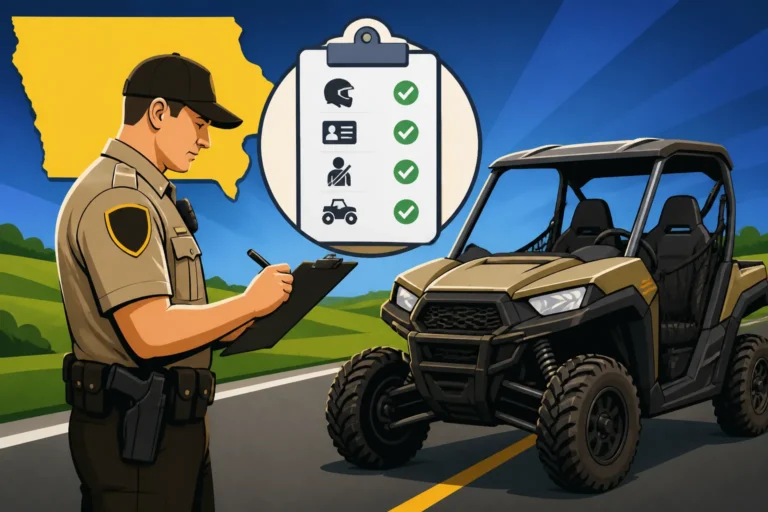
Another critical aspect of riding ATVs and UTVs on Iowa roads is the operator's qualifications. As mentioned, anyone operating an ATV or UTV on a public road in Iowa must be [Iowa Driver's License Rules for ATVs]. This means no minors, even if they hold an ATV safety certificate for off-road use. The road-use privilege is reserved for licensed drivers who are at least 18 years old. This is a strict rule that you'll hear consistently from law enforcement, and for good reason – the skills and judgment required for navigating shared roadways are different from those for private trails.
Furthermore, you must physically carry your driver's license with you while operating your OHV on the road. If you're pulled over by a deputy or conservation officer, they will ask for it. This isn't just about having the right age and license; it's about proving it on demand. [Why Iowa Requires a Driver 18 or Older] to operate these machines on roads stems from a combination of safety concerns, legal liability, and the general understanding that road operation requires a different level of maturity and driving experience.
Common Misconceptions and What to Watch Out For
The world of off-highway vehicle regulations can feel like a minefield, with different rules for different types of machines and varying interpretations. It's easy to get tripped up by common misunderstandings, especially when it comes to low-speed vehicles and their supposed cousins, the ATV and UTV. Clearing up these misconceptions can save you a lot of grief.
The "Golf Cart Rule" Confusion
One of the most frequent sources of confusion for ATV and UTV owners is the "golf cart rule." People often see golf carts puttering around neighborhoods, sometimes on public streets, and assume that if a golf cart can do it, surely their more robust ATV or UTV can too. However, golf carts have their own, often even more restrictive, set of rules in Iowa. Many municipalities and counties have specific ordinances that allow golf carts on certain local streets, often with speed limits much lower than even an LSV (sometimes capped at 20 mph), during specific hours, and requiring lights, mirrors, and slow-moving vehicle signs.
The key here is that a golf cart is not an LSV in Iowa's state definition, and neither is an ATV or UTV. Each type of vehicle operates under its own distinct legal framework. Just because a city council has opened certain streets for golf cart use doesn't automatically extend that privilege to ATVs or UTVs, or mean that your UTV is suddenly a "street-legal" golf cart. Always remember that golf carts, LSVs, and OHVs are three separate categories, each with their own unique limitations and permissions regarding public road access.
Aftermarket Upgrades and Road Legality
Many ATV and UTV owners love to customize their machines, and the aftermarket is brimming with fantastic products designed to enhance capability, safety, and comfort. You can find everything from turn signal kits to full cab enclosures, specialized tires, and even complete lighting systems from companies like SuperATV. It's only natural to think that if you add all the safety features required for an LSV – turn signals, a horn, a windshield, more mirrors – then your UTV effectively becomes an LSV or at least street-legal in a broader sense.
However, this is a crucial misconception. While these aftermarket upgrades can make your ATV or UTV safer and more visible for the limited road use that is permitted (like on unpaved secondary roads), they absolutely do not change the vehicle's fundamental classification under Iowa law. A gasoline-powered ATV or UTV, regardless of how many bells and whistles you bolt onto it, will not magically transform into an electric Low-Speed Vehicle. The state's definition is based on the vehicle's original design, power source, and factory-certified top speed. So, while that SuperATV windshield is great for keeping mud off your face, it won't exempt you from the standard [Iowa Rules for Riding an ATV on Iowa Roads] that apply to your off-highway vehicle.
Checking Local Ordinances
While state law provides the overarching framework, local control is a significant factor when it comes to ATVs and UTVs on roads. Both county boards of supervisors and city councils in Iowa have the authority to establish additional rules or even open some paved roads or streets to ATV and UTV traffic. This is where things get really localized and, frankly, can be confusing. For example, some counties might permit [Iowa Counties That Allow ATVs on Paved Roads], while their neighbor does not. Similarly, [Iowa Cities That Allow ATVs on Streets] are typically doing so via a specific local ordinance.
You cannot assume that if one town or county allows it, all of them do. Before you load up your machine and head out, it is absolutely essential to check with the specific county recorder's office, sheriff's department, or city clerk's office in the area where you plan to ride. They can provide accurate, up-to-date information on any local ordinances that might affect ATV and UTV use on their roads. Relying on hearsay or what "everyone else is doing" is a recipe for a ticket. Iowa doesn't publish a statewide list of these local ordinances, so doing your homework for each area is your best defense against inadvertently breaking a local rule.
Disclaimer
This article is for general informational purposes only and does not constitute professional advice. Laws, prices and regulations vary by location and change over time. Consult a qualified professional for guidance on your specific situation.