Iowa Cities That Allow ATVs on Streets
It's a common dream for many Iowa ATV and UTV enthusiasts: the ability to simply hop on your machine and ride it from your garage to the local store, or to connect directly to nearby trails without the hassle of trailering. But the reality is often a confusing maze of rules, leaving riders frustrated and unsure where they can legally operate. This guide is designed to cut through that confusion, explaining the complex world of local ordinances and helping you understand which Iowa cities, if any, permit ATVs and UTVs on their streets, and what that truly entails.
The Patchwork of Local Ordinances in Iowa
The biggest headache for anyone trying to figure out where they can legally ride an ATV or UTV on city streets in Iowa isn't a lack of rules, but rather a lack of consistency. There isn't a single statewide law that says, "Yes, all cities allow it," or "No, no cities allow it." Instead, Iowa’s legal framework leaves much of the decision-making up to individual local governments, creating a true patchwork of regulations across the state. This means that what's perfectly legal in one town might get you a hefty fine just a few miles down the road.
Imagine trying to plan a multi-city ride or even just understanding the rules for your own hometown, only to find out that every single municipality has its own unique set of regulations. This can be incredibly frustrating, leading many riders to simply avoid city streets altogether rather than risk unknowingly breaking a rule. The lack of a centralized, easy-to-access database of these local ordinances is a significant hurdle, forcing riders to become amateur legal researchers just to enjoy their machines.
Why There's No Statewide List
One of the most common questions I hear from fellow riders is, "Why isn't there just a list of all the cities that allow ATVs?" And honestly, it’s a perfectly valid question given the frustration of navigating disparate local rules. The simple truth is that [Why Iowa Publishes No List of City Ordinances] because the state legislature empowers cities and counties to make these specific decisions for themselves. This decentralization allows local communities to tailor regulations to their unique needs, traffic patterns, and public safety concerns.
For instance, a small, rural town with minimal traffic and a strong agricultural community might be more inclined to open its streets to ATVs and UTVs, recognizing their utility for local residents. On the other hand, a larger, more densely populated city with heavy vehicular and pedestrian traffic might deem ATV street use too risky and prohibit it entirely. This local control, while democratic, creates the very challenge riders face today: the necessity of researching each specific jurisdiction.
Understanding this principle is the first step toward navigating the system. It means that relying on what you heard about a neighboring town, or assuming your city operates like another, is a recipe for trouble. You absolutely must verify the rules for each specific city or county where you intend to ride on public roads. This individual research is a non-negotiable step in ensuring your ride is legal and safe.
How Cities Authorize ATV Use
So, if there's no statewide mandate, how exactly does a city or county decide to allow ATVs on its streets? It all boils down to local governance and the formal process of enacting an ordinance. [How a City Council Votes to Open Streets] typically involves several steps, starting with a proposal, often from concerned citizens, local riding clubs, or even city council members themselves. This proposal usually outlines the specific types of machines allowed, the roads they can use, and any safety requirements.
Once a proposal is on the table, it usually goes through public hearings, where residents can voice their support or opposition. City staff, including police and public works departments, might also weigh in on the practical implications of such a change. After public input and internal review, the city council or county board of supervisors will then vote on the proposed ordinance. If it passes, it becomes a legally binding part of that jurisdiction's municipal code.
These ordinances are incredibly detailed, often specifying everything from speed limits and hours of operation to the specific streets that are open, and even the type of equipment required on the machine itself. For example, an ordinance might require a horn, mirrors, turn signals, and proper lighting. This is where companies like SuperATV come into play, offering a wide range of accessories, including street-legal kits, that can help you get your ATV or UTV compliant with these detailed local requirements.
Examples of Iowa Cities with ATV-Friendly Streets
While it's impossible to provide an exhaustive, real-time list of every single Iowa city that currently allows ATVs on its streets (remember, these ordinances can change!), we can look at some well-known examples to illustrate what to expect. These examples highlight the varied approaches cities take and underscore the importance of local verification.
Waukon: A Case Study
The city of Waukon, nestled in Allamakee County, is a prime example of an Iowa community that has embraced ATV and UTV use on its streets. Their ordinance is often cited by riders as a model for how a city can integrate off-highway vehicles into its transportation network. [Waukon's Open Streets and Alleys] allow residents and visitors to ride their machines on most city streets, providing convenient access to businesses and connections to the surrounding countryside.
However, even in a progressive town like Waukon, there are still rules. For instance, the ordinance typically outlines specific hours of operation, often prohibiting riding during late night or early morning hours, such as [Waukon's Midnight to Five Ban], to minimize noise disturbances. Riders must also adhere to posted speed limits, yield to traditional vehicles, and ensure their machines meet certain safety equipment standards, which might include having a horn, headlights, tail lights, and a rearview mirror – all items readily available from aftermarket providers like SuperATV. The success of Waukon's approach often hinges on rider responsibility and adherence to these local rules.
It’s crucial to understand that even when a city opens its streets, it doesn't mean all streets. Often, main arterial roads or state highways passing through the city might remain off-limits, as state law often supersedes local authority on those specific routes. Always check the specific map or list of authorized streets within the ordinance itself, rather than assuming all paved surfaces are fair game.
Des Moines County's Approach
Beyond individual cities, some counties in Iowa have also taken steps to authorize ATV and UTV use on certain county roads. Des Moines County is one such example, with [Reading Des Moines County's Ordinance Fifty-Six] offering a glimpse into how a larger jurisdictional entity approaches the issue. A county ordinance typically governs the unincorporated areas and the secondary roads under county jurisdiction, rather than the streets within an incorporated city.
This means that if you're riding in a smaller community or rural area within Des Moines County that doesn't have its own city ordinance, the county's rules would apply. These county-level rules are often geared toward agricultural use or connecting rural residences. They might permit ATVs and UTVs on gravel or unpaved secondary roads, for instance, while keeping paved county roads restricted unless specifically opened by a separate resolution.
The distinction between city streets and county roads is vital. A city ordinance only applies within that city's corporate limits. A county ordinance applies to roads maintained by the county outside of city limits. When you ride, you're constantly crossing these invisible jurisdictional lines, and the rules can change with each crossing. This makes thorough research paramount. If you're looking to upgrade your machine with necessary safety features to meet county or city requirements, checking out the selection at SuperATV for lights, signals, or mirrors could be a smart first step.
What to Look For and How to Verify Local Rules
Given the fragmented nature of Iowa's regulations, it's clear that verifying the rules for your specific area is non-negotiable. "I didn't know" isn't an excuse that will hold up if you're stopped by law enforcement. Becoming your own expert on local ordinances is the best defense against accidental violations.
Contacting City Hall or the County Recorder
The most reliable way to find out if a city or county allows ATVs and UTVs on its streets is to go straight to the source. Don't rely on hearsay, social media groups, or outdated forum posts. Your first call should be to the city clerk's office for the city in question, or the county recorder's office for county roads. [Calling a City Clerk About ATVs] is the most direct route to accurate information.
When you call, be polite, specific, and patient. Ask if there is an existing ordinance or resolution regarding the operation of ATVs or UTVs on public streets or roads. If they say yes, ask for the specific ordinance number or section. Most municipalities will be able to either email you a copy of the ordinance or direct you to their online municipal code where you can read it yourself. It's often helpful to follow up any phone conversation with an email summarizing what you were told, just to have a written record. Don't be afraid to ask clarifying questions about specific routes or equipment requirements.
It’s important to distinguish between general state road use laws and specific local ordinances. While the state has broad rules about operating ATVs on public roads, local ordinances create exceptions or additional requirements within their jurisdiction. Always understand both sets of rules.
Key Elements of a Street-Legal Ordinance
When you finally get your hands on a local ordinance, what exactly should you be looking for? These documents can be dense and full of legal jargon, but understanding a few key elements will help you quickly determine if your machine and riding habits will be compliant.
Here are the critical components you should scrutinize:
| Ordinance Element | What to Look For |
|---|---|
| Permitted Vehicles | Does it specify "ATVs," "UTVs," "Off-Highway Vehicles," or a combination? Some ordinances might differentiate or have width restrictions. |
| Authorized Streets | Does it list specific streets, roads, or areas where riding is allowed? Conversely, does it list streets where riding is prohibited (e.g., state highways passing through town)? |
| Operating Hours | Are there time restrictions? Many ordinances will prohibit nighttime riding or have specific hours (e.g., sunrise to sunset). |
| Driver Requirements | What is the minimum age? Is a valid driver's license required? Does it mention any specific safety course certifications? (Note: State law also has an 18+ age requirement for public roads). |
| Insurance | Does the ordinance require specific liability insurance coverage? (State law already requires minimums for public road use). |
| Equipment | What safety equipment is mandated? Look for requirements like headlights, taillights, brake lights, turn signals, mirrors, a horn, and a slow-moving vehicle (SMV) triangle. |
| Speed Limits | Are there specific speed limits for ATVs/UTVs, or do they follow the posted municipal speed limits? (State law sets a 35 mph cap on public roads). |
| Penalties | What are the fines or consequences for non-compliance? |
Many ordinances will align with or build upon [What Iowa Requires of an ATV on a Public Road] under state law. For example, while the state requires a horn and a mirror for road use, a city ordinance might go further and require specific types of mirrors or even turn signals. This is where investing in a comprehensive kit from SuperATV or similar providers can save you a lot of headache, ensuring you have all the necessary components installed before you even think about hitting a city street. Always remember that even if a city opens its streets, state laws regarding things like [Iowa Minimum Age to Ride a Road] and [Iowa ATV Insurance Requirement] still apply.
Important Considerations for Riding on Iowa Roads
Even if you find a city that welcomes ATVs and UTVs on its streets, the journey to becoming "street legal" isn't over. You need to understand that local ordinances operate within the broader framework of Iowa state law. This means that you must comply with both the city's specific rules and the general state regulations for off-highway vehicle operation on public roads. Ignoring either set of rules can lead to citations and penalties.
General State-Level Road Rules
Iowa state law provides a foundational set of rules that apply whenever an ATV or UTV operates on any public road, whether it's a gravel county road or a city street that has been opened to such traffic. These rules are crucial to understand because they often dictate requirements that a local ordinance might not explicitly reiterate, assuming you already know them.
Key state-level requirements for operating an ATV or UTV on public roads in Iowa include:
- Age and Licensing: The operator must be at least [Iowa Minimum Age to Ride a Road], which is eighteen years old, and possess a valid driver's license. This means even if a city ordinance is silent on age, state law still applies.
- Insurance: Proof of financial responsibility, typically in the form of liability insurance, is mandatory. Iowa requires specific minimum coverage amounts for any vehicle operating on public roads. For more details, consult [Iowa ATV Insurance Requirement]. Not having this can result in significant fines.
- Speed Limit: Your machine cannot exceed 35 miles per hour on any public road, regardless of the posted speed limit for other vehicles.
- Headlights: Your headlights must be on at all times, even during daylight hours, when operating on a public road. This isn't just a safety recommendation; it's a legal requirement.
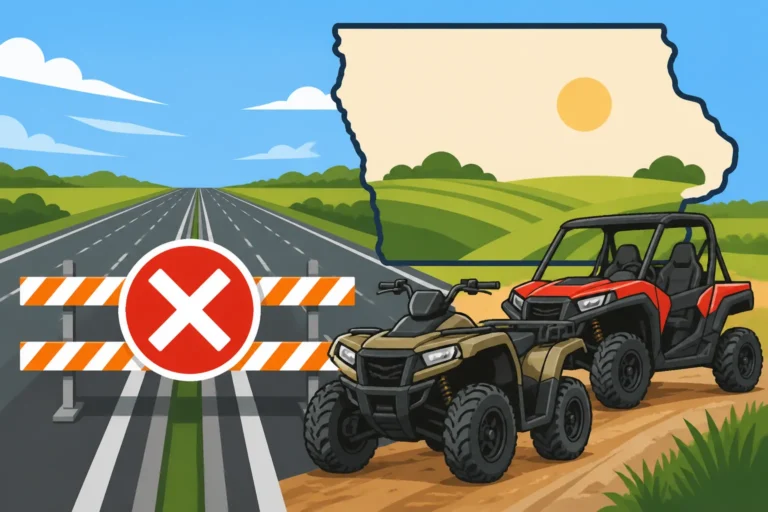
- Road Types: Generally, ATVs and UTVs are permitted on unpaved county secondary roads unless prohibited by the county. Paved county secondary roads, state highways, and city streets require specific authorization from the relevant local authority. Always remember that interstates and four-lane roads are generally off-limits. You can find more specific rules about various road types in articles like [Iowa Rules for Riding a Gravel Road] or [Iowa Rules for Riding a Paved Secondary Road].
These state rules act as a baseline. A city ordinance can add more restrictions (e.g., lower speed limits, specific hours), but it generally cannot lessen a state requirement. So, if a city ordinance doesn't mention the 18-year-old age limit, it doesn't mean a 16-year-old can ride; the state law still holds.
Equipment Beyond Basic Operation
Beyond the basic operational rules, state law also mandates specific equipment for ATVs and UTVs operating on public roads. Even if a city ordinance doesn't list every single piece of gear, you are still responsible for ensuring your machine meets these state requirements. This often means adding aftermarket accessories to your machine to make it road-legal.
Essential equipment required by Iowa law for public road use includes:
- Headlights and Taillights: These are obvious for nighttime visibility, but as mentioned, headlights must be on during the day too.
- Brake Lights: A functioning brake light is crucial for signaling to traffic behind you.
- Horn: Your machine must be equipped with a working horn, easily accessible to the operator. For details, see [Iowa Horn Requirement for Road Use].
- Mirrors: At least one rearview mirror is required. This is often a driver's side mirror. Many riders choose to install two for better visibility. Learn more at [Iowa Mirror Requirement for Road Use].
- Slow-Moving Vehicle (SMV) Triangle: This distinctive orange triangle with a red border must be affixed to the rear of your machine, indicating that it is designed to travel at speeds 25 mph or less. This is vital for safety on roads where traffic moves faster. Check [Iowa's Slow-Moving Vehicle Triangle] for proper placement and use.
- Turn Signals (Recommended, sometimes required): While not universally required by state law for all OHVs, many city ordinances do mandate turn signals for clarity in traffic. Even if not strictly required, they are a huge safety advantage.
- Tires and Brakes: Your machine must have proper tires for road use and fully functional brakes on all wheels.
Many riders find it easiest to purchase a "street legal kit" from a reputable vendor like SuperATV. These kits often include turn signals, a horn, mirrors, and sometimes even a license plate bracket and light, streamlining the process of getting your machine compliant. Trying to piece together these components individually can be frustrating and may result in missing a critical piece of equipment. Remember, a quick roadside check by a deputy will cover all these items, and being caught without them can lead to a citation and potentially impact your ability to continue your ride.
Disclaimer
This article is for general informational purposes only and does not constitute professional advice. Laws, prices and regulations vary by location and change over time. Consult a qualified professional for guidance on your specific situation.