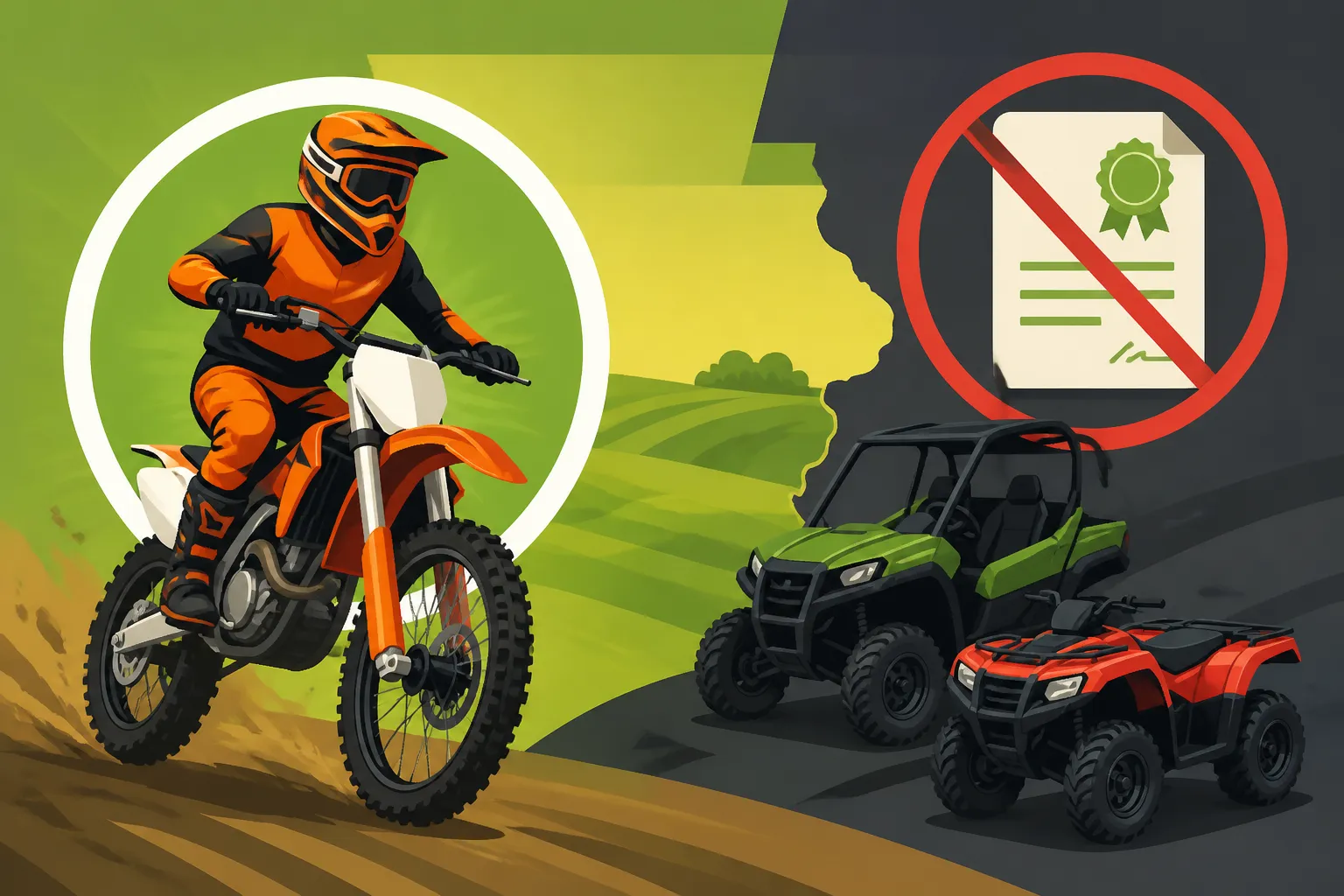
Dirt Bike Riders Are Exempt From the Certificate
If you ride a dirt bike in Iowa, you may have heard that younger ATV riders need a safety certificate and wondered whether the same rule applies to you. The key distinction is the machine type: Iowa exempts off-road motorcycle operators from this certificate requirement. That exemption is specific, though; it does not automatically settle registration, permits, access or park rules.
What the Iowa certificate exemption means
Iowa’s off-highway safety certificate requirement applies to certain younger riders on covered machines. A dirt bike classified as an off-road motorcycle is exempt from that certificate requirement. In other words, an operator does not need the Iowa ATV safety certificate simply because they are riding an off-road motorcycle.
That is different from saying the certificate requirement never applies to young riders, or that every machine with handlebars qualifies as a dirt bike. The machine’s classification matters. A quad is an ATV, and a side-by-side is a different type of machine; their operators may be subject to different requirements. The exemption for an off-road motorcycle should not be assumed to cover those machines.
| Machine being operated | Iowa safety certificate question |
|---|---|
| Off-road motorcycle or dirt bike | The operator is exempt from the certificate requirement |
| ATV or quad | The certificate requirement may apply to eligible younger operators |
| Side-by-side or UTV | Certificate rules differ from those for ATVs; check the specific rule |
| Street motorcycle | Do not assume off-road motorcycle rules determine road-use requirements |
The certificate is a specific safety-education requirement, not a general license that every off-road rider must carry. It also is not the same as a registration decal, nonresident permit, driver’s license or proof of landowner permission. Each of those may be relevant for a different reason.
For a closer look at how the rule applies by age and machine, see Iowa ATV Safety Certificate Requirements. If you are checking whether a particular young rider needs a certificate, start by confirming that the bike is actually treated as an off-road motorcycle under the applicable rules. A modified machine, a dual-purpose model or a bike being used on a public road can raise questions beyond the basic off-road exemption.
What qualifies as an off-road motorcycle
“Dirt bike” is a familiar everyday description, but the label alone does not decide how Iowa treats a machine. A small motorcycle built for off-road use is the typical example. A quad, three-wheeler or side-by-side does not become an off-road motorcycle just because it is used on trails or has off-road tires.
This matters when a family owns more than one type of machine. A teenager who is exempt while operating an off-road motorcycle may still need to meet the certificate rules when operating a covered ATV. The exemption follows the type of machine being operated, not the rider’s general experience or the fact that they already know how to ride.
When the classification is unclear, check the vehicle’s documents and the rules for the kind of riding you plan to do. A dealer description can be helpful, but it is not a substitute for checking the official requirements. If the bike has been altered or is equipped for both road and off-road use, confirm how it is classified before relying on the exemption.
It is also useful to separate the safety certificate from a motorcycle endorsement or other road-use qualifications. The off-road certificate exemption does not establish that a rider can operate a motorcycle on a public road. Road use involves separate vehicle, operator and traffic rules. If the plan includes public roads, do not treat the off-road certificate rule as permission to ride there.
The related rules for ATVs are covered in Why the Rule Follows the Machine Type. That distinction is especially useful for households with a dirt bike and a youth ATV: the exemption for one does not transfer to the other.
What the exemption does not waive
Being exempt from the Iowa safety certificate does not automatically exempt the motorcycle from other requirements. Registration, nonresident permits, land access and riding-area restrictions are separate questions. A rider should check each one for the machine, the rider’s residence and the place where the ride will happen.
For example, a resident’s machine may have registration obligations even though its operator does not need a safety certificate. Visitors may need to consider Iowa’s rules for machines registered in another state and whether a permit is required. The certificate exemption does not answer those questions. See Registering a Dirt Bike in Iowa for the registration issue, and Iowa’s Nonresident User Permit for the visitor-permit question.
Riding location also matters. Permission to ride a privately owned property is not the same as access to a public riding area. A property owner can set conditions for riding on their land, while a designated area may have its own entry, equipment and conduct rules. A certificate exemption does not grant permission to ride anywhere.
Before heading to a public riding area, check the rules that apply to that site and machine. Iowa’s designated areas and public-land rules are not interchangeable, and a route that is open to one type of vehicle may not be open to another. For an overview of where the rules apply, see Iowa Rules for Riding a Designated Riding Area and Iowa Rules for Riding Public Land.
A dirt bike may also need to meet site-specific requirements that have nothing to do with the certificate. These can include registration or permit status, approved trails, sound or equipment standards, hours and temporary closures. Read the posted rules or check with the area operator before loading the bike. A certificate exemption does not override a closure or authorize riding off a marked trail.
A quick check before riding
Use this sequence to avoid mixing up separate obligations:
- Identify the machine. Confirm that it is an off-road motorcycle, not an ATV or another type of vehicle.
- Check the rider requirement. Apply the certificate exemption only to the off-road motorcycle operation it covers.
- Check registration and permit rules. Consider whether the bike needs Iowa registration or whether a visiting rider needs a permit.
- Confirm access. Verify that the property or riding area allows dirt bikes and that the route is open.
- Review site rules. Check for equipment requirements, age rules, closures and other conditions before leaving.
This checklist is more reliable than using the word “dirt bike” as the answer to every question. A rider can be exempt from one requirement and still need to satisfy another.
What parents and visiting riders should check
For a parent, the practical issue is often a child who rides both a dirt bike and an ATV. Keep the machine categories separate when deciding whether the certificate is required. Do not assume a child’s dirt-bike experience replaces the certificate requirement for a covered ATV, and do not assume that an ATV certificate changes the rules for other kinds of riding.
If the child will ride an ATV as well, review Iowa Safety Certificate Age Range and Iowa Rules for Riders Under 12. Those pages address the age-related rules for the certificate and supervision. The point here is narrower: the off-road motorcycle exemption applies to the motorcycle, not automatically to every vehicle the rider might use.
Visiting riders should make a similar distinction. A home-state registration or credential may be relevant, but it does not by itself answer whether Iowa requires a nonresident permit or whether a particular riding site accepts the machine. Check the requirements for the visit before departure. Does Iowa Honor Out-of-State Registration? can help with the reciprocity question, while Iowa ATV Registration for a Nonresident covers the related visitor issue for an ATV.
A good pre-ride check can be brief: identify the machine, confirm the certificate rule, verify its registration or permit status, and check that the intended riding area is open to that type of vehicle. If any part of the bike’s classification or status is uncertain, ask the relevant Iowa agency or riding-area operator before relying on an exemption.
The bottom line is straightforward: Iowa exempts off-road motorcycle operators from the ATV safety certificate requirement. That exemption is not a blanket waiver for other machines or other rules. Treat the certificate, registration, permits and riding access as separate checks, and the answer for a dirt bike is much clearer.
Disclaimer
This article is for general informational purposes only and does not constitute professional advice. Laws, prices and regulations vary by location and change over time. Consult a qualified professional for guidance on your specific situation.