Does Iowa Honor Out-of-State Registration?
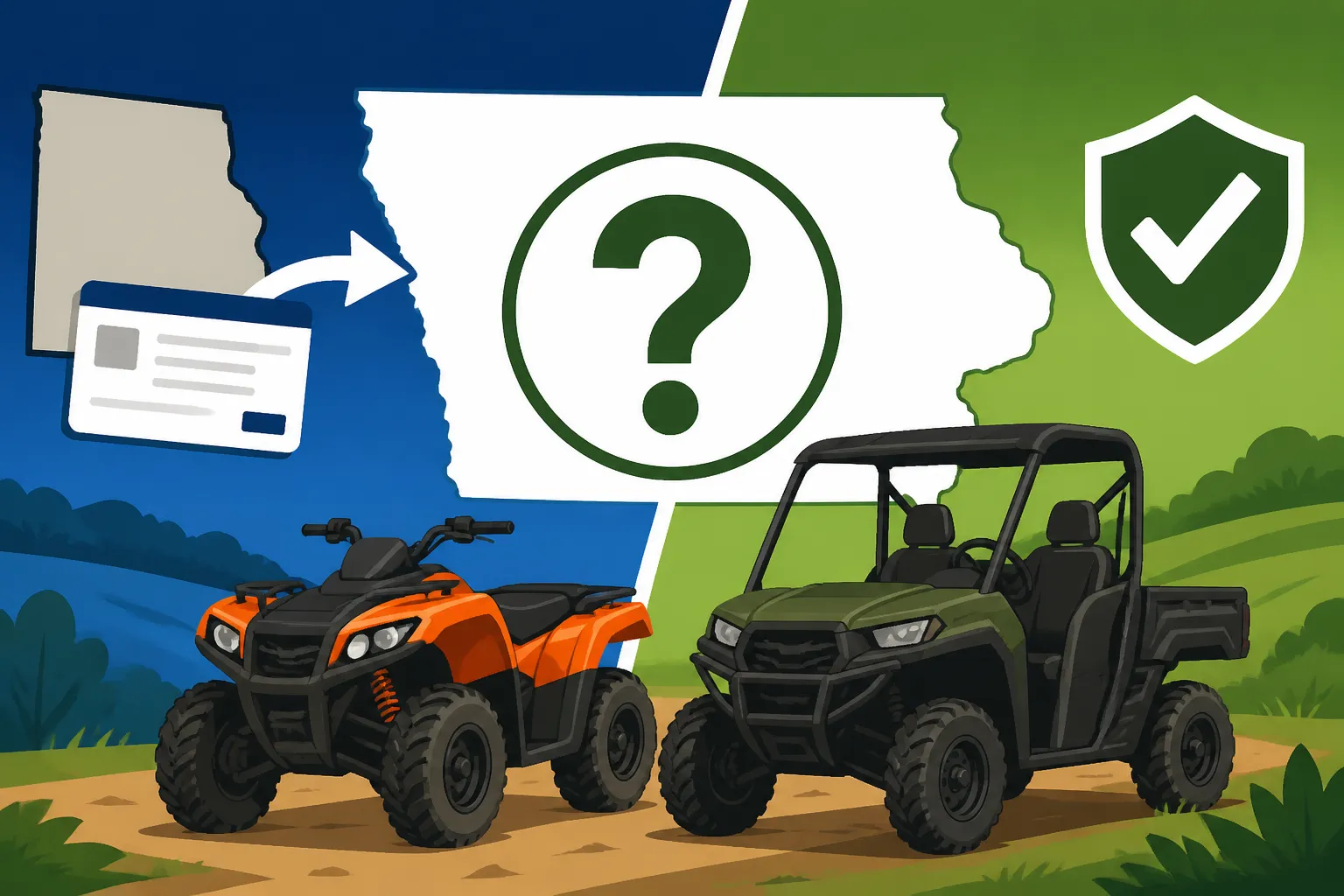
A valid registration from another state may be accepted in Iowa, but it does not automatically settle every permit question. The answer depends on your home state and where you plan to ride. Here’s how to check whether reciprocity applies, when a nonresident permit may be needed, and why registration is separate from permission to use a road or trail.
The short answer: Iowa recognizes some out-of-state registrations
Iowa has reciprocity arrangements with certain states. For a visitor, that can mean a valid registration from their home state satisfies Iowa’s off-highway registration requirement without also obtaining an Iowa nonresident user permit. Iowa’s reciprocity information includes Minnesota, Missouri, Nebraska and Wisconsin.
That does not mean Iowa recognizes every state’s registration, or that any out-of-state sticker is enough for every kind of riding. Reciprocity depends on the state where the machine is registered and the relevant Iowa requirements. Check the current rules for your home state before travelling, especially if you’re visiting from a state other than those listed above. The details may differ for an ATV, UTV, dirt bike or other off-highway vehicle.
A useful starting point is Riding Iowa With an Out-of-State Registration. If you’re visiting from a neighboring state, the state-specific pages on Iowa Reciprocity With Minnesota, Iowa Reciprocity With Missouri, Iowa Reciprocity With Nebraska and Iowa Reciprocity With Wisconsin can help you narrow down what to confirm.
The practical takeaway: don’t assume that “registered at home” automatically means “covered in Iowa.” Confirm that your state is included in Iowa’s reciprocity arrangements, that your registration is current, and that the machine you’re bringing is covered by it.
What reciprocity covers, and what it does not
Reciprocity is about whether Iowa recognizes another state’s registration for the relevant off-highway vehicle requirements. It is not a general pass for every place you might ride, and it does not replace separate rules about land access, road use or rider qualifications.
| Question | What to check |
|---|---|
| Is the machine registered in a state with an Iowa reciprocity arrangement? | Confirm the current arrangement for your home state. |
| Is the registration current and for this machine? | Check its expiration date and make sure the identifying details match. |
| Are you riding on a designated area or other public ground? | Check the site’s entry and operating requirements. |
| Are you planning to use a public road? | Check Iowa’s separate road-use rules and local authorization. |
| Are you riding on private property? | Get the owner’s permission and follow applicable rules. |
A registration sticker or card establishes something about the machine’s registration status. It does not grant permission to ride on private land, open a closed trail, or use a public road that does not allow the vehicle. Likewise, a nonresident user permit is not a substitute for road authorization. These are separate questions, so check each one for the places on your itinerary.
The distinction matters most when a trip combines different kinds of riding. A visitor might have a registration Iowa recognizes and still need to follow a park’s operating rules, stay off a closed trail, or avoid a road that is not open to ATVs or UTVs. See Iowa Rules for Riding a Designated Riding Area for the site-specific side of the question, and Iowa Rules for Riding Public Land for the broader public-land rules.
Keep your home-state registration proof with the machine. If an officer or park employee asks about it, having the document available makes it easier to show which state registered the vehicle and whether the registration is current. A worn, missing or hard-to-read decal can create avoidable confusion even when the paperwork is valid.
When a visitor may need an Iowa nonresident permit
If your home-state registration does not qualify under Iowa reciprocity, you may need an Iowa nonresident user permit to ride in Iowa. The permit is intended for qualifying visitors using off-highway vehicles in Iowa; it is not the same as registering the machine as an Iowa resident vehicle.
The need for a permit can depend on the vehicle and where you plan to operate it. In particular, don’t assume that a registration question has one answer for private property, public land and a designated riding area. Check the current requirements for the specific location and machine before setting out. Iowa’s Nonresident User Permit explains the visitor permit, while Do Visitors Need an Iowa ATV Permit? focuses on the decision a visitor needs to make.
If you determine that you need a permit, check the current purchase options and instructions through the Iowa DNR or its authorized system before the trip. Permit procedures and requirements can change, so rely on current official information rather than an old receipt, a friend’s experience from a previous season, or a retailer’s general product listing.
A permit also does not override the rules of the place where you ride. A designated area may have its own hours, closures, permitted vehicle types or safety requirements. A public trail may be closed because of conditions. Private property still requires the owner’s permission. Plan to confirm both the permit requirement and the site’s current operating status.
How to confirm your status before travelling
A few checks before loading the machine can prevent a wasted trip or a problem at the trailhead.
- Identify the machine and its home state. Have the vehicle type and registration state at hand. The answer for one type of off-highway vehicle may not apply to another.
- Check the registration’s status. Make sure it is current and corresponds to the machine you plan to bring. If the decal or paperwork is missing, ask your home-state registration authority how to replace or verify it before travelling.
- Confirm reciprocity with Iowa. Look for current Iowa information that specifically covers your state. If you cannot confirm that your registration qualifies, contact the Iowa DNR or the relevant official permit office rather than guessing.
- Check the riding destination. Ask whether the area is open, what vehicles it allows, and whether it has additional entry or safety requirements. A valid registration does not guarantee that a particular park or trail is open to your machine.
- Review any road segment separately. If your route involves a public road, confirm that the road is legally open to the vehicle and that you meet Iowa’s road-use requirements. A reciprocal registration does not itself make a road legal to ride.
- Carry proof. Bring your current registration documents and any required Iowa permit. Keep them accessible, not buried in a trailer or left at home.
If your trip includes more than one riding location, repeat the destination check for each one. A park may be open while another is closed, and one site’s requirements do not automatically establish the rules at another. The same is true of a route that crosses county or city boundaries: road authorization and local rules may change along the way.
A simple way to think about the decision is: first determine whether Iowa recognizes your home-state registration; next determine whether you need a nonresident permit; then confirm that your intended riding location and route allow the machine. If any answer is uncertain, get confirmation before you travel. That is safer than relying on a sticker alone or assuming that a permit covers every place in the state.
Disclaimer
This article is for general informational purposes only and does not constitute professional advice. Laws, prices and regulations vary by location and change over time. Consult a qualified professional for guidance on your specific situation.