Why the Safety Certificate Stops Mattering at 18
Turning 18 can make an Iowa ATV education certificate unnecessary, but it does not remove the rules for registering a machine or riding in particular places. The key distinction is that the certificate requirement depends on the rider’s age, while registration and road-use requirements are separate. Here’s what changes at 18—and what does not.
What changes when an Iowa ATV rider turns 18
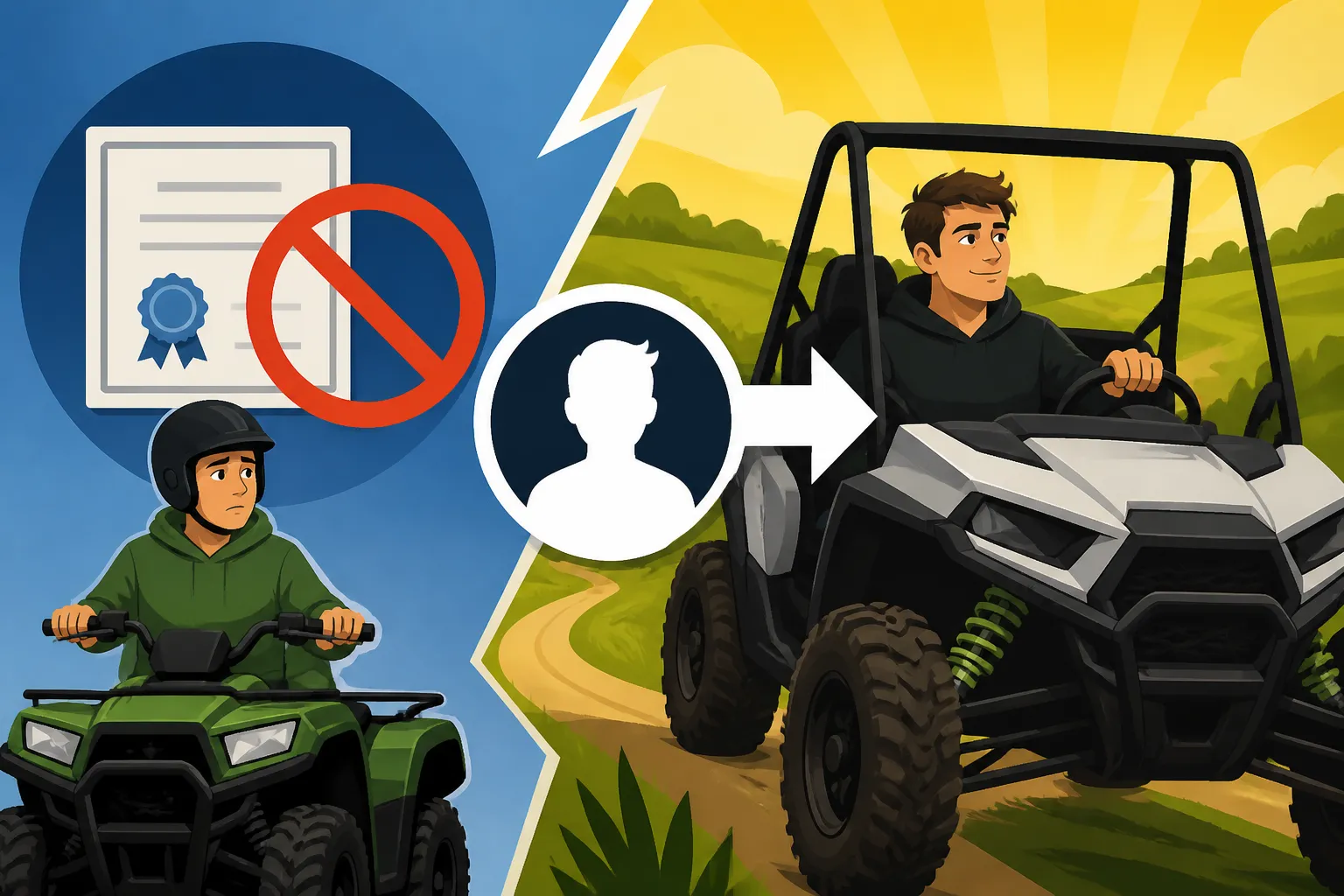
Iowa requires ATV operators ages 12 through 17 to complete an approved education course and carry the certificate when riding on public land, public ice, designated riding areas, or registration-funded land. According to the Iowa Department of Natural Resources (DNR), the course requirement applies to riders in that age range. Once a rider is 18, the age-based requirement to have and carry the certificate no longer applies.
That change is about the operator, not the ATV. Turning 18 does not make the machine exempt from registration, authorize riding wherever you choose, or automatically satisfy road-use requirements. It simply means the rider is no longer in the age group that must carry an ATV education certificate under this rule.
| Rider’s age | What the Iowa DNR requires for ATV education |
|---|---|
| Under 12 | According to the DNR’s Fiscal Services Division, a person under 12 cannot operate an ATV on public land and ice unless directly supervised by an experienced, licensed parent or guardian who is at least 18. |
| 12 through 17 | According to the Iowa DNR, the operator must complete an approved ATV education course and carry the certificate in the locations covered by the rule. |
| 18 or older | According to the Iowa DNR’s age-based course rule, an operator is no longer required to carry the ATV education certificate solely because of age. Other riding requirements still apply. |
The course is not a practical riding test. According to the Iowa DNR, there is no riding component, and students must pass the final exam with 80% accuracy to earn the certificate. A student must be at least 12 to earn the certificate through the online offering provided in collaboration with Fresh Air Educators.
For a closer look at the age rule and course requirements, see Iowa ATV Safety Certificate Requirements and Iowa Safety Certificate Age Range. If you are helping a teenager get certified, Iowa ATV Safety Course Cost covers the course’s stated cost and what it includes.
Turning 18 does not mean you need to retake the course
There is no need to treat the eighteenth birthday as a new certification deadline. The rule makes the certificate necessary for riders in the specified youth age range; it does not say an adult must earn a replacement certificate or repeat the course.
A rider who already completed the course can keep the certificate, but the age-based requirement to carry it no longer applies once the rider is 18. That does not change what is required for anyone else riding the same machine. A younger operator remains responsible for meeting the rules that apply to their own age.
It is also worth separating “not required to carry a certificate” from “not required to follow safety rules.” The certificate requirement is one specific condition. It does not take the place of registration, permission to ride, or any rules that apply to the machine or location.
What does not change: registration and where you ride
Iowa’s education certificate and ATV registration are different requirements. An adult may not need the youth education certificate, but an ATV used on public land, public ice, or a designated riding area still needs the registration required for that machine.
According to the Iowa DNR, off-highway vehicles operated on public land, public ice, or at a designated riding area must be registered. The DNR says registered ATVs can be operated in those places when displaying a current registration sticker. By contrast, an ATV does not need to be registered when operated on privately owned land, according to the DNR’s Fiscal Services Division. That private-land rule does not itself grant permission to use someone else’s property.
Registration paperwork and the certificate have different jobs:
- The education certificate relates to the operator’s age and ATV education requirement.
- The registration and decal relate to the vehicle and where it is operated.
- Permission to ride is a separate question, particularly on privately owned land.
If you are new to the registration process, Iowa ATV Registration Paperwork explains what documents are relevant. You can also read Iowa Rules for Riding Public Land for more about the location-specific side of the rules.
Keep the registration certificate available
The decal is not the only registration item to keep track of. According to the Iowa DNR, the operator must have the registration certificate either in the vehicle or on their person while the vehicle is in use. That requirement remains relevant to an adult even though the youth certificate requirement has ended.
Newly owned machines, and machines not yet entered into Iowa’s recreational vehicle and vessel registration system, must be registered through the County Recorder’s Office, according to the DNR. The DNR also says registrations must be renewed annually. The renewal period without penalty runs from September 1 through December 31.
ATV, ORV, and ORM registration renewals may be completed through the Iowa DNR Online License System. If you renew by mail, allow for delivery time: the DNR says registration and decals sent through USPS can take up to 14 business days or more to arrive. That wait matters if you are planning a ride and need to have the current decal in place.
A rider who has just turned 18 should therefore check the vehicle’s paperwork separately from their own certificate. A change in the operator’s age does not renew the registration or replace a missing decal.
The rules depend on the riding location
A rider may be old enough to stop carrying an education certificate and still be in a place where a current registration is required. Public land, public ice, and designated riding areas are not interchangeable with privately owned land for registration purposes.
Before a ride, identify what kind of place you will use and check the applicable access rules. A private property ride does not require ATV registration under the stated DNR rule, but that does not mean a rider can enter property without permission. Likewise, having a registered ATV does not by itself establish that a particular trail or area is open to riding.
For designated areas, review the specific riding-area requirements as well as the general rules. Iowa Rules for Riding a Designated Riding Area can help with that distinction. If you ride at a site with additional posted requirements, follow those as well; the education certificate rule is not a substitute for checking the rules that govern the location.
Public-road use is a separate age and equipment question
Turning 18 matters for Iowa public-road operation, but for a different reason than the safety certificate. According to the Iowa DNR’s Fiscal Services Division, an ATV operator on a public road must be at least 18 and hold a valid driver’s license. That is a road-use requirement; it is not an extension of the ATV education certificate rule.
An adult who has turned 18 but does not hold a valid driver’s license does not meet that stated road-use condition. And being licensed does not make every road available. The Iowa DNR says roadway use is allowed on roads except interstates and four-lane roads. Cities and counties may be more restrictive than state law, so local authorization and restrictions can matter.
The road rules also include conditions that are separate from age and certification. According to the Iowa Department of Transportation, an ATV or UTV on a public road must not exceed 35 miles per hour. The DOT also lists requirements for proof of insurance, headlights, taillights, brake lights, mirrors, a horn, a slow-moving vehicle sign, and a rear-mounted Iowa DNR registration sticker. Out-of-state vehicles must display an Iowa DNR nonresident user permit sticker.
These road-use requirements are not satisfied by carrying an ATV education certificate. Nor does being 18 remove the need for the required equipment or proof of insurance. For a more focused explanation of licensing, see Iowa Driver’s License Rules for ATVs. For general road restrictions, Are ATVs Street Legal in Iowa? is a useful next step.
Do not confuse an OHV road rule with the ATV course rule
The course facts here concern Iowa’s ATV education requirement. Iowa also regulates off-highway vehicles more broadly, but requirements can depend on the vehicle classification and where it is operated. An ATV rule should not automatically be applied to every UTV or other off-highway vehicle without checking the applicable classification and current requirements.
This distinction is especially important for families who share a machine or switch between different types of vehicles. A rider’s age may settle whether the ATV education certificate is required, but it does not settle every question about whether that vehicle can be used on a public road or a particular trail.
A practical checklist for the rider turning 18
Use the birthday as a prompt to review the rider’s requirements, not as a reason to assume every rule has changed.
- Check the machine type. Confirm that the vehicle is an ATV and that the ATV education rule is the one that applies. Do not assume the certificate rule automatically covers a different vehicle category.
- Apply the age rule to the operator. According to the Iowa DNR, ATV operators ages 12 through 17 must have the approved education certificate for the covered riding locations. At 18, that age-based certificate requirement no longer applies.
- Check registration separately. If the ATV will be used on public land, public ice, or a designated riding area, confirm that it has the required current registration and decal.
- Keep the registration certificate with the ride. The Iowa DNR requires the certificate to be in the vehicle or on the operator while it is in use.
- Review the place-specific rules. Confirm that riding is permitted where you plan to go, and get permission before using private property.
- Treat public roads as a separate category. According to the Iowa DNR’s Fiscal Services Division, road operation requires the operator to be at least 18 and have a valid driver’s license. The road also has restrictions and vehicle-equipment requirements.
- Check local limits before using a road. Iowa cities and counties may impose more restrictive rules than the state baseline.
This checklist also helps avoid a common mix-up: a rider can be done with the education-certificate requirement while the ATV still needs a decal, the registration certificate still needs to be carried, and a road route may still be off-limits.
If you are preparing for a registration renewal rather than a change in age, Iowa ATV Registration Online explains the online renewal option. The certificate requirement and renewal process are separate tasks, so handle each one that applies to your ride.
Sources
- Department of Natural Resources — OHV Registration & Fees | Department of Natural Resources (checked November 3, 2026)
- Department of Natural Resources — OHV Safety & Education | Department of Natural Resources (checked November 3, 2026)
- Fiscal Services Division — 1543036.pdf (checked November 3, 2026)
- Department of Transportation — Driving Your ATV or UTV/ORV on Iowa Public Roads | Department of Transportation (checked November 3, 2026)
- IOWA DEPARTMENT OF NATURAL RESOURCES — download?inline (checked November 3, 2026)
- Department of Natural Resources — OHV Dealers | Department of Natural Resources (checked November 3, 2026)
- Department of Natural Resources — Snowmobile Education & Safety | Department of Natural Resources (checked November 3, 2026)
- Iowa Department of Natural Resources — download?inline (checked November 3, 2026)
Disclaimer
This article is for general informational purposes only and does not constitute professional advice. Laws, prices and regulations vary by location and change over time. Consult a qualified professional for guidance on your specific situation.