Iowa Rules for Riders Under 12
A child under 12 may be able to ride an ATV or UTV in Iowa, but the answer depends on who is operating, where the machine is being used, and what kind of machine it is. The key is not to treat supervision, a safety certificate, registration, and a riding permit as interchangeable. This guide explains how to check each one before a child rides.
Start With the Child, the Machine, and the Place
Iowa’s rules are not simply “children can ride” or “children cannot ride.” Requirements can change with the child’s age, the machine’s classification, and whether the ride is on private property, a designated riding area, or a public road.
For an under-12 rider, the most important practical distinction is between operating the machine and being a passenger. A child steering and controlling a quad is an operator. A child seated in a UTV passenger seat is not operating it, but still needs to fit the seat, use the available restraints, and follow the park’s rules. Riding on a rack, in a cargo area, or in a seat not designed for a passenger is not a safe workaround.
The child’s age also does not determine every requirement. A parent may need to arrange the machine’s registration or permit even when the child is the one riding. The machine may have to display the correct decal, and the rider may need to be supervised. A safety certificate, when required, is a separate credential from registration or a permit.
| Situation | What to check before the ride |
|---|---|
| Child under 12 operating an ATV | Adult supervision requirements, the riding location, machine fit, and any area rules |
| Child under 12 operating a UTV | Machine classification, supervision and age rules, seat and restraint requirements, and park rules |
| Child riding as a UTV passenger | A passenger seat designed for the child, a properly fastened restraint, and the machine’s passenger limits |
| Family riding on private land | Permission from the landowner, safe boundaries, and any rules that apply to the property or machine |
| Family visiting an Iowa riding area | The machine’s Iowa registration or permit status, rider requirements, and current site rules |
| Child approaching age 12 | Whether the child will need an ATV safety certificate before operating an ATV on covered public riding ground |
| Any child considering a public road | Do not assume adult supervision makes road operation legal; Iowa road rules impose separate age requirements |
Use this table as a planning aid, not as a substitute for checking the rule that applies to the specific machine and location. If you are unsure whether a machine counts as an ATV, UTV, off-road motorcycle, or another type of vehicle, check the manufacturer’s description and ask the Iowa DNR or the riding area before relying on a rule for a different machine.
A good starting point is to identify the machine’s type and the exact place you plan to ride. A child on a family farm, a child at a designated OHV area, and a child on a county road are not necessarily covered by the same rules. The Iowa DNR’s off-highway vehicle resources can help explain how the state treats different machines; see The Iowa DNR and Off-Highway Vehicles for more background.
Supervision Is a Separate Requirement
For an under-12 child who is allowed to operate an ATV in a setting where the rule applies, Iowa requires adult supervision. Plan on a responsible adult being present and able to supervise the child—not merely somewhere on the property or riding far ahead. The adult should be able to see what is happening, communicate with the child, and step in if the child gets into difficulty.
The supervising adult requirement is more than an instruction to “keep an eye on them.” The adult must meet the applicable qualifications, including being an adult with a valid driver’s license and experience operating an off-highway vehicle. Do not assume that a teenager, an adult without the required license, or someone who has never operated this kind of machine will satisfy the supervision rule. For details on the qualifications, see A Licensed, Experienced Adult in Iowa.
The state rule is only a baseline for supervision. A young rider’s abilities may call for a closer arrangement than the minimum. For example, a child who is new to riding, nervous on uneven ground, or using a machine with more power than they have handled before may need the adult close by on foot or on a separate appropriately sized machine. An adult should not supervise several children from a distance and assume they can respond quickly to every rider. See Iowa Supervision for Riders Under Twelve for more on the supervision issue.
What active supervision looks like
Before starting the engine, agree on where the child may ride, where they must stop, and what signal means “come back now.” Keep the route within the adult’s view and choose a place without hidden drop-offs, traffic, or obstacles the child cannot handle. If the adult cannot see or reach the child in time to help, the setup is too loose for a beginning rider.
Supervision also means watching the conditions, not just the child. Iowa ground can be slick after rain, deeply rutted, or hard to read in tall grass. A route that seems easy to an experienced adult may be difficult for a smaller rider who has less strength and less experience judging traction. If conditions change, shorten the ride or stop.
An adult should be prepared to take control of the situation without creating a second hazard. That means having a phone available where service permits, knowing the route, and not leaving a child riding alone while the adult goes to retrieve equipment or help another rider. At a park, follow the site’s instructions about where adults may supervise and how children should be managed.
Supervision does not make every place legal
An adult’s presence does not give a child permission to ride wherever the adult can reach them. It does not override a road restriction, a closed trail, a landowner’s conditions, or an area’s minimum-age rule. It also does not turn a passenger seat into an operator seat or make an oversized machine suitable for a child.
If you are arranging a group ride, be honest about how many young riders the adults can actually supervise. One adult who is comfortable managing one child on a short loop may not be able to supervise several children spread over a large riding area. The safe number depends on visibility, terrain, the children’s experience, and the machines involved—not just on who is technically present.
ATV and UTV Rules Are Not Interchangeable
The word “off-highway vehicle” can cover different types of machines, but a rule that applies to an ATV does not automatically apply to a UTV. Check how the machine is classified before using age or safety-certificate information written for another type.
ATV operators and the safety certificate
Iowa’s safety-certificate requirement is relevant to ATV operators in the covered age range. Children who are not yet 12 are generally not in the same certificate group as riders aged 12 through 17, but that does not mean an under-12 child can ride without supervision or anywhere they choose. The certificate rule and supervision rule solve different problems: one is about rider education, while the other is about having a qualified adult supervise a young operator.
As a child approaches 12, plan ahead. Do not assume that the child can continue riding under the under-12 arrangement after their birthday, or that being supervised replaces a required certificate. Check the current certificate rule and whether it applies to the specific machine and riding location. The age group and requirements are discussed in Iowa’s Safety Certificate for Ages 12 to 17.
A course or card is not a permit to ride on private land, a public road, or a closed trail. It also does not certify that a particular ATV is the right size for the rider. Parents still need to make those decisions separately.
UTV operators and passengers
A UTV’s side-by-side seating and restraints can make it seem like a natural choice for a family, but its classification matters. Iowa has different safety-certificate treatment for side-by-sides than for ATVs. That distinction should not be stretched into a claim that every child may operate any UTV at any age or in any location. Read Why Iowa Exempts Side-by-Side Operators for the certificate distinction, then confirm the age, supervision, and operating rules for the particular UTV and riding area.
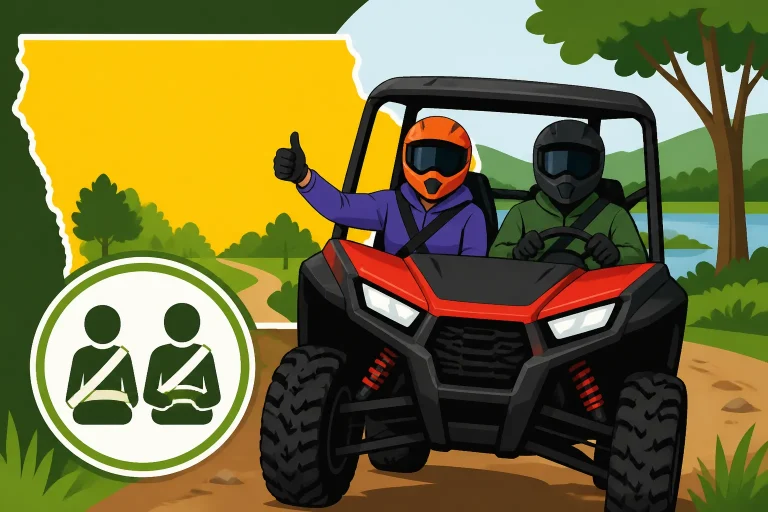
If the child is a passenger, use a passenger seat designed for their size and follow the machine’s instructions for seat belts, doors, nets, and other restraints. A child who cannot sit securely with the restraint positioned correctly may not be ready to ride in that seat. Never carry a passenger where the manufacturer says not to, and do not let a child ride standing, perched on a fender, or in the cargo bed.
If the child is operating the UTV, take extra care not to confuse “no certificate required for this vehicle type” with “no age or supervision limits.” The vehicle’s size and speed can make a mistake more consequential than on a small youth ATV. Confirm the child’s eligibility with the Iowa DNR and the riding area rather than relying on a rule for ATV operators.
Choose a machine the child can control
A machine should fit the child’s body and skill, not simply be available in the garage. The child should be able to reach and use the controls, maintain a stable riding position, and stop the machine reliably. A rider who must stretch for the brakes or cannot comfortably manage the throttle is not ready for that machine.
Use the owner’s manual as a starting point for age, size, passenger, and operating guidance. A manufacturer’s recommendation is not a substitute for Iowa law, but it can warn against a poor match. A parent should also consider the machine’s speed, weight, braking behavior, and how quickly it accelerates. A powerful adult ATV may be difficult for a young rider to control even on a short, flat route.
Where the Child Rides Changes the Answer
The place of the ride is just as important as the rider’s age. Private property, a designated public riding area, and public roads are different settings, and permission to ride in one does not automatically carry over to another.
Private property
On private land, get clear permission from the landowner and agree on where riding is allowed. If you own the property, set boundaries that make sense for the child: keep away from public roads, water, steep banks, equipment, livestock, buildings, and areas where other people may be working. If you are a tenant, guest, or family member, do not assume that access to the land includes permission to operate an ATV or UTV.
Landowner permission is important, but it is not a universal exemption from every other safety or legal requirement. The machine still needs to be suitable, and the adult should still supervise the child closely. If the ride includes a trail, public ground, or a property with posted conditions, those rules may add requirements. For the permission side of the issue, see Iowa Landowner Permission Rules.
Avoid creating an informal “trail” that crosses onto a neighbor’s property or connects to a public road without permission. A short ride can easily become a trespass or road-use problem if the child follows a track beyond the area the family has agreed to use.
Designated riding areas
A designated riding area may have its own rules for age, supervision, machine type, passenger use, protective equipment, trail direction, and closed sections. State-level requirements are not the only rules that matter at the gate. Check the site’s posted rules before unloading, and ask staff or the operator if a rule is unclear.
A registration decal or visitor permit may be required for the machine, even if the child is properly supervised. A certificate, where applicable, is also not a substitute for the machine’s required registration or the site’s conditions. Review Iowa Rules for Riding a Designated Riding Area before choosing a park or trail system.
A park may not allow every machine on every trail. A child’s youth ATV could be suitable for one area but not another; a full-size UTV may be restricted to certain routes. Trail width, surface, traffic, and difficulty matter. Check the route map and current closures instead of assuming that a site’s general description means every loop is appropriate for a beginner.
Public roads
Do not take a child under 12 onto a public road on an ATV or UTV on the assumption that adult supervision makes it legal. Iowa’s road-use requirements are separate from off-road supervision rules and have age restrictions. A road that looks quiet, gravelly, or close to home is still a public road unless you have verified that it is private.
This point matters even when the planned ride is mostly off-road. Do not let a child use a public road as a shortcut between two fields, as a route to an OHV park, or as a way back to a trailer. An adult riding alongside does not remove the age restriction. For more on the separate road rules, see Why No Iowa Minor May Ride a Road.
Also be cautious at road crossings and at the edge of a riding area. A route that starts on private land can meet a county road, highway, or public trail connection without much warning. Make sure the child knows where the permitted area ends and that the machine stops before reaching a road.
Permits, Registration, and Reciprocity Still Matter
A child’s age does not erase the requirements attached to the machine. Before going to an Iowa riding area, determine whether the machine needs Iowa registration or a nonresident permit. The parent or responsible adult usually needs to handle that paperwork, but the machine being used by a child does not make the decal or permit optional.
For Iowa residents, registration is commonly shown by the machine’s decal. Visitors may need an Iowa nonresident permit unless a valid exception or reciprocity arrangement applies. Reciprocity can depend on the home state’s rules and the type of registration the machine carries, so do not assume that an out-of-state plate or sticker automatically satisfies Iowa’s requirements. Check Do Visitors Need an Iowa ATV Permit? and confirm the current rule for the machine and destination.
Keep these requirements distinct:
- Registration or permit: Applies to the machine and where it is being used.
- Safety certificate: Applies to certain operators, ages, and machine types.
- Adult supervision: Applies to young riders in the settings covered by the rule.
- Site rules: Apply at a particular park, trail, event, or property.
- Road-use rules: Apply when a route involves a public road.
One document does not replace another. A child may be supervised and still be on a machine without the required decal. A machine may have the right decal while its operator does not meet the age or certificate rule. A valid home-state registration may not, by itself, authorize use at every Iowa destination.
If you are a visiting family, check the Iowa requirement before the trip rather than waiting until you reach the trailhead. Verify that the permit covers the correct machine and that it is displayed as instructed. A permit tied to one machine should not be moved to a sibling’s ATV just because the same child rides both. When in doubt, ask the Iowa DNR or the permit seller how the current process applies.
The under-12 rider’s status also does not affect whether a parent may need to carry proof of registration or other documents. Keep paperwork accessible and know where it is before starting the ride. For a child, it is usually better for the adult to manage the documents rather than expecting the child to carry or explain them.
A Practical Pre-Ride Plan for Families
A short check before leaving can prevent the most common misunderstandings. Work through the steps in order, especially if the child is new to riding or you are visiting a park for the first time.
- Identify the machine. Confirm whether it is an ATV, side-by-side, off-road motorcycle, or another vehicle. Use the manual or manufacturer information rather than relying on what the family calls it.
- Confirm the child’s role. Decide whether the child is operating the machine or riding as a passenger. Apply the rules for that role.
- Check the location. Identify the exact property or riding area, and make sure the route does not include a public road or closed section.
- Check age and supervision rules. Confirm the current rule for a child under 12 and make sure the supervising adult meets the required qualifications.
- Check certificates. If the operator is in an age group that needs a safety certificate for that machine and location, make sure it is completed and available as required.
- Check registration or permit status. Confirm that the machine has the right Iowa registration or visitor permit for the planned use.
- Check site conditions. Review opening status, wet-ground closures, trail limits, and the park’s rules for young riders.
- Fit protective equipment. Make sure the child has a properly fitting helmet and protective clothing before starting.
- Set a limited route. Choose terrain the child can manage and agree on boundaries and stop signals.
- Reassess during the ride. Stop if the child is tired, frightened, losing control, or facing conditions that have become harder than expected.
A helmet should fit securely and be intended for the type of riding being done. A loose helmet can shift during a fall; one that is too large or poorly fastened may not protect as intended. Consider eye protection, gloves, long sleeves, long pants, and over-the-ankle footwear as part of the riding setup. If you shop for gear through Amazon, compare the sizing information and safety details carefully, and do not choose a helmet only because it looks similar to an adult model. A local shop can often help check fit in person.
Fit the machine before the ride as carefully as the helmet. Ask the child to sit in the normal position and demonstrate the controls while the engine is off. Confirm that they can reach the controls without shifting into an unstable posture. If the child cannot operate the brakes smoothly or cannot hold a steady position, choose a smaller machine or wait.
Amazon can be useful for comparing gloves, eye protection, and other accessories, but product photos cannot tell you whether a helmet fits your child. Check the product’s intended use, safety information, return conditions, and size guidance. For a helmet or restraint, an in-person fit check is worth prioritizing over convenience.
Avoid treating a safety course as a riding lesson for an undersized machine. A young rider needs supervised practice in a controlled area, with an adult who can teach starting, stopping, turning, and recognizing hazards. Begin slowly, keep the first ride short, and stop before fatigue affects attention. A child who is ready for a short, flat loop may not be ready for a crowded trail or a steep hill.
Common Family Scenarios and What to Do
“My child is supervised, so can we ride any trail?”
No. Supervision is one part of the answer. You still need to check whether the trail allows the machine, whether the rider meets the site’s age rules, whether the machine has the right registration or permit, and whether the route is open. Adult supervision does not authorize riding on a closed trail or outside the marked area.
“We are only riding a short distance on the road.”
A short distance does not make a public-road trip lawful for an under-12 rider. Do not use a public road as a connector between a home, field, trail, or staging area. Arrange a trailer or use a permitted route that does not require the child to operate on the road. Read the public-road restrictions separately from off-road rules before planning any route.
“The child is riding in the UTV, so do the ATV rules still apply?”
First decide whether the child is a passenger or operator. For a passenger, focus on the designated seat, restraints, capacity, and the site’s passenger rules. If the child is driving, check the rules for UTV operators and do not borrow the ATV certificate rule without confirming it applies. The machine’s classification matters, but it does not make a child immune to age, supervision, or site restrictions.
“We have a permit, so can my child ride?”
A permit generally addresses the machine’s access or registration requirement. It does not establish that the child is old enough to operate, has completed any required safety course, or is being properly supervised. Check each requirement separately.
“We are riding on family land. Do we need to worry about any of this?”
Yes. Permission is a start, not the whole safety plan. Set clear boundaries, keep the child away from roads and hazards, use a suitable machine, and supervise closely. If the route leaves the private property or enters a public riding area, check the requirements for that place before continuing.
“My child turns 12 during the season. Can they keep riding the same way?”
Recheck the requirements before the birthday, not after the next trip. The child may move into a different safety-certificate age group for ATV operation. The machine, location, registration, and supervision questions still need separate answers. Do not assume the under-12 arrangement automatically continues.
“What if the park employee gives us a different answer?”
Ask what rule or site policy they are applying and confirm the detail with the park operator or Iowa DNR. A park may have a stricter rule than the general minimum. If the answer is uncertain, do not put the child on the machine until you can verify it.
The safest approach is to treat every ride as a combination of four checks: the child’s age and role, the machine’s classification and fit, the location’s rules, and the machine’s permit or registration status. When one of those is unclear, pause and verify it. A little checking before loading the trailer is easier than discovering at the gate—or after a close call—that the family relied on the wrong rule.
Disclaimer
This article is for general informational purposes only and does not constitute professional advice. Laws, prices and regulations vary by location and change over time. Consult a qualified professional for guidance on your specific situation.