Iowa’s Certificate Requirement at Twelve
Iowa’s age-twelve certificate rule can be easy to confuse with registration, permits, or adult supervision. The key is to check the rider’s age and the type of machine, then confirm where it will be ridden. Here’s how the requirement works, what the certificate does not replace, and what families should sort out before heading to a riding area.
What changes when an Iowa rider turns twelve
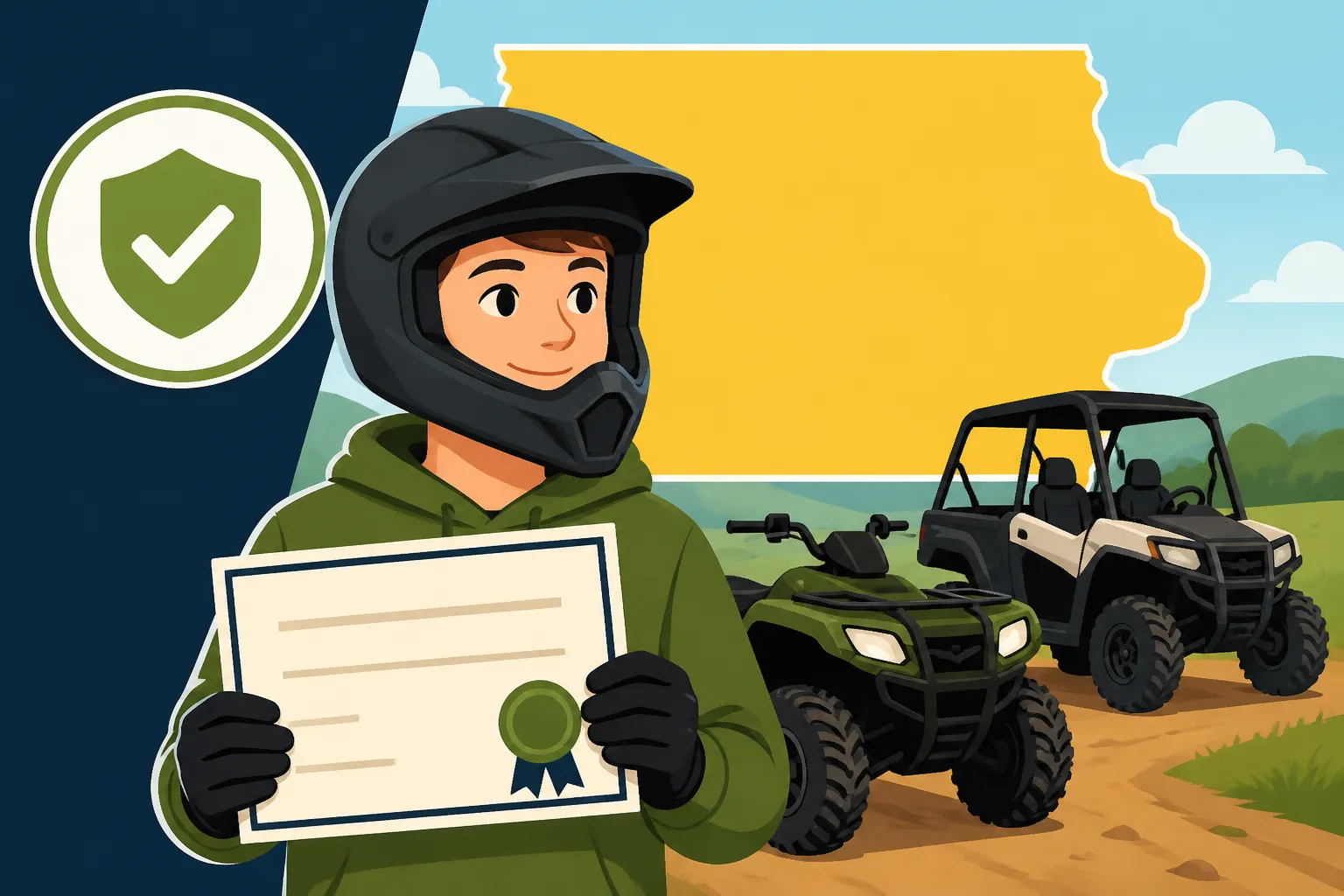
In Iowa, the off-highway vehicle safety certificate requirement applies to ATV operators from age twelve through age seventeen in settings covered by the state’s rules. Turning twelve is therefore an important point to check before a young rider operates an ATV. The requirement is about completing safety education; it is not a general driver’s license.
The certificate requirement is easy to misread because age rules can depend on the machine and where it is being operated. A certificate does not automatically authorize a child to ride every vehicle, on every kind of land, or without adult oversight. Check the rules for the particular machine and riding location, especially if the plan involves public land, a designated riding area, a club trail, or a private property.
A useful starting point is to separate three questions:
- How old is the operator? Riders under twelve, riders aged twelve through seventeen, and adults may be subject to different requirements.
- What kind of machine is it? An ATV, a side-by-side, and an off-road motorcycle may not follow the same certificate rules.
- Where will it be ridden? Public land and designated riding areas may have requirements that are different from a private-property ride.
For an ATV rider who is twelve through seventeen, do not assume that having an adult nearby replaces the certificate. Supervision and safety education are separate issues. Likewise, completing a course does not remove any applicable supervision rules or make a rider old enough to use a machine that is unsuitable or restricted for them.
The age boundary also works in both directions. A child younger than twelve does not become subject to the same certificate requirement merely because an older sibling has one. That younger child may still face supervision and location rules; see Iowa Rules for Riders Under 12. At eighteen, the youth certificate requirement no longer applies in the same way, but the adult rider must still follow registration, operating, and location rules.
| Rider or machine | Certificate question to check | What not to assume |
|---|---|---|
| ATV operator aged twelve through seventeen | Is the rider required to hold an Iowa safety certificate for the planned riding setting? | That adult supervision alone replaces the certificate |
| ATV operator under twelve | What supervision and location rules apply? | That the older youth certificate rule applies unchanged |
| Adult ATV operator | Does a separate certificate rule apply to this adult and machine? | That age removes registration or trail requirements |
| Side-by-side operator | Does the machine-type exemption apply? | That an ATV rule automatically applies to a UTV |
| Off-road motorcycle operator | Does the machine-type exemption apply? | That the rules for an ATV transfer directly to a dirt bike |
These are useful categories, not a substitute for checking current Iowa requirements. If the machine or riding location is unusual, verify the rule before the trip rather than relying on a broad age summary.
Which machines and riding locations matter
ATV rules do not automatically cover every off-road vehicle
The requirement discussed here is not a universal certificate rule for anyone operating any motorized recreational machine. Iowa treats different machine types differently. In particular, the state’s safety-certificate rules have exemptions for side-by-sides and off-road motorcycles. That distinction matters if a family owns more than one type of machine or if a rider switches between an ATV and another vehicle during a day out.
A side-by-side, often called a UTV, is not simply an ATV with extra seats for purposes of every rule. The relevant machine category can affect whether a certificate is required, as well as other rules for operation. See Why Iowa Exempts Side-by-Side Operators and Does an Iowa UTV Operator Need a Certificate? for the machine-specific distinction. Off-road motorcycle operators also have a separate exemption; an ATV certificate rule should not be assumed to apply to a dirt bike in the same way.
When the machine’s classification is unclear, use its official description and registration paperwork as a starting point, then confirm the classification with the appropriate Iowa authority. Informal names can be misleading: owners may call a vehicle a quad, four-wheeler, or utility machine without those terms settling its legal category. If the machine is modified or homebuilt, clarification is especially helpful before relying on an exemption.
The riding location is part of the answer
A rider’s age and machine type are not the only details to check. Iowa has rules tied to where an off-highway vehicle is being operated. Requirements that apply on public land or in a designated riding area should not be casually extended to every ride on private ground, and a private-property ride should not be treated as proof that the same rider is ready to use a public trail.
Before setting out, identify the land and the access arrangement:
- A designated OHV riding area: Check the area’s current rules as well as statewide requirements. A park may post operating conditions, safety requirements, or other restrictions at its entrance or online.
- Other public land: Confirm that ATV riding is permitted there at all. Public ownership does not mean every parcel or trail is open to motorized riding.
- Private property: Confirm the owner has allowed the ride and check whether any state or local rule still applies to the situation.
- A club trail or organized ride: Ask the organizer what documentation and conditions participants must meet. Event rules may add practical requirements.
- A road or road crossing: Road-use rules are separate from the off-highway safety certificate. A certificate does not make a machine street legal or authorize a road route.
For more on the distinction between land types, see Iowa Rules for Riding Public Land, Iowa Rules for Riding a Designated Riding Area, and [Iowa Rules for Riding Private Property]. The certificate question is only one part of deciding whether a ride is allowed.
A common mistake is to treat the certificate as an all-purpose pass. It is not a registration decal, nonresident permit, landowner permission, or park admission. Riders and families may need to handle more than one requirement before a trip. The machine’s registration status and any applicable nonresident requirements are separate matters; Iowa ORV Permits Explained provides more context on permits and riding access.
Getting the certificate and keeping proof available
For a young rider who needs the certificate, the practical step is to complete an approved Iowa ATV safety course and retain the resulting proof. Course access, delivery of a certificate, and accepted proof can vary by process, so follow the current instructions from the official Iowa provider rather than assuming that an old card, an unfinished course, or a screenshot of a registration page will be accepted.
A sensible preparation sequence looks like this:
- Confirm the machine category. Determine whether the rider will use an ATV, side-by-side, off-road motorcycle, or another type of machine.
- Confirm the age rule. Check whether the rider’s age and the intended activity trigger the certificate requirement.
- Use the official course route. Follow the current Iowa instructions for completing the applicable safety course.
- Finish every required step. Do not assume that starting a course or watching some lessons is equivalent to earning a certificate.
- Save proof in more than one place. Keep the original document or card safely stored and retain a backup copy where practical.
- Check what must be carried. Find out whether the rider must have the certificate available while riding, and whether a physical or electronic form is accepted.
- Recheck before the outing. Confirm the riding area’s rules, the machine’s registration, and any separate permit or access requirements.
The easiest way to avoid a last-minute problem is to handle the course before a planned trip. A parent or guardian can help the rider complete the process, but the certificate belongs to the qualified rider; it is not a document that can be borrowed from a sibling or an adult.
Keep proof where it can be retrieved without delaying a group or leaving a young rider unable to show it. A parent might keep a backup copy with the trip paperwork, but should check whether a backup is acceptable in place of the required certificate. Do not assume that a photo stored on a phone will satisfy a rule that calls for a particular form of proof.
A compact document pouch can help keep paperwork together with registration documents, particularly when riding conditions are wet or dusty. The important point is not which accessory you use, but that the certificate stays legible and accessible. Avoid attaching important papers to a place where they can be lost, soaked, or damaged during normal loading and unloading.
If the rider has already taken a course in another state, check whether Iowa recognizes that certificate for the planned activity. Do not assume that an out-of-state card is automatically accepted, or that an Iowa certificate replaces every requirement imposed by another state. Reciprocity and course recognition can depend on the issuing program and the specific rule. For a visiting rider, Does Iowa Honor Out-of-State Registration? addresses a separate issue that is often confused with certificate recognition: registration and safety education are not the same credential.
Supervision, registration, and other rules still apply
A safety certificate shows that a young operator has completed the required education. It does not grant unrestricted riding privileges. Families still need to consider supervision, suitable equipment, registration, permissions, and the conditions at the riding site.
Do not treat certification as a replacement for supervision
A rider’s certificate and an adult’s supervision serve different purposes. The certificate is proof of safety education. Supervision rules concern who may accompany or oversee a young rider in a particular situation. For riders younger than twelve, supervision is especially important, and the applicable rule should be checked before riding. [Iowa Supervision Rules for Riders Under 12] explains the age-specific issue.
Even when a twelve-to-seventeen-year-old has earned a certificate, a responsible adult can help make the ride safer by checking the route, the machine, the protective gear, and the rider’s experience. That is a practical safety measure, not a claim that the certificate itself requires an adult to ride alongside the youth in every setting. Follow the applicable rule for the activity and location, and use judgment about the young person’s ability.
Registration and permits are separate
The safety certificate does not register the machine. It does not prove ownership, replace a registration decal, or satisfy a visitor permit requirement. A family may need to have the certificate issue settled for the operator and the registration or permit issue settled for the machine.
Iowa residents should check that the ATV’s registration is current and that the required decal and documents are in order. Visitors should check what Iowa requires for a machine registered elsewhere. A nonresident permit, where required, is tied to the machine and is not a substitute for the rider’s safety certificate. See Iowa’s Nonresident User Permit for the visitor-permit topic and Iowa ATV Registration Paperwork for the registration documents.
The same separation applies to road use. A safety certificate does not authorize an ATV or UTV to travel on a road, waive equipment rules, or remove local restrictions. If a ride includes a road, a crossing, or a route to a park, check the road rules independently.
Check the whole outing, not just the rider’s card
Before loading the machine, make a short checklist:
- The rider is in the correct age category for the machine and activity.
- Any required certificate has been earned, and proof is available in the required form.
- The machine is correctly classified and its registration or permit is in order.
- The riding area allows the machine and the planned type of use.
- Any required permission has been obtained for private property.
- The rider has suitable protective gear and knows the site’s rules.
- The group has checked for current closures or restrictions.
This checklist is particularly useful when several young riders are going together. One child may be old enough for a particular rule while a sibling is not; one machine may fall under an exemption while another does not. Do not let one rider’s certificate or one machine’s paperwork stand in for the rest of the group.
For a broader look at the course and the age range, see Iowa ATV Safety Certificate Requirements and Iowa Safety Certificate Age Range. If a course, card, machine classification, or out-of-state credential is uncertain, get clarification from the relevant Iowa authority or riding area before the trip.
Common mistakes families can avoid
Assuming the rule starts at the same age for every vehicle. The certificate requirement discussed here concerns ATVs, while side-by-sides and off-road motorcycles have exemptions. Confirm the actual machine type rather than relying on a generic term such as “off-road vehicle.”
Assuming a certificate means a rider can go anywhere. A certificate does not open a closed trail, grant landowner permission, or allow riding on land where ATVs are prohibited. Check location rules separately.
Assuming a parent’s presence covers the certificate. Supervision and certification address different things. If the rider needs a certificate, do not treat an adult riding along as a substitute.
Assuming a certificate covers registration. The rider’s education record and the machine’s registration are separate. A registered ATV can still be operated by a rider who lacks a required certificate, and a certified rider can still be using a machine with incomplete registration paperwork.
Waiting until the day of the ride to check the course. Course completion and access to proof can take planning. Confirm the process early and leave enough time to finish it before a scheduled outing.
Assuming another state’s card is automatically accepted. If the rider completed a course outside Iowa, verify recognition rather than guessing. Also check whether a visitor needs an Iowa permit for the machine; that is a separate question from certificate reciprocity.
Relying on a remembered rule instead of checking the current one. Age limits, accepted proof, and site policies may be updated. Check the current official instructions and the riding area’s own information before travel, especially for a youth’s first visit.
Frequently Asked Questions
Does an Iowa ATV rider need a certificate at age twelve?
Iowa’s safety-certificate requirement applies to ATV operators aged twelve through seventeen in covered settings. Confirm the rule for the exact machine and riding location before the ride.
Does the certificate requirement apply to a side-by-side?
Iowa exempts side-by-side operators from this ATV safety-certificate requirement. Because machine classification matters, confirm that the vehicle is treated as a side-by-side under the applicable rules.
Does a safety certificate replace adult supervision?
No. A certificate and supervision are separate matters. Check the rules for the rider’s age and activity, especially for children under twelve.
Is an out-of-state course certificate accepted in Iowa?
Do not assume it is. Check with the relevant Iowa authority to confirm whether the specific certificate is recognized for the planned use.
Does the certificate register the ATV or act as a visitor permit?
No. Safety education, machine registration, and any applicable nonresident permit are separate requirements. Check each one independently.
Disclaimer
This article is for general informational purposes only and does not constitute professional advice. Laws, prices and regulations vary by location and change over time. Consult a qualified professional for guidance on your specific situation.