Iowa Reciprocity With Missouri
A Missouri plate, title, or other home-state document does not automatically answer whether your ATV or UTV can ride in Iowa without another permit. The key is whether Iowa recognizes the machine’s current Missouri credentials under its reciprocity arrangement. Here’s how to check that, what to carry, and which Iowa riding rules still apply.
What Iowa reciprocity with Missouri means
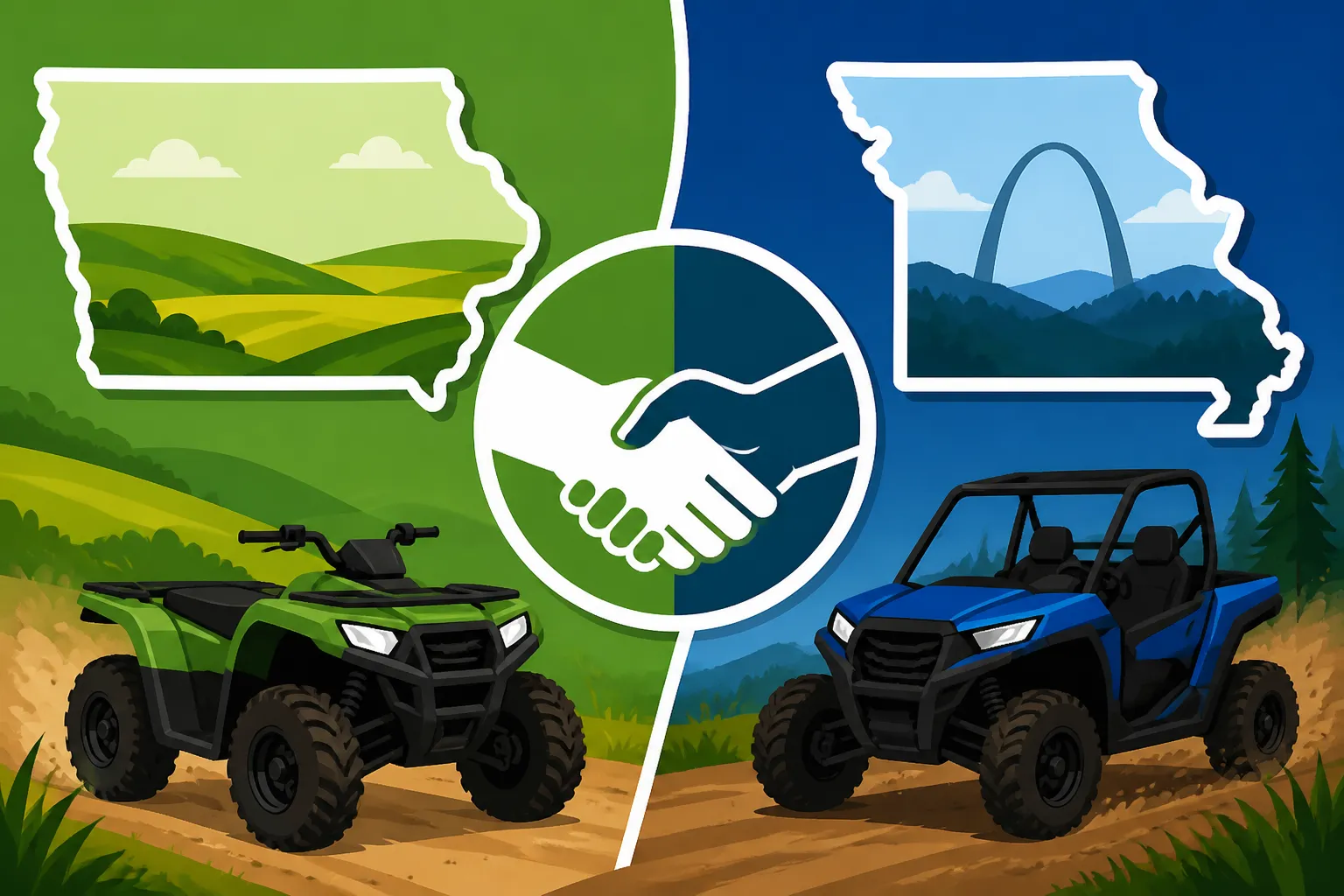
Iowa’s reciprocity arrangement can allow a qualifying machine from Missouri to operate in Iowa without buying an Iowa nonresident user permit. The important word is “qualifying”: reciprocity depends on the machine’s current credentials and Iowa’s recognition of them, not simply on the owner living in Missouri.
That distinction can be confusing because registration, title, and permission to use a particular riding area are different things. A title is evidence of ownership. A registration or other state-issued operating credential may show that the machine meets its home state’s requirements. A permit is permission to ride in a particular jurisdiction or setting. One document does not necessarily substitute for another.
Before loading up, confirm two points:
- The machine has the current Missouri credential Iowa recognizes for reciprocity.
- The type of riding you plan to do in Iowa is covered by that recognition.
If both are true, you may not need to purchase a separate Iowa nonresident user permit for that machine. If the machine has no current credential, the document you have is only a title, or you are not sure which Missouri paperwork applies, don’t assume that reciprocity covers it. Check Iowa’s current instructions before traveling. The rules and accepted documentation can change, and a quick check can prevent a problem at a trail entrance or during a roadside stop.
The state permit question is separate from the trail’s operating rules. A Missouri machine that qualifies for reciprocity still has to follow Iowa requirements for riding on designated areas, public land, or roads. Reciprocity is not a general exemption from Iowa law.
For a broader explanation of permits for visiting machines, see Iowa’s Permit for a Visiting Machine and Iowa’s Nonresident User Permit. If you want to compare the basic question of whether a home-state credential is accepted, Does Iowa Honor Out-of-State Registration? is also relevant.
| Your situation | What to do before riding in Iowa |
|---|---|
| Your machine has current Missouri credentials that Iowa recognizes | Confirm reciprocity applies to the machine and riding area; carry the documents |
| You have a Missouri title but no current operating credential | Ask Iowa whether the title alone qualifies; don’t treat ownership paperwork as proof of permit exemption |
| Your machine is unregistered or its paperwork is incomplete | Ask whether an Iowa nonresident user permit is required before you ride |
| You are renting or borrowing a machine | Check the machine’s credentials and who is responsible for the required permit |
| You plan to ride on an Iowa road | Check road-use authorization and equipment rules separately; reciprocity does not make an ATV or UTV street-legal |
Check the machine’s paperwork before you leave Missouri
The safest way to use reciprocity is to verify the documents for the specific machine, not rely on a general statement that “Missouri and Iowa have reciprocity.” A registration or credential can be expired, belong to another machine, or fail to establish the status Iowa requires. A title or bill of sale may help establish ownership but may not serve as an operating credential.
Before you travel, gather the machine’s documents and confirm:
- The machine identification number matches the paperwork.
- The credential is current and belongs to the machine you plan to bring.
- The name or names on the documents make sense for your situation, especially if the machine is borrowed, recently purchased, inherited, or owned by a business.
- Iowa recognizes that particular Missouri credential for the kind of machine you have.
- The exemption applies to your intended riding location, rather than only to a narrower situation.
If the machine was recently bought, transferred, or brought into Missouri from another state, there may be a gap between the paperwork you have and the current operating status. A purchase receipt does not necessarily prove registration. For a used machine, review the documents carefully and compare the identification number on the machine with the one on the paperwork. The process for a machine brought from another state may also depend on its history; Bringing a Machine From Missouri covers that issue from the ownership and registration angle.
If you are unsure whether a document is a title, registration, or another credential, ask the issuing agency in Missouri to identify it. Then ask the Iowa DNR whether that document satisfies the reciprocity condition. This is more reliable than guessing based on what a seller, friend, or online discussion says. The question to ask is specific: “Does this current Missouri document qualify this machine for Iowa reciprocity, and does that exemption apply where I plan to ride?”
Keep a copy of the answer or the applicable instructions with your travel paperwork if the situation is unusual. For instance, that can help if the machine has joint owners, the current operator is not the titled owner, or the paperwork is being updated after a sale. It does not replace any required credential, but it can make it easier to resolve questions.
Carry the home-state documents with you when you ride. A photo on a phone can be useful as a backup, but do not assume it will be accepted instead of an original or official electronic record. Confirm what Iowa requires and make sure the information is readable. A waterproof document pouch can protect paper documents from mud and rain; general retailers, including Amazon, offer simple options, but the important thing is that the paperwork stays legible and available.
For practical tips on what to keep with the machine, see Carrying Your Home-State Registration on a Visit. If you are uncertain about decals or stickers, What Sticker a Visiting Out-of-State Quad Needs? explains why the required marking should be confirmed rather than inferred from the machine’s home-state plate.
What reciprocity does not allow
A reciprocity exemption concerns the Iowa permit requirement. It does not create a blanket right to ride wherever you want. The location, trail designation, landowner permission, and road authorization can all impose separate requirements.
Designated riding areas and public land
Iowa has specific rules for riding on designated areas and other public land. A machine can meet the reciprocity requirement and still be prohibited from a particular area, trail, or route. Follow posted signs and closure notices, stay on marked routes where required, and check the area’s current rules before unloading.
Wet-weather closures matter too. A trail or park may close because riding conditions would damage the surface, even when your paperwork is in order. A valid home-state credential does not override a closure. For riding-location rules, review Iowa Rules for Riding a Designated Riding Area and Iowa Rules for Riding Public Land.
Private land is different again. Reciprocity does not give a visitor permission to ride someone else’s property. Get permission from the landowner before entering, and follow any limits they set on where and when you may ride.
Public roads
A machine that is permitted to ride on an Iowa trail is not automatically legal on an Iowa road. Road use involves a separate set of restrictions, which can depend on the road type, local authorization, the operator, and required equipment. A Missouri credential does not by itself grant permission to ride a road in Iowa.
Before planning a route that uses public roads, check the rules for the specific road and local jurisdiction. Do not assume that a road open to ATVs in Missouri is open to them in Iowa, or that a short connection between trails is allowed. Read Iowa Rules for Riding a Gravel Road if your route may include gravel, and Are ATVs Street Legal in Iowa? for the broader road-use question.
Borrowed, rented, and recently purchased machines
If you are riding a borrowed machine, the owner’s paperwork may be valid, but you should still verify that it applies to the machine and that you can show it if asked. Ask the owner for the documents before you leave. If the machine is rented, confirm who is responsible for any Iowa permit and what paperwork comes with the rental. Do not assume the rental company has addressed every requirement simply because it operates in Missouri.
A recent private purchase deserves particular care. A bill of sale documents a transaction, but it may not establish that Iowa will recognize the machine as currently registered for reciprocity. If you bought the machine shortly before your trip, check whether its status has transferred or whether additional paperwork is needed. The safest option is to resolve the question before reaching an Iowa riding area.
A simple pre-trip check for Missouri riders
Use this short checklist before each trip, especially if the machine or its paperwork has changed since your last visit.
- Identify the machine and its credential. Match the machine identification number to the current Missouri document. Make sure you know whether you have a title, registration, permit, or another record.
- Confirm Iowa recognizes it. Check current Iowa DNR guidance or contact the appropriate office. Ask whether the credential qualifies for reciprocity for your machine type.
- Ask whether an Iowa permit is still needed. If the credential is missing, expired, unclear, or does not qualify, find out whether an Iowa nonresident user permit is required before riding.
- Check the riding location. Confirm the area is open and that the rules allow your machine. A reciprocal credential does not replace site-specific conditions or landowner permission.
- Check the route. If you will use a public road, look up Iowa’s road rules separately. Do not treat trail eligibility as road authorization.
- Carry readable paperwork. Bring the required documents while riding and make sure the machine’s identifying information matches them.
- Recheck after a change. Revisit the question after a sale, transfer, expiration, change of owner, or change in where you plan to ride.
The point of this check is not to collect extra paperwork for its own sake. It is to confirm that the machine has a recognized home-state status and that the planned ride is permitted. If Iowa’s instructions say the Missouri credential qualifies, keep it current and carry it. If they do not, ask about the Iowa nonresident permit before you head out.
For a broader overview of visiting machines and permit costs, see What a Visitor Pays to Ride Iowa. To compare the rules for other nearby states, the separate posts on Iowa Reciprocity With Nebraska and Iowa Reciprocity With Wisconsin address those situations.
Disclaimer
This article is for general informational purposes only and does not constitute professional advice. Laws, prices and regulations vary by location and change over time. Consult a qualified professional for guidance on your specific situation.