City Streets and Iowa Council Authorization
It’s a common scenario for Iowa ATV and UTV riders: you’re out enjoying the trails or working on the farm, and you just need to get across town or to the next section of gravel road. But then you hit a paved city street, and a wave of uncertainty washes over you. Can you even be here? This guide is here to untangle the complexities of riding your off-highway vehicle (OHV) on Iowa city streets and explain precisely how local city councils grant authorization.
The Complex Web of Iowa Road Laws for ATVs and UTVs
Riding an ATV or UTV in Iowa can feel like navigating a patchwork quilt of rules, especially when you venture beyond private land. The state provides a foundational framework, but then individual counties and, most notably, cities get to add their own unique stitches, creating a landscape that can be downright confusing for even experienced riders. Understanding this hierarchy is the first step to staying legal and safe.
Why City Streets Are Different from County Roads
One of the biggest sources of confusion stems from the fundamental difference in how county roads versus city streets are governed. When you’re out on a county gravel road, particularly in a rural area, you’ll often find a more consistent set of rules, largely because those roads fall under county jurisdiction, guided by broader state provisions. Many counties have embraced the economic and recreational benefits of OHV use, opening up vast networks of unpaved secondary roads for riders. This can feel liberating, like the open road is truly yours to explore, within reason.
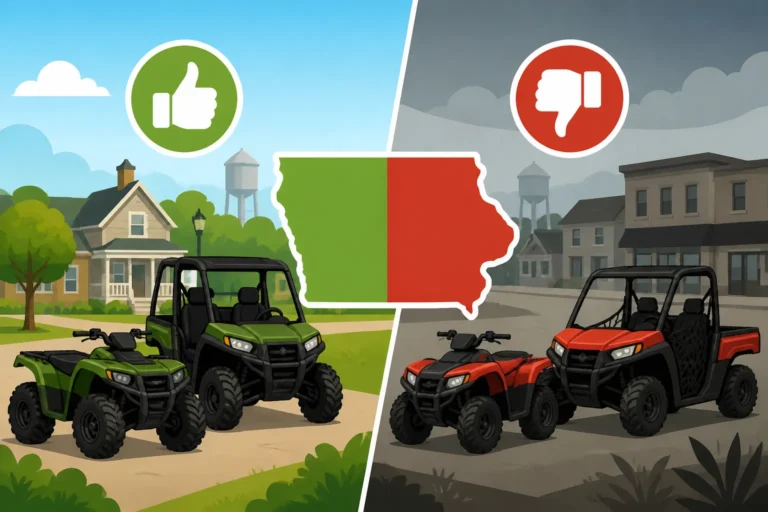
However, the moment you cross an invisible line into an incorporated city, the rulebook can, and often does, change dramatically. City streets, even the quiet residential ones, are under the direct purview of the city council. They have the authority to establish their own ordinances that dictate if, when, and how ATVs and UTVs can operate within their municipal boundaries. This distinction is crucial because what’s perfectly legal on a county road just outside the city limits could land you a ticket once you’re inside the city. It’s this sudden shift in authority and rules that often catches riders off guard, leading to frustration and, sometimes, costly fines.
The Core State Law and Local Exceptions
At its heart, Iowa's state law generally restricts off-highway vehicles, including ATVs and UTVs, from operating on primary highways and paved secondary roads unless specifically authorized. The intention behind these state-level restrictions is primarily safety, given the design differences between OHVs and conventional vehicles, and the potential for increased traffic congestion or accidents. This means that, by default, many public paved surfaces are off-limits for your machine. It’s a blanket rule designed to cover the majority of situations and keep the flow of traffic predictable and safe for all road users.
However, recognizing the growing popularity of OHV recreation and their utility, the state legislature has also provided avenues for local control. This is where the concept of local exceptions comes into play. Cities and counties in Iowa have the ability to pass their own ordinances that can either permit or further restrict OHV use on roads within their jurisdiction, sometimes carving out very specific allowances. For example, a city council might decide that certain secondary streets or alleys can be used to connect to a trail system or reach a gas station, even if state law would generally prohibit it. This allowance for local determination is a double-edged sword: it offers flexibility for communities to adapt to local needs and desires, but it also means that riders must meticulously check the specific rules for every single city they plan to ride in. You cannot assume that because City A allows it, City B will too. This decentralized approach is why [Why Iowa Publishes No List of City Ordinances] statewide, making your research a critical part of any urban ride plan.
How an Iowa City Council Authorizes ATV/UTV Use
So, if the state has a general restriction, how exactly does a city council open its streets to ATVs and UTVs? It’s not a snap decision made overnight. It’s a deliberate, often lengthy, process that involves public input, debate, and formal legislative action at the local level. Understanding this process can help riders and advocates better engage with their local governments.
The Ordinance Process: From Idea to Law
The journey from a casual suggestion to a legally binding authorization for ATVs and UTVs on city streets begins with a formal ordinance process. Typically, this starts when a citizen, a group of riders, or even a city council member themselves identifies a need or desire for such a change. Perhaps local businesses see the potential for increased tourism, or residents want easier access to nearby trailheads. This initial idea is then brought before the city council, often introduced as a proposed ordinance.
What follows is usually a series of public hearings and workshops, where community members are invited to express their opinions, concerns, and support. This is a crucial phase where residents might voice worries about noise, safety, or increased traffic, while riders and business owners can highlight economic benefits and recreational opportunities. The city council will weigh all this input, often working with city staff, law enforcement, and public works departments to draft specific language for the ordinance. They might consider everything from designated routes and hours of operation to specific equipment requirements for machines. Eventually, after multiple readings and potential revisions, the council will hold a vote. If the majority votes in favor, the ordinance is formally passed, signed by the mayor, and then goes into effect. This entire process can take weeks or even months, reflecting the careful consideration given to changes that impact public safety and quality of life. For a deeper dive, consider how a local body arrives at a decision, like [How a City Council Votes to Open Streets].
Factors Influencing a Council's Decision
When a city council considers an ordinance to open its streets to ATVs and UTVs, they're juggling a variety of factors, often trying to balance the interests of different groups within their community. Safety is almost always at the top of the list. Council members will look at local traffic patterns, speed limits, pedestrian activity, and the capacity of their local police force to enforce new regulations. They'll ask questions like: Will allowing OHVs increase accidents? Can our police adequately monitor compliance? Are there particularly dangerous intersections or busy roads that should remain off-limits?
Beyond safety, economic impact plays a significant role. Rider communities often advocate by highlighting how increased OHV access can boost local businesses – gas stations, restaurants, convenience stores, and even lodging. If riders can easily access amenities within city limits, they're more likely to spend their money there. Conversely, councils also contend with resident complaints, particularly about noise, dust, or perceived reckless driving, which can create tension within neighborhoods. They also consider the existing infrastructure, such as whether there are logical routes to connect riders to trails or if it would simply lead to OHVs aimlessly cruising residential streets. The goal is often to find a compromise that serves the recreational and economic interests of some, without unduly inconveniencing or endangering others. It’s a delicate balancing act that ultimately shapes whether a city says yes or no to OHV road access.
What an ATV/UTV Ordinance Typically Covers
Once an Iowa city council authorizes ATV or UTV use on its streets, that authorization isn't a free-for-all. Instead, it comes with a very specific set of rules and limitations, all laid out within the ordinance itself. Riders absolutely must familiarize themselves with these details, as ignorance of local law is rarely a valid defense.
Designated Streets and Hours of Operation
One of the most critical aspects of any city ATV/UTV ordinance is the precise designation of which streets are open to these vehicles. It is exceptionally rare for a city to open up all its streets. More commonly, councils will identify specific routes, often secondary roads, low-traffic residential streets, or even alleys, that serve as connectors. These routes might link riders to gas stations, restaurants, local businesses, or allow passage from one section of county gravel road to another without having to trailer their machine. The intention is usually to provide necessary access while minimizing disruption on main arteries or in sensitive areas like school zones. You might find that a city like Waukon has opened certain streets, but even there, [Waukon's Midnight to Five Ban] means you won't be cruising after hours.
Beyond specific routes, ordinances almost always include strict hours of operation. This is primarily to address concerns about noise and public disturbance, especially in residential areas. Many cities will restrict OHV use to daylight hours, or prohibit it during late night and early morning, ensuring that residents aren't woken up by the sound of engines. For example, some ordinances specify "sunrise to sunset," while others might set fixed times like "6:00 AM to 10:00 PM." It's imperative that you obtain and read a copy of the actual city ordinance, whether from the city clerk's office or the city's official website, to understand these precise limitations. Relying on hearsay or what's allowed in a neighboring town is a recipe for trouble.
Rider and Machine Requirements Within City Limits
In addition to specifying where and when you can ride, city ordinances will almost certainly impose specific requirements on both the operator and the machine itself. These often build upon, or even go beyond, the general state regulations for OHV road use. For instance, age limits are a common feature. While some rural county roads might have slightly more lenient rules for younger riders under adult supervision, city ordinances often strictly enforce an [Eighteen Years Old Behind the Bars] requirement, meaning only licensed adults are permitted to operate an ATV or UTV on city streets. This is largely due to increased traffic complexity and public safety concerns in urban environments.
Insurance is another non-negotiable requirement. Just like any other motor vehicle operating on public roads, your ATV or UTV must be properly insured. [Iowa ATV Insurance Requirement] typically mandates minimum liability coverage to protect against property damage or injury in the event of an accident. Furthermore, your machine must be equipped to be considered "street legal" within the city's definition. This usually includes proper headlights, tail lights, brake lights, a horn, and at least one rearview mirror. Some cities might even add requirements for turn signals or a visible slow-moving vehicle triangle, particularly if the state law doesn't explicitly mandate them for OHVs on all roads. While [What Iowa Requires of an ATV on a Public Road] gives you the state baseline, a city ordinance can certainly add more stipulations, so equipping your machine with accessories like a quality SuperATV turn signal kit or additional mirrors can be a wise investment to ensure compliance and enhance safety. These requirements are not just suggestions; they are enforceable laws designed to ensure that OHVs can integrate safely, if minimally, into the flow of city traffic.
Finding Out Which Iowa Cities Allow ATV/UTV Road Use
This is often the most frustrating part for riders: figuring out the specifics for any given town. Because Iowa's system grants significant autonomy to local governments, there's no single, easy answer, and you can't simply consult one definitive list.
Why No One Keeps a Statewide List
If you're looking for a simple, comprehensive document from the Iowa Department of Natural Resources (DNR) or the Department of Transportation that lists every city allowing ATV or UTV use on its streets, you're going to be disappointed. The plain truth is, [Why Iowa Publishes No List of City Ordinances] concerning OHV use on city streets. This isn't an oversight; it's a direct consequence of how local governance works in Iowa. Each of Iowa's hundreds of incorporated cities has the independent authority to draft, debate, and pass its own ordinances regarding ATV and UTV use within its municipal limits.
Imagine the logistical nightmare of trying to maintain such a list: every time a city council amends an ordinance, holds a new vote, or even changes its mind, that statewide list would need to be updated. There's no central state agency tasked with collecting and disseminating this hyper-local, constantly evolving information. This decentralized approach creates a significant hurdle for riders who might want to plan a multi-city route or simply aren't sure about the rules in a town they're passing through. It means the burden of research falls squarely on the individual rider, making pre-ride planning much more involved than simply checking a map.
Your Best Strategies for Checking City Rules
Given the lack of a statewide registry, proactive research is your best friend when planning to ride your ATV or UTV on city streets in Iowa. The most reliable method is to go straight to the source: the city itself. Your first line of attack should be to [Calling a City Clerk About ATVs]. The City Clerk's office is the official custodian of all city ordinances and will be able to tell you definitively whether an ordinance exists that allows OHVs on city streets, and if so, provide you with a copy or direct you to where you can read it. They can also clarify specific restrictions like designated routes, hours, and equipment requirements. It's always best to get the information directly rather than relying on secondhand accounts.
Many cities also publish their ordinances online on their official municipal websites. A quick search for "[City Name] ATV ordinance" or "[City Name] UTV streets" might lead you directly to the relevant document. However, always verify that the ordinance you're reading is the most current version, as these can be updated. Beyond official channels, local riding clubs or online forums dedicated to Iowa ATV/UTV riding can sometimes offer insights or point you toward cities that are known to be OHV-friendly. Just remember to use these as starting points for your own verification, rather than definitive sources. Always, always make that call or check that official website before you roll into a new town, because [What an Iowa Deputy Checks Roadside] includes whether you're legally permitted to be there in the first place.
Navigating City Streets Safely and Legally
Once you've done your homework and confirmed that a specific Iowa city allows ATV or UTV access on its streets, the next step is to ensure you're riding not just legally, but also safely and responsibly. Integrating an off-highway vehicle into city traffic requires a different mindset and sometimes different equipment than purely off-road riding.
Essential Gear and Machine Compliance
While city ordinances will outline the minimum required equipment for your ATV or UTV, thinking beyond the bare legal necessities can significantly enhance your safety and visibility on paved city streets. Standard OHV headlights and taillights are designed for off-road conditions and might not be bright enough to stand out in urban traffic or at dusk. Upgrading to brighter LED lighting can make your machine much more noticeable to other drivers. Turn signals are often a critical add-on, as hand signals can be difficult to see or interpret, especially for riders with limited mobility or in busy traffic. Investing in a robust aftermarket turn signal kit, perhaps from a reputable brand like SuperATV, can be a game-changer for clear communication with other vehicles.
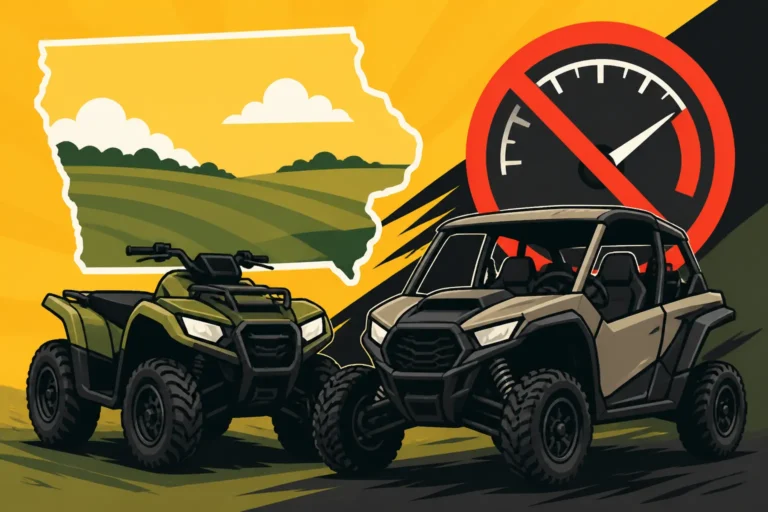
Mirrors are another key component. While one mirror on the left is typically the minimum requirement, having both left and right rearview mirrors provides a much better field of vision, helping you monitor traffic behind and beside you. Furthermore, consider your tires. Aggressive off-road knobbies, while excellent for mud and trails, can wear down quickly and offer less traction on pavement, especially in wet conditions. If you frequently ride on city streets, a more road-friendly tire with a denser tread pattern might be a safer and more economical choice. Finally, a visible slow-moving vehicle (SMV) triangle affixed to the rear of your machine is often required by state law for road use and is crucial for alerting faster-moving traffic to your presence, especially since [Iowa's 35 mph Cap] on public roads means you'll almost always be moving slower than other vehicles.
Riding Etiquette and Avoiding Issues
Operating an ATV or UTV on city streets is about more than just legal compliance; it's about being a good ambassador for the entire OHV community. Mind your speed. Even if the posted limit is higher, stick to [Iowa's 35 mph Cap] or the designated city speed limits for OHVs, which might be even lower. Excessive speed is not only dangerous but also a surefire way to generate complaints from residents, potentially leading to city councils reconsidering their ordinances. Noise is another major factor. While aftermarket exhaust systems can sound great on the trail, they can be highly disruptive in residential areas. Be mindful of your engine's noise, especially during early morning or late evening hours.
Always respect private property. Do not ride on sidewalks, through yards, or cut across private parking lots unless you have explicit permission. These actions erode public trust and can quickly turn public opinion against OHV access. Be predictable and courteous in traffic, using your signals, stopping at stop signs and lights, and yielding when appropriate. Remember that many other drivers may not be accustomed to seeing ATVs and UTVs on city streets, so drive defensively and assume they might not see you. Finally, always be prepared for a roadside stop. Have your registration, proof of insurance ([Iowa ATV Insurance Requirement]), and driver's license readily accessible. A friendly and cooperative attitude with law enforcement can go a long way in ensuring a positive interaction, even if you're just being checked to ensure compliance.
| Feature | City Ordinance (Example) | Iowa County Gravel Road (General) |
|---|---|---|
| Authorization | Specific city council ordinance | State law / County board action |
| Designated Routes | Usually restricted to specific streets | Often open to all secondary roads |
| Hours of Operation | Common (e.g., sunrise to sunset) | Less common, often 24/7 |
| Speed Limit | Max 35 mph (state) or lower by city | Max 35 mph (state) or lower |
| Operator Age | Often 18+ (licensed driver) | Varies, 12+ with certificate* |
| Insurance | Required | Required |
| Headlights/Taillights | Required | Required |
| Horn | Required | Required |
| Mirrors | Required (often at least one left) | Required (often at least one left) |
| Turn Signals | Often required by city ordinance | Not always state-mandated |
| SMV Triangle | Often required | Required |
| Helmet | Not required by Iowa law for adults | Not required by Iowa law for adults |
*Note: Iowa's safety certificate applies to riders aged 12-17 on public land, and UTV operators are exempt from the certificate requirement. City ordinances may impose stricter age limits for paved streets.
The Future of ATV/UTV Use on Iowa City Streets
The landscape of ATV and UTV use on Iowa city streets is not static; it's a dynamic environment shaped by ongoing debates, advocacy efforts, and evolving community needs. What's allowed today might change tomorrow, underscoring the importance of continued engagement and responsible riding.
Ongoing Debates and Rider Advocacy
The discussion around allowing ATVs and UTVs on city streets is a microcosm of broader community dialogues about shared public spaces. On one side, rider organizations and enthusiasts passionately advocate for greater access, emphasizing the economic benefits for local businesses, the convenience for accessing trails or services, and the recreational enjoyment. They often highlight the responsible nature of most riders and the desire to connect communities. Companies like SuperATV play a role by providing accessories that help riders meet street-legal requirements, indirectly supporting the push for more accessible riding areas.
On the other side, city councils often hear from residents concerned about increased noise, potential safety hazards, traffic congestion, and a perceived decline in residential quality of life. These debates can become quite spirited, as councils attempt to balance the desires of various constituent groups. The outcome often depends on the specific characteristics of the city – its size, traffic volume, proximity to trail systems, and the overall community sentiment towards OHVs. Rider advocacy, when conducted respectfully and with clear, data-backed arguments, can significantly influence these discussions, encouraging councils to consider pilot programs or well-defined ordinances that address concerns while still expanding access.
Potential Trends and Policy Shifts
Looking ahead, it's reasonable to expect continued evolution in how Iowa cities approach ATV and UTV access. As the popularity of these machines grows, and as trail systems expand across the state, the pressure on cities to provide connecting routes or access to amenities will likely increase. We might see more cities, particularly smaller towns that recognize the economic potential of OHV tourism, embracing ordinances that allow limited street use. There could also be a trend towards more standardized ordinances within regions, as neighboring cities might look to each other for best practices.
However, policy shifts could also lean towards increased restrictions if widespread issues, such as reckless riding or a surge in accidents, become prevalent. This underscores why responsible riding is so crucial today – every rider acts as an ambassador for the entire community. Future policy discussions might also include enhanced safety education programs, clearer signage for designated routes, or even technology-based solutions to monitor compliance. The key takeaway for riders is that the fight for responsible access is ongoing. Staying informed about local regulations, actively participating in public forums, and consistently demonstrating safe and respectful riding practices are the best ways to ensure that city streets remain a viable, if limited, option for your Iowa ATV and UTV adventures.
Disclaimer
This article is for general informational purposes only and does not constitute professional advice. Laws, prices and regulations vary by location and change over time. Consult a qualified professional for guidance on your specific situation.