Measuring the Most Direct Route
It can be incredibly frustrating trying to figure out Iowa's rules for riding your ATV or UTV on public roads, especially when you encounter phrases like "most direct route." You're not alone in feeling like you need a roadmap just to understand the regulations before you even hit the gravel. This guide is here to break down exactly what Iowa means by the "most direct route" and provide practical advice on how to measure and plan your rides legally and safely, ensuring you stay compliant and avoid unnecessary fines.
Understanding Iowa's "Most Direct Route" Rule for OHVs
Iowa's approach to allowing ATVs and UTVs on certain public roads is carefully balanced, aiming to provide access while maintaining safety and minimizing disruption. One of the cornerstone principles governing this access is the "most direct route" rule. It's not just a suggestion; it's a legal requirement that riders need to fully grasp before venturing onto paved or unpaved secondary roads. This rule directly impacts how you can travel between your private property, an off-highway vehicle (OHV) park, or other approved destinations.
What the "Most Direct Route" Really Means
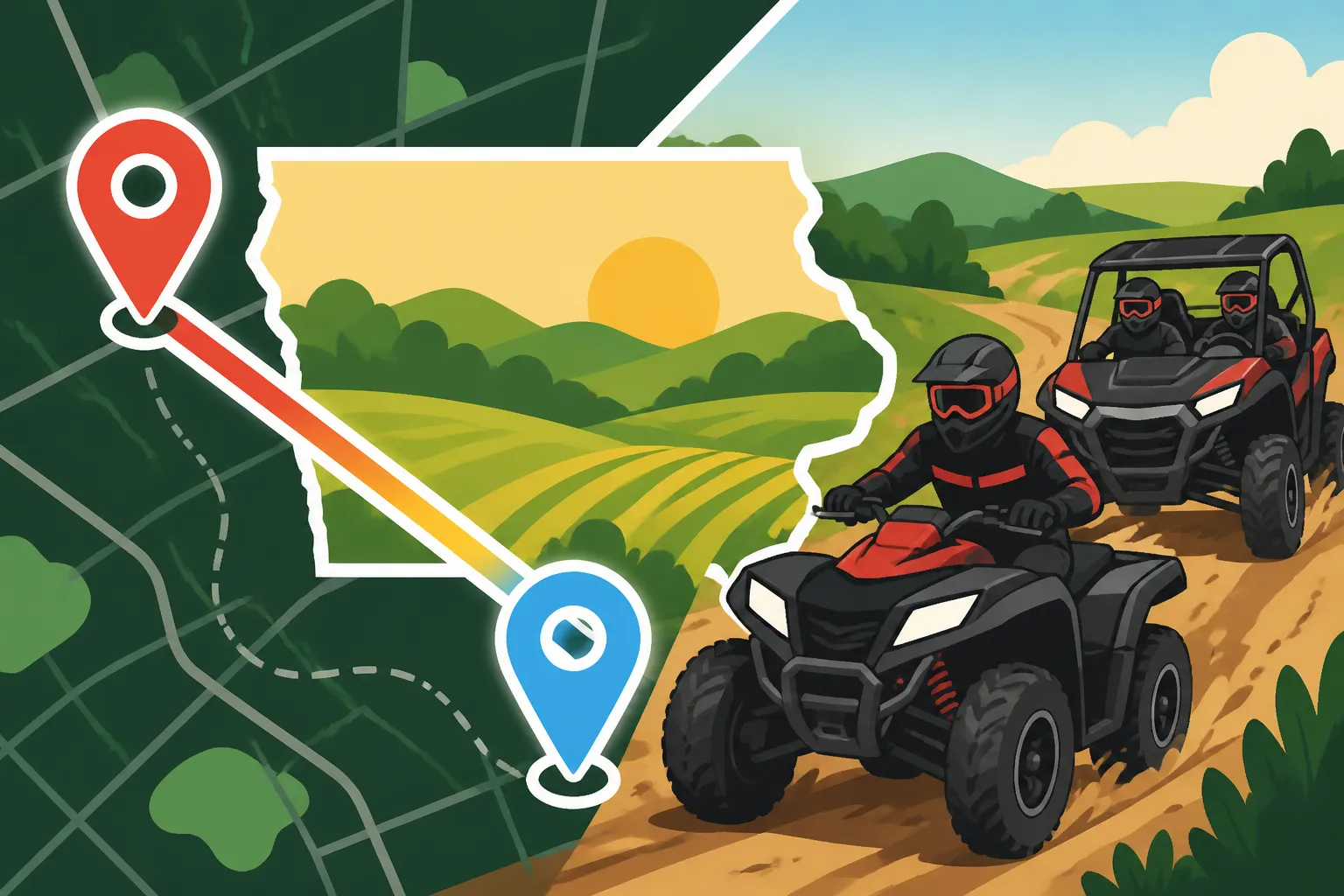
When Iowa law states that you must take the "most direct route," it means precisely what it says: you are legally obligated to choose the shortest, most geographically straightforward path available from your point of origin to your intended destination. This isn't about personal preference, scenic drives, or avoiding a bit of extra dust. It's about minimizing the time and distance your off-highway vehicle spends on public roads.
For example, if you're leaving your farm to head to [Gypsum City OHV Park at Fort Dodge], and there are two routes of similar quality, but one is clearly shorter by a few miles, the shorter one is your "most direct route." This might mean foregoing a smoother road for one that's a bit rougher but gets you there faster in terms of distance. It’s crucial to understand that "most direct" is measured in miles, not necessarily in time or convenience. A longer route, even if it feels faster due to higher speed limits or fewer stops, is not compliant if a shorter path exists. This rule helps ensure that road riding for ATVs and UTVs remains a means of access, not an end in itself for recreational cruising on public thoroughfares.
Why This Rule Exists in Iowa
The "most direct route" rule isn't some arbitrary hurdle; it's deeply rooted in the state's intent to regulate off-highway vehicle use on public infrastructure. Iowa understands that ATVs and UTVs are primarily designed for off-road use, and their presence on public roads, especially higher-speed or paved ones, comes with inherent safety considerations and potential impacts on other traffic. By mandating the most direct route, the state achieves several objectives.
Firstly, it limits the exposure of OHVs to general road traffic, reducing the risk of accidents. Secondly, it helps prevent recreational riding on public roads that are not specifically designated for such activities. The primary goal of allowing OHVs on certain roads is often for access—getting to trails, fields, or neighboring properties—rather than for joyriding on county blacktops. Finally, it provides a clear, measurable standard for law enforcement. A deputy or state trooper can easily assess if a rider is taking an unnecessarily circuitous route, providing a clear basis for potential enforcement actions. This rule, therefore, serves as a pragmatic compromise, allowing necessary road access while mitigating the broader concerns associated with integrating OHVs into the public road network.
When the Rule Applies to Your Ride
Understanding when this rule applies is just as critical as knowing what it means. The "most direct route" requirement primarily comes into play whenever you are operating your ATV or UTV on any public road where such operation is permitted, with the specific intent of getting from one location to another. This includes traveling between private land parcels, accessing designated OHV parks or trails, or even [Riding 2 Miles From the Farm in Iowa] for agricultural purposes where public roads are used for transit.
For instance, if you're taking your UTV from your home in rural Mahaska County to access a specific fishing spot that requires crossing a county gravel road, the path you take on that road must be the most direct one. If you ride your ATV from your garage to a gas station a few blocks away in a town that has opened its streets, you still must use the most direct path to that station. The rule applies whether you're heading to [Bluff Creek OHV Park at Eddyville] or simply moving your machine from one barn to another. It does not apply, however, to riding within a designated OHV park or on private property where you have permission. The moment your tires hit a public road, even a level B minimum maintenance road, the "most direct route" principle becomes a legal obligation.
Practical Steps for Identifying Your Most Direct Route
Successfully adhering to the "most direct route" rule requires a bit of forethought and planning. It's not something you want to figure out on the fly when you're already on the road. Taking the time to map out your journey beforehand can save you from potential fines and ensure a smooth, legal ride. Think of it like planning a hiking trail—you wouldn't just wander off into the woods hoping for the best. The same principle applies here.
Mapping Your Starting and Ending Points
The first, and arguably most crucial, step is to clearly define your starting point and your intended destination. This might seem obvious, but precision matters. Are you starting from your driveway, a specific gate on your property, or a staging area near an OHV park? Is your destination the entrance to a trail system, a specific field you're working, or a friend's house? Once these two points are locked in, you can begin to visualize or digitally map potential routes.
Use a reliable mapping tool, like a GPS app on your phone (ensure you have cell service in rural areas!) or even old-fashioned paper maps, to identify all possible public roads connecting your start and end points. Pay close attention to county roads, township roads, and any state highways that might be part of your journey. Many modern GPS apps can calculate the shortest distance, which can be a huge help. However, you must cross-reference this with local ordinances, as not all roads are open to OHVs, even if they appear on a map. For accessories like windshields or mirrors that might aid in road visibility and navigation, consider brands like SuperATV, which offer a range of products designed to enhance the safety and functionality of your machine for mixed-use riding. This step of diligent mapping forms the foundation of a compliant journey.
Considering Road Classifications and Restrictions
Not all roads are created equal in Iowa when it comes to ATV and UTV access. Iowa law clearly distinguishes between different types of roads, and while some are open, others are strictly prohibited. For instance, [Iowa Rules for Riding a Gravel Road] are often more permissive than rules for paved secondary roads, which require specific county authorization. Interstates and most four-lane primary highways are generally off-limits entirely.
Before you finalize your "most direct route," you must overlay these legal restrictions onto your map. Eliminate any roads from consideration that are legally closed to OHV traffic. For example, if your GPS suggests a route that uses a paved state highway for five miles, but that highway is not open to ATVs, you cannot take it. Even if it's the shortest physical distance, it's not a legal route. Your "most direct legal route" might end up being slightly longer than the absolute shortest physical route if the latter involves prohibited roads. This careful consideration of [Iowa Rules for Riding an ATV on Public Road] is paramount to avoiding citations.
| Road Type | ATV/UTV Access Status in Iowa (General) | "Most Direct Route" Applies? |
|---|---|---|
| Unpaved Secondary Roads | Generally Permitted | Yes |
| Paved Secondary Roads | Requires County Authorization | Yes |
| Undivided Two-Lane Primary Highways | Permitted for Direct Route Only | Yes |
| Divided Four-Lane Highways | Generally Prohibited | No (as not permitted) |
| Interstate Highways | Prohibited | No (as not permitted) |
| City Streets | Requires City Ordinance | Yes |
| Level B Roads | Generally Permitted | Yes |
This table provides general guidance. Always check local county and city ordinances for specific rules, as these can vary.
Documenting Your Chosen Path
After identifying your precise start and end points and factoring in road classifications, it's a good idea to document your chosen "most direct route." This isn't a legal requirement, but it's a smart practice that can serve you well in unexpected situations. You could save the route on a GPS device, print a map with your path highlighted, or even take screenshots on your phone.
Having this documentation readily available can be incredibly useful if you're ever stopped by law enforcement. You can clearly demonstrate that you've done your due diligence and are intentionally following the shortest legal path. It helps to remove any ambiguity and shows you're a responsible rider. Think of it as your personal proof of compliance. It also helps you remember the route yourself, especially if you're exploring new areas or making a trip you don't undertake often. Furthermore, this documentation can be shared with riding partners so everyone is on the same page, enhancing group safety and compliance.
Navigating Common Challenges When Determining a Route
Even with a clear understanding of the rules and mapping tools at your disposal, determining the "most direct route" isn't always straightforward. Iowa's landscape and road network can present unique challenges that require careful thought and, sometimes, local knowledge. It's these nuances that often trip up even experienced riders.
Dealing with Intersections and Restricted Road Types
One of the most common challenges arises when your most direct route involves crossing or briefly traveling on a road type that is generally restricted or prohibited for OHVs. For example, [Crossing a Multi-Lane Highway at an Intersection] is often permitted if it's the most direct way to get from one legal road to another, but traveling along that multi-lane highway is typically not. The distinction between crossing and traveling is vital. You might need to cross a primary highway to get to a gravel road on the other side, but you cannot drive down the highway for any significant distance.
Similarly, an otherwise direct route might encounter a short stretch of paved road in a county that hasn't authorized ATV use on paved roads. In such a scenario, that short segment effectively breaks your "most direct route." You would then need to find an alternative, even if slightly longer, path that entirely avoids prohibited road types. This might mean adding several miles to your trip by sticking to gravel or authorized paved roads. It’s a constant balancing act between distance and legality, with legality always taking precedence. Always prioritize compliance over convenience, and remember that even a quick illegal jaunt can lead to a significant fine.
When "Direct" Isn't Always "Easiest"
It's tempting to opt for the smoothest, fastest, or most familiar route, but remember, "most direct" refers strictly to distance. There might be a route that is technically shorter but involves rougher terrain, more tight turns, or less-maintained roads. Your GPS might calculate a shorter distance via a Level B minimum maintenance road that could be muddy or difficult to traverse after heavy rain. While a longer, well-maintained paved road might feel safer or quicker, if it adds miles, it's not the "most direct route" under Iowa law.
This means riders sometimes need to accept a less comfortable or seemingly less efficient path if it is indeed the shortest legal distance. This is where your machine's capabilities and your riding skills come into play. A SuperATV lift kit or heavier-duty tires might make a technically shorter but rougher route more manageable, but it doesn't change the legal definition of "most direct." Always check [Iowa Trail Conditions Before You Ride] if your route includes less-traveled roads that might be affected by weather. The goal is to get from point A to point B legally, even if it adds a bit of adventure to the journey.
Seeking Local Clarification
When in doubt, don't guess. The best course of action is always to seek clarification from local authorities. This could mean contacting the county sheriff's office, the county recorder's office (where you typically handle ATV registrations), or the city clerk if you plan to ride within city limits. These local officials are often the most knowledgeable about specific county ordinances or city council resolutions that impact OHV road use.
For example, while Iowa state law provides a general framework, individual counties have the authority to open or close paved secondary roads to ATVs and UTVs. Similarly, city councils can pass ordinances allowing OHV use on certain city streets. [Calling a City Clerk About ATVs] is a proactive step that can save you a lot of trouble. Always verify the most current regulations for the specific area you plan to ride. Rules can change, and what was permissible last year might not be this year. A brief phone call can confirm your route's legality and give you peace of mind before you head out.
Safety and Legalities Beyond the Route Itself
While meticulously planning your "most direct route" is essential, it's only one piece of the puzzle for safe and legal ATV/UTV road riding in Iowa. There are other critical requirements and best practices you must adhere to to ensure your safety, the safety of others, and your compliance with state law. Overlooking these can negate all the effort you put into route planning.
Essential Equipment for Road Legality
Before you even think about putting tires on pavement or gravel, your ATV or UTV must be equipped with specific safety features to be considered "street legal" on authorized roads in Iowa. This isn't an optional list; these are mandatory items designed to make your machine visible and controllable in a road environment.
Here’s a quick rundown of what Iowa generally requires:
- Headlights and Taillights: Your machine must have working headlights and taillights, and your headlights must be on at all times when operating on a public road, regardless of the time of day. [Headlights On All Day in Iowa] is a firm rule.
- Brakes: Functional brakes are non-negotiable.
- Muffler and Spark Arrester: Your machine needs an effective muffler to keep noise levels reasonable and a spark arrester to prevent wildfires.
- Mirror: At least one rearview mirror is required. [One Mirror on the Left] is typically sufficient.
- Horn: A working horn is necessary to alert others.
- Slow-Moving Vehicle Triangle: This distinctive orange triangle must be affixed to the rear of your machine, clearly visible to traffic approaching from behind. Brands like SuperATV offer kits to help make your machine road-ready, including mirrors and horn assemblies that meet these specifications.
- Turn Signals (Recommended): While not explicitly required by state law for all OHV road use, turn signals are a wise addition, especially if you plan to frequently ride on roads, as they greatly enhance communication with other drivers.
Ensuring all these components are in working order before each ride is critical, not just for legal compliance, but for your own safety on roads shared with larger, faster vehicles.
Insurance and Licensing Requirements
Beyond the machine itself, you as the operator also have specific responsibilities when riding an ATV or UTV on Iowa's public roads. The most important of these are insurance and operator licensing.
- Insurance: Iowa law mandates that any ATV or UTV operated on public roads must be covered by liability insurance. The minimum coverage limits are typically $20,000 for bodily injury to one person, $40,000 for bodily injury to two or more people, and $15,000 for property damage. [Iowa ATV Insurance Minimum Coverage] is a serious requirement. Carrying proof of insurance with you, such as an insurance card, is essential, as law enforcement can ask to see it. [Iowa Fines for No Proof of Insurance] can be substantial, so never ride on public roads without adequate coverage.
- Driver's License: Anyone operating an ATV or UTV on a public road in Iowa must possess a valid driver's license. [Eighteen Years Old Behind the Bars] is the rule; minors, even if they have an ATV safety certificate, are generally prohibited from operating on public roads. This ensures that operators have demonstrated basic knowledge of traffic laws and safe driving practices. Always carry your driver's license with you when riding on roads, just as you would in a car.
Riding Etiquette and Visibility
Even when you've meticulously planned your route and equipped your machine, safe road riding comes down to your behavior and visibility. Remember that ATVs and UTVs are smaller and often slower than other vehicles on the road.
- Stay Right and Be Predictable: Always ride as far to the right side of the road as safely possible. Use hand signals or turn signals if you have them to indicate turns or stops. Avoid sudden movements.
- Mind the Speed Limit: Iowa law generally caps the speed of ATVs and UTVs on public roads at 35 mph. [Iowa's 35 mph Cap] is strictly enforced. Even if the posted speed limit for cars is higher, you must adhere to the 35 mph maximum.
- Enhance Visibility: Wear bright, high-visibility clothing, especially if riding near dusk or dawn. While not legally mandated for adults, a helmet is always a smart safety choice, offering critical protection in the event of an accident. Consider adding additional reflective tape to your machine or helmet for even greater visibility.
- Yield to Other Traffic: Always be prepared to yield to cars, trucks, and other larger vehicles. They may not expect to see an OHV on the road, and their reaction time might be slower. Pull over safely to let faster traffic pass if necessary.
- No Passengers Beyond Capacity: Do not carry more passengers than your machine is designed for, and ensure all passengers are safely seated and secured. Iowa law dictates [Iowa Rules for a Passenger on a Road], generally requiring them to be on a seat designed for a passenger.
By adhering to the "most direct route" rule and these crucial safety and legal guidelines, you can enjoy your ATV and UTV adventures responsibly on Iowa's authorized roads, making sure you get to your destination without incident.
Disclaimer
This article is for general informational purposes only and does not constitute professional advice. Laws, prices and regulations vary by location and change over time. Consult a qualified professional for guidance on your specific situation.