The Most Direct Route Home in Iowa
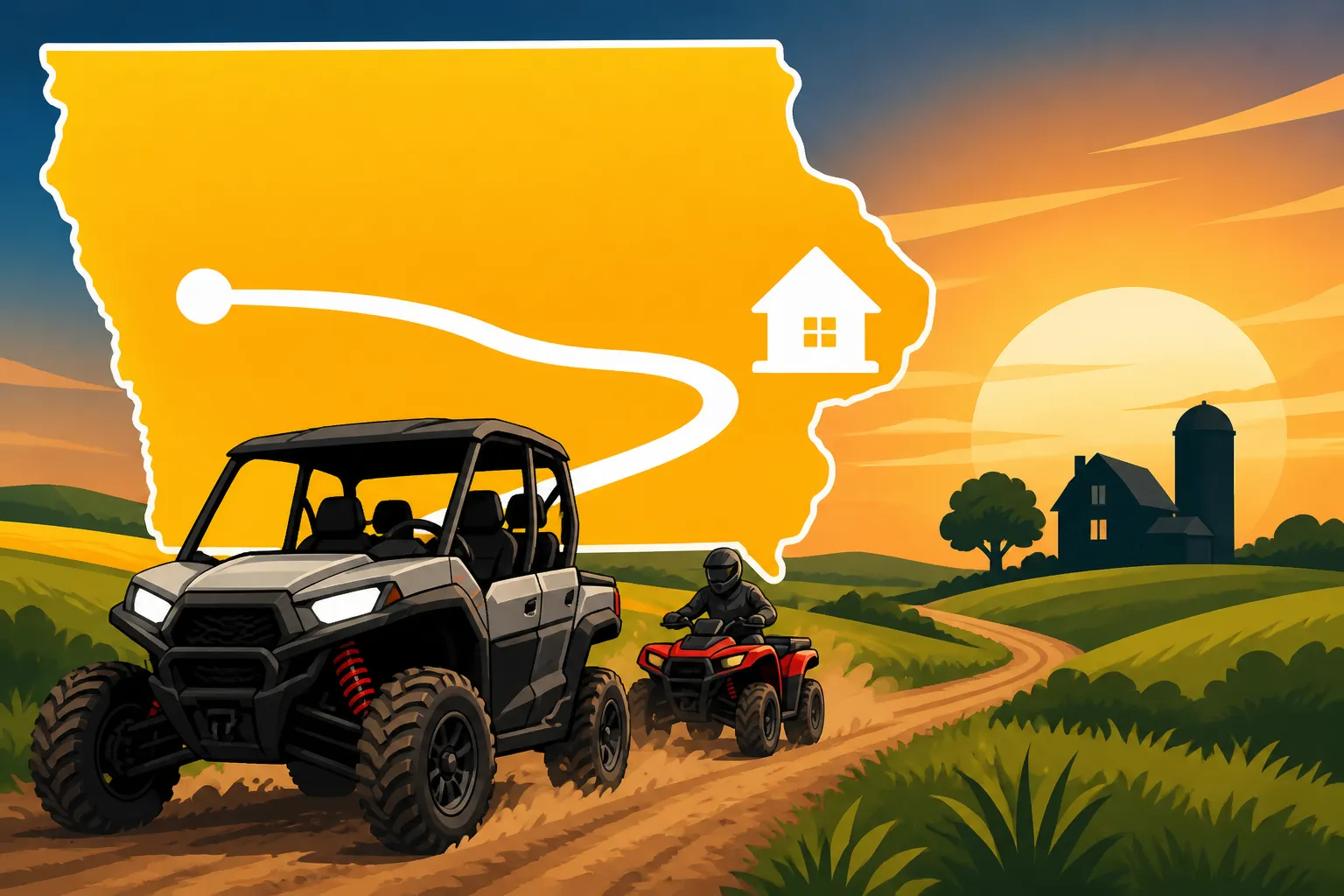
It's a familiar scenario for many Iowa ATV and UTV enthusiasts: you’ve had an incredible day tearing up the trails at Gypsum City or exploring the back forty of a friend’s farm, and now the sun is dipping below the horizon. All you want to do is get your machine back to your truck or home, but that journey often involves navigating a stretch of public road. This guide will walk you through Iowa's specific rules regarding what constitutes "the most direct route home" for your off-highway vehicle, helping you avoid common legal pitfalls and ensuring your ride ends on a good note.
Decoding Iowa's "Most Direct Route" Rule for ATVs and UTVs
The phrase "most direct route" sounds simple enough, doesn't it? But when it comes to navigating Iowa's complex web of ATV and UTV road laws, it's anything but. Many riders, understandably, get frustrated by the seeming contradiction of having a powerful off-road machine that can only touch pavement under very specific circumstances. Iowa's legislators recognized that completely banning OHVs from roads would make it nearly impossible for many rural residents and trail users to access their properties or designated riding areas. So, they established rules, including the "most direct route," to create a compromise.
What "Most Direct Route" Really Means on Iowa Roads
At its heart, "the most direct route" means exactly what it sounds like: the shortest, most efficient path your ATV or UTV can take from Point A to Point B, adhering to all other legal requirements. This isn't an invitation to cruise the scenic byways or take a leisurely tour of the countryside. It's a practical allowance for essential movement. Think of it as a necessity, not a privilege for casual joyriding on public roads. It's about getting from your private property to an authorized trail, or from one piece of farm ground to another, or, crucially, getting back to your staging area or home after a ride. The key is intent and efficiency.
You might be thinking, "But what if there's a slightly longer, but much safer, route?" This is where the law can feel a bit rigid. While common sense often dictates taking a route with less traffic or better visibility, the legal interpretation of "most direct" doesn't typically account for such nuances. A conservation officer or sheriff's deputy at a roadside stop will likely be looking for evidence that you are indeed on the shortest practical path. Deviating significantly, even for what seems like a good reason to you, could lead to questions, or worse, a citation for illegal road use. This rule is often the subject of debate among riders because it doesn't always align with what feels like the most responsible route, but rather the most expeditious one.
The Legal Framework: When This Rule Applies
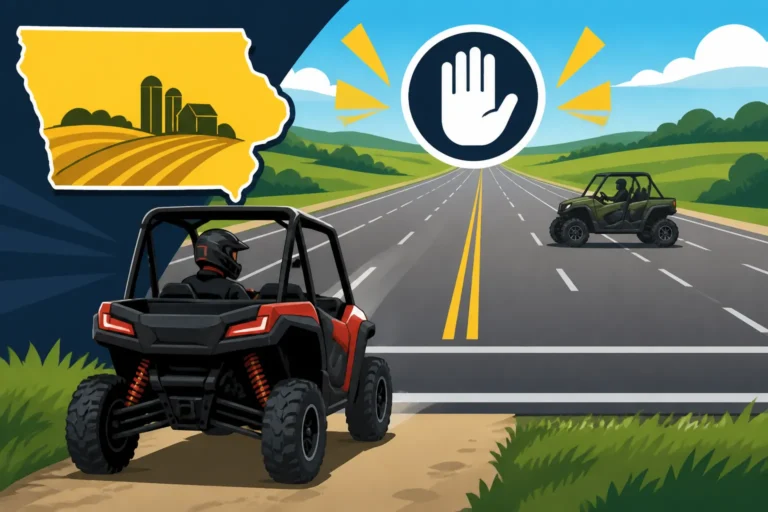
Iowa's law, specifically Iowa Code Section 321I.10, outlines when an off-highway vehicle (OHV) can operate on certain public roadways. The "most direct route" rule typically applies when you are connecting private property to private property, accessing an [Undivided Two-Lane Primary Highways in Iowa] to cross it at an intersection, or when you are traveling to or from an authorized public riding area. It's not a blanket permission to operate your ATV or UTV on any road at any time. Rather, it's a specific exception to the general prohibition.
For instance, if you live adjacent to an authorized OHV park and want to ride your machine directly from your garage to the park entrance, the "most direct route" rule would apply. Similarly, if you're a farmer needing to move your machine between fields separated by a gravel road, you'd utilize this rule. It’s crucial to remember that this allowance is often paired with other requirements, such as operating only during daylight hours, having the proper insurance, and equipping your machine with necessary safety features. It’s never just about the route; it’s about the route and adhering to all other stipulations of [What Iowa Requires of an ATV on a Public Road].
Practical Examples: Riding Home, Riding to the Trails
Let's imagine you've spent the day riding at Bluff Creek OHV Park. Your truck and trailer are parked in the staging lot, and you need to get your UTV loaded up to head home. The path from the trail exit to the staging lot is usually considered part of your "most direct route home." However, if you decide to take a detour to a nearby gas station for a snack or an extra fuel can, you've likely strayed from the "most direct route." Even if the gas station is just a quarter-mile down the road, it introduces a secondary purpose to your journey that may not be covered by the law's intent.
Another common scenario involves rural property owners. Say you live on a county gravel road and your riding area is on your land, but you occasionally want to visit a neighbor's property a mile down the road to help with fencing. If that mile is entirely on an [Unpaved County Secondary Roads in Iowa], and it's the shortest path, you're likely within the "most direct route" rule. The moment you decide to go an extra mile past your neighbor to pick up some parts in town, however, you've likely stepped outside the bounds of the law. This is where many riders get into trouble, as convenience often overrides strict legal interpretation. [The Most Direct Route Home in Iowa] specifically guides these actions.
Navigating Different Iowa Road Types Legally
Understanding the "most direct route" also requires a firm grasp of which types of roads you can even consider riding on in Iowa. It's not a free-for-all, and specific county and city authorizations play a massive role in where your wheels can legally turn. The frustration many riders feel is valid—it's incredibly difficult to keep track of every county's individual ordinances, especially when planning a trip through multiple jurisdictions.
Unpaved Secondary Roads: Your Primary Gateway
When it comes to legal ATV and UTV road use in Iowa, unpaved secondary roads, often referred to as gravel roads, are generally your most permissible option. These are the roads that weave through Iowa's rural landscapes, connecting farms, small towns, and private residences. State law often grants counties the authority to regulate OHV use on these roads, and most Iowa counties allow it to some degree, particularly for purposes like farming, hunting access, or as part of a "most direct route" to a specific destination or authorized trail.
However, "generally permissible" doesn't mean "anything goes." You still need to adhere to all other state laws regarding registration, insurance, and equipment. You're expected to operate safely, share the road with other vehicles, and not exceed the posted speed limits (or the state-mandated 35 mph cap, whichever is lower). These roads are not your personal playground; they are public rights-of-way. Many riders love the freedom of these gravel roads, and aftermarket accessories from companies like SuperATV, such as upgraded suspension components, can make long stretches of gravel much more comfortable and stable, ensuring your machine handles safely even on less-maintained surfaces.
Paved Secondary Roads and the County's Call
Here's where things get a bit more restrictive. Unlike unpaved secondary roads, the use of ATVs and UTVs on [Paved Secondary Roads and County Authorization] is not universally permitted by default in Iowa. For an OHV to be legally operated on a paved county secondary road, the county Board of Supervisors must explicitly authorize it through a formal resolution or ordinance. This is a critical distinction that often trips up riders who assume all "county roads" are fair game.
The decision to open paved secondary roads to OHVs is left entirely up to each of Iowa's 99 counties. What's allowed in one county, say Webster County near Gypsum City OHV Park, might be strictly prohibited just over the border in an adjacent county. This patchwork of regulations can be incredibly confusing and frustrating for riders, making it essential to do your homework before venturing onto any paved county road. Always check with the specific county's sheriff's office or county recorder's office for the most current information. Without explicit authorization, riding your ATV or UTV on a paved secondary road, even if it's part of what you consider the "most direct route," could lead to a significant fine and a roadside conversation with a local deputy.
State Highways and Crossing Rules
State highways, especially the multi-lane primary highways, are generally off-limits for ATVs and UTVs in Iowa, with very few exceptions. You simply cannot ride your machine down the shoulder or in a lane of a state highway for extended periods. This is for the safety of both OHV operators and the high-speed traffic typically found on these routes. The machines are not designed for sustained highway speeds, nor do they offer the same level of protection as an enclosed vehicle.
However, there is a crucial allowance: you are typically permitted to cross a [Undivided Two-Lane Primary Highways in Iowa] at a 90-degree angle, provided it's at an intersection and you're doing so as part of your "most direct route." This is not an opportunity to drive on the highway, but merely to traverse it quickly and safely to get from one authorized road or private property to another. Always yield to oncoming traffic and ensure the crossing is absolutely clear before attempting it. This rule underscores the idea that road use for OHVs is primarily for connectivity, not for travel on major arteries.
Essential Requirements for Road-Legal ATV/UTV Use in Iowa
Even when you're on an authorized road and taking the "most direct route," there are a host of other requirements your machine and you, as the operator, must meet. Neglecting these can turn an otherwise legal journey into a costly mistake.
Driver Age, Licensing, and Rider Responsibilities
In Iowa, if you're going to operate an ATV or UTV on any public road, you must be at least 18 years old and possess a valid driver's license. This is a non-negotiable rule. [Iowa Driver's License Rules for ATVs] are strict about this; a minor, even with a valid safety certificate for off-road riding, cannot legally operate an OHV on a public road, including gravel roads. This is a common point of confusion, as younger riders might be perfectly legal on trails but not on public thoroughfares.
As the operator, you also carry significant responsibilities. This includes obeying all traffic laws, such as stop signs, yield signs, and speed limits (even if they're higher than your machine's 35 mph cap on public roads). You must operate your machine in a safe and prudent manner, meaning no reckless driving, wheelies, or anything that could endanger yourself or others. Remember, you're sharing the road with cars, trucks, and farm equipment, and they might not expect to encounter an ATV or UTV. Your conduct reflects on all OHV riders, so set a good example.
Mandatory Equipment for Iowa Road Use
To be considered "street legal" for approved road use in Iowa, your ATV or UTV must be equipped with specific features. It's not enough to just have a loud exhaust and a cool paint job. These are safety items designed to make your machine visible and controllable on public roads:
- Headlights: Must be on and functioning, even during daylight hours.
- Taillights and Brake Lights: Essential for visibility from the rear, especially when stopping.
- Horn: A working horn is required to alert other drivers or pedestrians.
- Mirror: At least one rearview mirror is needed to see traffic approaching from behind.
- Slow-Moving Vehicle (SMV) Triangle: This red-orange reflective triangle must be displayed on the rear of your machine, indicating that your vehicle travels at 25 mph or less. Even though ATVs can go faster, the law requires it due to their typical operating speeds on roads.
- Spark Arrester: While more for trail use, a U.S. Forest Service approved spark arrester is technically required for any OHV operation, ensuring sparks don't ignite dry vegetation.
- Muffler: Your machine must have an adequate muffler to prevent excessive noise.
Many riders turn to aftermarket providers like SuperATV for these critical components. Their extensive catalog offers everything from robust LED light bars that provide superior nighttime visibility (though remember, night riding on roads is generally prohibited for OHVs) to durable mirrors and street-legal horn kits, ensuring your machine meets Iowa's stringent requirements.
Insurance: Non-Negotiable for Road Riding
This is a big one, and often overlooked. If you're going to operate your ATV or UTV on any public road in Iowa, including those unpaved secondary roads, you absolutely must have liability insurance. This isn't a suggestion; it's a legal requirement, just like for any other motor vehicle. The minimum coverage limits are typically 20/40/15 (meaning $20,000 for bodily injury to one person, $40,000 for bodily injury to two or more people, and $15,000 for property damage). [Iowa ATV Insurance Requirement] is in place to protect you and others in case of an accident.
Carrying proof of insurance with you while riding is also mandatory. A physical or digital insurance card that clearly shows your coverage for the specific ATV or UTV you are operating will suffice. If a law enforcement officer pulls you over and you cannot provide proof of insurance, even if you are otherwise legally on the "most direct route," you could face significant fines and penalties. This is one of the easiest ways to get cited, and it's completely avoidable with a little planning. [Iowa Fines for No Proof of Insurance] can quickly add up, making the cost of a policy seem trivial by comparison.
Common Pitfalls and How to Avoid Them on Iowa Roads
Navigating Iowa's OHV road laws can feel like walking through a minefield. The intricacies, combined with the natural human inclination to seek convenience, lead to several common mistakes that riders make. Being aware of these pitfalls is the first step to avoiding them and ensuring your rides are always within the bounds of the law.
The Allure of a Shortcut vs. the "Most Direct Route"
We've all been there: you're heading home, and you know a paved shortcut that will save you five minutes, even if it's technically a mile longer than the gravel road. Or perhaps there's a quick jog through a small town that seems more convenient than looping around on the county roads. This is precisely where the "most direct route" rule gets violated. The temptation to take a more convenient, but not necessarily shorter, path is strong.
However, convenience is not a legal justification. If your chosen path is longer, or if it takes you onto a prohibited road type (like an unauthorized paved secondary road or through a city that hasn't opened its streets), you're no longer on the "most direct route." Law enforcement officers are well-versed in these common deviations. Their job is to ensure public safety and adherence to the law, and they will likely not be swayed by arguments of "but it was faster" or "I always go this way." Stick to the shortest, legally permissible path, even if it feels like a slight inconvenience. This strict interpretation means you might pass up a familiar convenience store in favor of sticking to the shortest route back to your trailer.
Understanding City Ordinances and Their Impact
Iowa's OHV road laws often defer to local control, particularly concerning city streets. While a county might authorize OHV use on its paved secondary roads, a city within that county has its own separate authority to decide whether ATVs and UTVs can operate on [Iowa City Streets and Iowa Council Authorization]. This means that even if you're on a legal county road and following your "most direct route," the moment you cross into city limits, the rules can change dramatically.
Many cities in Iowa have not opened their streets to OHVs, or they have very specific restrictions on which streets are open, when, and for what purpose. You cannot assume that because you're riding legally on a county road that you can just cruise through the nearest town. It’s absolutely essential to [How a City Council Votes to Open Streets] and check with the specific city clerk's office or police department if you plan to enter city limits on your machine. Riding through a city without proper authorization can quickly lead to a citation, even if it's only for a block or two as part of your perceived "most direct route."
Enforcement and Penalties for Non-Compliance
So, what happens if you're caught riding illegally? A deputy or conservation officer isn't going to give you a lecture and send you on your way. [A Deputy at an Iowa Roadside Stop] is empowered to issue citations, and the penalties for illegal ATV/UTV road use in Iowa can be significant. Fines for operating an unregistered machine, riding on a prohibited road, or lacking insurance can quickly add up. These aren't just minor tickets; they can sometimes run into hundreds of dollars.
Beyond financial penalties, repeated violations could lead to more serious consequences, such as impoundment of your machine or even suspension of your driver's license in extreme cases. It's simply not worth the risk. Understanding and adhering to the "most direct route" rule, along with all other requirements, is paramount. Ignorance of the law is never an excuse, and officers are trained to identify OHV violations. A little proactive research and adherence to the rules will save you a lot of headache, and money, in the long run.
Strategic Planning for Your Iowa Road Routes
Given the complexities of Iowa's OHV road laws, a little forethought and planning can go a long way in ensuring your rides are enjoyable and legal. Don't just wing it; take the time to map out your journey and understand the local regulations.
Mapping Your Most Direct Route Safely
Before you even load your machine, take a moment to look at a map. Consider where you're starting, where you're going (whether it's a trail, private property, or your home), and what public roads are involved. Utilize online mapping tools to identify the shortest path, specifically looking for [The Most Direct Route to an Iowa OHV Park] or other legal destinations. Focus on gravel roads where possible, as they generally have fewer restrictions. If paved secondary roads are unavoidable, make sure to verify county authorization.
| Road Type | General OHV Legality in Iowa | Key Restrictions & Considerations |
|---|---|---|
| Unpaved Secondary | Generally Permitted | Must adhere to "most direct route," 35 mph cap, require lights, horn, mirror, SMV triangle, insurance. |
| Paved Secondary | Only if County Authorizes | Requires explicit county resolution. If authorized, same equipment/speed rules apply. Check local laws! |
| State Highways | Prohibited (except crossings) | Can only cross at 90 degrees at an intersection as part of "most direct route." No driving on highway. |
| City Streets/Alleys | Only if City Authorizes | Requires explicit city ordinance. Many cities prohibit. Check local laws with City Clerk. |
| Private Land | Always Permitted | Requires landowner permission. No registration or road equipment needed if never touches public land. |
This pre-ride mapping is especially important when exploring new areas or when you anticipate a short road section to connect two different riding areas. Don't rely on memory or assumptions. If you're going to a destination like Bluff Creek, understanding the [The Most Direct Route Home in Iowa] from the park to your trailer or home will save you stress.
Checking Local Ordinances Before You Ride
This is perhaps the most critical step to avoid an unexpected citation. As mentioned, the rules for paved county roads and city streets vary widely. Before you ride, especially if you plan to deviate from purely unpaved roads, contact the relevant local authorities:
- County Sheriff's Office or County Recorder: For information on [Iowa Counties That Allow ATVs on Paved Roads].
- City Clerk's Office or Local Police Department: For specific details on [Iowa Cities That Allow ATVs on Streets].
Don't be afraid to ask specific questions: "Is Highway 14 in your county authorized for ATV use on the shoulder?" or "Can I ride my UTV on the paved secondary road from Main Street to my property just outside city limits?" Getting clear answers upfront will save you potential headaches down the line. Sometimes, the most direct route might technically be a paved road that isn't authorized for OHV use, forcing you to find a slightly longer, but legally permissible, alternative.
Preparing Your Machine for the Road Ahead
Finally, once you've mapped your route and confirmed local legality, make sure your machine is ready for the road. This means more than just having the required equipment. Do a quick pre-ride check:
- Tire Pressure: Are your tires properly inflated for road use? (Often higher than trail pressure for better handling).
- Lights: Are all headlights, taillights, and brake lights functioning?
- Horn: Does it work?
- Mirrors: Are they clean and properly adjusted?
- SMV Triangle: Is it securely mounted and visible?
- Registration and Insurance: Do you have your current registration certificate and proof of [Iowa ATV Insurance Requirement] on hand? [Carrying the Certificate on an Iowa Ride] is legally required.
Taking these few extra minutes to prepare your machine, in addition to planning your route, demonstrates responsibility and preparedness. It shows that you're not just an off-road enthusiast but a conscientious road user, which can sometimes make a difference in how a [A Deputy at an Iowa Roadside Stop] approaches an interaction.
Disclaimer
This article is for general informational purposes only and does not constitute professional advice. Laws, prices and regulations vary by location and change over time. Consult a qualified professional for guidance on your specific situation.