What an 18-Year-Old Needs to Ride an Iowa Road
It’s a rite of passage for many young adults in Iowa: turning eighteen and dreaming of hitting the open road, or at least the open gravel roads, on their ATV or UTV. You’ve likely spent years riding private land, maybe even taking a safety course, and now you feel ready for more freedom. But the leap from private property to public roads, even those less traveled, comes with a whole new set of rules that can feel incredibly confusing. This guide will walk you through exactly what an 18-year-old needs to legally and safely operate an ATV or UTV on Iowa's public roads, clarifying the requirements so you can ride with confidence and avoid unnecessary hassle.
The Basics of Iowa's Road Rules for OHVs
Riding an off-highway vehicle (OHV) on public roads in Iowa isn't quite like hopping in a car. While an ATV or UTV might feel substantial, the law treats them differently, especially when it comes to shared roadways. Understanding the fundamental distinctions is your first step toward responsible and legal riding. It's not just about what you can do, but also about the important responsibilities that come with it.
Age and Licensing Requirements
One of the most critical aspects for any 18-year-old looking to ride an ATV or UTV on Iowa roads is meeting the age and licensing requirements. It might seem obvious, but there’s a nuance here that often catches riders off guard. Simply being 18 isn't enough; you need to possess a valid driver's license. This isn't just about showing an ID; it's about proving you have demonstrated the basic skills and knowledge required to operate a motor vehicle safely on public thoroughfares.
Many riders, especially those who've grown up riding on farms or private property, may have never needed a formal driver's license for their OHVs. They might have taken an ATV safety course and received a certificate, which is fantastic for trail riding, but it doesn't translate to road legality. The state of Iowa specifically stipulates that anyone operating an ATV or UTV on a public road must be at least 18 years old and hold a valid driver's license. This requirement is in place because public roads involve interactions with other vehicles, traffic laws, and varying road conditions that demand a level of experience and judgment generally associated with licensed drivers. This means if you're 18 but haven't yet passed your driver's test, your road-riding dreams will have to wait a little longer. [Iowa Driver's License Rules for ATVs] provides more specific details on what's expected of you.
Machine Eligibility and Equipment
Beyond the rider, the machine itself must meet certain criteria to be considered road-legal in Iowa. This isn't just a matter of having four wheels and an engine; it's about specific safety equipment designed to make your OHV visible and controllable in a mixed-traffic environment. First and foremost, your ATV or UTV must be registered with the county recorder. This isn't optional for road use; it's a fundamental step that includes titling and getting that all-important decal. Without current registration and the corresponding decal prominently displayed, you're immediately riding illegally, no matter how many other boxes you check. [Registering an ATV in Iowa] is a good resource for understanding this process.
Once registered, your machine needs specific functional equipment. You'll need working headlights and taillights, which seems straightforward, but they must be visible from certain distances, especially if you plan on riding near dusk or dawn. A working horn is also essential for signaling other drivers or pedestrians. Mirrors are a must, typically at least one rearview mirror, to help you see what's behind you. And, crucially, your OHV needs a slow-moving vehicle (SMV) triangle securely affixed to the rear. This bright orange-red triangle serves as a universal signal to other drivers that your machine is designed for speeds under 25 mph, even though Iowa's road speed limit for OHVs is capped at 35 mph. These aren't just suggestions; they are legal requirements intended to enhance your safety and the safety of others sharing the road. Aftermarket accessory companies like SuperATV offer a wide range of options for these vital components, from comprehensive turn signal kits to durable rearview mirrors, helping you get your machine up to snuff.
Essential Gear and Machine Modifications for Road Use
It's tempting to think that once you've got your driver's license and your machine is registered, you're good to go. However, preparing your ATV or UTV for the road involves more than just the basics. There are specific modifications and pieces of equipment that Iowa law requires, and for good reason. These aren't just arbitrary rules; they're designed to make your OHV as visible and predictable as possible when sharing the road with cars, trucks, and other vehicles that operate at much higher speeds.
Lighting, Mirrors, and Horns
When you're out on a public road, visibility is paramount. Your ATV or UTV, especially compared to larger vehicles, can be surprisingly hard to see. This is why Iowa law is very particular about lighting, mirrors, and horns. Your machine needs working headlights that are on even during daylight hours, ensuring you're seen head-on. Just having them isn't enough; they need to be properly aimed and bright enough to fulfill their purpose. Similarly, you must have working taillights that are clearly visible from the rear, especially important for preventing rear-end collisions. Beyond these, the law often implies the need for brake lights that illuminate when you slow down or stop, and some riders wisely add turn signals, even if not explicitly mandated for all road types, to clearly communicate their intentions to other drivers. While not all OHVs come equipped with robust signal systems from the factory, aftermarket solutions, such as those offered by SuperATV, can provide integrated turn signal kits and upgraded LED lighting that significantly boost your visibility.
As for mirrors, you need at least one rearview mirror to maintain awareness of traffic behind you. Many riders opt for two mirrors, one on each side, for better peripheral vision, much like a car. This allows you to check for approaching vehicles before making a turn or changing your position on the road, adding a crucial layer of safety. And don't forget the horn! It's not just for startling wildlife; it's a vital communication tool on the road. A quick tap of the horn can alert a distracted driver to your presence, warn a pedestrian, or signal another rider. Ensure your horn is loud enough to be heard over engine noise and other traffic, but not so aggressive that it's misused. These small but mighty components are your voice and eyes on the road, and getting them right is non-negotiable for safe and legal operation. [Iowa Lighting Requirements for ATVs] provides further detail on these specifics.
Slow-Moving Vehicle Signs and Insurance
Perhaps one of the most distinctive requirements for an OHV on Iowa roads is the slow-moving vehicle (SMV) triangle. This bright, reflective orange-red triangle must be securely mounted on the rear of your ATV or UTV, visible to any vehicle approaching from behind. The purpose of this sign is incredibly important: it immediately signals to other drivers that your machine will be traveling at a significantly lower speed than typical road traffic. Even though the legal speed limit for OHVs on Iowa roads is 35 mph, the SMV triangle helps manage expectations for motorists approaching you, giving them more time to react and slow down. Without it, drivers might assume you're moving faster than you are, creating a dangerous situation. It's a simple, yet profoundly effective, safety device that absolutely cannot be overlooked.
Equally critical, and often a point of confusion for riders, is the requirement for liability insurance. Just like a car, if you're riding an ATV or UTV on public roads in Iowa, you must carry proof of financial responsibility. This typically means having an insurance policy with minimum coverage amounts, commonly referred to as 20/40/15: $20,000 for bodily injury to one person, $40,000 for bodily injury to two or more persons, and $15,000 for property damage. The thought of an accident is never pleasant, but having this insurance protects not only you but also others in case of an incident. Getting pulled over without proof of insurance can lead to significant fines and penalties, far outweighing the cost of a basic policy. [Iowa ATV Insurance Requirement] explains these minimums in depth. Don't assume your homeowner's policy or existing auto insurance will cover your OHV on public roads; always verify with an insurance provider to ensure you have adequate coverage specifically for road use. It’s an investment in your peace of mind and your legal standing.
Navigating Iowa's Permitted Roads and Restrictions
Understanding the general rules is one thing, but knowing where you can actually ride your ATV or UTV on Iowa roads is another challenge entirely. Iowa's laws are designed to allow some flexibility for OHV use on public roads, particularly in rural areas, but they come with very specific limitations. It’s not a free-for-all, and mistakenly venturing onto a prohibited road can quickly lead to a citation or worse. The patchwork of state, county, and city regulations means you always need to be aware of your surroundings and local ordinances.
Gravel Roads and Secondary Roads
For many Iowa ATV and UTV riders, the unpaved secondary roads, often referred to simply as "gravel roads," are the primary attraction for road riding. And for good reason: these are generally where OHV use is most widely permitted across the state. The law allows ATVs and UTVs to operate on these unpaved county secondary roads. This means those winding, dusty, picturesque routes that crisscross Iowa's rural landscapes are often fair game. However, even on gravel, there are rules. You must still adhere to the 35 mph speed limit, and all the equipment requirements we've discussed (lights, horn, mirrors, SMV triangle, and insurance) remain in full effect. It’s crucial to remember that these roads are shared with cars, trucks, and farm equipment, so vigilance and defensive riding are always necessary. [Iowa Rules for Riding a Gravel Road] goes into more detail about how to safely navigate these routes.
The situation becomes a bit more complex when you consider paved secondary roads. While many counties open their gravel roads to OHVs by default, paved secondary roads require specific authorization from the county board of supervisors. This means that just because a road is a "secondary road" doesn't automatically grant you permission to ride your ATV or UTV on its paved surface. Each county makes its own decision, and some counties have chosen to open certain paved secondary roads while others have not. It’s not uncommon to find that one county has opened many of its paved routes, while an adjacent county has kept them largely closed. This local variation can be a source of frustration, making it essential to do your homework before you embark on a ride that includes paved sections. Calling the county recorder's office or checking the county's website for ordinances is a smart move. [Iowa Rules for Riding a Paved Secondary Road] clarifies these specific authorizations.
City Streets and Prohibited Highways
Moving beyond county roads, the rules for city streets and state highways become even more restrictive. Generally speaking, state highways, which include primary highways (like US routes or state routes) and especially interstates, are strictly off-limits to ATVs and UTVs. These roads are designed for high-speed traffic, and the slower speeds and different dynamics of OHVs present an unacceptable safety risk. Even crossing a multi-lane highway should only be done at an intersection, taking the most direct route across. It's a stark reality that if you’re caught riding on these prohibited highways, you’re looking at serious fines and legal trouble. [Iowa Rules for Riding a State Highway] leaves no room for ambiguity on this point.
When it comes to city streets, the authority rests with individual city councils. Just like paved county roads, a city council must specifically pass an ordinance to allow ATVs or UTVs on its streets and alleys. This means that a city like Waukon might have opened its streets to OHVs (often with specific hours and other restrictions), while a neighboring town has not. There is no statewide blanket permission for city riding, and unfortunately, there's no single statewide list of cities that have opened their roads. This puts the onus on the rider to research the specific city's ordinances before entering. You might find yourself riding legally on a gravel road, only to cross an invisible line into a town where OHVs are prohibited on city streets, leading to an immediate violation. Always check with the city clerk's office or review local municipal code if you plan to ride within city limits. It’s a frustrating reality that the freedom you feel on a county gravel road can quickly evaporate at a city's edge.
Understanding the "Most Direct Route" Rule
The "most direct route" rule is one of those legal concepts that sounds simple on paper but can cause a lot of head-scratching and anxiety for Iowa ATV and UTV riders. It's a critical component of Iowa's OHV road use laws and is designed to balance the need for riders to access trails or private land with minimizing their time spent on public roads. Misinterpreting this rule can land you in hot water, so it's essential to understand its nuances.
Intent and Interpretation
At its core, the "most direct route" rule is about purpose and efficiency. The intent is not to allow ATVs and UTVs to cruise aimlessly on public roads for recreation, but rather to provide a legal pathway for riders to get from point A to point B, where point A is typically private property or a staging area, and point B is an approved OHV park or another piece of private land. The law permits you to use approved roads to travel the "most direct and accessible route" to or from a designated OHV riding area, a service station, a repair shop, or your residence or lodging. This implies a straightforward, logical path, not a meandering scenic tour. It's about minimizing the distance and time your OHV spends on a public road, recognizing that OHVs are not primary road vehicles. [Iowa's Most Direct Route Rule] highlights the importance of this specific directive.
The challenge comes with interpretation. What constitutes "most direct"? Is it the shortest physical distance, even if it's less safe or convenient? Or does it consider other factors? Generally, law enforcement officers will look for a common-sense approach. If there's a clear, unobstructed gravel road that takes you directly to your destination, that's likely the "most direct." Taking a significantly longer, more circuitous route, especially if it involves more paved roads or passes through areas you could have avoided, might be seen as a violation of the spirit of the rule. The rule is meant to facilitate necessary transit, not joyriding on public roads. It's a testament to the state's cautious approach to integrating OHVs into the public road system, acknowledging their utility while prioritizing safety and minimizing conflict with conventional traffic.
Practical Application for Riders
For an 18-year-old rider, applying the "most direct route" rule practically requires a bit of planning and common sense. Let's say you live on a farmstead in rural Mahaska County and you want to ride your UTV to Bluff Creek OHV Park. You'd typically look at a map and identify the shortest path using legal roads – likely a series of gravel and perhaps county-authorized paved secondary roads. If taking a particular paved secondary road means you shave off five miles compared to staying exclusively on gravel, and that paved road is authorized for OHVs by the county, then that could be considered part of your "most direct route." However, if that paved road is unauthorized, you'd need to stick to the authorized routes, even if slightly longer. [Riding to Bluff Creek the Short Way] is a perfect example of this.
Another common scenario is needing to get fuel. If you're riding on gravel roads and your fuel gauge is dropping, you can take the most direct route to the nearest gas station that is accessible via legal OHV roads. You can't, however, decide to take a scenic detour through town or a prohibited highway just because it's "on the way" to the gas station. Similarly, if you're riding home from a trail, the expectation is that you will take the most efficient route back to your residence, not prolong your road journey unnecessarily. It also means you should be carrying your registration certificate with you on the machine, or at least on your person, to prove your intentions if stopped. This rule is a constant reminder that road riding in Iowa for ATVs and UTVs is conditional and serves a specific, limited purpose, always prioritizing the shortest and most sensible path.
Financial and Legal Ramifications of Non-Compliance
It's easy to get caught up in the excitement of riding, but ignoring Iowa's ATV and UTV road laws can lead to significant headaches and financial burdens. Law enforcement in Iowa, including county deputies and DNR conservation officers, are well-versed in these regulations and are not shy about enforcing them. What might seem like a minor infraction to a rider can translate into serious legal and financial consequences, impacting your wallet, your insurance, and potentially your driving record. The goal is always prevention, but it's important to understand the risks.
Fines and Penalties
The most immediate consequence of illegal road use is, of course, a fine. Riding an unregistered ATV or UTV, or operating one on a prohibited road, can result in citations that carry substantial monetary penalties. These aren't just minor parking tickets; they can quickly add up. For example, [Iowa Fines for Illegal ATV Road Use] details how riding on a state highway or interstate, or within a city that hasn't authorized OHV use, can lead to a significant financial hit. Beyond the initial fine, you might also face court costs and other administrative fees, further escalating the expense. Imagine planning a fun weekend ride only to end up with a bill for hundreds of dollars because you misunderstood a single rule. It's a frustrating situation that no rider wants to be in.
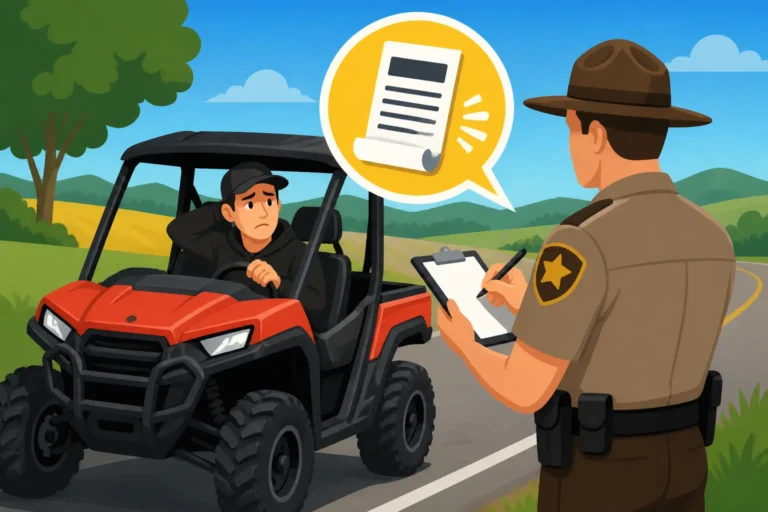
But the penalties don't stop at fines. Operating an OHV without the required insurance is another serious offense. Iowa law mandates minimum liability coverage for road use, and if you're caught without it, you can face stiff penalties beyond the cost of the ticket for riding on an unauthorized road. [Iowa Fines for No Proof of Insurance] can include additional fines, and in some cases, your vehicle could even be impounded. Furthermore, if you're involved in an accident while illegally operating your ATV or UTV, the legal repercussions could be much more severe, potentially leading to civil lawsuits where you are personally liable for damages. This can turn a simple outing into a life-altering financial disaster. Law enforcement takes these violations seriously, understanding the potential dangers that illegally operated OHVs pose to other motorists and pedestrians.
Insurance Consequences and Liability
Even if you have an insurance policy, riding illegally can have devastating consequences for your coverage. Most insurance policies have clauses that render them void if you're operating the vehicle outside the law. This means if you have an accident while riding an unregistered ATV, or on a prohibited road, or without the required safety equipment, your insurance company could deny your claim. Suddenly, you're not just facing fines; you're personally responsible for all damages, medical bills, and legal fees resulting from the incident. This could amount to tens or even hundreds of thousands of dollars, a burden that most 18-year-olds simply cannot bear.
Consider a hypothetical scenario: you're 18, licensed, and your UTV is registered. But you decide to take a shortcut on a paved secondary road that your county hasn't authorized for OHVs. An unforeseen event causes you to swerve, and you clip another vehicle, causing damage and minor injuries. If your insurance company finds out you were operating on a road where you legally shouldn't have been, they could deny your claim. Now, not only are you responsible for repairing your UTV, but you're also on the hook for the other driver's car repairs, their medical bills, and any legal fees that arise from the accident. This is where the true cost of non-compliance becomes terrifyingly clear. It's a stark reminder that understanding and adhering to Iowa's ATV and UTV road laws is not just about avoiding a ticket; it's about protecting yourself and your financial future. Always double-check your routes and ensure your machine is fully compliant before you hit any public road.
| Requirement | ATV/UTV Road Use Checklist for 18-Year-Olds | Details |
|---|---|---|
| Rider Age | 18 years old | Absolutely non-negotiable. No exceptions for younger riders on public roads. |
| Driver's License | Valid Iowa driver's license | Required to operate any motor vehicle on public roads. An ATV safety certificate is not a substitute for road use. |
| Registration & Decal | Yes, current and displayed | Your machine must be titled and registered with the county recorder, and the decal must be affixed. |
| Liability Insurance | Yes, minimum coverage | Proof of financial responsibility (e.g., 20/40/15 minimums) is mandatory. |
| Headlights | Yes, operational and visible | Must be on even during daylight hours for maximum visibility to other drivers. |
| Taillights/Brake Lights | Yes, operational and visible | Essential for rear visibility and signaling deceleration or stops. |
| Horn | Yes, operational | Required for alerting other drivers or pedestrians to your presence. |
| Rearview Mirror(s) | At least one, operational | Helps you monitor traffic approaching from behind. Many riders prefer two for better vision. |
| SMV Triangle | Yes, securely mounted to rear | Slow-Moving Vehicle sign (orange-red triangle) is crucial to warn faster traffic of your lower speed. |
| Speed Limit | 35 mph maximum | Even if the posted speed limit is higher, OHVs must not exceed 35 mph on public roads. |
| Road Type | Unpaved secondary roads | Generally permitted. |
| Road Type | Paved secondary roads | Only if specifically authorized by county ordinance. Must check locally. |
| Road Type | City streets | Only if specifically authorized by city ordinance. Must check locally. |
| Road Type | State/Primary Highways & Interstates | Generally Prohibited. Cross at intersections using the most direct route. |
| "Most Direct Route" | Yes, applicable | Use legal roads only to travel the shortest, most efficient path to or from an approved destination (OHV park, residence, service station, etc.). No aimless recreational cruising on public roads. |
Disclaimer
This article is for general informational purposes only and does not constitute professional advice. Laws, prices and regulations vary by location and change over time. Consult a qualified professional for guidance on your specific situation.