Iowa Rules for Carrying Fuel
Carrying spare fuel on an ATV or UTV can help on a long ride, but a container that shifts, leaks or sits near hot parts creates a serious hazard. In Iowa, the right answer depends on where you ride and the rules for that area. Here’s how to separate permit requirements from fuel restrictions and carry gasoline more safely.
What Iowa rules mean when you carry spare fuel
Fuel carried on a machine raises two different questions: whether the ride and location are allowed, and whether the fuel is being transported safely. An ATV registration, nonresident permit or safety certificate does not automatically answer both.
Start with the place where you plan to ride. A designated OHV area, private trail, event or other managed property can have its own operating rules. Conditions can also change when fire restrictions or closures are in effect. Check with the park or land manager before loading a fuel container, especially if you’re traveling to a park for the day. Iowa Rules for Riding a Designated Riding Area covers the broader question of where designated riding is permitted.
If you’re visiting from another state, check the entry requirements separately. A valid home-state registration may matter for reciprocity, and a nonresident permit may be required in some circumstances. Neither should be treated as permission to carry fuel in any quantity or container. For the separate entry question, see Does Iowa Honor Out-of-State Registration? and Iowa’s Permit for a Visiting Machine.
The route matters, too. Riding a public road is not the same as riding a park trail, and road access can depend on the road type and local authorization. If your trip includes a road segment, confirm that the segment is legal for your machine before focusing on fuel storage. Iowa Rules for Riding Public Land and Iowa Rules for Riding a Club Trail explain different land-use situations.
A practical rule is to treat fuel permission as site-specific. Before you leave, check:
- Whether the land manager allows spare fuel containers on the machine or at the riding area
- Whether temporary fire restrictions apply
- Whether the ride or event has additional rules for fuel, refueling or support vehicles
- Whether your route is authorized for your machine
- Whether an out-of-state rider needs a separate Iowa permit
If the rules aren’t clear, contact the park, club or event organizer directly. Do not rely on another rider’s recollection or assume that a rule from one riding area applies everywhere.
| Question | What to check |
|---|---|
| Is the ride allowed? | Confirm access, route and any permit or reciprocity requirements |
| Can I bring spare fuel? | Ask the land manager or event organizer about containers and quantity restrictions |
| Where can I refuel? | Check whether refueling is permitted on the trail, at the staging area or only in designated places |
| Are there temporary restrictions? | Look for current fire notices, closures or special site instructions |
| Is the container safe for the machine? | Use a purpose-made fuel container and secure it away from heat and moving parts |
Choosing and securing a container
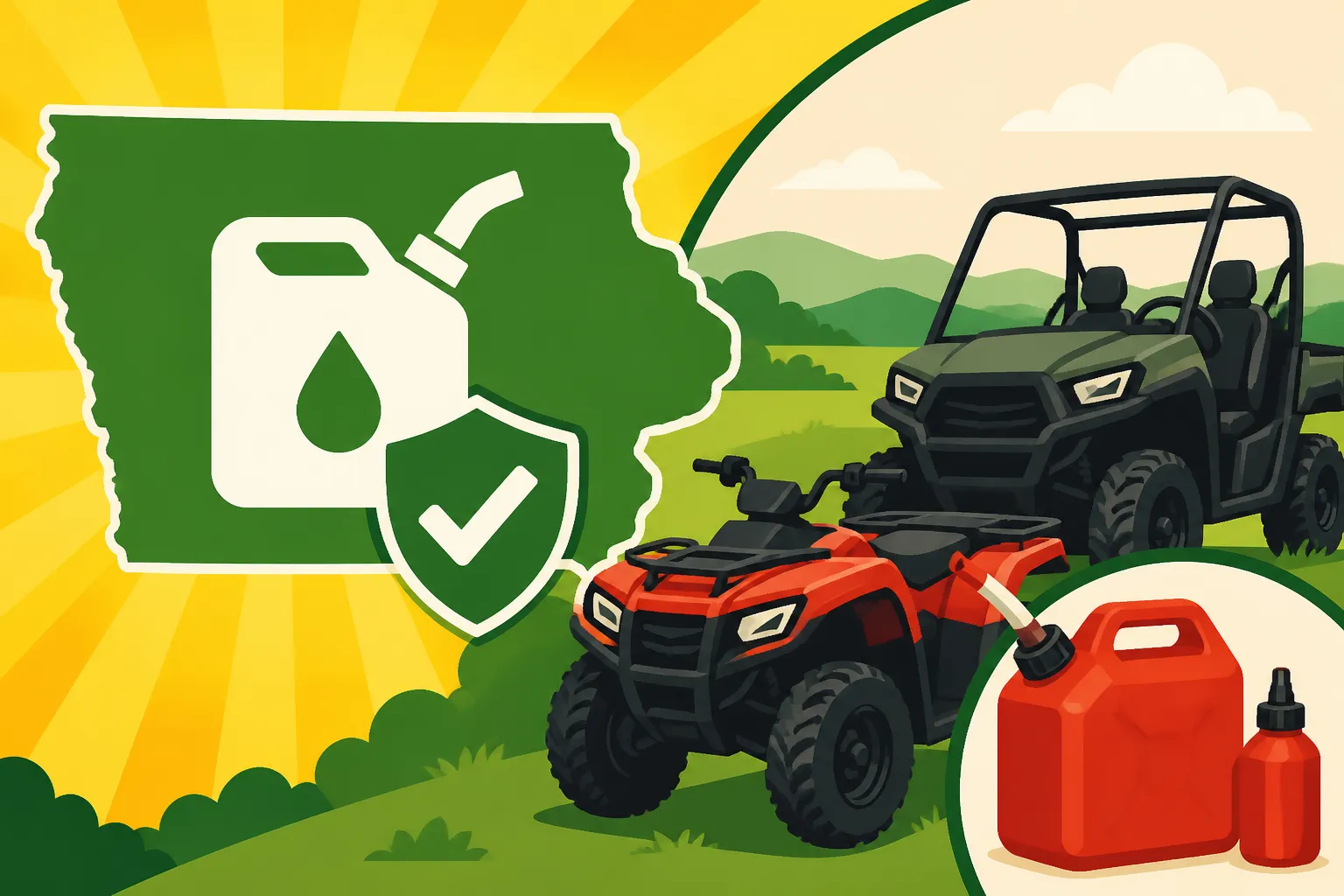
Use a container made and labeled for gasoline. A drink bottle, household jug or unmarked plastic can is not a safe substitute. Fuel can attack unsuitable materials, and a container that was not designed for gasoline may leak or fail when bumped, heated or tipped.
Check the container before every ride. Look for damage, a loose cap, a worn seal, cracks, swelling or residue around the opening. Replace a container that shows signs of deterioration. Close it fully and follow the manufacturer’s instructions for the cap, vent and storage position. Do not modify the container to make it fit a rack.
A purpose-built ATV or UTV fuel pack may be easier to mount than a general portable can, but fit alone is not enough. The container and its brackets need to be compatible with the machine and installed as intended. If you shop online, including on Amazon, confirm that the item is explicitly designed for gasoline and that the mounting system suits your machine; do not choose one based only on its shape or capacity.
Secure the container so it cannot slide, bounce, fall off or contact the exhaust, muffler, engine, drive belt, tires, suspension or other moving parts. Keep it away from sharp edges and anything that could pinch a hose or cap. A loose tie-down is not a reliable substitute for a proper mount. After mounting, push and pull the container firmly and check that it remains stable through suspension movement.
Pay particular attention to:
- Heat: Keep fuel away from hot components and exhaust outlets. Allow enough clearance for heat, vibration and movement.
- Ventilation: Do not carry a leaking container or trap fuel vapors in an enclosed storage space.
- Visibility: Do not block lights, reflectors, the operator’s view, a plate or decal, or access to controls.
- Balance: Avoid placing heavy fuel high or far to one side. Uneven loading can affect handling.
- Passenger and cargo space: Keep the container from interfering with a passenger, footrests, racks or safe entry and exit.
- Mounting hardware: Use a mount designed for the container and vehicle, and inspect it for looseness before riding.
If a container is carried in a trailer or support vehicle instead of on the ATV, secure it against movement and keep it away from ignition sources. Follow the container maker’s storage directions and any rules that apply at your destination. A storage location that is convenient for loading may not be appropriate for a hot machine, a tent, a cabin or another enclosed area.
Refueling on the trail and responding to a spill
Refuel only when the machine is off and stable, and give hot parts time to cool. Avoid smoking, open flames and other ignition sources. Do the transfer in a well-ventilated place, away from other riders and camp activity. If the park has a designated refueling area, use it rather than topping up beside a trail or in a busy staging lane.
Do not overfill the tank. Fuel needs room to expand, and a brim-full tank can spill as the machine warms or moves. Close the fuel cap securely before restarting. Wipe up small drips with an appropriate absorbent material and keep contaminated materials away from heat and flames. Never leave fuel-soaked rags or absorbent material on the ground.
A spill is a reason to stop, not to carry on and hope it evaporates. Keep people and machines clear, prevent ignition sources, and follow the park’s emergency directions. For a spill that is more than a minor drip, or where fuel reaches soil or water, contact the land manager and follow their instructions. Do not wash gasoline into a ditch, drain, stream or lake.
If a container leaks while you are riding:
- Stop in a safe place away from other machines, flames and hot surfaces.
- Shut the machine off and keep people clear of the leak.
- Do not try to ride with fuel dripping or pooling near hot parts.
- Notify the park, land manager or event staff and follow their response instructions.
- Do not reuse the container until the cause of the leak is identified and the container or mount is repaired or replaced.
Pack only the amount that makes sense for the route. Carrying more fuel than you need adds weight, affects handling and increases the consequences of a leak. Plan the distance, expected riding conditions and available refueling options before deciding whether a spare container is necessary. A longer trip does not make an unsuitable container or an unapproved refueling location safe.
A pre-ride checklist for Iowa riders
A few checks before departure can prevent a fuel problem from becoming a trail emergency. Do them before the machine is loaded, then repeat the quick security check at the staging area.
- Confirm access and permits. Verify the riding area’s entry rules and any requirements for an Iowa resident or visitor. A permit is about access; it does not necessarily settle fuel-container rules.
- Ask about site restrictions. Check with the land manager or event organizer about spare fuel, refueling locations, temporary fire restrictions and any current closure notices. Organized rides can have additional instructions, so review Iowa Rules for an Organized Ride if you are attending one.
- Inspect the container. Check that it is designed for gasoline, closes properly and has no leaks or visible damage.
- Inspect the mount. Confirm that the container is held firmly, clear of hot and moving parts, and positioned so it does not interfere with safe operation.
- Plan the fuel amount. Consider the route and refueling options. Take only what is reasonably needed rather than loading extra fuel “just in case.”
- Review your machine’s instructions. Use the manufacturer’s guidance for the fuel system, rack and accessory mounts. Do not exceed the vehicle’s load limits.
- Secure fuel in a support vehicle properly. If you are carrying fuel off the ATV, keep it stable and follow the container instructions and the destination’s rules.
- Know whom to contact. Save or note the park or event contact information so you can report a spill, leak or other problem promptly.
Renters should not assume that a spare can is permitted just because the rental machine has a rack or cargo box. Ask the rental provider and the riding area before adding fuel, and follow the machine’s instructions. Iowa Rules for a Rented Machine is useful for sorting out rental-specific responsibilities.
The safest approach is straightforward: confirm that your ride is allowed, ask the site about fuel restrictions, use a gasoline-rated container and mount it securely away from heat. If any part of the setup is uncertain, leave the spare fuel off the machine until you can verify the rules and find a safer way to carry it.
Disclaimer
This article is for general informational purposes only and does not constitute professional advice. Laws, prices and regulations vary by location and change over time. Consult a qualified professional for guidance on your specific situation.