A Licensed, Experienced Adult in Iowa
Iowa’s supervision rule can be easy to misread: a child’s ride may depend not only on age, but also on the machine, where it is being ridden and who is watching. The key is to choose an adult who meets the stated qualifications and can provide real oversight—not simply someone who happens to be nearby.
What a Licensed, Experienced Adult Means
For an ATV rider under 12 who is subject to Iowa’s supervision requirement, the supervising adult must be at least 18, hold a valid driver’s license and have experience operating an ATV. These are separate qualifications. Being a parent, owning the machine or having a license alone does not automatically establish that an adult meets all three.
The rule is intended to put a capable, responsible person in a position to supervise a young rider. It is not a substitute for checking whether the child may ride that machine in that location, or whether other requirements apply. Start with the relevant age and machine rules in Iowa Supervision for Riders Under Twelve and Iowa Rules for Riders Under 12.
The experience requirement matters. A licensed adult who has never operated an ATV may not be an appropriate supervisor simply because the license is current. Conversely, someone who rides regularly but has no valid driver’s license may not meet the stated qualification. When there is doubt about whether a particular adult’s background qualifies, confirm the current rule with the Iowa DNR before the ride.
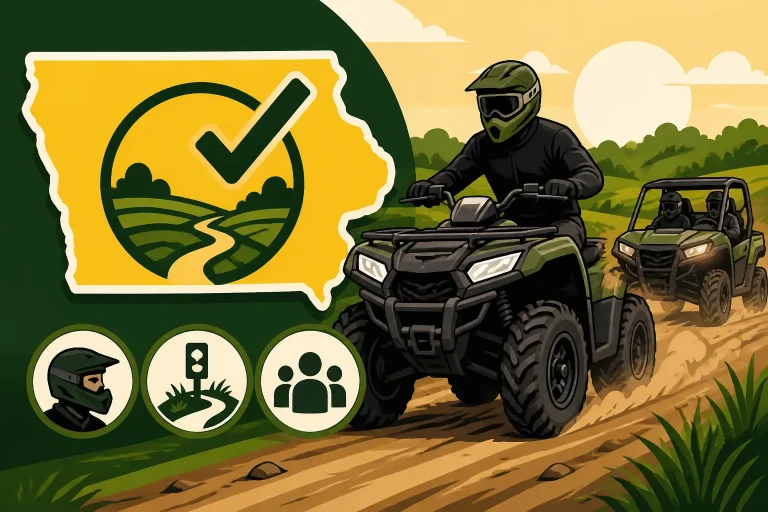
A useful way to think about the phrase is to check three things:
| Qualification | What to verify | Why it matters |
|---|---|---|
| Adult | The supervisor is at least 18 | A young rider needs a responsible adult, not another child acting as lookout |
| Licensed | The adult holds a valid driver’s license | Riding experience does not replace the licensing requirement |
| Experienced | The adult has operated an ATV and understands its controls and risks | Supervision is more effective when the adult can recognize unsafe operation and respond |
Do not treat these qualifications as a checklist that ends once the adult is identified. The adult also needs to be able to pay attention, communicate with the rider and respond if something goes wrong. A person who qualifies on paper but is distracted, too far away or unable to intervene may not provide meaningful supervision.
License and riding experience are different
A driver’s license shows that the adult holds driving credentials; it does not prove ATV competence. ATVs handle differently from cars, and riders need to account for terrain, traction, stability, turning and stopping. An experienced supervisor should know the machine’s controls and limits well enough to help a child avoid predictable hazards.
Experience should also be relevant to the machine and riding conditions. Someone familiar with a small ATV may still need to learn the controls and handling of a different model before supervising a child on it. Likewise, a machine that feels manageable on a flat, open area may be much harder to control on a slope or uneven trail.
When the Supervision Requirement Applies
The first question is not only “Who can supervise?” It is also “Does this rule apply to this rider, machine and location?” Iowa has distinct rules and requirements for different types of machines and riding situations. Do not assume a rule for one type of ATV automatically applies to a side-by-side, dirt bike or other off-highway vehicle.
A child’s age is an important starting point. Iowa’s requirements for riders under 12 differ from those for older children. A rider who reaches 12 should still check the rules that apply to their age group; turning 12 does not make every requirement disappear. [Iowa Minimum Age to Ride Public Land] provides a useful starting point for sorting out age and access questions.
Where the ride takes place also matters. A designated riding area, private property and a public road are not interchangeable settings. Each may have separate access, operating and safety rules. Permission from a landowner, for example, does not necessarily answer every question about what requirements apply to the machine or rider. For more on private-property considerations, see [Iowa Rules for Riding Private Property] and Iowa Landowner Permission Rules.
The supervising-adult rule should not be mistaken for general permission to ride anywhere. It does not itself authorize a child to enter a closed area, ride off a marked trail, operate a machine that is not allowed there or use a road where ATVs are prohibited. Check the area’s current rules and conditions before setting out. Iowa Rules for Riding a Designated Riding Area explains why the location’s rules matter.
Keep the machine type clear
An ATV is not the same as a UTV or side-by-side for every purpose. Requirements can differ by vehicle type, so identify what the machine is before relying on information written for another category. If the child will operate a side-by-side, check the specific requirements for that machine rather than assuming an ATV supervision rule answers the question. [Does an Iowa UTV Operator Need a Certificate?] covers one related distinction.
Do the same for dirt bikes and other off-highway motorcycles. Requirements that refer to ATV operators may not cover every kind of off-highway vehicle in the same way. If the machine’s classification is unclear, ask the Iowa DNR or the riding area before the trip.
Do not confuse supervision with a certificate or permit
Supervision, a safety certificate and machine registration or a visitor permit are different things. Meeting one requirement does not automatically satisfy the others.
For example, a qualified adult does not replace a safety certificate when the rider’s age and machine make a certificate necessary. Nor does a certificate replace required supervision. Check Iowa ATV Safety Certificate Requirements for the certificate rules, including which ages and machine types they cover.
Registration and visitor requirements also deserve a separate check. An Iowa registration decal, a nonresident permit and an operator’s safety certificate serve different purposes. A child may need to ride with a qualified adult and the machine may still need the correct registration or permit for the location. Visitors can review Do Visitors Need an Iowa ATV Permit? and Iowa’s Permit for a Visiting Machine before traveling.
Choosing an Adult Who Can Supervise
The best supervisor is not merely the nearest eligible adult. Choose someone who can stay focused on the rider and make sensible decisions if the conditions change. A group ride, busy trail or unfamiliar machine may demand more attention than a quiet practice session.
Before choosing the adult, discuss the plan. The supervisor should know:
- Which machine the child will use and where its controls are
- The route, riding-area boundaries and any posted rules
- The child’s current skill level and what the child is practicing
- How the group will communicate if riders become separated
- What to do if the machine stalls, tips or develops a problem
- Which adult is responsible for which children
It is better to assign responsibility clearly than to assume that everyone in a group is watching everyone else. If one adult is supervising several young riders, consider the group’s size, the adults’ positions and how much attention the terrain demands. A supervisor cannot monitor a child effectively while also managing unrelated tasks or riding beyond the child’s reach.
Confirm the adult’s qualifications before departure
A quick conversation can prevent confusion at the trailhead. Confirm that the adult is at least 18, holds a valid driver’s license and has real experience operating an ATV. If the group includes different machine types, confirm the adult knows the machine the child will use rather than assuming familiarity carries over.
If the adult’s license is expired, suspended or otherwise not valid, do not rely on it as satisfying the licensing qualification. If the adult has only ridden a different kind of vehicle, or has very limited ATV experience, choose someone better qualified or ask the DNR for clarification before the child rides.
Keep current registration, permit and certificate documents available as required for the ride. Documents do not replace supervision, but having them accessible can make it easier to answer questions about the machine and rider. Carrying the Certificate on an Iowa Ride and Carrying Your Home-State Registration on a Visit cover related document questions.
Match supervision to the child and terrain
A child’s age alone does not show whether they can handle a particular machine. Consider the rider’s size, coordination, attention, experience and ability to follow instructions. The supervisor should also consider the terrain: loose surfaces, steep slopes, mud, narrow trails and other riders can make control more demanding.
Start with conditions that suit the child’s ability, not the most challenging part of the area. Explain where to stop, how to signal and what to do if the child feels unsure. Set a pace the child can maintain, and agree that the child can stop without being pressured to keep up.
If the child is tired, upset, distracted or struggling to control the machine, pause the ride. A plan that worked at the beginning may no longer be appropriate after fatigue or changing conditions set in. Supervision includes deciding when to stop, not just watching while the machine is moving.
What Effective Supervision Looks Like
The law’s qualifications identify who may supervise; good judgment determines how that supervision works in practice. An adult should be engaged enough to notice developing problems and available enough to help the child respond. The safest arrangement will depend on the location, the child’s ability and whether the adult is riding too.
Before the machine starts, walk through the basic plan together. Make sure the child understands the controls, the agreed route, how to stop and how to get help. The adult should know what the child can do independently and where the child may need reminders. If the child cannot follow the plan or control the machine reliably, the ride should wait.
During the ride, keep the child within a range where the adult can monitor what is happening and respond. That may mean riding close, choosing a slower pace or stopping at decision points. On an unfamiliar trail, the adult should not get so far ahead that the child is left to guess which way to go. Nor should the supervisor assume another rider is responsible unless that role has been agreed.
Pay attention to conditions as well as the child. A trail can become slippery, crowded or difficult, and a route that is appropriate for one rider may be too demanding for another. Respect closures and posted restrictions. For broader access rules, see [Iowa Rules for Riding a Closed Trail].
A simple pre-ride routine can help:
- Confirm that the adult meets the age, license and experience qualifications.
- Check the child’s age, machine type and any certificate requirement.
- Verify that the machine has the registration or permit required for the ride.
- Review the riding area’s rules, route and current conditions.
- Explain how the adult and child will communicate and regroup.
- Start on terrain that fits the child’s ability, then reassess as conditions change.
- Stop if the child, machine or trail is no longer safe for the plan.
Riding in a group
Group rides can make supervision harder, not easier. A large group creates more distractions and can leave a child unsure which adult to follow. Name the supervising adult before the ride, establish a leader and a regrouping plan, and make sure no child is left behind while the group continues.
If several adults are present, decide who is responsible for which young rider. A general instruction such as “the adults will keep an eye on them” can fail when each person assumes someone else is watching. Make the assignment explicit, especially at intersections, trail junctions and stopping areas.
Keep the child’s pace in mind when planning the route. The adult should not pressure a young rider to follow faster or more experienced operators. If the group cannot ride at a pace that suits the child, split into smaller groups or choose a different route.
Buying equipment and preparing the machine
Supervision does not make suitable protective equipment or a properly maintained machine optional. Check the riding area’s equipment rules, make sure the child has properly fitting protective gear, and confirm the machine is in safe operating condition. A helmet that fits poorly can be uncomfortable and less useful; size and fit matter more than a convenient purchase.
If comparing helmets or other protective gear online, including on Amazon, check the applicable safety standard, fit guidance and return conditions before ordering. A product listing alone does not prove that a particular item fits the rider or meets the rules of the place where the child will ride.
The machine should also suit the child’s size and skill. Controls that are difficult to reach or a machine the child cannot manage confidently can undermine even attentive supervision. Review Youth Machine Sizes and Iowa Rules before choosing equipment for a young rider.
Common Mistakes to Avoid
The most frequent mistake is treating supervision as a name on a form instead of an active responsibility. An adult may meet the age, license and experience qualifications but still be a poor choice for a particular ride if they are distracted, unfamiliar with the child’s machine or unable to keep the child in view.
Other mistakes include:
- Assuming a parent or guardian is automatically qualified without checking the license and experience requirements
- Assuming any licensed adult has ATV experience
- Treating past experience on a different machine as proof of familiarity with the child’s ATV
- Confusing a safety certificate with adult supervision
- Assuming an adult’s presence permits riding in a closed area or on a road
- Assuming ATV rules apply identically to a UTV or dirt bike
- Letting several adults share responsibility without deciding who is watching the child
- Allowing the child to ride beyond the supervisor’s ability to monitor and respond
- Relying on old information without checking current requirements and riding-area rules
A second common problem is making a decision based on only one part of the situation. For example, a child may have permission to ride on private land, but the family should still check the applicable operator and machine rules. Likewise, a registered machine does not automatically make its operator eligible to ride in every place.
When a detail is unclear—such as whether the adult’s experience counts, whether the child needs a certificate or whether the vehicle is classified as an ATV—ask the Iowa DNR or the land manager before riding. A short check is easier than trying to resolve a rules question after arriving at the site.
Frequently Asked Questions
Does the adult have to be the child’s parent?
The key qualifications are age, a valid driver’s license and ATV operating experience. Do not assume that the rule is satisfied merely because the supervisor is a parent or guardian. Confirm the current requirements for the child’s riding situation.
Is a driver’s license enough?
No. The adult must also be at least 18 and experienced operating an ATV. A license does not prove ATV experience, and experience does not replace the license requirement.
Does supervision replace an Iowa safety certificate?
No. Supervision and a safety certificate are separate requirements. Check the child’s age, machine type and riding location to determine whether a certificate is also required.
Can an adult supervise a child from far away?
Do not treat the adult’s presence somewhere in the area as effective supervision. The supervisor should be able to monitor the child, communicate and respond. The appropriate distance depends on the terrain, conditions and rider, so plan a ride that keeps the child within effective oversight.
Disclaimer
This article is for general informational purposes only and does not constitute professional advice. Laws, prices and regulations vary by location and change over time. Consult a qualified professional for guidance on your specific situation.