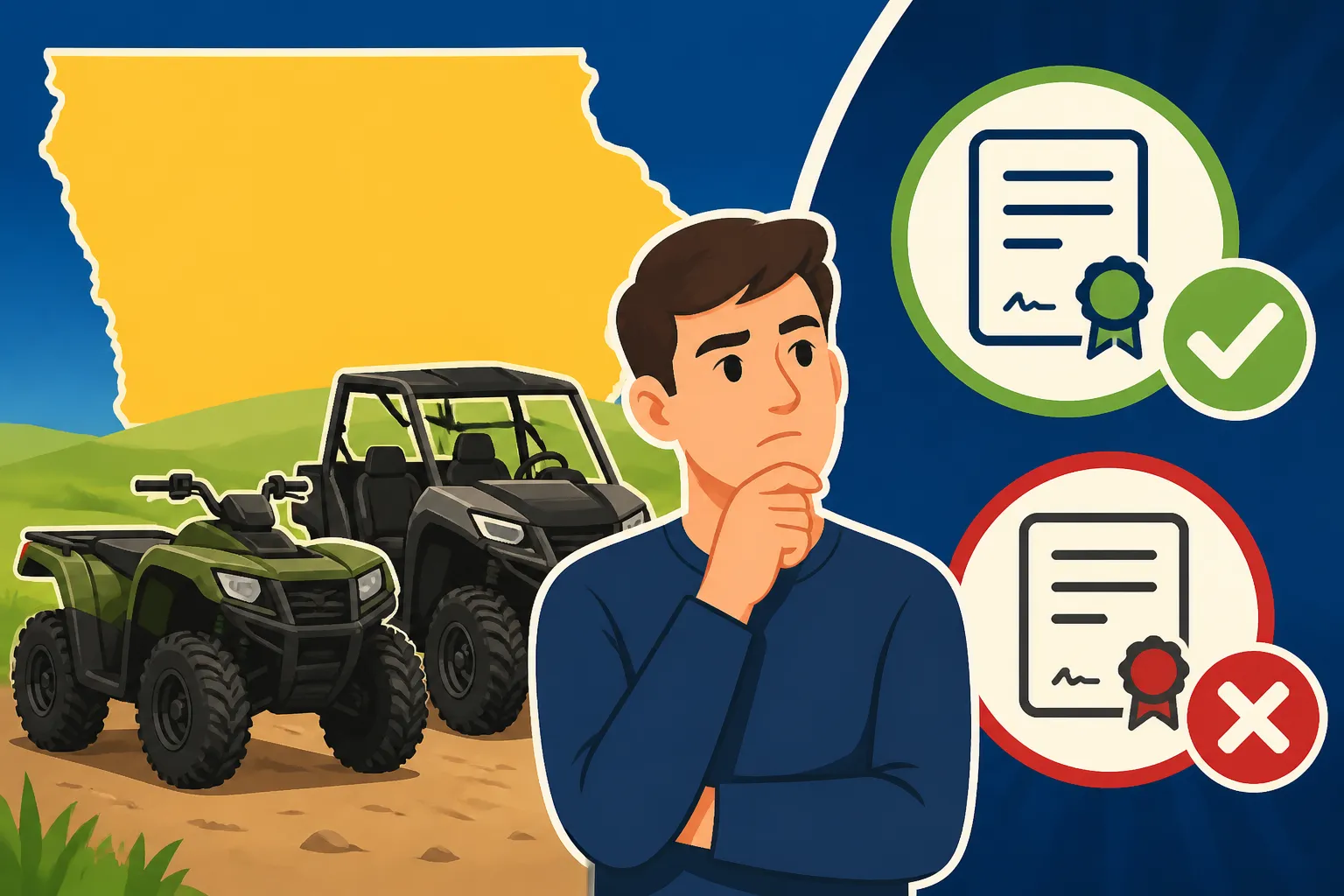
Does an Iowa Adult Need a Certificate?
If you’re an adult planning to ride an ATV in Iowa, the age-based safety certificate rule is straightforward: adults generally do not need one. The confusion comes from mixing that rule with registration, visitor permits and land-access requirements. Here’s what the certificate does—and does not—mean for adult riders.
Does an adult need an Iowa ATV safety certificate?
No. Iowa’s safety-certificate requirement applies to ATV operators ages 12 through 17 in situations covered by the state’s off-highway vehicle rules. An operator who is 18 or older is not required to hold the certificate just to ride an ATV in Iowa.
The rule is tied to the operator’s age, not to whether they are a first-time rider, an Iowa resident or an experienced adult who has ridden elsewhere. If you are 18 or older, you do not need to take the course to meet Iowa’s age-based certificate requirement. For the full age range and related conditions, see Iowa ATV Safety Certificate Requirements and Iowa Safety Certificate Age Range.
That answer is specific to the certificate. It does not mean an adult can ride any machine, on any land, without meeting other requirements. Registration or a nonresident permit may still apply, and a trail, park, landowner or event can have its own rules. A certificate also does not replace permission to ride or make an otherwise prohibited route legal.
The certificate rule is about the operator
The relevant age is the age of the person operating the ATV. A parent or other adult riding alongside a teenager does not take the teenager’s place for certificate purposes. Likewise, an adult who has a certificate from a course does not make an underage operator exempt from the rules that apply to that young rider.
If you are 17, do not assume that being close to 18 changes the rule. The adult exemption begins when you are 18. Until then, check the requirements for the particular riding area and make sure the young operator has the required certificate and follows applicable supervision rules.
The under-12 rules are a separate issue. Being too young for the certificate requirement does not mean a child can ride without limits. Iowa has supervision rules for younger riders, and the permitted activity and location matter. See Iowa Rules for Riders Under 12 and [Iowa Supervision Rules for Riders Under 12] if you are planning a ride with a child.
A certificate is not a general ATV license
An Iowa safety certificate is proof that a rider completed the required safety education. It is not a driver’s license, a registration document, a trail pass or permission to use someone else’s property. Adults do not need it as a state age requirement, but they still need to follow the rules that apply to their machine and riding location.
| Question | What the certificate rule means |
|---|---|
| I am 18 or older. Do I need the certificate? | No, not under Iowa’s age-based ATV certificate requirement. |
| I am 12 through 17. Does age matter? | Yes. The certificate requirement applies to this age group in covered situations. |
| Does the certificate register my ATV? | No. Registration or a permit is a separate matter. |
| Does it let me ride private land? | No. You still need the landowner’s permission and must follow applicable rules. |
| Does having a certificate let me ride a closed trail? | No. Trail closures and site rules still apply. |
| Does the same certificate rule apply to every machine type? | No. Iowa’s requirements distinguish among machine types; check the rule for the vehicle you will operate. |
What adults still need to check before riding
Even when you do not need a safety certificate, you may need to satisfy other Iowa requirements. The most useful approach is to check the machine, the rider and the route separately rather than treating “I don’t need a certificate” as a complete answer.
Registration and nonresident permits
If you own an ATV, determine whether it needs Iowa registration and a decal for the kind of riding you plan to do. Visitors should also check whether their home-state registration is recognized for their intended use or whether they need an Iowa nonresident permit. The certificate question and the permit question are separate: an adult can be exempt from the certificate requirement and still need the appropriate registration or permit.
For a visitor, start with Do Visitors Need an Iowa ATV Permit? and Iowa ATV Registration for a Nonresident. Those topics help distinguish a machine’s home-state documents from the Iowa requirements that may apply while riding in the state. Check the current Iowa DNR information before traveling, especially if you plan to use a designated riding area.
Do not assume that a sticker or document from another state automatically covers every type of Iowa riding. Reciprocity, registration status and the location where you ride can affect what applies. Keep the required documents with you or available as directed by the applicable rules.
Where you ride matters
A private farm, a public riding area, a trail system and a road are not interchangeable. An adult may not need a certificate, but access and operating rules can change with the location.
On private ground, permission is central. A landowner’s invitation does not necessarily remove other legal requirements, and being on private property does not give a rider permission to enter neighboring land. For more on the distinction, see [Iowa Rules for Riding Private Property] and [Iowa Landowner Permission Requirements].
At a designated riding area, follow its posted rules, trail markings and closure notices. A certificate exemption does not authorize riding off a marked trail or entering a closed section. Before loading up, check the site’s current information and any DNR closure alerts. The rules for Iowa Rules for Riding a Designated Riding Area can help you separate general state requirements from site-specific conditions.
If your plan includes a public road, check road-use rules separately. Certificate status does not make a machine street legal or grant permission to use a road. Iowa’s road rules can involve the route, road type, operator qualifications, equipment and insurance. Do not treat an off-road certificate as a substitute for those requirements.
Machine type can change the answer
The phrase “ATV safety certificate” is sometimes used loosely for different off-highway vehicles. Iowa’s rules do not treat every machine type identically. In particular, side-by-sides and off-road motorcycles have distinct rules from ATVs in the certificate framework. If the vehicle is a UTV rather than an ATV, check Does an Iowa UTV Operator Need a Certificate? rather than applying the ATV answer automatically.
That distinction matters when people ride together. An adult operating an ATV, a teenager operating an ATV and an adult operating a side-by-side may each be subject to different conditions. A youth passenger’s age does not by itself answer whether the operator needs a certificate; focus on who is driving, what machine is being operated, and where it is being used.
When a machine’s classification is unclear, use its documentation and the state’s description of the covered vehicle types. A seller’s casual description—such as “quad,” “buggy” or “four-wheeler”—may not be enough to settle which rule applies.
Should an adult take the course anyway?
The state age requirement and the practical value of safety training are different questions. An adult may not need a certificate, but taking a course can still be worthwhile, particularly for a new rider, someone returning after a long break, or a person moving from a small ATV to a heavier or more powerful machine.
A safety course can help riders think through terrain, speed, braking, hills, passengers, protective gear and the limits of a machine. Those skills matter even when no card is required. Iowa trails can include changing surfaces and conditions, and a route that looks manageable from a map may be more demanding in person. The certificate exemption is not a statement that an adult already knows how to ride safely.
Consider training if you are:
- New to ATVs or unfamiliar with the controls on a particular machine.
- Planning to ride with children or supervise younger riders.
- Moving from private ground to a designated trail system.
- Returning to riding after years away.
- Riding in a group where machines, experience and terrain vary.
If you take a course voluntarily, keep the completion record if it is useful to you, but do not confuse it with your registration or permit documents. For a rider who is 12 through 17, the certificate requirement is a compliance issue in covered situations; for an adult, training is a safety choice rather than a way to satisfy that age-based requirement.
A parent arranging training for a teenager should check the current Iowa course and certificate process before relying on an old card, an out-of-state course record or a verbal assurance that training was completed. The details of course delivery and proof can change. Confirm the current requirements with the Iowa DNR or the applicable course provider.
A practical check before an Iowa ride
For an adult, the certificate question is usually the easiest part of the preparation. Use this short checklist to avoid overlooking the requirements that still apply:
- Confirm the operator’s age. If the operator is 18 or older, Iowa’s age-based ATV safety-certificate requirement does not apply to that adult. For a younger operator, check the requirements for their age and situation.
- Identify the machine type. Confirm whether it is an ATV, UTV, off-road motorcycle or another type of off-highway vehicle. Do not assume the same certificate rule covers all of them.
- Check the documents for the machine. Determine whether Iowa registration or a nonresident permit is required for the ride you are planning.
- Confirm where you will ride. Review landowner permission, designated-area rules, posted restrictions and current closures.
- Separate off-road and road rules. If any part of the trip uses a road, check the applicable road-use requirements independently.
- Carry what the rules require. Keep registration, permit or other required proof available in the manner directed by the relevant authority or riding area.
If you are renting, borrowing or using a family member’s machine, do not assume the owner’s paperwork settles every question for the operator. Check the machine’s documents, the rental or site rules, and the age requirements for the person who will drive. [Iowa Rules for Riding a Rented Machine] covers that separate situation.
The bottom line is simple: an adult aged 18 or older does not need an Iowa ATV safety certificate under the state’s age-based requirement. But registration or a visitor permit, land access, machine classification, road rules and riding-area restrictions still deserve their own checks. If you are preparing for a trip with a teenager, make the certificate question part of a broader review of supervision and the specific place you intend to ride.
Disclaimer
This article is for general informational purposes only and does not constitute professional advice. Laws, prices and regulations vary by location and change over time. Consult a qualified professional for guidance on your specific situation.