Checking Two Iowa Parks Before You Drive
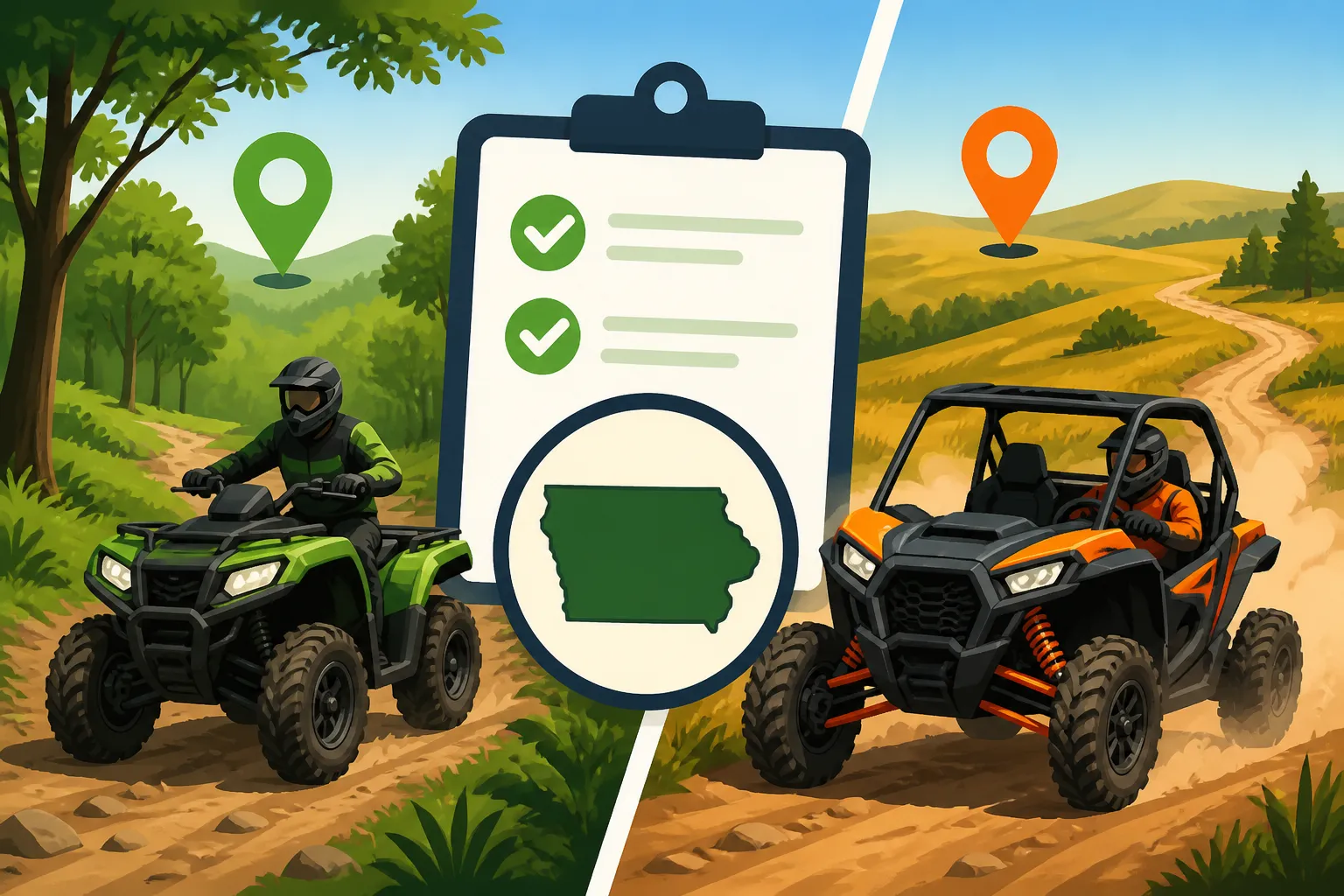
A two-park Iowa ATV trip can sound like a smart backup plan until you’ve loaded the trailer, driven an hour, and found a gate closed after rain. Checking conditions at both destinations before leaving helps you avoid wasted miles and choose a realistic fallback. This guide explains what to verify, where to look, and how to make a practical Plan B.
Start With the Two Parks You Can Actually Reach
Compare drive time, not just map distance
Choose a primary park and a backup before you start loading. For example, a rider heading toward Gypsum City OHV Park near Fort Dodge might compare it with another destination only if the added drive still makes sense for the group, trailer, fuel range, and available riding time. A backup that adds several hours isn’t much of a backup if the first park is closed.
Use a route planner to compare the full trip, including the drive between the two parks. A straight-line distance can be misleading on Iowa roads, especially when your route includes smaller county roads, construction, or a long haul with a trailer. Work out how long you can comfortably keep driving before deciding whether the second park is a genuine option.
Before you set out, check that both destinations fit your group. Consider machine width, rider experience, youth riders, and the sort of terrain everyone wants. A beginner-friendly alternative may be more useful than a technically closer park with trails that are a poor fit for your youngest or least-experienced rider. For help comparing destinations, start with Iowa Trail Difficulty Ratings and Iowa Trails for Beginners.
Confirm each park is open to riding
A park’s usual season or posted hours don’t guarantee that it will be open on the day you plan to visit. Weather, trail conditions, maintenance, and other local decisions can affect access. Treat general descriptions and old trip reports as planning clues, not proof that the gates are open today.
Check the park’s own updates and the Iowa DNR’s alerts before you leave. If the status is unclear, contact the park or its operator directly. Ask whether the trails are open to riding—not just whether the campground or parking area is accessible. If staff or a posted notice says trails are closed, don’t assume you can use them because the lot looks open.
For a useful starting point, review Iowa Trail Closures to Check First and Reading a DNR Closure Alert. If your preferred destination is one of Iowa’s larger riding areas, Iowa’s Eight Designated OHV Parks can help you identify alternatives, but you’ll still need to confirm the status of each specific park.
Check Conditions at Both Parks Before You Load
Look beyond the weather forecast
A forecast tells you what the sky may do; it doesn’t tell you exactly how a trail will ride. Rain earlier in the week can leave Iowa clay slick, deeply rutted, or soft enough that park staff close trails to prevent damage. A dry forecast for Saturday doesn’t erase the effects of a wet Thursday.
Look for the timing and location of recent rain, not just the day’s general forecast. Conditions can vary across the state, so a shower near Eddyville may not tell you much about trails near Fort Dodge. If a closure notice mentions wet trails, follow it even if your home area looks dry. Trail conditions at the park matter more than the weather outside your garage.
When an update is vague, ask a focused question: Are the trails open now? Are all loops open, or only certain sections? Has rain changed access since the latest notice? That gives you more useful information than asking whether the park is “good.” For additional planning, read Iowa Trail Conditions Before You Ride and Iowa Riding After Heavy Rain.
Use maps for navigation, not as proof of access
An off-road map can help you understand where a park sits, estimate travel between destinations, and avoid arriving at the wrong entrance. Tools such as onX Offroad can be useful for organizing a route and keeping trip details together, particularly when your group is comparing a primary park with a backup. Check the map carefully against the park’s official directions before you hitch up.
A map is not a live closure notice. A trail or access road displayed on a map may be closed, restricted, or unsuitable for your machine. Don’t use a mapped line as permission to ride outside a designated area or cross private property. Confirm current access rules through the park or official local information.
It also helps to save the route and the park’s contact details before you leave. Cell service can be unreliable in some rural areas, and a group chat may not be enough if riders become separated or a plan changes. onX Offroad can serve as one planning reference, while official park updates remain the source to check for closures. Keep the two roles separate: maps help you orient yourself; park notices tell you whether you can ride.
| What to check | Primary park | Backup park |
|---|---|---|
| Open to riding on your date | Confirm through official updates or the operator | Confirm separately; don’t assume it shares the primary park’s status |
| Recent rain and trail conditions | Look for wet-trail closures or restrictions | Check local conditions near this park, too |
| Hours and entrance details | Verify current directions and access | Confirm the correct entrance and any posted restrictions |
| Fit for your group | Check trail difficulty and machine suitability | Make sure the alternative works for every rider |
| Travel plan | Estimate drive time with your trailer | Include the added distance from the primary park |
| Backup decision | Decide how long you’ll wait for an update | Set a clear point when you’ll switch destinations |
Make a Backup Plan That Works in Real Life
Decide in advance when you’ll switch
A backup only helps if your group agrees on when to use it. Decide whether you’ll switch parks before leaving home, while stopping for fuel, or only after checking in with the park. Without an agreed decision point, riders can end up debating in a parking lot while the day disappears.
For example, your group might agree that if the primary park is closed or its status can’t be confirmed by a certain point, you’ll head to the backup rather than drive to the gate and hope. Make that choice based on the added drive time and remaining daylight, not on optimism. If the alternative is too far away to leave a worthwhile riding window, it may be better to reschedule.
Share the plan with everyone towing or navigating. Include the backup’s name, address or directions, and the phone number or official page you’ll use to check its status. If one driver gets delayed, the rest of the group can follow the same plan instead of making separate guesses.
Confirm that the alternative is suitable
Being open is not the only requirement. Check whether the backup park can accommodate your machine and your group’s experience. A wide side-by-side, a youth rider, or someone new to trail riding can change which destination is practical. Verify any park-specific rules before you commit.
Think through the basics: Is there a suitable place to unload? Do you have enough fuel for the drive and ride? Are you bringing the right gear for the expected conditions? If the second park has different terrain, make sure your group is comfortable with the change. A backup should make the day safer and easier, not pressure anyone into riding beyond their ability.
If children are coming, check the rules and plan supervision before departure. A park change can affect the day’s timing and who is responsible for each young rider. These details are easier to settle at home than beside a trailer after a closure notice. Related guidance includes Iowa Trails Good for Kids and Iowa OHV Park Hours.
Use a Simple Check Before You Leave
Run through the final checks on departure day
A quick final review can catch the problems that were not apparent when you made plans earlier in the week. Check each park’s current closure information, confirm hours and directions, review the latest weather near both destinations, and make sure your backup is still realistic. If the status is unclear, call rather than treating silence as an open-gate announcement.
Then verify that your paperwork and machine are ready for the ride. Iowa registration and riding requirements depend on the machine and where you plan to use it. Review Iowa ORV Permits Explained and Iowa Trail Maps From the DNR as part of your broader trip planning, and confirm any park-specific rules before you go.
Keep your decision simple: if the first park is open and conditions suit your group, go there. If it is closed or conditions are unsuitable, switch only if the backup is confirmed open and the drive still leaves enough time to ride. If neither destination checks out, turning around or postponing is frustrating—but it beats spending the day chasing uncertain access.
Keep a record of what worked
After the trip, note which contact method gave you the clearest answer, how long the drive took with your trailer, and whether the backup was genuinely convenient. Save useful park pages and directions so the next trip takes less research. If you relied on a map, update your saved route if the entrance or approach was confusing.
A short trip note can be especially helpful when you ride with the same group. Record which trails were open, what the conditions were like, and whether the park suited your machines and riders. Keep those notes as personal observations rather than treating them as a substitute for fresh closure checks. A trail that was dry on one weekend may be closed after the next storm.
That habit turns a last-minute scramble into a repeatable routine. Pick two parks, verify both through reliable channels, check the local conditions, and agree on when to change plans. onX Offroad may help with route organization, but the final go-or-no-go decision should come from current park information and the conditions on the ground.
Disclaimer
This article is for general informational purposes only and does not constitute professional advice. Laws, prices and regulations vary by location and change over time. Consult a qualified professional for guidance on your specific situation.