Meeting a Full-Size Truck on a Park Trail
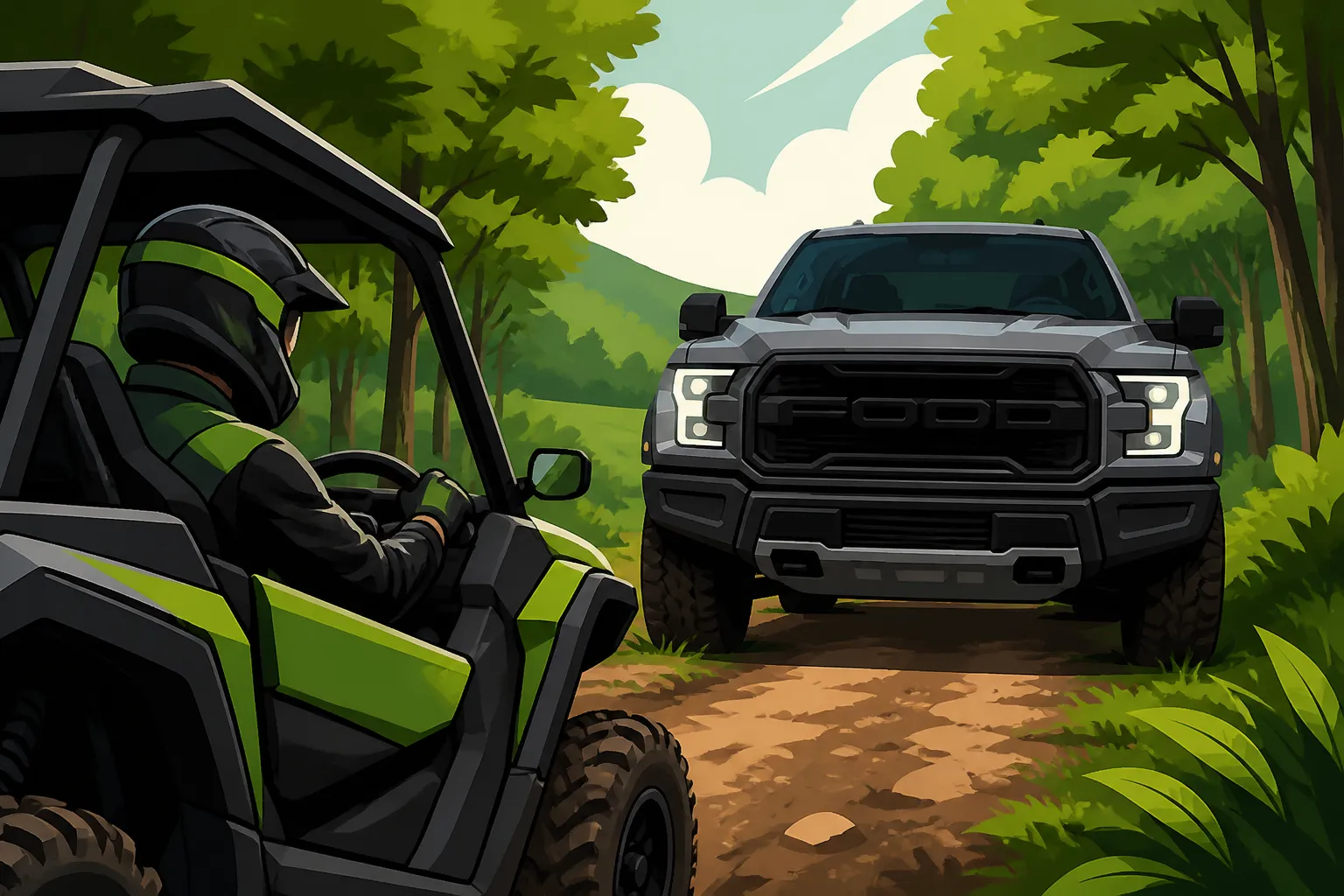
Meeting a full-size truck on an Iowa park trail can feel startling, especially when the route narrows and there’s nowhere obvious to pull over. The safest response is to slow down early, make yourself visible, and avoid squeezing past or backing blindly. This guide explains how to prepare, handle the encounter, and keep everyone moving safely.
Before you enter an Iowa trail
Check that the route is open to full-size vehicles
A truck on a trail may be an authorized trail user, a park or maintenance vehicle, or a sign that you’ve reached a route shared with larger vehicles. Don’t assume every Iowa OHV trail is open to full-size rigs. Rules and permitted vehicle types vary by riding area, and a route that looks wide enough is not automatically a legal route for trucks.
Check the park’s current map and posted rules before unloading. If you’re unsure whether a particular trail is shared, call the park or managing organization rather than guessing at the trailhead. Iowa Rules for a Full-Size Rig on a Trail and Calling a Park Before You Load can help you think through the questions to check.
This matters even if you’ve visited before. A route may be closed, rerouted, or restricted because of conditions or maintenance. At places with multiple trail types, the park map and signs—not another rider’s tire tracks—are the best guide to where your machine belongs.
Study the trail and conditions first
A narrow, wooded section is a different situation from a broad, open route with clear sightlines. Before riding, look at the map for loops, intersections, steep sections, and places where two vehicles might have room to pass. Trail difficulty ratings can help you choose a route that suits your experience and machine, but they don’t guarantee that every part of the trail will feel wide or easy.
Check for closures and recent conditions, too. Iowa soil can become slick or deeply rutted after rain, making it harder to stop or move safely onto the edge. Iowa Trail Maps From the DNR, Iowa Trail Difficulty Ratings, and Iowa Trail Conditions Before You Ride are useful starting points for planning. An app such as onX Offroad can help you review a route before the trip, but verify access and closures with the park’s own information.
A simple pre-ride check can prevent a stressful surprise:
- Confirm the park is open and the route allows your machine.
- Review the current map and posted trail signs.
- Check whether the route is shared with larger vehicles.
- Identify safe places to stop or turn around if the trail becomes unsuitable.
- Make sure everyone in your group knows how to communicate a stop.
What to do when you see a truck
Slow down early and make your presence clear
When a full-size truck appears, ease off the throttle and reduce speed in a controlled way. Avoid a sudden stop in a blind corner if you can safely continue a short distance to a spot with better visibility. Keep enough room between your ATV or UTV and the rider ahead so the group doesn’t bunch up or collide during a quick slowdown.
Let the truck driver know you’re there without startling them. Use a brief, deliberate signal such as a wave, and make eye contact if it’s possible. Don’t assume the driver has seen you just because the vehicle is facing your direction. A truck’s size, windows, mirrors, occupants, and trail noise can make it difficult for the driver to notice a smaller machine.
If you’re riding with others, tell the group to stop in a safe, visible place rather than forming a line around a blind bend. One rider can signal the rest to hold back while the lead rider assesses the space. onX Offroad may help you discuss route choices before the ride, but no map can tell you what the driver sees around a corner in that moment.
Choose a safe place to stop and pass
If the trail is narrow, don’t try to squeeze between the truck and a tree, ditch, rock, or steep edge. Stop where both vehicles can see each other, and look for a firm, reasonably level area that leaves room for the truck to maneuver. Avoid pulling onto fragile ground, soft shoulders, or a slope where your machine could slide or tip.
Once stopped, give the truck room. The driver may need to reposition, reverse slowly, or use a nearby wider area to pass. Don’t move forward simply because the truck pauses; wait until the driver’s intention is clear. If you’re unsure whether there is enough clearance, stay put and communicate rather than testing the gap with your handlebars, tires, or cargo rack.
Here’s a practical way to assess the encounter:
| Trail situation | Safer response |
|---|---|
| You see the truck well ahead on a broad section | Slow down, stay to your side, and follow signs or the park’s passing guidance |
| The trail narrows before you can pass | Stop at a visible, stable spot and let the driver assess the space |
| The truck is approaching around a blind curve | Stop before the curve if safe, stay visible, and don’t enter the blind section to investigate |
| There is no safe room to pass | Wait for the driver to reposition or use a suitable wider area |
| The truck appears to be on a restricted trail | Don’t confront the driver; move to a safe place and contact park staff if appropriate |
Don’t back up blindly or rush around the vehicle
Backing an ATV or UTV on a narrow trail can be risky, especially with a passenger, a trailer, limited rear visibility, or a steep drop beside the route. If you need to reverse, do it slowly and only after checking behind you. Have a passenger or companion guide you if available, using clear signals and staying out of the machine’s path.
Don’t ride around the truck on the shoulder, through vegetation, or along an unmarked shortcut. A few seconds saved can cause trail damage, create a collision risk, or put you somewhere the park does not allow riders to go. If the route is too tight for a safe pass, waiting is the sensible choice. Sharing Gypsum City With Full-Size Rigs offers related context for riders using trails where larger machines may be present.
Safer habits for a group ride
Keep the group compact but not crowded
A large group can turn a simple meeting into a confusing one. Riders at the back may not know why the lead rider stopped, while those at the front may be tempted to move around the truck before everyone has caught up. Agree on a signal before setting out—such as a raised hand for stop—and make sure each rider knows to pass it along.
Leave enough distance between machines that a rider can slow down without striking the person ahead. At the same time, don’t spread the group so far apart that the lead rider and tail rider lose contact in a busy or wooded section. If the group has children or less experienced riders, keep a confident adult nearby and make sure they understand that “stop” means stay stopped until directed.
A phone or two-way radio can help a group coordinate, but don’t rely on cell service being available everywhere. Agree on what to do if the group gets separated: stay on the marked route, don’t ride off alone searching, and return to a known meeting point only if that can be done safely.
Give the truck room to maneuver
A full-size vehicle may need more space to turn, reverse, or avoid a rut than an ATV does. Keep your machine out of the truck’s likely path, including blind spots near the front, rear, and sides. Don’t stand immediately behind it while the driver is reversing, and don’t assume the driver can see you through the mirrors.
If you’re with a group, keep everyone in one safe holding area rather than letting riders scatter around the vehicle. A passenger should remain seated and belted as appropriate for the machine, and children should stay close to their supervising adult. Keep hands and feet away from tires and moving parts, even when the truck seems to be stopped.
If the driver asks you to move, make sure you understand the direction before moving. A short verbal exchange or clear hand signal is better than guessing. If the truck driver is trying to get through a narrow section, patience gives them time to make a controlled choice and gives your group time to stay out of the way.
When an encounter becomes unsafe
Leave room for poor visibility and difficult ground
Dust, mud, vegetation, and uneven terrain can make it hard for either driver to see the trail edge. On a dusty route, slow down and allow dust to settle before proceeding if visibility is poor. In muddy conditions, avoid stopping on a slick incline where your machine might slide when you start again. If the ground beside the trail is soft or steep, it may be safer to wait on the trail in a visible, stable position than to pull off.
Don’t treat a map as a promise that the route will be passable in every condition. A track shown on an app may not reflect a temporary closure, a washed-out section, or a newly posted restriction. Use onX Offroad or another mapping tool for planning, then follow the park’s signs and updates on the ground. If conditions make the route unsafe, turn back only when you can do so safely and legally.
Know when to ask for help
If the truck blocks the trail, a driver behaves aggressively, or there’s a collision or injury, prioritize getting people out of immediate danger. Don’t stand in a blind spot or try to force a passage. If anyone is hurt, contact emergency services and give a clear location, using a trail name, intersection, loop marker, or nearby landmark if known.
For a non-emergency access concern, contact park staff or the organization responsible for the riding area. Avoid arguing in the middle of a narrow trail, where both vehicles and other riders may be at risk. If you believe a vehicle is using a closed or restricted route, note the location and vehicle details only if it’s safe to do so, then report the concern through the appropriate park channel.
The goal is not to decide who “owns” the trail during a tense encounter. It’s to avoid a collision, protect the trail, and give everyone a safe way to continue or turn around. Calm communication and a willingness to wait are usually more useful than trying to win a tight passing situation.
Make the next ride easier
After an encounter, take a moment to check that your group is together and that everyone feels comfortable continuing. If the trail was unexpectedly shared or too narrow for your machine, adjust your route rather than assuming the next stretch will be easier. Recheck the map, look for posted directions, and consider a different loop or riding area.
When you get home, make a note of the trail section and conditions. That detail can help you plan the next trip and warn your riding partners about a pinch point. If you need to choose a route that better suits a wider machine, Iowa Trails for a Wide Machine may help you compare options, and Iowa Trail Closures to Check First can help you build closure checks into your routine.
Disclaimer
This article is for general informational purposes only and does not constitute professional advice. Laws, prices and regulations vary by location and change over time. Consult a qualified professional for guidance on your specific situation.