Are ATVs Street Legal in Iowa?
It's a common dream for many of us in Iowa: just hopping on our ATV or UTV and cruising down the road, maybe to a buddy's place, or just a quick run to the store. But then reality hits – those nagging questions about legality, what's allowed, and what could land you a hefty fine. This guide is here to untangle the often confusing web of Iowa's rules for riding your off-highway vehicle on public roads, giving you the clear, realistic answers you need.
The Core Question: Are ATVs Street Legal in Iowa?
This is the big one, and it's where most of the confusion starts. You see side-by-sides running around some towns, or quads on gravel roads, and you wonder, "Can I do that too?" The simple answer is almost never a straightforward "yes" or "no" in Iowa.
The General Rule: No, But There Are Exceptions
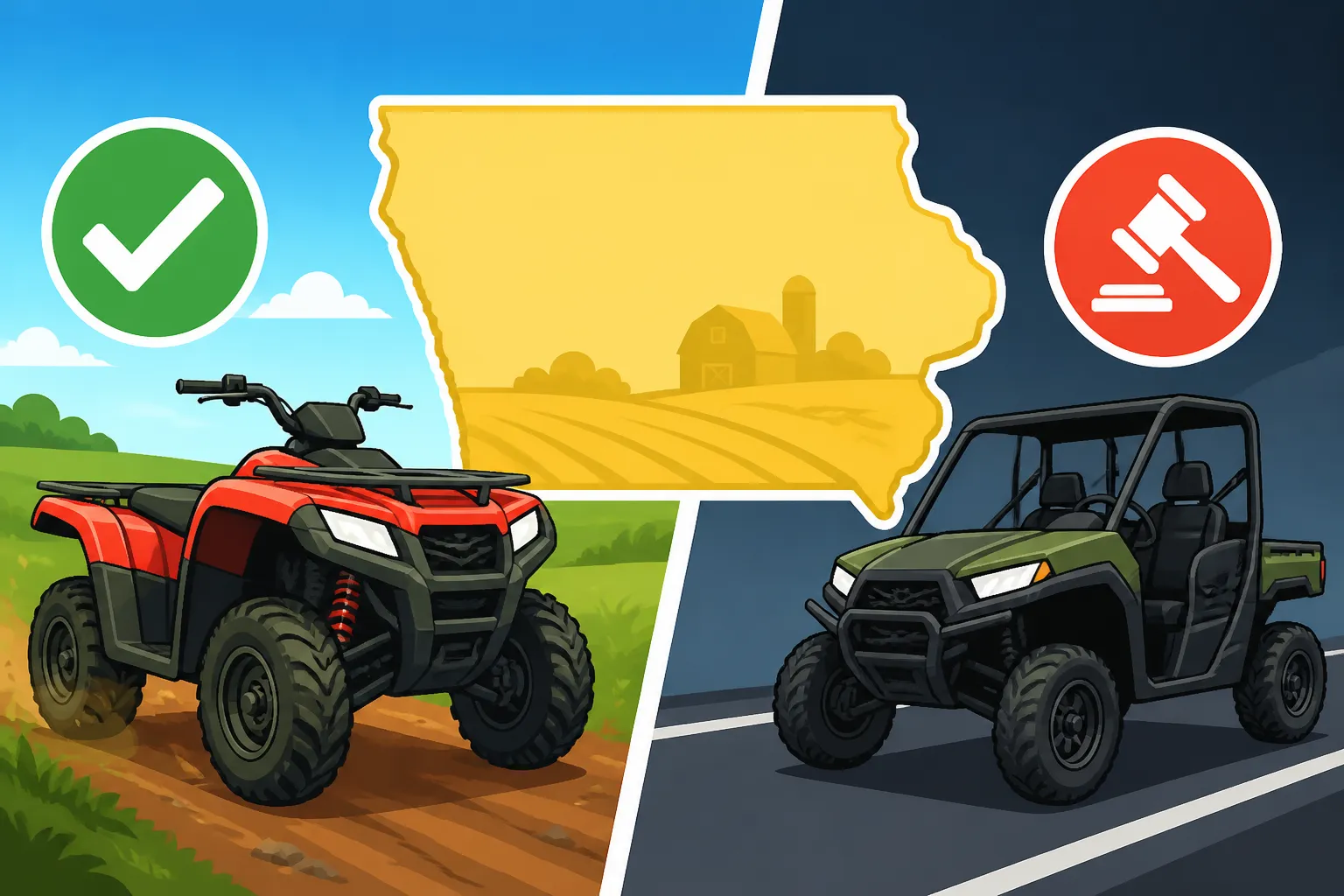
At its heart, Iowa law generally says no, your ATV or UTV is not designed or intended for use on public streets and highways. This means you can't just treat it like another car or truck. You can't hop on the interstate, and you definitely can't cruise down a paved state highway unless very specific conditions are met. This can be incredibly frustrating, especially when you live in a rural area and a gravel road is the most natural way to get around. You might feel like you're being unfairly restricted from using your machine for practical purposes.
However, that "no" isn't absolute. Iowa recognizes that these machines have a place, both for recreation and for practical work. So, while you generally can't ride on the paved primary roads that connect our larger towns and cities, or any four-lane highway, there are very specific pathways carved out for off-highway vehicle (OHV) use on other types of roads. This nuanced approach often leaves riders scratching their heads, trying to figure out if their specific situation falls into one of these exceptions.
Who Decides What Roads You Can Ride?
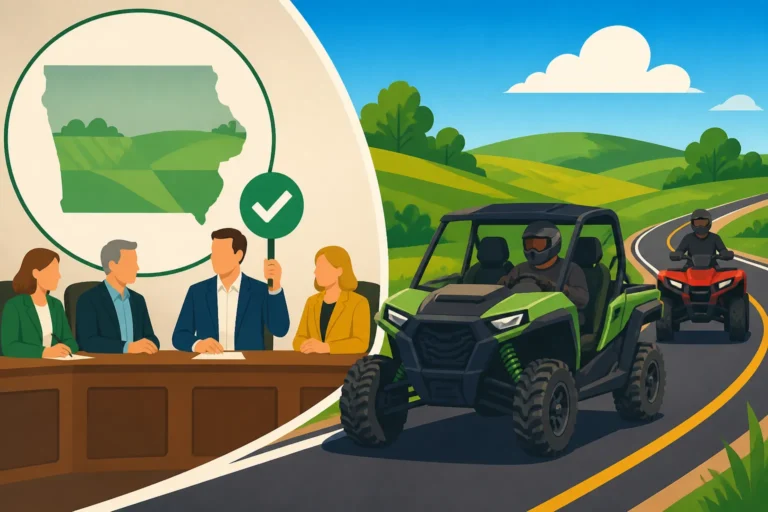
This is where things get locally specific. Iowa doesn't have a blanket, statewide rule that says "all gravel roads are open" or "all city streets are closed." Instead, the authority to open certain types of roads to ATVs and UTVs rests with local governing bodies.
For most of the unpaved roads outside of city limits, these are known as "secondary roads," and their fate rests with your county Board of Supervisors. They have the power to pass resolutions that allow OHVs on the gravel roads in their jurisdiction. And yes, some counties have done this, while others haven't. This means a gravel road might be legal to ride in one county, but a mile down the road in the next county, it could be illegal. Talk about confusing! For a deeper dive into these specifics, check out [Iowa Rules for Riding a Gravel Road].
When it comes to the roads within city or town limits, the power shifts to the city council. A city council can pass an ordinance (a local law) that designates specific streets, or even all streets, as open to OHVs. Just like with counties, this varies wildly from one town to the next. Some small towns, recognizing the agricultural use or the popularity of OHVs among residents, have opened their streets. Others, perhaps due to traffic concerns or simply a lack of public pressure, have kept them closed. This patchwork of regulations means you absolutely cannot assume that just because you rode your UTV down Main Street in Anytown, Iowa, you can do the same in the next community over. It's a real headache for riders to keep track of!
Understanding Iowa's Road Riding Rules
So, once you've navigated the tricky waters of who can open what roads, you then have to contend with what conditions you need to meet to ride legally. Iowa isn't just going to let you zip around on a road without some basic safety and equipment requirements.
Paved Secondary Roads and City Streets: Local Authority Is Key
Even if your county decides to open some paved secondary roads, or your city decides to open its streets, it's not a free-for-all. The county board of supervisors has to formally pass a resolution to allow OHV use on specific paved secondary roads. They usually don't just open everything; they might pick certain stretches or routes. This is designed to provide access without creating undue traffic hazards. Similarly, city councils, as mentioned, can pass ordinances. Some cities might open all streets except state highways running through town, while others might restrict it to specific routes or even only during certain hours.
For instance, you might find a small town like Waukon in Allamakee County that has explicitly opened its streets and alleys to ATVs and UTVs with specific rules. You might even hear about riders in places like Des Moines County. But you need to know that these are specific local decisions. If you're planning to ride on city streets, your absolute first step should always be to call the city clerk's office and ask for a copy of their local ordinance regarding OHV use. This is crucial because, frustratingly, there isn't one single statewide list of cities that allow ATVs. For more on navigating these city-specific rules, take a look at [Iowa Cities That Allow ATVs on Streets].
Specific Requirements for Road Use
Once you've confirmed that the road you want to ride is legally open to OHVs, you then need to make sure your machine and you, as the operator, meet Iowa's specific requirements. These are non-negotiable and apply across the board for any legal road use.
First off, age and licensing: You must be at least 18 years old to operate an ATV or UTV on any public road in Iowa, and you must possess a valid driver's license. This means your teenaged rider, even if they're a seasoned pro on the trails, cannot legally operate an OHV on a public road. This is a common point of misunderstanding and can lead to fines if ignored. You can find more details on this requirement in [Iowa Minimum Age to Ride a Road].
Next, speed: Iowa imposes a strict speed limit of 35 mph for ATVs and UTVs on any public road. This isn't just a suggestion; it's the law. Even if the posted speed limit for cars is higher, your OHV cannot exceed 35 mph. This rule is designed to ensure that these machines, which handle differently than cars, are operated safely in a mixed-traffic environment. Understanding this limit is key; read more about it here: [Iowa's 35 mph Cap].
Insurance is another critical piece of the puzzle. Iowa requires proof of financial responsibility for any OHV operating on public roads. This means you need insurance coverage with minimums of $20,000 for bodily injury to one person, $40,000 for bodily injury to two or more people, and $15,000 for property damage (often seen as 20/40/15). If you're pulled over and can't provide proof of this insurance, you could face significant penalties. Don't risk it; ensure you're covered. More on insurance can be found in [Iowa ATV Insurance Requirement].
Your machine itself also needs to meet certain equipment standards for road use. This includes:
- Headlights: Must be on at all times, even during the day. This helps with visibility, which is crucial for OHVs on roads.
- Tail Lamps & Signal Lamps: Your machine needs functioning tail lights and turn signals to indicate your intentions to other drivers.
- A Horn: A working horn is required to alert others to your presence or in case of an emergency.
- At Least One Mirror: You need at least one rear-view mirror, mounted to provide a clear view of the road behind you. Many riders opt for a full set of side mirrors, which you can easily find from companies like SuperATV, to enhance visibility and safety on shared roads.
- Slow-Moving Vehicle Triangle: This reflective orange triangle must be displayed on the rear of your machine. It's a standard safety device for any vehicle traveling slowly on public roads, signaling to others that you might be moving below typical traffic speeds.
For a deeper dive into lighting, mirrors, and other required equipment, consult [Iowa Lighting Requirements for ATVs] and [Iowa Mirror Requirement for Road Use].
Interestingly, unlike some other states, Iowa does not require helmets for adult ATV or UTV operators on public roads. While the law leaves it up to you, wearing a helmet is always a smart choice for personal safety. After all, accidents can happen quickly, and a helmet provides vital protection. You can explore more about Iowa's helmet laws at [Iowa Helmet Law for ATV Riders].
The "Most Direct Route" Rule and Exceptions
Beyond the locally opened roads, Iowa law also provides for specific, limited circumstances where you can legally operate your OHV on certain public roads, even if they aren't generally open to recreational riding. These exceptions are often about getting you to a legal riding area or for specific agricultural work.
Getting To and From an OHV Park or Private Land
Iowa law includes a "most direct route" provision. This means that if you are traveling to or from a designated OHV park or private property where you have permission to ride, you are allowed to operate your ATV or UTV on unpaved secondary roads, and sometimes even a paved secondary road if authorized by the county, for the shortest distance necessary to reach your destination.
Think of it this way: you live a couple of miles down a gravel road from an OHV park entrance. You can ride your machine those two miles on the gravel road to get to the park. However, this isn't a license to just go cruising. The intent must be genuinely about access. You can't take the scenic route, or detour for errands unrelated to your riding destination. It must be the "most direct route." This also applies if you're riding from your home to a neighbor's timber where you have permission to ride. The goal is to facilitate access to legal riding areas without forcing you to trailer your machine for every short hop. For more details on what constitutes the "most direct route," check out [The Most Direct Route to an Iowa OHV Park]. This rule acknowledges the practical challenges of enjoying off-road recreation in rural settings.
Agricultural Use Exemptions
Farmers and agricultural workers often rely on ATVs and UTVs for tasks around the farm. Iowa law recognizes this and provides specific exemptions for machines used as an "implement of husbandry." This is a crucial exception, but it comes with strict conditions.
For an OHV to be considered an implement of husbandry, it must be:
- Used directly in an agricultural operation: This means tasks like checking fences, moving feed, herding livestock, or accessing fields for planting or harvesting.
- Operated within two miles of the home farm: This limits how far you can travel on public roads under this exemption. So, you can't take your farm UTV ten miles down the road to help a distant relative. More details on this specific distance can be found at [2 Miles From the Farm in Iowa].
- Operated only between sunrise and sunset: No late-night farm runs on public roads under this exemption.
- Registered with the county recorder as an OHV: Even if it's used for farming, it still needs its basic registration.
It's vital to understand that this implement of husbandry exemption is not for recreational riding, even on a farm. The moment you are using the machine for something other than direct farm work, or you exceed the two-mile limit, or ride outside of sunrise to sunset, it ceases to be an implement of husbandry for road use purposes, and you fall back under general OHV road rules. This is a common area of confusion, and enforcement can be strict. For a full breakdown of this important exemption, refer to [The Implement of Husbandry Exemption in Iowa]. It's a lifeline for many farmers, but it's not a loophole for casual use.
What You Need to Know Before You Ride on a Road
Before you even think about putting tires on a public road in Iowa, there are a few more critical pieces of information you need to have firmly in place to avoid any unwanted encounters with law enforcement.
Registration, Titling, and Nonresident Permits
Even if you meet all the equipment, age, and location requirements for road use, your ATV or UTV still needs to be properly registered with your county recorder. This is the fundamental requirement for operating your machine on any public land, including roads. The registration process ensures your machine is identified and that you're contributing to the state's OHV fund, which supports trails and enforcement. You can learn about the registration process in [Registering an ATV in Iowa].
Additionally, almost all ATVs and UTVs in Iowa must be titled. The title proves ownership, similar to a car. When you buy a machine, especially a used one, ensure you get a properly assigned title. This is a separate process from registration but equally important. For more on this, consult [Titling an ATV in Iowa].
If you're visiting Iowa from out of state and plan to ride on any public land, including roads, your out-of-state registration isn't enough. You'll need to purchase an Iowa nonresident user permit. This permit allows your machine to be operated legally within Iowa for a specified period. This is an essential step for visitors to avoid fines. You can find more information about this at [Iowa's Nonresident User Permit].
Enforcement and Penalties
Iowa's OHV laws are enforced by a range of authorities, including county sheriffs, local police departments, and Iowa Department of Natural Resources (DNR) conservation officers. These officers are well-versed in the specifics of OHV regulations, and they are out there ensuring compliance.
If you are caught operating an ATV or UTV illegally on a public road – perhaps you're underage, don't have insurance, are riding on a closed road, or lack the proper equipment – you could face significant fines and penalties. These can vary depending on the specific infraction and whether it's a first offense, but they are never cheap. An officer might issue a citation, which means a court appearance and potentially a hefty bill. In some cases, your machine could even be impounded. The bottom line is, ignorance of the law is not a valid excuse. Always do your homework before you ride. To understand the potential financial consequences, read up on [Iowa Fines for Illegal ATV Road Use].
The best advice is always to check with your county recorder's office for county-specific ordinances and your city clerk's office for city ordinances. Don't rely on hearsay or what a friend of a friend told you. Get the official word.
Iowa ATV & UTV Road Use Requirements
To help you keep track, here's a quick reference table for the key requirements if you plan to ride your ATV or UTV on legally designated Iowa roads:
| Requirement | Detail |
|---|---|
| Minimum Age | 18 years old |
| Driver's License | Valid Iowa driver's license required |
| Speed Limit | Max 35 mph, regardless of posted limit |
| Insurance | Minimum 20/40/15 financial responsibility coverage |
| Registration | Current Iowa OHV registration decal |
| Titling | Proper Iowa title for the machine |
| Headlights | On at all times (day and night) |
| Tail Lights | Functioning rear tail lamp(s) |
| Signal Lamps | Functioning turn signals (front and rear) |
| Horn | Audible horn required |
| Mirror | At least one rear-view mirror |
| SMV Triangle | Slow-moving vehicle triangle displayed on rear |
| Helmet | Not required for adults (but highly recommended) |
| Local Authority | Road must be specifically opened by county (paved sec. roads) or city (streets) |
| Nonresidents | Iowa Nonresident User Permit required (if not an Iowa resident) |
This table provides a snapshot, but always remember that the nuances of local ordinances and the "most direct route" rule require your specific attention to detail. Equipping your machine with durable lights, mirrors, and horns from reputable brands like SuperATV can make meeting these requirements much easier and safer.
Disclaimer
This article is for general informational purposes only and does not constitute professional advice. Laws, prices and regulations vary by location and change over time. Consult a qualified professional for guidance on your specific situation.