Waukon’s Midnight to Five Ban
It can be incredibly frustrating to try and understand where you can legally ride your ATV or UTV on Iowa roads, especially when local rules add extra layers of complexity. You might hear that ATVs are "street legal" in some places but completely forbidden in others, leading to a lot of head-scratching and worry about getting a ticket. This guide aims to clear up that confusion by breaking down Iowa's state laws and then digging into how specific local ordinances, like Waukon's well-known midnight to five ban, impact your ability to ride on city streets and paved county roads.
Understanding Iowa's General Rules for ATVs on Roads
Before we dive into the specific nuances of city ordinances, it's crucial to grasp the foundational state laws governing ATV and UTV use on Iowa's public roads. These rules set the baseline, and any local ordinance will either operate within these parameters or expand upon them where the state allows. Many riders often assume a blanket "no" or "yes" when the reality is far more intricate, depending heavily on the type of road and the purpose of your ride.
The Baseline: Unpaved Secondary Roads and the "Most Direct Route"
Iowa law generally permits the operation of ATVs and UTVs on unpaved county secondary roads. This is a significant point of flexibility for riders, allowing access to a vast network of gravel and dirt roads that crisscross the state. However, it's not simply an open invitation to joyride anywhere. There's a crucial caveat: you must be taking the [Most Direct Route to an Iowa OHV Park], to access services, or to get between pieces of private property where you have permission to ride. It's about purposeful travel, not recreational cruising on public thoroughfares.
Imagine you're heading out for a day of riding at Gypsum City OHV Park near Fort Dodge. You might live a few miles down a gravel road from the main paved highway. The state law allows you to use that [Iowa's Unpaved Secondary Road Rule] to get to the highway, or to connect to another gravel road that leads directly to your destination. What it doesn't generally permit is simply spending your afternoon doing laps on the gravel roads for no specific travel purpose. The intent behind your presence on the public road matters immensely. If a deputy stops you, they'll want to know where you're going and why you're using that particular route. This also applies if you're traveling from your farm field to another parcel of land you own or manage, always striving for the [Iowa's Most Direct Route Rule].
State Highways and Crossing Rules
When it comes to state highways, the rules tighten up considerably. Generally, ATVs and UTVs are not permitted to be operated longitudinally on state highways, meaning you can't ride along them for any significant distance. These are often busier, higher-speed roads not designed for the lower speeds and different handling characteristics of off-highway vehicles. Trying to ride a quad or side-by-side alongside semi-trucks and passenger cars on a two-lane primary highway is incredibly dangerous and explicitly prohibited by state law.
However, there are exceptions for crossing. You are typically allowed to cross an undivided two-lane primary highway at a 90-degree angle, provided it's safe to do so and you yield to all traffic. This allows you to get from one side of a highway to another if, for example, your trail or private property is bisected by the road. You can't, however, use an intersection to turn onto a state highway and ride it for miles. For multi-lane highways, like four-lane roads or interstates, the prohibition is even stricter: no longitudinal travel and generally no crossing unless specifically designated, which is rare. Always assume state highways are off-limits for anything more than the briefest, safest, and most direct crossing, if even that is allowed.
The "Implement of Husbandry" Exemption and Farm Use
One area where ATVs and UTVs often intersect with road use is in agricultural settings, thanks to what's known as the "implement of husbandry" exemption. This exemption allows certain vehicles, when used for bona fide agricultural purposes, to operate on public roads even if they wouldn't otherwise be considered street legal. For ATVs and UTVs, this means that if your machine is being used directly in a farming operation – say, checking fences, moving feed, or monitoring livestock across different fields – it might qualify as an implement of husbandry.
It's important to understand that this isn't a loophole for recreational riding. The machine must be primarily and directly engaged in agricultural work. Hauling your fishing gear to a pond on the back forty might not qualify, but transporting tools to fix a broken gate in a distant pasture likely would. The exemption also comes with its own set of rules, such as often being restricted to a certain distance from the farm headquarters, typically 2 miles, and usually requiring you to observe special lighting and signage (like a slow-moving vehicle triangle) when operating on roads. This exemption is really about supporting farmers in their work, not about expanding general ATV access to roads. The moment you use that farm quad for a non-farm purpose on a public road, the exemption likely vanishes.
Local Control: Cities and Counties Opening Paved Roads
While state law provides a general framework, Iowa also grants significant authority to local jurisdictions – counties and cities – to establish their own rules regarding ATV and UTV use on paved roads within their boundaries. This is where much of the confusion arises, as what's allowed in one county or town might be strictly forbidden just a few miles down the road. It means that checking local ordinances is not just a good idea, it's absolutely essential if you plan to ride anywhere other than designated OHV parks or private land.
How a County Authorizes Paved Secondary Roads
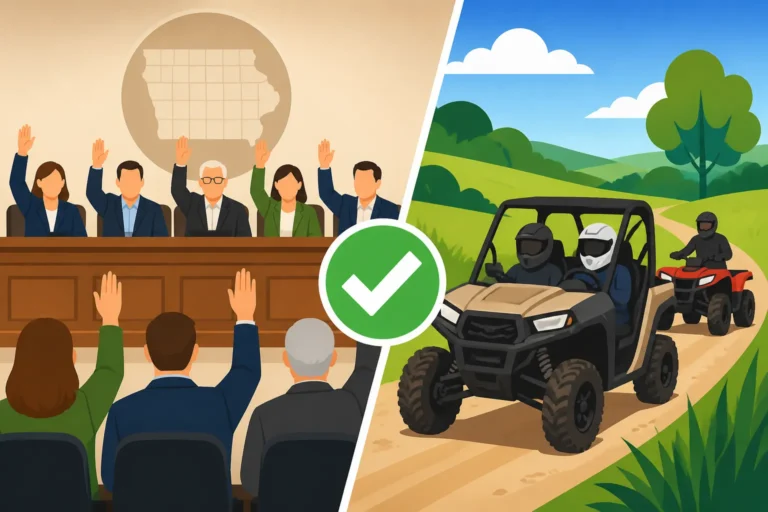
Counties have the power to open paved secondary roads to ATV and UTV traffic. This isn't a default setting; it requires a deliberate action by the county's Board of Supervisors. They typically pass an ordinance or resolution that specifically designates which paved roads, if any, are open for off-highway vehicle use. This process usually involves public hearings, consideration of safety concerns, and input from local residents and law enforcement. They might decide to open all paved secondary roads, only specific ones, or none at all.
When a county does decide to open its paved secondary roads, it's usually with a set of accompanying rules. These rules might mirror state equipment requirements for ATVs on roads, or they could add additional restrictions. For instance, they might specify operating hours, or even require a county-specific permit in addition to state registration. It's not uncommon for a county to open only certain paved roads that lead directly to popular trailheads or connect rural communities, rather than turning every single paved road into an ATV route. Always look for official signage or check the county recorder's office or sheriff's department website for the most up-to-date information on [Iowa Rules for Riding a Paved Secondary Road] in any given county.
City Streets and Council Authorization
Even more granular than county rules are those set by individual cities and towns. Just like counties, city councils have the authority to pass ordinances that allow or prohibit ATVs and UTVs on their streets. This is why you'll find places like Waukon, which has very specific rules, while a neighboring town might have a blanket ban. A city council's decision often reflects the unique character of the community, local traffic patterns, and the concerns of its residents.
A city ordinance will typically outline which streets are open, if any, and under what conditions. They might specify hours of operation, speed limits (which are always capped at 35 mph by state law on public roads), and additional equipment requirements. For example, [Waukon's Open Streets and Alleys] might specify that ATVs are allowed, but with a particular curfew, while another city might only allow them on certain access roads to businesses or recreational areas. Because there's no statewide list of these varying city ordinances, you literally have to check with the city clerk's office or the local police department in every single town you plan to ride through. It's a significant administrative hurdle, but it's the only way to be sure you're riding legally. Trying to guess can lead to fines and citations.
Why Not Every City or County Says "Yes"
It's natural to wonder why not every city or county in Iowa simply opens its paved roads to ATVs and UTVs. The reasons are varied and often stem from practical considerations. Safety is a primary concern; ATVs and UTVs typically have a higher center of gravity and different braking characteristics than street-legal vehicles, making them less suited for high-speed traffic or complex urban environments. Noise can also be a significant issue for residents, especially in residential areas. Many machines, particularly those equipped with performance exhausts, can be quite loud, leading to complaints from homeowners.
Infrastructure wear and tear is another factor. While many off-road vehicles have robust suspensions, they aren't always designed for prolonged use on pavement, and their tire types can be abrasive, potentially accelerating road degradation in some cases. Furthermore, cities and counties must consider the resources required for enforcement. If ATVs are allowed, local law enforcement needs to be equipped and trained to enforce the specific ordinances, which can be an added burden. For these reasons, many jurisdictions opt for a cautious approach, or simply decide that the potential benefits do not outweigh the risks and challenges. The decision usually involves a careful balancing act, often influenced by local advocacy from rider groups versus concerns from other community members.
Diving Into Waukon's Specifics: The Midnight to Five Ban
When discussing local ordinances that allow ATV and UTV use on city streets, Waukon, Iowa, often comes up as a prime example. The city has taken steps to permit off-highway vehicles on its municipal roads, but it has done so with very specific restrictions, most notably its "midnight to five" ban. Understanding this kind of detailed local rule is crucial for any rider hoping to experience what can feel like a rare privilege in Iowa: riding a quad or side-by-side on city streets.
Waukon's Ordinance: What It Means for Riders
The city of Waukon, recognizing the desires of its residents and perhaps the benefits for local businesses, has passed an ordinance allowing ATVs and UTVs on most city streets and alleys. This is a progressive step for an Iowa town, as [Iowa Cities That Opened Their Streets] are not as numerous as riders might hope. However, this permission is not without its limits. The most significant restriction, and the one that defines this particular ordinance, is the prohibition on riding during specific nighttime hours. Riders are generally not permitted to operate their ATVs or UTVs on Waukon's streets between midnight and 5:00 AM.
This restriction is likely in place to address concerns about noise, public safety during low visibility, and potential disturbances during typical sleeping hours. It’s a common compromise in communities that want to be rider-friendly but also need to maintain peace and quiet for their residents. Beyond the time restriction, riders in Waukon must also adhere to all standard state laws for road use, including possessing valid registration, proper lighting, a rearview mirror, and an operator's license. They are also subject to all traffic laws, such as speed limits, stop signs, and yielding requirements.
Practical Implications of the Restricted Hours
For riders, [Waukon's Midnight to Five Ban] has several practical implications. First, it means you need to plan your rides accordingly. If you're out enjoying the evening, perhaps heading to a local restaurant or visiting friends, you must ensure your machine is off the public streets and parked by midnight. Trying to squeeze in one last ride or heading home just after the curfew could result in a citation. This makes late-night recreational riding impossible and requires a mindful approach to timing your activities.
Second, it highlights the importance of being aware of the exact time. It’s not enough to be "close" to midnight; the ban is typically strictly enforced. Imagine you're out with a group, and someone suggests one last loop around town. If it's 11:55 PM, you're cutting it extremely close. This kind of specific detail really drives home the message that local ordinances are designed to be followed precisely. It also means that if you're visiting Waukon, you can't just assume what's allowed; you absolutely must know the local rules.
How Other Cities Might Differ or Align
Waukon's approach is just one example of how a city might manage ATV and UTV access. Other Iowa cities that have opened their streets might have different rules entirely. Some might have no time restrictions at all, while others might restrict riding to certain days of the week, or only on specific routes that avoid residential areas. For instance, a city might allow ATVs on roads that lead directly to a county conservation area or an OHV park, but prohibit them in the downtown core.
Conversely, many cities in Iowa still maintain a complete ban on ATV and UTV operation on public streets. This is why it's so critical to understand that there is no universal "street legal" status for ATVs across Iowa. A machine might be perfectly legal to ride on the streets of Waukon during the day but illegal an hour later, or illegal on any street in a neighboring town. Always remember that [Why Iowa Publishes No List of City Ordinances], meaning the onus is entirely on the rider to research and understand the rules for each specific municipality. A quick call to the city clerk or local police department is always the best first step.
Equipment and Rider Requirements for Road Use
Beyond the "where and when" of riding on Iowa roads, there's also the crucial "how." Operating an ATV or UTV on any public road, even those where it's explicitly allowed, comes with a mandatory set of equipment requirements for your machine and specific qualifications for the operator. These are not optional suggestions; they are legal necessities designed to ensure safety for both the rider and other road users. Ignoring them isn't just risky, it's a surefire way to earn a citation.
Mandatory Machine Equipment for Street Legal Status
For any ATV or UTV to be legally operated on an Iowa public road (where allowed), it must be equipped with certain safety features. These are largely consistent with what you'd expect for any street-legal vehicle, adapted for an off-highway machine.
Here's a breakdown of the typical requirements:
- Headlights and Taillights: Your machine must have functioning headlights and taillights. The headlights must be on at all times, even during daylight hours, for maximum visibility. Taillights, of course, are critical for riding after dark, within permitted hours.
- Brakes: Effective braking systems on both front and rear wheels are non-negotiable.
- Muffler and Spark Arrester: All machines must be equipped with a muffler that effectively limits engine noise and a spark arrester that is in good working order to prevent wildfires.
- Rearview Mirror: At least one rearview mirror is typically required, allowing the operator to see traffic approaching from behind. Many riders choose a wider UTV mirror or a durable ATV mirror from a company like SuperATV to enhance their field of vision and meet these requirements.
- Horn: A working horn or warning device is necessary for signaling other vehicles or pedestrians.
- Slow-Moving Vehicle (SMV) Triangle: When operating on roads, especially on paved secondary roads or when the machine's top speed is less than the typical flow of traffic (which is often the case for ATVs capped at 35 mph), an SMV triangle emblem must be affixed to the rear of the machine. This bright orange triangle alerts other drivers to your slower speed.
- Insurance: Perhaps one of the most critical requirements, ATVs and UTVs must carry liability insurance if operated on public roads. [Iowa ATV Insurance Requirement] typically mandates minimum coverage limits (e.g., $20,000 for one person's injury, $40,000 for two or more, and $15,000 for property damage). Without this, you could face significant fines.
Here's a quick reference table for general Iowa road use equipment:
| Equipment Feature | Requirement | Notes |
|---|---|---|
| Headlights | Functional, on at all times (day/night) | Aimed correctly |
| Taillights/Brake Lights | Functional | Visible from the rear |
| Brakes | Effective on front and rear wheels | Maintained in good working order |
| Muffler | Limits engine noise effectively | Prevents excessive sound pollution |
| Spark Arrester | Functional | Reduces fire risk, often OEM equipment |
| Rearview Mirror | At least one, providing clear view to the rear | Essential for traffic awareness |
| Horn | Audible warning device | For signaling other vehicles/pedestrians |
| SMV Triangle | Affixed to rear, visible | Required for vehicles traveling 25 mph or less on roads |
| Insurance | Minimum liability coverage (20/40/15) | Proof of insurance must be carried |
| Decal/Registration | Current Iowa OHV registration decal | [Iowa ATV Decal Placement] and [Registering an ATV in Iowa] needed |
Rider Age, Licensing, and Insurance Requirements
Operating an ATV or UTV on an Iowa public road is not just about having the right machine; it's also about having the right qualifications as a rider. These requirements are in place to ensure that operators have a basic level of knowledge and responsibility for safe road use.
- Minimum Age: To operate an ATV or UTV on a public road in Iowa, the operator must be at least 18 years old. This is a strict rule; minors, even those with an ATV safety certificate, are generally prohibited from riding on public roads.
- Driver's License: An operator must possess a valid Iowa driver's license. Your ATV or UTV is being treated as a vehicle on the road, and thus requires the same licensing as a car or truck. Carrying this license on your person during operation is also mandatory.
- Insurance: As mentioned in the equipment section, liability insurance is required. You must be able to provide proof of insurance if requested by law enforcement. Failure to do so can result in substantial fines.
These rules collectively mean that an unsupervised 16-year-old, even if they're a seasoned off-road rider, cannot legally take their quad down a county gravel road or through Waukon's streets. The combination of age, license, and insurance forms a protective layer for both the rider and the public. For more detail, refer to the [Iowa Minimum Age to Ride a Road] and [Iowa ATV Insurance Requirement] guides.
Speed Limits and Safe Operation on Roads
When riding an ATV or UTV on public roads in Iowa, even where permitted, there are strict speed limits you must observe. The state law caps the speed for off-highway vehicles on public roads at 35 mph. This is a critical rule to remember, as exceeding it not only puts you at risk but also violates the law. Regardless of the posted speed limit for cars, your ATV or UTV cannot go faster than 35 mph on a public road.
Beyond the speed limit, safe operation demands heightened awareness. ATVs and UTVs handle differently than cars; they have a higher center of gravity, which can make them more prone to rollovers, especially in turns or on uneven pavement. Their tires are often designed for off-road traction, which can reduce grip on hard surfaces, especially when wet. Therefore, it's crucial to:
- Maintain Control: Drive defensively and be constantly aware of your surroundings, traffic, and road conditions.
- Observe Traffic Laws: All rules of the road apply – stop signs, traffic signals, yielding, and lane discipline.
- Stay Right: Keep to the right side of the road, allowing faster traffic to pass safely.
- Avoid Distractions: Focus solely on operating your machine and navigating the road.
Remember that while a company like SuperATV offers robust accessories for off-road performance, like upgraded suspension or tires, these modifications don't negate the need for cautious and compliant road use. Always prioritize safety and adherence to the [Iowa ATV Speed Limit on Roads] and other traffic regulations.
Navigating the Grey Areas and Staying Compliant
The patchwork of state and local regulations for ATVs and UTVs on Iowa roads can feel like a minefield. It's easy to accidentally step into a grey area, or worse, unknowingly violate a rule. For dedicated riders, understanding how to navigate these complexities and stay compliant isn't just about avoiding tickets; it's about being a responsible member of the riding community and helping ensure continued access where it's currently allowed.
The Importance of Checking Local Ordinances
We've touched on this repeatedly, but it bears repeating: before you even think about putting a tire on a paved road, or even some gravel roads, within a city or county, you absolutely must check the local ordinances. Relying on word-of-mouth or anecdotal evidence is a recipe for trouble. What your buddy heard about one town might not apply to another, or the rules might have changed.
Your first point of contact should generally be the county recorder's office for county roads, or the city clerk's office for city streets. These offices can provide official copies of ordinances or direct you to where they are published online. Don't be afraid to make a phone call; local officials are often happy to clarify rules for responsible citizens. This due diligence is particularly vital when visiting new areas. For instance, if you're traveling through Allamakee County and want to ride through Waukon, you'll need to be aware of [Waukon's Midnight to Five Ban] and all other local rules, even if you just came from a county with no such restrictions.
Consequences of Illegal Road Use
The penalties for operating an ATV or UTV illegally on Iowa roads can range from irritating to severe, depending on the nature of the violation. Getting caught without proper registration, insurance, or operating in a prohibited area can result in significant fines. These fines are often comparable to those for other traffic violations and can quickly add up, turning a fun ride into an expensive mistake. [Iowa Fines for Illegal ATV Road Use] can be a real hit to your wallet, and they don't stop there.
Beyond monetary penalties, repeated violations or more serious infractions (like reckless operation) could lead to your machine being impounded. In some cases, operating without a valid driver's license or insurance could even have implications for your standard driving record or lead to more serious legal troubles if an accident occurs. Imagine getting into a minor fender bender while riding illegally on a paved road; without insurance, you could be personally liable for thousands of dollars in damages. The potential consequences far outweigh the convenience of ignoring the rules, making compliance the only sensible approach.
Enhancing Your Machine for Road Safety
Even when you're riding legally on designated roads, enhancing your ATV or UTV for improved road safety is always a wise investment. While state and local laws dictate minimum requirements, going above and beyond can significantly increase your visibility, control, and overall safety. Many aftermarket companies specialize in products designed to make your off-road machine more road-friendly.
Consider upgrading your lighting beyond the minimum. Brighter LED headlights and taillights improve visibility for you and other drivers, especially at dawn, dusk, or in adverse weather. Adding turn signals, if your machine doesn't have them, is another huge safety boost, making your intentions clear to traffic around you. Many UTVs can be equipped with full street-legal kits that include signal lights, a horn, and proper mirrors. Companies like SuperATV offer a wide range of accessories, from mirrors and lighting solutions to windshields and suspension components, all of which can enhance your machine's on-road performance and safety. A good, shatterproof rearview mirror, for example, is essential for keeping track of traffic behind you. Investing in these types of upgrades not only makes your ride safer but also demonstrates a commitment to responsible riding, which can only benefit the off-highway vehicle community as a whole.
Disclaimer
This article is for general informational purposes only and does not constitute professional advice. Laws, prices and regulations vary by location and change over time. Consult a qualified professional for guidance on your specific situation.