The Most Direct Route to an Iowa OHV Park
We all know the excitement of gearing up for a day out at one of Iowa's incredible OHV parks like Gypsum City or Bluff Creek. You've got your machine loaded, your cooler packed, and the open trail is calling your name. But before you hit the main roads, a common question gnaws at many riders: "How do I legally get my ATV or UTV from my trailer or private property to the park entrance without running afoul of the law?" It’s a real headache, trying to decipher the nuances of Iowa’s road use statutes, especially when you just want to enjoy your ride. This guide is here to clear up the confusion surrounding Iowa's "most direct route" rule for getting your off-highway vehicle to a designated riding area.
Understanding Iowa's "Most Direct Route" Rule
Iowa's laws regarding ATV and UTV use on public roads can feel like a labyrinth, especially when you're trying to figure out the simplest, most legal way to get to your favorite OHV park. The "most direct route" rule is a crucial piece of this puzzle, designed to allow limited road access for off-highway vehicles, but with very specific constraints. It's not a free pass to cruise the highways; it's a carefully crafted permission slip for a specific purpose.
Defining "Most Direct" Legally
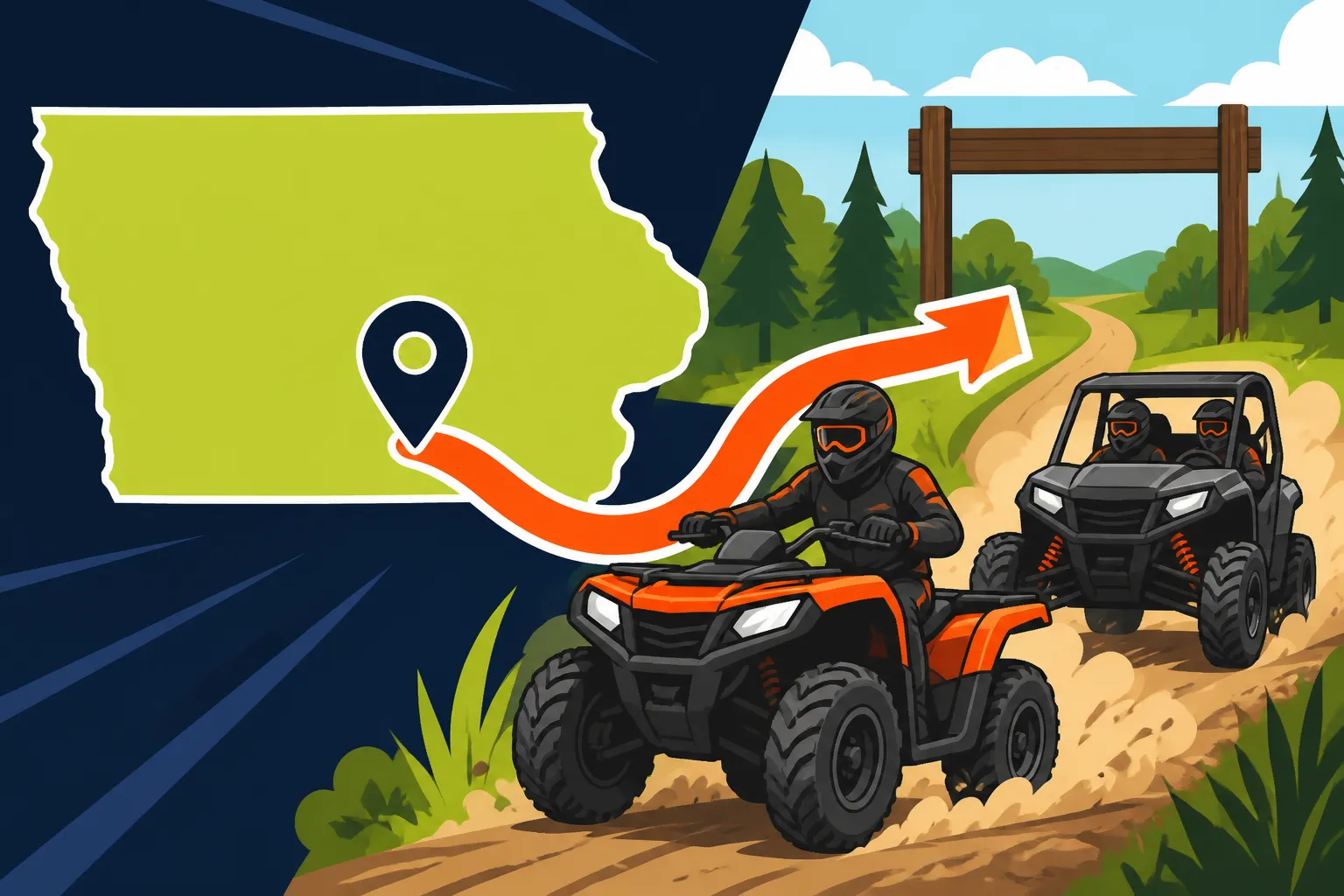
When the law talks about the "most direct route," it's not suggesting you take the prettiest scenic bypass or stop at that charming little diner you love. It means precisely what it says: the shortest, most efficient path from your point of origin (whether that's your home, a friend's farm, or a staging area) to the entrance of a designated OHV park or trail. There's no room for interpretation here. This isn't about enjoying the pavement; it's about transit.
Imagine you're pulling your side-by-side out of your driveway, excited to hit the trails at Rathbun OHV Area. Your GPS might offer a few options, but the "most direct route" is the one that minimizes your time and distance on public roads. This often means sticking to secondary roads and making as few turns as possible. You should avoid any detours, even if they seem minor or convenient, unless that detour is genuinely part of the single, most efficient path. This rule exists because ATVs and UTVs aren't designed for sustained road use, and the state wants to limit their exposure to faster, heavier traffic for everyone's safety. Understanding this strict definition is your first step in staying legal.
Why This Rule Exists for OHVs
The "most direct route" rule isn't some arbitrary bureaucratic hurdle; it's rooted in safety and the fundamental design of off-highway vehicles. Unlike cars, ATVs and UTVs have different handling characteristics, braking distances, and top speeds that make them less suitable for sustained highway travel. The rule aims to mitigate potential hazards by reducing the time these machines spend interacting with conventional road traffic.
Think about it: an ATV is nimble and powerful off-road, but on pavement, its knobby tires and higher center of gravity can be less stable, especially at higher speeds or during quick maneuvers. UTVs, while larger, still present a different profile than a car or truck. By limiting their road presence to the absolute minimum necessary for travel to a designated riding area, Iowa protects both the OHV operator and other motorists. It's a pragmatic balance, acknowledging that riders need a way to access legitimate riding parks while upholding public safety. This also helps maintain the integrity of Iowa's trails, which are designed for off-road use, preventing riders from treating public roads as extensions of the trail system.
Navigating Different Road Types to Reach a Park
Iowa's road network is a mix of gravel, paved secondary, and primary highways, and each comes with its own set of rules for OHV access. Knowing which roads you can legally use, and under what conditions, is paramount to avoiding a citation while en route to your destination. It's not a one-size-fits-all approach, and a misunderstanding can quickly turn your fun day into a costly one.
Unpaved Secondary Roads and Your Journey
Good news for gravel enthusiasts: unpaved county secondary roads are generally fair game for ATVs and UTVs when traversing the [Most Direct Route to an Iowa OHV Park]. These are often the very roads that lead to trailheads or the rural properties where many riders stage their machines. They're typically less traveled and their surfaces are more forgiving for off-highway tires, making them a natural choice for this type of transit.
However, "fair game" doesn't mean "anything goes." You still need to abide by all other road-use regulations, such as maintaining a safe speed, ensuring your machine is properly equipped (more on that later), and, crucially, sticking to that "most direct route." These roads provide a vital link for riders, especially those living in rural areas or camping near parks, allowing them to bridge the gap between their temporary staging ground and the entrance gate. Always be mindful of dust, visibility, and other vehicles, as these roads are shared with agricultural equipment and local traffic. They are your primary pathway to freedom on the trails.
Navigating Paved Secondary Roads and Highways
This is where things get a little trickier and often cause confusion. While unpaved secondary roads are generally open, paved secondary roads and, even more so, state primary highways, have stricter regulations. For paved secondary roads, a county board of supervisors must authorize their use by ATVs or UTVs. This isn't a blanket statewide authorization; it's a county-by-county, sometimes road-by-road, decision. You absolutely cannot assume a paved secondary road is open.
When it comes to undivided two-lane primary highways, Iowa law typically allows ATVs and UTVs to use them only for the purpose of crossing at an intersection or to use the shoulder when it's part of the [Most Direct Route to an Iowa OHV Park]. This is usually for very short distances, to link up with an authorized secondary road or to reach an entrance. Multi-lane highways and interstates are almost always off-limits. The key takeaway here is caution and research. Before you plan your route, check with the specific county's secondary road department or the Iowa DNR to see which paved roads, if any, are authorized for OHV use in your area. Without explicit authorization, even a short hop on a paved road can lead to a fine.
| Road Type | ATV/UTV Use for OHV Park Access | Key Restriction / Condition |
|---|---|---|
| Unpaved County Secondary Roads | Generally Allowed (Most Direct Route) | Must adhere to all road use laws (speed, equipment, etc.). No joyriding. |
| Paved County Secondary Roads | Allowed ONLY if County Authorizes | County Board of Supervisors must explicitly authorize. Varies by county. Check local ordinances. |
| Undivided Two-Lane Primary Highways | Limited Use (Crossing or Shoulder) | Only for crossing at an intersection or using the shoulder for the most direct route. Short distances only. |
| Multi-lane Primary Highways/Interstates | Generally Prohibited | Very rarely allowed, typically only for crossing at intersections if absolutely necessary and explicitly permitted. Highly restricted. |
| City Streets | Allowed ONLY if City Authorizes | City Council must explicitly authorize. Varies by municipality. Check local ordinances. |
Essential Gear and Operator Requirements for Road Use
Just because you're on a public road, even for a short, direct route to a park, doesn't mean you can slack on safety or legality. Iowa has specific requirements for ATVs and UTVs operating on public roads, and these are enforced rigorously by local law enforcement and conservation officers. Ignoring these rules is a sure way to end your riding day prematurely, with a costly citation to boot.
Mandatory Machine Equipment for Road Transit
To legally traverse Iowa's roads on your ATV or UTV, even for that quick dash to the OHV park, your machine needs to be outfitted with certain essential gear. This isn't just about common sense; it's about meeting specific statutory requirements designed to ensure visibility and communication with other road users. First and foremost, you'll need functional headlights and tail lights. These must be on whenever you're on a public road, regardless of the time of day. This significantly enhances your visibility, especially crucial for a smaller vehicle like an ATV or UTV.
Next up, a mirror. Specifically, you need at least one rearview mirror mounted on the left side of your machine. This helps you keep an eye on traffic behind you, a critical safety feature when sharing the road with faster vehicles. A horn is also a non-negotiable item, allowing you to alert other drivers to your presence. Finally, Iowa law mandates a slow-moving vehicle triangle on the rear of your machine. This bright orange and red reflective emblem signals to drivers approaching from behind that your vehicle is traveling at a speed significantly slower than normal traffic. Many riders find that quality aftermarket accessories, perhaps from a brand like SuperATV, can provide robust and reliable lighting, mirrors, and horns that meet or exceed these requirements, ensuring your machine is ready for the road. Don't forget, functional brakes are always a given, and a windshield (if applicable) must meet visibility standards, free from excessive tinting or damage that obstructs your view.
Operator Requirements and Insurance
Beyond the machine itself, Iowa law also places requirements on the operator when riding on public roads to reach an OHV park. The most crucial of these is age: you must be at least 18 years old to operate an ATV or UTV on any authorized public road. This means minors, even if they possess an [Iowa ATV Safety Certificate Requirements] for off-road riding, are prohibited from using public roads for transit. This is a non-negotiable rule, intended to ensure a certain level of maturity and driving experience when sharing the road.
Furthermore, you must possess a valid driver's license. This isn't just about having it; it means carrying it on your person so you can present it if stopped. Just like any other vehicle on the road, proof of insurance is also mandatory. Iowa requires specific minimum liability coverage: $20,000 for bodily injury to one person, $40,000 for bodily injury to two or more people, and $15,000 for property damage. Not having this insurance can result in significant fines and penalties. Think of it this way: when you're on public pavement, you're operating a motor vehicle, and the same fundamental responsibilities apply. Being properly licensed, insured, and of legal age are foundational elements of safe and legal road transit.
Planning Your Journey to an Iowa OHV Park
Successfully and legally getting your ATV or UTV to an Iowa OHV park hinges heavily on good planning. It’s not enough to simply know the rules; you need to apply them to your specific situation and map out your journey carefully. A little preparation can save you a lot of grief, and ensure your day starts on the trails, not pulled over on the side of the road.
Mapping the Most Direct Path
Before you even think about firing up your engine, get out a map – a physical one, a detailed online map, or a GPS app – and meticulously plot your route. The goal is to identify the absolute shortest and most efficient path from your starting point to the park entrance. Consider all available roads: prioritize unpaved secondary roads, and only use paved secondary roads if you've confirmed they are authorized by the specific county. Cross primary highways at intersections only, and for the bare minimum distance.
When mapping, think about potential obstacles or alternative routes. Is there a bridge out? Are there any restricted areas? Does your chosen route take you through a town that prohibits OHV use on its streets? Call ahead to the county sheriff's office or the Iowa DNR to clarify any uncertainties about road authorizations in your specific area. Having a clear, pre-planned route not only ensures compliance with the "most direct" rule but also gives you confidence on your journey. Don't leave it to chance; trace every mile your tires will touch.
Checking Local Ordinances and DNR Alerts
Iowa's OHV road use laws have a layer of local control, meaning counties and cities can establish their own ordinances that either open up or restrict certain roads. What's legal in Webster County might be prohibited in Mahaska County. This variability makes it absolutely crucial to check local ordinances for your specific route. For instance, some cities might allow OHVs on certain streets to access services or the edge of town, while others have blanket bans. The [Iowa DNR and Off-Highway Vehicles] website is a great resource, but it often won't list every local ordinance.
You'll need to contact the county recorder's office, county sheriff's department, or city clerk's office for the areas you'll be traversing. Ask specific questions about ATV and UTV access on the roads you've mapped out. Furthermore, always check the Iowa DNR's alert feed or the specific park's website for any trail closures due to weather or maintenance. Nothing is more frustrating than meticulously planning your road transit only to arrive and find the park gates shut. Staying informed about both local road rules and trail conditions is an indispensable part of a successful and legal riding trip.
Common Pitfalls and How to Avoid Them
Even with the best intentions, it's easy to fall into common traps when navigating Iowa's ATV and UTV road laws. Many riders have learned these lessons the hard way, often resulting in fines or the premature end of a riding day. Being aware of these pitfalls beforehand can help you steer clear of trouble and keep your focus on the fun.
The Temptation of a "Quick Detour"
This is perhaps the most common mistake riders make: thinking a "quick detour" won't hurt. You're on your way to Gypsum City OHV Park, following your carefully mapped direct route, when you suddenly remember you forgot drinks, or your buddy texts that he's waiting at a gas station just "a block off the route." The temptation to deviate, even briefly, can be strong. However, any deviation from the [Most Direct Route to an Iowa OHV Park] for non-essential reasons (like grabbing a snack or meeting a friend) is a violation of the law.
The "most direct route" is not a suggestion; it's a strict requirement. Law enforcement officers understand the purpose of this rule, and they're often on the lookout for machines that appear to be joyriding or making unnecessary stops. If you get pulled over for a "quick detour," claiming ignorance or necessity for a non-essential stop likely won't hold up. Always ensure your necessities are packed beforehand, or plan to get them before you embark on your direct route, or after you arrive at the park and unload. The cost of a fine far outweighs the convenience of a quick, illegal stop.
Misinterpreting County and City Authorizations
Another significant pitfall stems from misunderstanding or simply not checking local authorizations for paved roads and city streets. Many riders mistakenly believe that if one county allows ATVs on paved secondary roads, all counties do. This is a dangerous assumption that can quickly lead to a ticket. Similarly, just because a small town you passed through on a previous trip allowed street access doesn't mean the next town on your route has the same policy.
Counties and cities have the autonomy to make these decisions, and their rules can vary wildly. Some counties have blanket authorizations for all paved secondary roads, others specify certain ones, and many have none at all. The only way to truly know is to do your homework and contact the relevant local authorities for the specific roads and municipalities on your planned direct route. Don't rely on word-of-mouth or outdated information. A quick phone call before your trip to the county recorder's office or the local sheriff's department can save you from an expensive lesson in Iowa's varied local ordinances.
What Happens If You Deviate From the Direct Route
Understanding the rules is one thing, but knowing the consequences of breaking them can be a powerful deterrent. Deviating from Iowa's "most direct route" rule for OHVs isn't just a minor infraction; it can lead to immediate and costly repercussions that put a significant damper on your riding plans. It's vital to recognize that law enforcement takes these rules seriously, prioritizing public safety on shared roads.
Fines and Penalties for Illegal Road Use
If you are caught operating your ATV or UTV on a public road in Iowa in a manner that doesn't strictly adhere to the "most direct route" rule, or if you're on an unauthorized road, you're looking at a citation. The specific [Iowa Fines for Illegal ATV Road Use] can vary depending on the exact nature of the violation and whether it's your first offense, but they are generally significant enough to sting. These aren't just slap-on-the-wrist warnings.
Beyond the initial fine, you could also face additional penalties if your machine isn't properly equipped (no horn, no mirror, no slow-moving vehicle triangle, or insufficient lighting), or if you don't have the proper driver's license or insurance. Each of these can stack up, turning a single roadside stop into a very expensive experience. Furthermore, depending on the severity of the infraction, your machine could even be impounded. The bottom line is that violating these rules isn't a gamble worth taking; the financial hit and the loss of your riding time will far outweigh any perceived convenience of ignoring the law.
Safety Implications and Accident Liability
Beyond the legal and financial penalties, the most crucial consequence of illegal road use is the inherent safety risk. ATVs and UTVs are simply not built for sustained highway speeds or navigating dense traffic. Their design, tires, and suspension are optimized for off-road conditions. When you ride on unauthorized roads or deviate from the direct route, you increase your exposure to other vehicles, which may not expect an OHV, especially on a high-speed road. This dramatically elevates the risk of an accident.
In the unfortunate event of a collision while operating illegally on a public road, your liability could be significantly increased. Your insurance might even contest coverage if you were operating outside the legal parameters for road use. This could mean you're personally responsible for medical expenses, vehicle damage, and other costs incurred by all parties involved. The state's strict "most direct route" rule isn't just about control; it's about minimizing these severe risks. By adhering to the law, you're not just protecting your wallet and your riding privileges; you're actively safeguarding your life, the lives of your passengers, and the well-being of others on Iowa's roads.
Disclaimer
This article is for general informational purposes only and does not constitute professional advice. Laws, prices and regulations vary by location and change over time. Consult a qualified professional for guidance on your specific situation.