Reading Des Moines County’s Ordinance
Oh, the labyrinth that is ATV and UTV road-use regulations in Iowa! It’s a common frustration for so many of us who just want to enjoy our machines, but the rules seem to change not just from state to state, but from county to county, and even city to city. You load up your rig, ready for a ride, only to wonder if you're actually allowed to take that gravel road shortcut or cross that paved county line. It’s confusing, it’s frustrating, and honestly, it can be a real headache trying to find clear answers. This guide is here to help you navigate one specific piece of that puzzle: understanding and reading Des Moines County’s ordinance regarding ATV and UTV use on its roads.
The Frustration of Local ATV/UTV Road Rules in Iowa
It's a story as old as off-highway vehicles themselves: you hear whispers at the trailhead, read conflicting posts online, and get different advice from everyone you talk to about where you can and can't ride your ATV or UTV. The state of Iowa has a general framework, of course, but the real kicker is how much power individual counties and cities have to modify, restrict, or expand upon those state rules. It means that what's perfectly legal for your buddy in Webster County might land you a hefty ticket just a county over in Des Moines County. It's enough to make you want to throw your hands up and stick to private land!
Why County Ordinances Matter More Than State Law
Here's the rub: while the State of Iowa provides a baseline for off-highway vehicle (OHV) operation, it also grants significant authority to county boards of supervisors and city councils to make their own rules regarding road use. Think of the state law as a broad canvas, and each county ordinance as the specific, detailed painting on that canvas. If a county decides to be more restrictive than the state law in certain areas, those local restrictions are what you, as a rider, must adhere to within that county's borders. This is a crucial point that many riders miss, leading to genuine bewilderment when they get pulled over. They might say, "But the state allows it!" and unfortunately, the deputy has to explain that the county does not. This patchwork of rules means that understanding your specific county's ordinance, like the one in Des Moines County, isn't just helpful, it's absolutely essential for staying legal and safe. For example, some counties might allow specific paved secondary roads that the state law generally restricts, while others might ban ATVs entirely from certain areas, even if state law doesn't explicitly forbid it.
The Importance of Digging Into the Details
You might think you've got a handle on the rules just by asking around, but when it comes to county ordinances, a casual understanding simply isn't going to cut it. We're talking about legal documents here, and just like any other law, the devil is often in the details. What seems like a minor stipulation could be the difference between a fun day of riding and a costly citation. For instance, assuming "gravel road legal" means all gravel roads, or mixing up a county's regulations with a nearby city's specific street allowances, are common pitfalls. Many ordinances include specifics about operating hours (sunrise to sunset, for example), minimum age requirements for operators, whether passengers are allowed, and what safety equipment your machine absolutely must have. If you're riding in Des Moines County, you need to know exactly what its ordinance says about these points. This kind of deep dive means you can ensure your machine is properly equipped, your driving habits comply, and you're not inadvertently trespassing or violating a local time restriction. It can feel tedious, but trust me, it’s far less painful than dealing with a ticket.
Deciphering Des Moines County's ATV/UTV Ordinance
So, you're ready to dive into the specifics of Des Moines County's rules. But where do you even start? It's not like there's a giant "ATV Rules Here!" sign at the county line. The process of finding and understanding these documents can feel a bit like a scavenger hunt, but with a little persistence, you can get the clarity you need.
Where to Find the Official Document
The first step is always to locate the official ordinance itself. You generally won't find this information neatly summarized on a friendly "rider's guide" pamphlet. Instead, you'll need to go directly to the source. Your best bet is usually the Des Moines County website. Look for sections related to "County Ordinances," "Board of Supervisors," "County Auditor," or "County Clerk." Often, these documents are part of a larger compilation of county laws, sometimes organized by chapter or topic. A good search term to use on their site (or even just in a general web search) would be "Des Moines County ATV UTV ordinance" or "Des Moines County Off-Highway Vehicle regulations."
Sometimes, these documents are published as PDFs, which can be a bit clunky to navigate, but at least they're the official word. If you're struggling to find it online, don't hesitate to call the Des Moines County Auditor's Office or the Board of Supervisors' office. These folks are the keepers of the official records and can direct you to the right place, or even email you a copy. Remember, these legal documents aren't always written in plain English, so be prepared to read carefully and perhaps even reread sections to ensure you understand them fully. It’s definitely not light reading, but it’s critical.
Key Sections to Look For in the Ordinance
Once you've got the Des Moines County ordinance in hand, congratulations! Now comes the fun part: picking it apart to understand what it actually means for your ride. Don't skim, and don't assume. Here are the critical sections you absolutely need to pay close attention to:
-
Definitions: This is often at the beginning, and it’s arguably the most important section. How does Des Moines County define an "ATV"? What about a "UTV" or an "OHV"? Sometimes, the county's definitions can differ slightly from the state's, and those nuances can be significant. They'll also define terms like "highway," "roadway," "right-of-way," and "county road." Misunderstanding these core definitions can lead to misinterpreting the entire document. For example, if "highway" in the ordinance means any public road, that's a very different scenario than if it specifically refers to state primary highways.
-
Permitted Roads and Exclusions: This is probably why you're reading the ordinance in the first place. Does Des Moines County allow ATVs and UTVs on all unpaved secondary roads? What about some paved county roads? Are there specific roads or areas that are explicitly off-limits? Many ordinances will list types of roads or even specific road numbers that are either allowed or prohibited. You might find something like, "ATVs and UTVs are permitted on all unpaved secondary roads within Des Moines County, except for County Road X and County Road Y." This is vital information that directly impacts your route planning. [Iowa Rules for Riding a Gravel Road] might be a good general resource, but the county ordinance overrides it for Des Moines County.
-
Hours of Operation: Can you ride your UTV on county roads after dark? Many local ordinances specify "sunrise to sunset" operation, particularly if your machine isn't fully equipped with road-legal lighting. If you plan on any evening rides, this section is a must-read. [Iowa Rules for Riding After Dark] can give you a general idea, but again, the county rules are king here.
-
Operator Requirements: What age must you be to operate an ATV or UTV on Des Moines County roads? Do you need a valid driver's license? What about a state-issued safety certificate? While state law has general guidelines, local ordinances can add their own requirements. For instance, some may specifically state an 18-year-old minimum, even if state law allows younger riders under certain conditions. Reviewing [Iowa Minimum Age to Ride a Road] and [Iowa Driver's License Rules for ATVs] might provide a helpful context.
-
Machine Requirements: This is where you confirm your rig is up to snuff. The county ordinance will detail what equipment your ATV or UTV needs to be considered "street legal" on its roads. This almost universally includes proper headlights, taillights, brake lights, mirrors, and a horn. Many also mandate a slow-moving vehicle (SMV) triangle on the rear. This is where you might find yourself looking at aftermarket accessories to get your machine compliant. Companies like SuperATV specialize in these kinds of parts, offering everything from universal horn kits to DOT-approved windshields and mirrors designed for road use. Making sure your machine has all the required safety gear isn't just about avoiding a ticket; it's about making sure you're visible and safe for everyone else on the road. For specific requirements, compare with [What Iowa Requires of an ATV on a Public Road] to see if Des Moines County has additional mandates.
-
Insurance Requirements: Does Des Moines County specifically mandate liability insurance for road use? While Iowa state law has a minimum, some local ordinances might emphasize this or even have higher expectations. Always carry proof of insurance if it's required. [Iowa ATV Insurance Requirement] is a good article to review.
-
Permit/Registration: Beyond the state registration decal you get from the county recorder, does Des Moines County require any additional local permits for road use? This is less common but worth checking. Most often, your valid state registration and decal are sufficient, provided your machine meets all other equipment requirements.
-
Penalties: This section will tell you what kind of fines or other penalties you could face for violating the ordinance. Knowing the consequences can certainly motivate you to be thorough in your review. It's often where you'll see details similar to [Iowa Fines for Illegal ATV Road Use].
By carefully examining these sections, you'll gain a comprehensive understanding of what's expected of you and your machine when riding on Des Moines County roads.
Practical Implications for Riding in Des Moines County
Once you've wrapped your head around the ordinance's language, it's time to translate that into real-world riding. Understanding the rules is one thing; putting them into practice safely and effectively is another.
Understanding the Road Classifications
Iowa has a hierarchy of roads, and Des Moines County’s ordinance will almost certainly refer to these classifications. It’s not just about "paved" or "gravel." You need to understand:
- State Highways (Primary Highways): These are typically numbered routes like Highway 34 or 61. For the most part, ATVs and UTVs are not allowed on these, except for direct crossings at intersections. If the Des Moines County ordinance allows any usage on these, it would be extremely specific and rare.
- County Paved Secondary Roads: These are the paved roads maintained by the county, often linking smaller towns or rural areas. This is where county ordinances vary widely. Some counties allow ATVs/UTVs on all paved secondary roads, while others specifically exclude them, or only allow them on certain designated ones. You must check the Des Moines County ordinance for this. Don't just assume.
- Unpaved County Secondary Roads (Gravel Roads): These are usually the most common type of road where ATV/UTV use is permitted. However, even here, the county might have exclusions or special rules. The article [Unpaved County Secondary Roads in Iowa] can give you general context, but again, defer to Des Moines County’s specific language.
- City Streets: Roads within incorporated city limits are usually governed by city ordinances, not county ones. Even if Des Moines County allows ATVs on its roads, that doesn't automatically mean you can ride them in Burlington, West Burlington, or any other city within the county. You’d need to check that city’s specific rules, which might be similar to [Waukon's Open Streets and Alleys] if the city has opened its roads.
The ordinance will specify which of these categories are fair game and which are off-limits. Plan your routes accordingly, and if there's any doubt about a specific road, assume it's prohibited until you can confirm otherwise.
Equipping Your Machine for Compliance
As we touched on earlier, meeting the equipment requirements in the Des Moines County ordinance is non-negotiable for road use. This isn't just a suggestion; it's the law.
- Lighting: Your machine needs to be seen. This means fully functional headlights, taillights, and brake lights. Some ordinances might even specify amber turn signals. If your machine didn't come with these from the factory, or if they're not road-legal, you'll need to upgrade.
- Mirrors: Most ordinances require at least one rear-view mirror, and often two (one on each side). These allow you to monitor traffic behind you, a critical safety feature when sharing roads with cars and trucks.
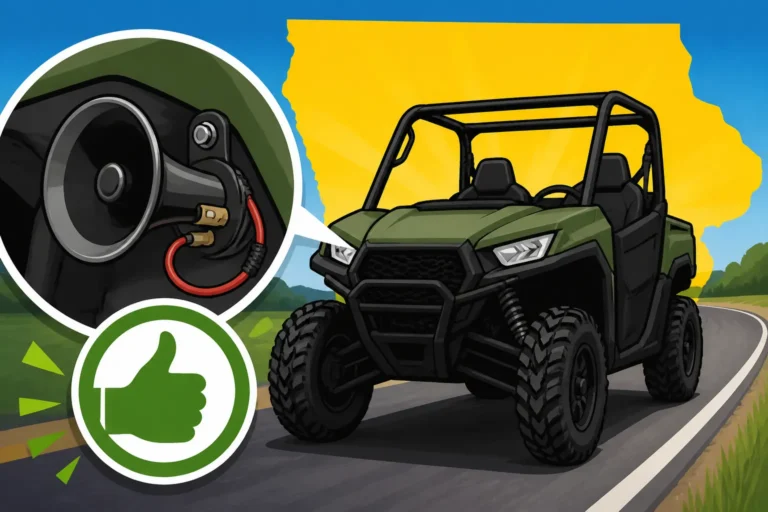
- Horn: A working horn is necessary to alert others to your presence, whether it's a deer on the road or a car backing out of a driveway.
- Slow-Moving Vehicle (SMV) Triangle: This reflective orange triangle with a red border is crucial for machines traveling below 25 mph. It warns faster-moving traffic that you're going slowly, giving them time to react. You typically mount this on the rear of your ATV or UTV. [Iowa Slow-Moving Vehicle Sign Rules] provides more detail on this.
- Insurance: Always carry proof of insurance as required by the state (and potentially by the county). This is often an insurance card that you can keep in a waterproof bag on your machine or in your wallet.
For many of these accessories, you can find high-quality, durable options from companies like SuperATV. They offer a wide range of aftermarket parts designed to help you meet street-legal requirements, from wiring harnesses and light bars to mirrors and turn signal kits. Investing in these upgrades ensures you're not only compliant with Des Moines County’s rules but also safer on public roads.
Navigating and Staying Safe on Des Moines County Roads
Even when you're legally riding on Des Moines County roads, remember that you are sharing the space with other vehicles, and safety must always be your top priority.
- Defensive Riding: Assume other drivers don't see you. Your machine is smaller and less conspicuous than a car or truck. Drive predictably, use hand signals (if not equipped with turn signals), and always be aware of your surroundings.
- Speed Limits: The Iowa state law sets a 35 mph cap for ATVs/UTVs on roads, but Des Moines County might have its own lower limits on certain roads, or simply adhere to posted speed limits. Always follow the posted speed limit, or 35 mph, whichever is lower. [Iowa ATV Speed Limit on Roads] provides state-level context.
- Dust Control: On gravel roads, your machine can kick up a significant amount of dust. This can severely reduce visibility for drivers behind you. Slow down when approaching other vehicles or residential areas, and give plenty of space.
- Respect Private Property: Even on public roads, be mindful of adjacent private land. Do not trespass, and avoid riding in ditches unless explicitly allowed by the ordinance.
- Be Visible: Beyond proper lighting, consider wearing bright, reflective clothing, especially during dawn, dusk, or overcast conditions. Every bit of visibility helps.
Riding legally in Des Moines County means more than just having the right decal; it means understanding and respecting the local environment and its inhabitants.
Common Pitfalls and Misconceptions
Despite your best efforts to read and understand the Des Moines County ordinance, there are still some common traps riders fall into. Being aware of these can help you avoid unnecessary trouble and frustration.
The "Everyone Else Does It" Trap
This is perhaps the most dangerous misconception out there. You pull up to a trailhead or a local gathering spot, and you see other ATVs and UTVs cruising along county roads that you think might be illegal. So, naturally, you think, "Well, if they're doing it, it must be okay!" This is a trap, and it's one that can lead directly to a citation for you, even if the other riders somehow manage to avoid one.
Law enforcement officers enforce the laws as they are written, not as they are popularly interpreted or ignored. Just because someone else is breaking the rules doesn't make it legal for you. It's often the case that some riders are simply unaware, or they're willing to take the risk. Don't let someone else's bad judgment dictate yours. Ignorance of the law, even a complicated local ordinance like Des Moines County's, is generally not a valid defense. Always confirm the rules for yourself.
Confusing City and County Jurisdiction
Another significant point of confusion arises when riders don't distinguish between county roads and city streets. As mentioned, a Des Moines County ordinance typically governs roads outside of incorporated city limits. The moment you cross into a city like Burlington, Fort Madison (though Fort Madison isn't in Des Moines County, it's a good example of a larger city), or even a small town, you are now subject to that city's ordinances, not the county's.
Many cities have their own specific rules, and some maintain strict bans on ATV/UTV use within their corporate boundaries, even if the surrounding county permits it. Others, like the example of [Waukon's Open Streets and Alleys], might open up certain streets or alleys to OHVs. So, if your ride in Des Moines County involves passing through or riding within a city, you need to check that city's clerk's office or website for their specific regulations. Never assume that county permission extends into city limits. This is why [How a City Council Votes to Open Streets] is important background reading.
Road Conditions and Common Sense
Finally, even if Des Moines County’s ordinance legally permits you to ride a certain road, always apply a layer of common sense and good judgment. Legal doesn't always mean safe or appropriate.
- Traffic Volume: Is the road unusually busy? Riding an ATV or UTV on a heavily trafficked road, even if technically legal, can be dangerous for you and frustrating for other drivers.
- Visibility: Are there blind hills or sharp curves? Your machine is smaller and less visible. If you can't see oncoming traffic, they might not see you either.
- Weather: Heavy rain can turn gravel roads into muddy, rutted hazards. Snow and ice create incredibly slippery conditions. Even if the road is open, poor weather conditions might make riding unsafe.
- Special Events: Sometimes, local events, construction, or emergencies can temporarily alter road access or conditions. Stay alert for signage.
Your safety, and the safety of others, should always outweigh simply exercising a legal right to ride. The goal is to enjoy your machine responsibly, and that often means making smart choices beyond the letter of the law.
Comparative Overview: Iowa State vs. Des Moines County (Illustrative)
To give you a clearer picture of how a county ordinance might interact with state law, here's an illustrative table. Please remember, this table provides examples of what you might find and is not a substitute for reading the actual Des Moines County ordinance, which you must consult for precise, up-to-date details.
| Requirement | Iowa State Law (General) | Des Moines County Ordinance (Illustrative Example) |
|---|---|---|
| Paved Roads | Generally prohibited, except specific exemptions/crossings, unless county authorizes. | Might specify: "All unpaved secondary roads, and County Roads 10, 25, and 45 are permitted; all other paved roads prohibited." |
| Unpaved Roads | Generally permitted. | Might specify: "All unpaved secondary roads permitted, except for those within 2 miles of City X limits during peak hours." |
| Speed Limit | Max 35 mph. | Might specify: "Max 35 mph, or posted speed limit if lower. 25 mph on all unpaved roads within 1 mile of any residence." |
| Operating Hours | Generally not specified at state level for roads, but OHV park rules apply. | Might specify: "Sunrise to sunset only on all county roads." |
| Operator Age | 12-17 with safety certificate & adult supervision (under 16). 18+ w/ driver's license. | Might specify: "Operators must be 18 years of age or older with a valid driver's license for all road use." |
| Insurance | Required minimum liability (20/40/15). | Often reiterates state minimums; may emphasize penalties for non-compliance. |
| SMV Sign | Required for machines traveling under 25 mph. | Always required for road use on county roads. |
| Headlights/Taillights | Required after dark. | Always required for road use, even during daylight hours, as a visibility measure. |
| Mirrors/Horn | Required for road use. | Required for all road use; one left-side mirror minimum, two recommended. |
As you can see, a county ordinance can be far more specific and sometimes more restrictive than the general state guidelines. Your job, as a responsible rider in Des Moines County, is to consult that official document and ensure you’re always riding within its specific parameters.
Disclaimer
This article is for general informational purposes only and does not constitute professional advice. Laws, prices and regulations vary by location and change over time. Consult a qualified professional for guidance on your specific situation.