Fifteen Thousand for Property Damage
Trying to make sense of Iowa's rules for riding your ATV or UTV on public roads can feel like deciphering a secret code. You know you need insurance, but what exactly does "Fifteen Thousand for Property Damage" mean, and why is it so crucial? It's a common point of confusion, and frankly, a bit stressful to ensure you're compliant without breaking the bank or running afoul of the law. This guide will cut through the noise, explaining exactly what that specific insurance requirement entails for your off-highway vehicle in Iowa, why it matters, and how to make sure you're covered before you hit the gravel.
Understanding Iowa's Minimum Liability Insurance for ATVs on Roads
When you decide to take your ATV or UTV from private land to a public road in Iowa, even if it's just a short hop down a gravel lane, you're entering a different regulatory landscape. The state of Iowa, like many others, recognizes the increased risk that comes with operating any motor vehicle on public thoroughfares, and that includes your off-highway machine. This is where insurance steps in, specifically liability insurance, to protect not just you, but also other motorists and property owners. It's a fundamental part of being a responsible rider when you're no longer just tearing through your back forty.
The "Fifteen Thousand for Property Damage" Explained
Let's break down that specific number: $15,000 for property damage. This figure is part of what’s often referred to as Iowa’s "20/40/15" liability insurance minimums. When you hear "15," it directly refers to the minimum amount of coverage your insurance policy must provide to cover damage you might cause to another person's property in an accident. Imagine you're riding your UTV on an approved secondary road, and through an unfortunate chain of events, you accidentally swerve and clip a mailbox, or worse, another vehicle. This $15,000 component of your liability insurance is designed to pay for the repairs or replacement of that damaged property, up to that specified limit.
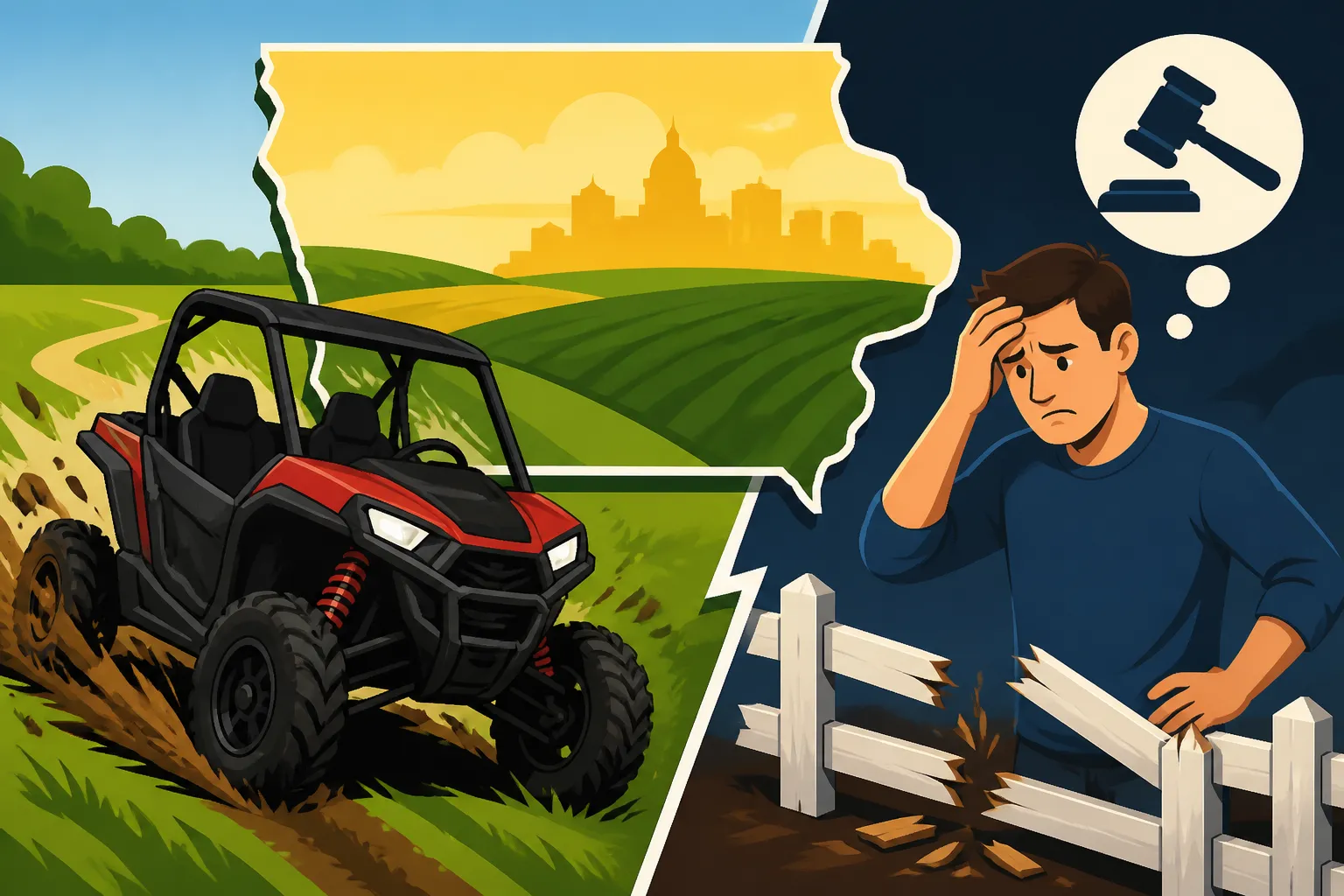
It's absolutely critical to understand that this is a minimum. While $15,000 might sound like a lot for a mailbox, it can be quickly exhausted if you damage a newer vehicle, a fence line, or even a small outbuilding. If the damage you cause exceeds this $15,000 limit, you, as the at-fault party, would be personally responsible for paying the difference out of your own pocket. This is why many riders, once they fully grasp the implications, choose to carry higher limits, even though the state only mandates the minimum. It's about protecting your financial future from unexpected accidents.
| Coverage Type | Minimum Amount (Iowa) | What It Covers |
|---|---|---|
| Bodily Injury (Per Person) | $20,000 | Injuries to one person in an accident you cause. |
| Bodily Injury (Per Accident) | $40,000 | Total injuries for all people in an accident you cause. |
| Property Damage | $15,000 | Damage to another person's property in an accident you cause. |
Why Iowa Requires Insurance for Road-Legal ATVs and UTVs
Iowa's requirement for liability insurance on ATVs and UTVs used on public roads isn't just arbitrary; it's rooted in a strong public policy to ensure that victims of accidents are compensated. The moment your wheels touch a public road, whether it's a paved secondary road or a section of gravel, your machine is considered a motor vehicle under certain circumstances, and thus falls under the same general insurance principles as cars and trucks. The state wants to avoid situations where an uninsured operator causes significant damage or injury and then has no means to pay for it, leaving the victims with crippling financial burdens. This is a common-sense safeguard for everyone sharing the road.
This requirement specifically targets public road use. If your ATV or UTV never leaves private property—say, you only ride it on your own farm or lease land that prohibits public road access—then Iowa doesn't mandate liability insurance for that private use. However, the moment you transition onto a county gravel road, cross a paved highway, or venture into an approved riding area that requires public access, that insurance policy becomes legally essential. Understanding this distinction is key for [Iowa ATV Insurance Requirement]. It ensures that you're only paying for the coverage you genuinely need, but that you have it when the law demands it.
Navigating the Consequences of Uninsured Road Use
The temptation might be there to skip the insurance, especially if you only plan to ride on public roads "just this once" or "for a very short distance." However, this is a gamble that simply isn't worth taking in Iowa. The state takes its insurance requirements seriously, and the penalties for non-compliance are designed to be a significant deterrent. It's not just about getting caught; it's about the very real and potentially devastating financial repercussions if an accident occurs. Think of it as a small upfront cost to avoid a potentially massive future headache.
What Happens If You Don't Have Property Damage Coverage
If you are caught operating your ATV or UTV on an Iowa public road without the required liability insurance, you could face immediate and significant consequences. The first thing you're likely to encounter is a hefty fine. While specific amounts can vary, [Iowa Fines for No Proof of Insurance] are designed to sting, making the cost of the ticket far greater than what a year of insurance might have been. Beyond the fine, you could also have your machine impounded, which means additional towing and storage fees, adding insult to injury. This disruption can be a major inconvenience, especially if you rely on your machine for work or recreation.
However, the fines and impoundment are just the tip of the iceberg. The real financial danger lies in what happens if you're involved in an accident and don't have that $15,000 property damage coverage. If you cause damage to another vehicle, a fence, or any other property, you will be personally responsible for the full cost of repairs or replacement. Without insurance, there's no company to step in and cover those costs. A simple fender bender could lead to thousands of dollars in debt, potential lawsuits, and a long-lasting negative impact on your financial standing. It's a stark reminder that the liability coverage isn't just a legal formality; it's a vital safety net.
The Broader Picture: Injury and Other Liability Minimums
While this article focuses on the "$15,000 for property damage," it's crucial to remember that this figure is just one part of Iowa's minimum liability coverage. The full minimums are often expressed as 20/40/15:
- $20,000 for bodily injury to one person: This means your insurance will cover up to $20,000 for medical expenses, lost wages, and pain and suffering for a single person injured in an accident you cause.
- $40,000 for bodily injury to two or more persons: This is the total maximum your insurance will pay for all injuries sustained by multiple people in a single accident that you are at fault for.
These bodily injury coverages are equally, if not more, important than property damage. Medical bills, rehabilitation costs, and lost income after a serious accident can quickly skyrocket into hundreds of thousands of dollars. The state minimums of $20,000 and $40,000, while meeting the legal threshold, are often woefully inadequate to cover severe injuries. For this reason, many riders, after doing their research and considering their assets, opt for significantly higher liability limits to truly protect themselves from financial ruin. Just like with property damage, if the costs exceed your policy limits, you become personally responsible for the remainder.
Securing Your ATV or UTV Insurance in Iowa
Getting the right insurance for your ATV or UTV in Iowa doesn't have to be a complicated ordeal, but it does require a bit of due diligence. You want a policy that not only meets the state's minimum requirements but also provides you with adequate protection for your specific riding habits and the value of your machine. Don't just grab the first policy you see; take the time to understand what you're buying. This investment in protection is just as important as the investment you made in your machine, perhaps even more so when considering its use on public ways.
Finding the Right Policy for Road Riding
When you're looking for an ATV or UTV insurance policy that covers road riding in Iowa, you'll primarily be focused on liability coverage to meet the 20/40/15 minimums. However, many riders choose to go beyond just liability. You can also get options like:
- Collision coverage: This pays for damage to your own ATV or UTV if it collides with another vehicle or object, regardless of who is at fault.
- Comprehensive coverage: This protects your machine from non-collision incidents, such as theft, vandalism, fire, or damage from natural disasters.
- Uninsured/Underinsured Motorist (UM/UIM) coverage: This is a smart addition, as it protects you if you're hit by another driver (even another ATV/UTV) who doesn't have enough, or any, insurance to cover your damages or injuries.
It's wise to shop around. Many major insurance carriers offer specialized ATV and UTV policies, and some even provide discounts if you bundle your off-road vehicle insurance with your car or home insurance. Don't be afraid to ask for quotes from several providers to compare coverage limits, deductibles, and premiums. When getting quotes, be prepared to answer questions about your machine's make, model, year, and how you plan to use it (e.g., recreational, agricultural, road use). This information helps the insurer tailor the policy and give you an accurate price. For those looking for the [Cheapest ATV Insurance in Iowa], remember that cheap often means minimum coverage, which might not be enough protection in the long run.
Documenting Your Coverage and What to Carry
Once you've secured your insurance policy, the next crucial step is to ensure you can prove it. Iowa law requires that you have proof of financial responsibility (your insurance) readily available when operating your ATV or UTV on public roads. This means carrying a physical or digital copy of your insurance card or declaration page on you or in your machine. This isn't just a suggestion; it's a legal obligation that a deputy or state trooper will check if you're pulled over.
Imagine a scenario where [What an Iowa Deputy Checks Roadside] and you're asked for proof of insurance. Fumbling around or admitting you don't have it can immediately lead to a citation and further investigation. Keep your proof of insurance with your ATV's registration certificate, perhaps in a waterproof pouch in your glove box or saddlebag. Some riders even keep a clear photo of their insurance card on their phone for easy access. Just make sure your phone battery is charged! Being prepared shows responsibility and can help you avoid unnecessary hassle or fines during a routine stop, especially when you're riding on gravel roads [Iowa Rules for Riding a Gravel Road].
Beyond Insurance: Other Iowa Road Legal Requirements
While having the correct liability insurance, including that all-important "$15,000 for property damage," is a non-negotiable for riding your ATV or UTV on Iowa's public roads, it's just one piece of the puzzle. Iowa has a comprehensive set of regulations designed to ensure the safety of all road users. Ignoring these other rules, even if you're perfectly insured, can still land you in hot water. Think of it as preparing your entire machine, and yourself, for the rigors of road travel, not just your wallet. Many riders find that a company like SuperATV offers many of the necessary components to get their machines road-ready, providing solutions that combine safety and compliance.
Essential Equipment for Road-Legal Machines
Making your ATV or UTV truly road-legal in Iowa means equipping it with specific safety features, much like any other vehicle. These aren't just recommendations; they are mandated by law to increase your visibility and ability to signal your intentions to others. You'll need:
- Headlights: Must be on at all times, even during daylight hours, when operating on public roads. [Iowa Lighting Requirements for ATVs] specifies the details.
- Taillights and Brake Lights: Essential for visibility from the rear and signaling when you're slowing down.
- Mirrors: At least one rearview mirror is typically required, often on the left side, to give you a clear view of traffic behind you. For optimal safety, many riders choose to install two. [Iowa Mirror Requirement for Road Use] outlines the necessity.
- Horn: A working horn is needed to alert other drivers or pedestrians to your presence.
- Slow-Moving Vehicle (SMV) Triangle: Because ATVs and UTVs are typically slower than other road traffic, this reflective orange triangle mounted on the rear of your machine is critical for warning following vehicles.
- Spark Arrester: While often associated with trail riding to prevent wildfires, a working spark arrester is also generally required for any off-road vehicle operating on public lands or roads.
Ensuring your machine has these items in good working order isn't just about avoiding a ticket; it's about your safety and the safety of others. Companies like SuperATV offer a wide range of accessories, from mirrors to lighting kits, that can help you upgrade your machine to meet these requirements. It's much better to invest in these items upfront than to face an accident or a citation because your machine wasn't properly equipped.
Age, Licensing, and Road Types in Iowa
Beyond the machine itself, the operator also needs to meet certain criteria to legally ride an ATV or UTV on Iowa roads. First and foremost, you must be at least [Iowa Minimum Age to Ride a Road], which is typically 18 years old, and possess a valid driver's license. Unlike off-road operation where a safety certificate might suffice for younger riders, operating on public roads requires a full driver's license. [Iowa Driver's License Rules for ATVs] make this distinction clear, emphasizing that the privileges of an off-road safety course do not extend to public highway use for minors.
Furthermore, Iowa has specific rules about which roads ATVs and UTVs can be operated on. Generally, they are permitted on [Unpaved County Secondary Roads in Iowa], often referred to as gravel roads, unless prohibited by local ordinance. Some counties or cities may also open specific paved secondary roads or city streets, but this requires explicit authorization from the county board of supervisors or city council, respectively. You cannot just assume all paved roads are open. Interstates and most primary highways remain off-limits, with very limited exceptions for crossing at intersections. Riding your machine on the way to an OHV park, for instance, must be done via [Iowa Rules for Riding to an OHV Park] which usually means the "most direct route" possible on legal roads. Always check local ordinances before riding, as rules can vary even within neighboring communities.
Disclaimer
This article is for general informational purposes only and does not constitute professional advice. Laws, prices and regulations vary by location and change over time. Consult a qualified professional for guidance on your specific situation.