Written Permission From an Iowa Landowner
A landowner’s yes can make a private-property ride possible, but a vague agreement can lead to disputes over boundaries, guests, timing, or damage. Written permission gives both rider and owner a clear record of what was allowed. It does not, by itself, turn private ground into a public trail or waive other applicable requirements for the machine or rider.
What Written Permission Does and Does Not Cover
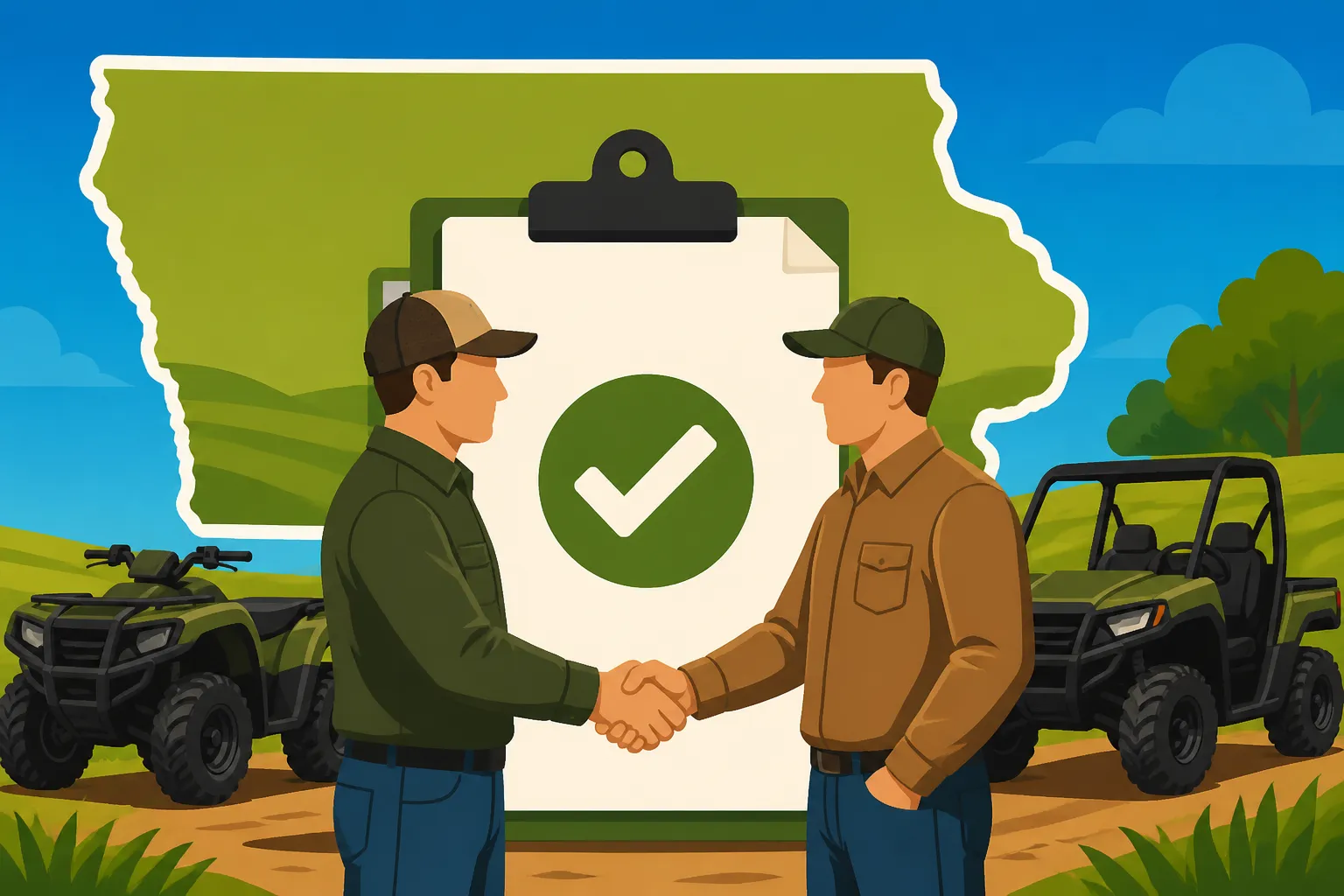
Written permission is a record that the person with authority over a property has agreed to a particular kind of riding. It can help settle practical questions later: which parcel was included, which riders were invited, and whether riding was allowed on a certain date or for a particular event.
In Iowa, getting permission matters because owning or having access to a machine does not give you the right to ride across someone else’s land. Permission should come from someone authorized to allow the activity. Depending on the property, that may be the owner, a tenant with the right to grant access, or another person acting with the owner’s approval. If authority is unclear, ask rather than assume.
A written note is often the simplest way to avoid relying on memory. It can be an email, text message, signed letter, or a more formal agreement. The format is less important than whether the terms are clear and whether the person granting permission can be identified.
Written permission is not a universal substitute for other rules. In particular, it does not automatically:
- Allow riding on neighboring land, public land, a road, or a trail outside the described property.
- Make a machine exempt from registration or other requirements that apply to its use.
- Replace a nonresident permit when one is required for the planned use.
- Authorize an organized event, commercial activity, or trail operation that may need additional approval.
- Change age, supervision, safety, or operating requirements that apply in a particular setting.
- Give a rider permission to ignore posted closures, access restrictions, or a separate lease or conservation agreement.
The distinction between permission and legal requirements is important. A landowner can authorize access to land they control, but that authorization does not necessarily answer whether a machine can be ridden there under applicable state or local rules. For a broader explanation of the boundaries of private-property access, see Riding Private Ground in Iowa and Iowa Rules for Riding Private Property.
| Question | What written permission can clarify | What it does not automatically do |
|---|---|---|
| Where can I ride? | Identifies the parcel, route, or permitted area | Extend access onto adjoining land |
| When can I ride? | States approved dates, hours, or season | Override a closure or local restriction |
| Who can ride? | Lists the permitted riders or guests | Give every visitor permission by default |
| What activities are allowed? | Describes ATV or UTV use and limits | Approve an event or commercial operation without any other required approval |
| What about the machine? | Helps document the landowner’s consent | Replace registration, permits, or other applicable requirements |
What to Put in the Permission
A useful permission note does not need legal language. It should be specific enough that someone who was not part of the conversation can understand what was agreed to. If the owner and rider disagree later, “you can ride out there sometime” may not resolve much.
Identify the property and permitted area
Describe the parcel as clearly as practical. A street address, parcel description, farm name, or a simple attached map may help. If permission applies only to a particular field, timber, lane, or marked loop, say so. Avoid assuming that permission for one part of a property includes every field or access route.
A map can be especially helpful where a property borders another owner’s land, a road right-of-way, a public area, or a trail. Mark the permitted route and any areas that are off-limits. If boundaries are uncertain, ask the landowner to point them out before riding.
Name the riders and machines
State who is allowed to ride. If the permission is for a household, club, or group, identify the riders or explain how additional guests can be approved. A landowner may intend to allow only the person who asked, not everyone that person brings along.
It can also help to describe the type of machine covered, such as an ATV, UTV, or off-road motorcycle. If the landowner has restrictions on machine size, passenger use, noise, or vehicle width, include them. Permission for one person or one machine should not be treated as permission for another without checking.
Set dates, hours, and conditions
State whether permission is for one ride, a range of dates, or ongoing access that can be withdrawn. Include any time limits and seasonal restrictions. Conditions might cover speed, staying on established paths, avoiding wet ground, closing gates, or keeping away from livestock, crops, buildings, and equipment.
Be precise about special instructions. “Stay out of the north field” is more useful when the rider knows which field that means. If there is a gate code, key, or entry procedure, handle it privately and only with the person who needs access.
Make guest and event rules explicit
If a rider plans to bring guests, get approval for those guests rather than assuming the original permission includes them. A landowner may want to know how many machines are coming, who is responsible for the group, and whether the ride is private or open to others.
A planned gathering can raise issues that an ordinary ride does not. A large group, organized ride, race, fundraiser, guided trip, or activity involving payment may require more than an informal note. Do not treat ordinary private-land permission as approval for every event format. Review Iowa Rules for an Organized Ride when the ride involves a group activity, and ask the relevant landowner or managing authority what additional approvals may be needed.
Agree on damage, cleanup, and responsibility
Discuss how riders should respond if they damage a fence, rut a field, hit a gate, or cause another problem. The note can identify who to call and what the landowner expects. It is better to ask about sensitive areas before riding than to debate the cause of damage afterward.
Do not assume that a written permission note releases a rider from responsibility for damage or injury. Nor should a landowner assume that a simple note addresses every liability issue. For an event, repeated access, or commercial use, a more formal agreement and appropriate professional advice may be prudent.
Permission, Leases, Registration, and Permits
Before riding, check who actually controls access to the land. A farm tenant may have possession of fields but not the right to invite recreational riders. A hunting lease, farm lease, conservation contract, or other agreement may limit who can enter and for what purpose. If someone other than the owner gives permission, ask whether that person has authority to allow ATV or UTV use.
This is particularly important on farmland. A lease may grant specific agricultural rights without granting recreational access. Conversely, an owner may have promised a tenant that certain areas remain undisturbed. Clarify the arrangement before entering. A Farm Lease and Riding Rights in Iowa explains why a rider should not infer recreational access from the fact that a property is farmed or leased.
A landowner’s approval also does not decide whether your machine needs registration for the way you plan to use it. Requirements can depend on the vehicle, the location, and whether the ride crosses onto public ground or a designated riding area. Check the rules for your specific use rather than treating a private-property invitation as a blanket exemption. For more detail, see Iowa Landowner Permission Rules and Iowa ATV Registration for a Nonresident.
Nonresidents should be especially careful not to confuse the owner’s permission with a state permit. Permission addresses access to the land; a permit or registration addresses the machine’s legal status for a particular type of use. A home-state registration, an Iowa requirement, and a landowner’s consent can be separate questions. Check each one before unloading.
The same separation applies to public trails. A private owner cannot grant permission to ride a public trail on behalf of the agency or organization responsible for it. Nor does a landowner’s permission automatically authorize riding off a marked route. If access is through a club-managed trail, confirm with the trail manager as well as the property owner. See Iowa Rules for Riding a Club Trail for the distinction between private access and trail-specific rules.
A practical check before the ride
Use this short sequence before taking a machine onto private land:
- Confirm who has authority. Ask the owner or the person responsible for access whether they can approve recreational riding.
- Describe the intended ride. Give the date, number of riders, machine types, route, and whether guests will attend.
- Get the terms in writing. A clear message or email can record the agreement; attach a map if the boundary is not obvious.
- Check restrictions beyond the landowner’s consent. Verify registration, permit, age, supervision, and operating rules that apply to the planned location and machine.
- Stay within the agreement. Keep to the approved area and hours, follow conditions, and do not invite additional riders without approval.
- Report problems promptly. Contact the landowner if there is damage, a blocked route, an unexpected boundary issue, or a change in conditions.
A Simple Permission Note and Common Problems
There is no need to make a permission note complicated. The goal is to preserve the essential details, not to create a substitute for a formal contract when one is needed. A short written record can include:
- The name of the person granting permission and the rider or group receiving it.
- A description of the property and the area where riding is allowed.
- The permitted dates or the period during which access is allowed.
- The types of machines and named riders covered.
- Any guest, passenger, route, speed, noise, or time restrictions.
- Any conditions for gates, livestock, crops, wet ground, parking, or cleanup.
- A contact method for questions or emergencies.
- Confirmation that access may be limited or withdrawn.
Both sides should keep a copy. If the terms change, write down the change too. A text saying “you can ride the west timber this Saturday, stay on the marked trail, and bring one guest” is more useful than a message that only says “sure.”
When the permission is vague
If the note does not identify the route or riders, ask for clarification before the ride. Do not use a vague yes to justify crossing a boundary, adding a group, or staying longer than expected. If a landowner gives permission verbally, it is reasonable to follow up with a short message that restates the details and asks the owner to confirm them.
When land ownership or access is unclear
A fence, field entrance, or familiar route does not reliably show who owns or controls the land. A property may have multiple owners, an active lease, a shared driveway, or a separate access agreement. Stop and confirm before riding if the person who gave permission cannot identify the route or explain their authority.
When permission is withdrawn
Treat a landowner’s decision to end access as a reason to stop riding and leave by the approved route. Do not continue because a previous message allowed access on another date or because the machine is already on the property. If a disagreement arises, avoid escalating it on the land. Preserve the written messages and resolve the question directly or seek appropriate advice.
When a ride expands into an event
A plan that begins as a few invited riders can change once people start bringing guests, advertising a ride, collecting money, or setting up a route for repeated use. Ask again before the scope changes. A landowner may have agreed to a private outing but not to a public event, commercial tour, or ongoing trail. If the activity falls into one of those categories, check the additional requirements instead of relying on the original permission.
Written permission works best when it is treated as a clear boundary, not a loophole. Confirm who may ride, where they may go, and what conditions apply; then check any separate requirements for the machine, rider, and location. That approach protects the landowner’s expectations and gives riders a much firmer basis for planning a private-property ride.
Disclaimer
This article is for general informational purposes only and does not constitute professional advice. Laws, prices and regulations vary by location and change over time. Consult a qualified professional for guidance on your specific situation.