Passing at 80 Percent
Passing the Iowa ATV education exam can feel harder when you do not know what the score means or what happens after you pass. The key threshold is clear, but the number of questions and retake process should not be assumed. Here is how to prepare, understand the result, and carry the right certificate when you ride.
What passing at 80 percent means
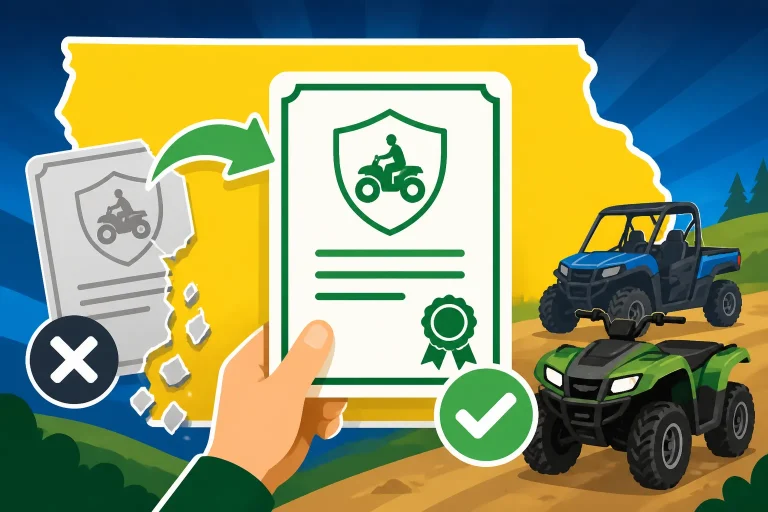
Iowa’s ATV education course has a final exam, and students must pass it with at least 80% accuracy to earn an education certificate, according to the Department of Natural Resources. That score is the passing threshold; it does not tell you how many questions the exam contains or how many correct answers you need unless you know the test’s total number of questions.
The certificate is for ATV education. Iowa requires ATV operators ages 12 through 17 to complete an approved ATV safety course and carry the certificate when riding on designated areas, public land, or public ice, according to the Department of Natural Resources. For more on who needs one and where the requirement applies, see Iowa ATV Safety Certificate Requirements.
The online certification offering is provided through ATVCourse.com in collaboration with Fresh Air Educators, according to the Department of Natural Resources. Students must be at least 12 years old to earn the ATV education certificate through ATVCourse.com, according to the Department. The course has no riding component, so passing the exam is about completing the education requirement rather than demonstrating riding skill.
That distinction matters. A passing score confirms that you have met the course’s exam standard; it does not replace the separate requirements for registering a machine, following trail rules, or operating legally. If you are planning a public-land ride, review Iowa Rules for Riding a Designated Riding Area and Iowa Rules for Riding Public Land as well.
| Checkpoint | What to know |
|---|---|
| Passing standard | The Department of Natural Resources requires at least 80% accuracy on the final exam. |
| Who can earn the online certificate | A student must be at least 12 years old to earn it through ATVCourse.com. |
| Course format | The online course has no riding component. |
| Riding requirement | ATV operators ages 12 through 17 must have completed an approved course and carry the certificate in covered riding areas. |
The exact number of correct answers depends on the exam’s question count. Do not guess that figure or rely on a score calculation from a different course. Use the exam instructions shown in the course you are taking, and check the course provider’s current rules for details such as how results are displayed or what to do if you do not pass.
How to prepare for the final exam
A useful study plan is straightforward: take the course attentively, make brief notes on material you need to remember, and review those notes before starting the final. The exam is part of the education course, so the most reliable preparation is to understand the course material rather than search for an assumed question bank or memorized answer key.
Work through the lessons carefully
Avoid rushing through course pages just to reach the exam. Pay attention to the concepts the course emphasizes, especially material that seems easy to confuse or that you need to revisit. If the course lets you review earlier sections, use that option when a term or rule is unclear.
Keep notes in your own words. A short explanation of an idea is usually more helpful for review than copying a whole lesson. You might write down a rule, then add a reminder of what it means in a riding situation. The goal is to make it easier to recall and apply the material, not to create a second version of the course.
Read each exam question closely
During the final, pause long enough to understand what each question is asking. Watch for words that change the meaning, such as whether the question asks what is required, what is allowed, or what applies in a particular setting. If an answer choice seems close, compare it with the wording and explanation in the course rather than choosing based on what sounds familiar.
If the exam interface permits you to move between questions or review answers, follow its instructions. Do not assume that every online exam offers the same features. The provider’s on-screen directions are the best guide to how to submit answers and view your result.
Keep the score in perspective
The 80% threshold is a defined pass mark, not a promise that every student will find the exam easy. If you do not pass on an attempt, avoid concluding that you cannot complete the course. Revisit the material you found difficult and follow the provider’s instructions for what happens next. The available facts do not establish a retake limit or waiting period, so verify those details with the course provider rather than relying on advice from another course.
You can also review the basic certificate rules before riding. Iowa Safety Certificate Age Range explains the age requirement, while Iowa Rules for Riders Under 12 addresses a separate situation: Iowa does not allow a child under 12 to operate an ATV on public land or public ice unless directly supervised by an experienced, licensed parent or guardian who is at least 18 years old, according to the Fiscal Services Division. That supervision rule is not a substitute for the education certificate required for riders in the covered age group.
What to do after you pass
After passing, make sure you know how to access or obtain your education certificate through the course process. Do not treat a passing score alone as proof that you have the certificate in hand. Follow the provider’s instructions for completing the course and receiving the certificate, and keep the certificate available for riding.
The Department of Natural Resources says education certificates must be in the operator’s possession when riding on public land, public ice, and designated riding areas. The Fiscal Services Division also states that people ages 12 through 18 must possess a DNR-approved education certificate while operating an ATV on public land, ice, trails, or registration-funded land. Because the age wording differs across the stated rules, riders should check the Department’s current instructions for the specific riding location and their circumstances.
A certificate requirement is separate from registration. The Department of Natural Resources requires off-highway vehicles used on public land, public ice, or at a designated riding area to be registered with the DNR. The registration certificate must be in the vehicle or on the operator while the vehicle is in use, and the machine must display a current registration sticker to operate on public land, public ice, or designated riding trails. If you are new to the process, Registering an ATV in Iowa covers registration, and Carrying the Certificate on an Iowa Ride focuses on keeping the registration certificate accessible.
Before loading up, check the rules for the specific place where you intend to ride. A course certificate does not authorize riding on private property without permission, replace a required registration decal, or override a trail closure. It is one part of being ready to ride, alongside the machine’s paperwork and the applicable land-use rules.
Keep the education certificate distinct from registration paperwork
It is easy to mix up the education certificate and registration certificate because both may be called a certificate. They serve different purposes:
- The ATV education certificate shows that the eligible operator completed the required education course.
- The registration certificate relates to the vehicle’s DNR registration.
- The registration decal is displayed on the machine; the registration certificate must be in the vehicle or on the operator while it is in use, according to the Department of Natural Resources.
For practical help with the education card, see Can the Safety Certificate Ride in Your Pocket?. For registration paperwork and decal questions, use the relevant registration instructions instead of assuming that one document covers both requirements.
Common mistakes to avoid
Assuming 80% means a fixed number of correct answers. The passing percentage is known, but the question count is not specified here. Use the exam’s own instructions to understand the score.
Confusing course completion with riding permission. Passing the exam meets the course’s score standard, but other requirements may still apply. Registration, a current decal, land access, and local riding rules are separate considerations.
Waiting until the ride to find the certificate. The Department of Natural Resources requires the education certificate to be in the operator’s possession in covered riding areas. Confirm that you can access it before heading out.
Treating the course as a hands-on test. The Department of Natural Resources says there is no riding component for the ATV education course. The exam and course do not demonstrate practical riding ability, so operators still need to use sound judgment and ride within their ability.
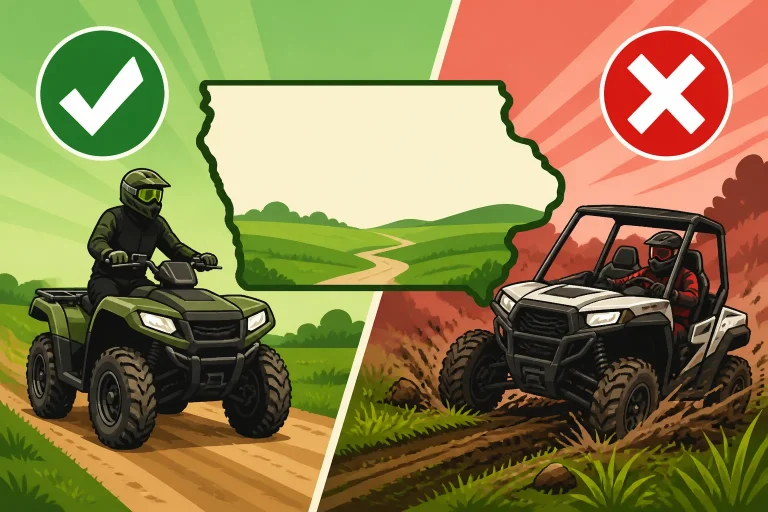
Assuming the rules for a different vehicle are identical. The cited education requirement is for ATV operators. Check the Department’s guidance for the specific machine and riding location instead of assuming that every ATV, UTV, or other off-highway vehicle follows the same certificate rule.
If you are uncertain about course access, exam attempts, or how the certificate is delivered, check the current instructions from the course provider and the Department of Natural Resources before you ride. The central point remains simple: meet the required 80% exam standard, complete the provider’s certificate steps, and carry the required education certificate when riding in areas where it applies.
Sources
- Department of Natural Resources — OHV Safety & Education | Department of Natural Resources (checked November 3, 2026)
- Fiscal Services Division — 1543036.pdf (checked November 3, 2026)
- Department of Transportation — Driving Your ATV or UTV/ORV on Iowa Public Roads | Department of Transportation (checked November 3, 2026)
- IOWA DEPARTMENT OF NATURAL RESOURCES — download?inline (checked November 3, 2026)
- Department of Natural Resources — Snowmobile Education & Safety | Department of Natural Resources (checked November 3, 2026)
- Iowa Department of Natural Resources — download?inline (checked November 3, 2026)
Disclaimer
This article is for general informational purposes only and does not constitute professional advice. Laws, prices and regulations vary by location and change over time. Consult a qualified professional for guidance on your specific situation.