Getting the Safety Card After You Pass Online
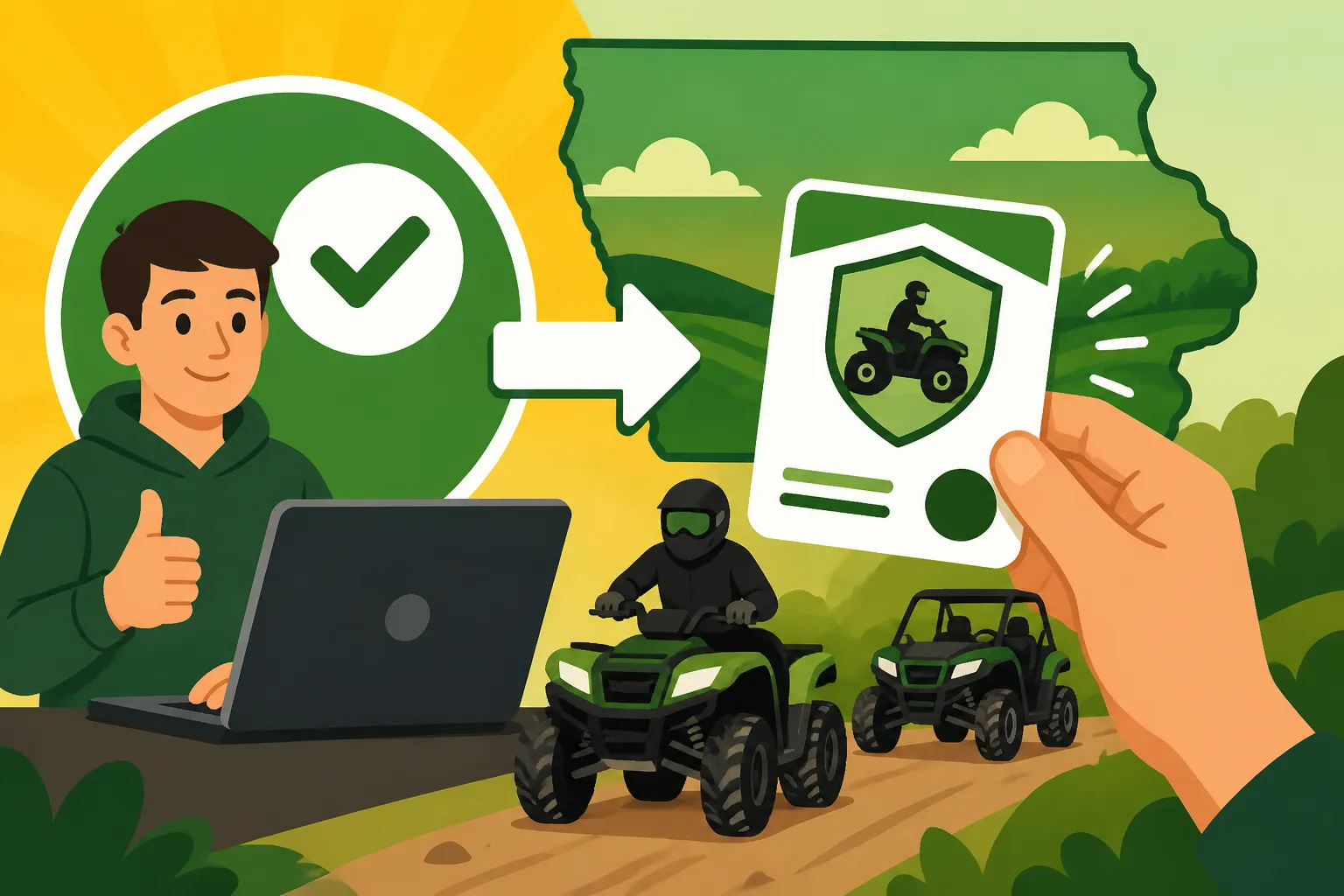
Passing the online ATV course is not quite the same as having the certificate ready to show when you ride. If the exam says you passed but you cannot find your safety card, the next steps are to confirm the course record, locate the certificate, and make sure you can carry it as required.
What passing the course means
Iowa’s ATV education requirement applies to operators ages 12 through 17 riding in places such as public land, public ice, designated riding areas, and registration-funded land. According to the Department of Natural Resources, riders in that age range must take and pass an approved ATV education course, and they must have the education certificate in their possession while riding in the covered areas.
The online course is an option: the DNR collaborated with Fresh Air Educators to provide an online certification offering through ATVCourse.com. According to the Department of Natural Resources, students must be at least 12 to earn the certificate through ATVCourse.com, and must pass the final exam with 80% accuracy. The course has no riding component.
Passing the exam is the achievement that makes you eligible to earn the certificate. It does not, by itself, tell you where the certificate is stored or whether it is ready to carry. The course provider’s account and completion records are the practical place to check next. Course screens and delivery procedures can vary, so use the instructions shown in your course account rather than assuming a certificate will automatically arrive by mail or appear in a particular format.
The card is also separate from vehicle registration. According to the Department of Natural Resources, OHVs operated on public land, public ice, or at a designated riding area must be registered, and the operator must have the registration certificate in the vehicle or on their person. A registration decal does not replace an education certificate, and an education certificate does not register the ATV. For the broader age and riding rules, see Iowa ATV Safety Certificate Requirements and Iowa Safety Certificate Age Range.
How to locate your certificate after an online pass
If your results show that you passed but you cannot find the certificate, work through the course record before starting the course again. A repeated exam or a second purchase is unlikely to solve a missing-document problem if the original account already shows a completed course.
-
Sign back in to the account used for the course. Check the course dashboard, completion area, and any section labeled for certificates or records. Make sure you are using the same account and email address you used during enrollment.
-
Confirm the course status. Look for a completed or passed status, not only a message that the exam has been submitted. If the result is still pending or the course shows a section as incomplete, follow the instructions displayed in the account before assuming the certificate is ready.
-
Check the email account connected to the course. Search the inbox, junk, and spam folders for messages from the course provider. Search for terms such as “certificate,” “completion,” or “ATV.” Also check whether the provider has a current email address on file.
-
Review the course’s own help or contact information. If the certificate is not visible, use the support instructions provided by the course platform. Have the account email and the information identifying your completed course ready. If the provider’s instructions do not resolve the issue, contact the provider for guidance on the certificate record.
-
Keep a copy in a usable form. If the course account provides a certificate file or print option, save or print it and make sure the rider can access it while riding. Do not assume that a screenshot, a receipt, or a result page is accepted in place of the education certificate. If you are unsure whether a digital version meets the possession rule, confirm that with the course provider or the DNR before riding.
The DNR requirement is possession of the education certificate in the covered riding situations. The available facts do not establish a universal delivery method or a standard time for receiving the card after passing, so do not rely on a particular mailing schedule. If the account confirms completion but no certificate appears, ask the course provider which step remains and how the certificate is made available.
The course fee is separate from the certificate’s physical or digital format. According to the Department of Natural Resources, the total online course fee is $34.95, including the $5 DNR education certificate fee, as of November 2026. If you are asked to pay again after completing the course, check your account and contact the provider before making another purchase.
| What you have | What it proves | What to do next |
|---|---|---|
| A passing exam result | You met the exam requirement shown by the course | Check the account for the completed-course status and certificate |
| A course completion email | The provider sent a completion notice | Follow its instructions and confirm the certificate is available |
| A course receipt | A payment was recorded | Do not treat it as the education certificate; check the course account |
| A saved or printed certificate | You have a copy of the certificate | Keep it accessible while riding and confirm any questions about acceptable format |
| A DNR registration certificate or decal | The vehicle’s registration is documented | Keep it separate from the rider’s education certificate |
What to carry, and when the card matters
Once you have the certificate, make sure the rider can produce it while operating an ATV in the places covered by the rule. The Department of Natural Resources says education certificates must be in the operator’s possession when riding on public land, public ice, and designated riding areas. The DNR also identifies registration-funded land as a place where the certificate requirement applies to riders in the relevant age range.
Keeping the certificate in a safe place at home is not enough if the rider cannot access it during a ride. Choose a way to carry it that protects it from water, dirt, and damage. If the certificate is available digitally, verify in advance that the rider can open it in the conditions where they will be riding, and confirm whether that format meets the possession requirement. A dead phone battery or a lost password can make a digital copy difficult to show, so a printed copy may be a useful backup if the provider supplies one.
Do not confuse the ATV education certificate with the registration certificate. The education certificate belongs to the rider; registration applies to the machine. According to the Department of Natural Resources, the registration certificate must be either in the vehicle or on the operator while it is in use. The agency also requires registration for off-highway vehicles operated on public land, public ice, or at designated riding areas. More detail on keeping the documents handy is covered in Can the Safety Certificate Ride in Your Pocket? and Carrying the Certificate on an Iowa Ride.
For a newly owned machine, or one that has not yet been entered in the recreational vehicle and vessel registration system, registration is handled through the County Recorder’s Office. Registration and the safety card are separate tasks, so completing one does not complete the other. If you still need to register the ATV, see Iowa ATV Registration Paperwork and Where to Register an ATV in Iowa.
A rider may also need to meet requirements beyond carrying the card. The course certificate does not grant permission to ride on land, replace the ATV’s registration, or make otherwise restricted road use legal. Before a ride, check the specific location’s rules and make sure the machine is properly registered where required. For designated riding areas, Iowa Rules for Riding a Designated Riding Area provides related information.
If the rider passed but still cannot show a card
If a ride is coming up and the certificate is still missing, treat the document problem as unresolved. A passing score is important, but the DNR requires the certificate to be in the operator’s possession in the covered settings. Do not assume that a test-result screen, purchase receipt, or verbal confirmation will substitute for it.
First, check that the course account belongs to the rider who passed. Then confirm that the account shows the final course as complete, rather than showing only an exam result or a partially completed course. If the certificate is not available, contact the provider using its own help instructions and ask how to retrieve or verify the certificate. If the provider says the record is complete but you still have a question about what form of proof to carry, ask the DNR before the ride.
A rider should also understand which age rule applies. According to the Department of Natural Resources, ATV operators ages 12 through 17 must take and pass the education course. The online offering through ATVCourse.com is for students who are at least 12. The certificate requirement is not a general substitute for supervision rules: according to the Department of Natural Resources, children under 12 cannot operate an ATV on public land and public ice unless directly supervised by an experienced, licensed parent or guardian who is at least 18. See Iowa Rules for Riders Under 12 for that separate issue.
A certificate is not a road-use qualification, either. It does not change the rules for operating an ATV on public roads. According to the Fiscal Services Division, a person operating an ATV on a public road must be at least 18 and have a valid driver’s license. Those roadway rules are distinct from the education requirement for younger riders on public land, public ice, and designated riding areas.
For a visit to Bluff Creek OHV Park, the certificate requirement still concerns the rider, while registration concerns the machine. If you plan to ride there, check that both are in order before leaving. Carrying the Card at Bluff Creek covers the practical document question for that setting. If the certificate is still missing, postponing the ride is the safer choice than relying on proof that may not meet the possession rule.
Sources
- Department of Natural Resources — OHV Safety & Education | Department of Natural Resources (checked November 3, 2026)
- Fiscal Services Division — 1543036.pdf (checked November 3, 2026)
- Department of Transportation — Driving Your ATV or UTV/ORV on Iowa Public Roads | Department of Transportation (checked November 3, 2026)
- IOWA DEPARTMENT OF NATURAL RESOURCES — download?inline (checked November 3, 2026)
- Department of Natural Resources — OHV Dealers | Department of Natural Resources (checked November 3, 2026)
- Iowa Department of Natural Resources — Snowmobile Dealers | Department of Natural Resources (checked November 3, 2026)
- Department of Natural Resources — Snowmobile Education & Safety | Department of Natural Resources (checked November 3, 2026)
- Iowa Department of Natural Resources — download?inline (checked November 3, 2026)
Disclaimer
This article is for general informational purposes only and does not constitute professional advice. Laws, prices and regulations vary by location and change over time. Consult a qualified professional for guidance on your specific situation.