Iowa’s Unpaved Secondary Road Rule
There's nothing quite like the freedom of hopping on your ATV or UTV and hitting the trails, but what about getting there, or just enjoying a scenic route through Iowa's beautiful countryside? For many riders, the question of whether you can legally ride your off-highway vehicle on public roads can feel like navigating a legal minefield. It’s a common frustration, with rules that seem to vary from state to state, and even county to county. This comprehensive guide is here to unravel the complexities of Iowa's unpaved secondary road rule, helping you understand exactly when, where, and how you can legally operate your ATV or UTV on these specific public pathways.
Understanding Iowa's Road Riding Landscape
Iowa's approach to ATV and UTV use on public roads can certainly feel like a puzzle with missing pieces. You might have heard whispers of strict prohibitions, only to see someone else cruising down a gravel road on their side-by-side. It’s enough to make any rider scratch their head and wonder what the real deal is. The truth is, it's not a simple "yes" or "no" answer; it's a nuanced set of regulations designed to balance recreational freedom with public safety.
The General Prohibition and Its Nuance
At its core, Iowa law generally considers ATVs and UTVs off-highway vehicles, meaning they're primarily designed for off-road use and aren't typically "street legal" in the same way a car or motorcycle is. This blanket prohibition is often the first thing riders encounter, and it can be incredibly disheartening. You bought your machine for adventure, and suddenly it feels like a caged beast. This general rule aims to keep these machines, which lack many of the safety features of traditional automobiles, off high-speed, high-traffic paved roads where they could pose a significant risk.
However, and this is where the nuance comes in, Iowa law carves out specific exceptions for certain types of roads and conditions. It's not about making every road a free-for-all, but recognizing the practical needs of riders, particularly those who live in rural areas or need to access designated riding trails. The confusion often stems from the fact that these exceptions aren't universally applied across all road types. One moment you might be legally riding, and the next, you could be in violation, simply by turning onto a different classification of road. This can lead to genuine bewilderment and even costly citations for riders who genuinely believe they are following the rules. It's a system that requires careful attention to detail, far beyond a simple assumption that if one road is open, they all are.
What Exactly is an "Unpaved Secondary Road?"
To fully grasp the "unpaved secondary road rule," we first need to define what exactly constitutes an "unpaved secondary road" in the eyes of Iowa law. Forget city streets with their asphalt and traffic lights, or those bustling four-lane highways that connect major towns. We're talking about something entirely different. These are the arteries of rural Iowa, the roads that wind past cornfields, connect small farmsteads, and often see more tractors than passenger cars.
An unpaved secondary road is typically a gravel, dirt, or unimproved roadway that falls under the jurisdiction and maintenance of the county. These roads are distinct from "primary highways," which are state and federal routes, often marked with route numbers like US 30 or IA 14, and are almost always paved. Secondary roads, paved or unpaved, are managed by the county and are often less traveled, but no less vital to local communities. The "unpaved" part is key here—if it's blacktopped, it's a different animal with different rules, which we'll touch on later. It's important not to confuse "secondary" with "unimportant" or "private." These are still public roads, subject to traffic laws, but their classification grants specific permissions for ATVs and UTVs that other road types do not. Understanding this classification is the very first step toward knowing where you can and cannot legally ride your machine.
The Core "Unpaved Secondary Road Rule"
Now that we've established what an unpaved secondary road is, let's dive into the meat of the matter: the actual rules governing ATV and UTV use on them. This is where the exceptions to the general prohibition become clear, but also where specific requirements kick in. It’s not a free pass to tear down every gravel lane; there are conditions and responsibilities that come with this privilege.
Who Can Ride and Where
When it comes to operating an ATV or UTV on Iowa's unpaved secondary roads, the law is quite clear about who can be behind the handlebars or wheel. First and foremost, the operator must be at least 18 years old. This isn't a suggestion; it's a strict requirement. If you're 17 or younger, even if you have an ATV safety certificate, you generally cannot operate an off-highway vehicle on these public roads. This age restriction is rooted in safety concerns, recognizing that operating these machines on public thoroughfares, even quiet gravel roads, requires a level of maturity and driving experience typically associated with adult licensure. Beyond age, the operator must possess a valid driver's license. This means a standard automobile driver's license is sufficient; you don't need a special ATV endorsement, but you do need to be legally licensed to operate a motor vehicle. [Iowa Driver's License Rules for ATVs]
The "where" part is also crucial. These roads are generally open for ATV/UTV use, but there's an important caveat: unless specifically prohibited by a county ordinance. This means that while state law grants permission, individual counties retain the authority to close certain unpaved secondary roads or segments of them to OHV traffic. It's vital to check with the local county's sheriff's office or recorder's office for any such restrictions before you head out, especially if you're exploring a new area. Finally, and this is a big one, you generally must be taking the "most direct route" to or from a designated OHV park, trail, or private land where you have permission to ride. This isn't intended for leisurely joyrides across multiple counties but rather as a practical means of access. The state wants riders to use these roads for specific, purposeful travel, not as recreational trails themselves.
Mandatory Machine Requirements for Road Use
It's not enough to simply be an eligible rider on an open road; your ATV or UTV itself needs to meet certain specifications to be legally operated on Iowa's unpaved secondary roads. These requirements are all about making your machine visible and safe for yourself and others sharing the road. Think of it as putting your off-road machine in "road mode."
First, and this is non-negotiable, your machine must have functional headlights. And here's the kicker: they must be on at all times, even in broad daylight. This is crucial for visibility, as an ATV or UTV can be easily overlooked by larger vehicles. Similarly, you need taillights and brake lights that are fully operational. These ensure that drivers behind you can see your presence and anticipate your stops, especially in dusty conditions. Beyond lighting, a rearview mirror is a must-have. While many off-road machines come with mirrors, make sure yours is properly installed and provides a clear view of traffic behind you. You also need a functional horn for signaling, just like any other road vehicle. A quick beep can alert a passing car or a farmer exiting a field. Lastly, and very distinctly, your ATV or UTV must be equipped with a slow-moving vehicle (SMV) triangle prominently displayed on the rear. This bright orange triangle with a red border is a universal sign warning other motorists that your vehicle will be traveling at a slow speed, giving them ample time to react and pass safely. Riders often find great options for these road-legal accessories, including mirrors and horns, from manufacturers like SuperATV, ensuring their machines are compliant and safe. Without these essential components, even on an unpaved secondary road, you could face a citation from law enforcement.
The Crucial Role of Insurance
Just like driving your car, operating an ATV or UTV on public roads in Iowa—including those unpaved secondary ones—comes with a mandatory insurance requirement. This isn't just a good idea; it's the law, and failing to comply can lead to significant penalties. Iowa requires minimum liability insurance coverage for any off-highway vehicle operated on a public road.
The specific minimums are often expressed as 20/40/15. Let's break down what those numbers mean in practical terms. The "20" represents $20,000 for bodily injury liability for one person in an accident. The "40" means $40,000 for total bodily injury liability for all persons in an accident. And the "15" stands for $15,000 for property damage liability. These figures dictate the maximum amount your insurance company will pay out for damages and injuries you cause in an accident. While these are the minimums, many riders opt for higher coverage limits for greater peace of mind, especially given the potential for severe injuries or extensive property damage in an OHV accident. Riding uninsured on an Iowa public road, even a quiet gravel lane, is a serious offense. If you're pulled over and cannot provide proof of current liability insurance, you could face hefty fines and potentially have your machine impounded. It’s a gamble that’s simply not worth taking, both for your wallet and for the safety of others.
Speed Limits and Safe Riding Practices
Even on the most remote gravel road, operating an ATV or UTV demands adherence to specific speed limits and a keen awareness of safe riding practices. These aren't just arbitrary rules; they're designed to protect you, your passengers, and anyone else you might encounter on these public pathways. The characteristics of unpaved roads themselves necessitate a different approach to riding than what you might be used to on a dedicated off-road trail.
The 35 MPH Speed Cap
One of the most critical rules to remember when riding your ATV or UTV on Iowa's unpaved secondary roads is the strict 35 mph speed limit. This isn't a guideline; it's the law. While your machine might be capable of much higher speeds, exceeding this limit on public roads is a direct violation and can result in a citation.
There are very good reasons for this seemingly restrictive speed cap. Unpaved roads, by their very nature, present different challenges than paved surfaces. They are often less predictable, with varying conditions like washboards, loose gravel, potholes, and ruts. At higher speeds, these imperfections can quickly lead to loss of control, especially for vehicles like ATVs and UTVs that have a higher center of gravity and different handling characteristics compared to traditional cars. Additionally, the purpose of allowing OHV use on these roads is generally for access, not for high-speed recreational riding. Keeping speeds lower minimizes dust, reduces wear and tear on the roads, and significantly decreases the severity of accidents if they do occur. It’s a rule that prioritizes safety and the longevity of the public infrastructure over unbridled speed. Adhering to this 35 mph cap is fundamental to legal and responsible road riding in Iowa.
Riding Etiquette and Road Hazards
Beyond the legal speed limit, safe riding practices on unpaved secondary roads involve a healthy dose of common sense and road etiquette. Remember, you're sharing these roads with other vehicles, including cars, trucks, and often large, slow-moving farm equipment. Your machine, while capable and fun, is often smaller and less visible than other traffic.
Always stay to the far right side of the road, giving ample room for oncoming traffic and for vehicles to pass you safely. When approaching another vehicle, especially one kicking up a dust cloud, slow down, be prepared to stop, and ensure you can be seen. Yielding to other traffic, particularly those large combines and tractors, is not just polite, it’s a matter of self-preservation. These rural roads also come with their own set of unique hazards. Loose gravel can cause your tires to lose traction, especially on curves or when braking. Washboards—those rippled sections of road—can make for a very bumpy and potentially uncontrollable ride at speed. Keep an eye out for hidden driveways where vehicles might suddenly emerge, and always approach blind corners with extreme caution, assuming another vehicle could be just around the bend. Dust can also be a significant issue, reducing visibility for both you and other drivers. If you're riding in a group, spread out to reduce dust clouds and maintain safe following distances. Good quality side-by-side windshields, often available from brands like SuperATV, can help mitigate some dust impact for UTV riders, but remaining vigilant is always your best defense. Riding defensively and anticipating potential problems are key to a safe and enjoyable experience on Iowa’s unpaved secondary roads.
County Authority and Local Ordinances
While Iowa state law provides the framework for ATV and UTV use on unpaved secondary roads, it's crucial to understand that local county governments hold significant power to further regulate or even restrict this privilege. This local control can be a source of confusion and frustration for riders, as what's permissible in one county might be strictly forbidden just across the county line.
How Counties Can Restrict Unpaved Roads
The state may say "yes" to ATVs and UTVs on unpaved secondary roads, but counties have the authority to say "no," or at least, "not on this one." This local control allows counties to respond to specific concerns from their residents, address unique road conditions, or manage traffic flow. A county board of supervisors, through a local ordinance, can vote to prohibit OHV use on certain unpaved secondary roads or even on all of them within their jurisdiction. [How an Iowa County Authorizes a Paved Road]
This means that simply because a road is unpaved and secondary doesn't automatically mean it's open season for your ATV or UTV. The onus is on the rider to research the local ordinances of the county they plan to ride in. How do you do this? The best resources are usually the county recorder's office, the county sheriff's department, or the county's official website. Many counties will have their ordinances posted online or can provide you with information over the phone. The inconsistency across county lines is a genuine point of frustration for many riders. You might have a favorite gravel route that spans two counties, only to find out that half of it is legal and the other half isn't. This patchwork of rules requires diligence and forethought, reinforcing the need to plan your route and confirm its legality before you hit the trail.
The "Most Direct Route" Rule in Practice
The "most direct route" rule is a pivotal aspect of legal ATV and UTV road use on Iowa's unpaved secondary roads, and it’s one that often causes confusion. It’s designed to allow riders practical access to trails or private property, not to facilitate leisurely cruising. Law enforcement officers often pay close attention to this particular regulation, and misunderstanding it can easily lead to a citation.
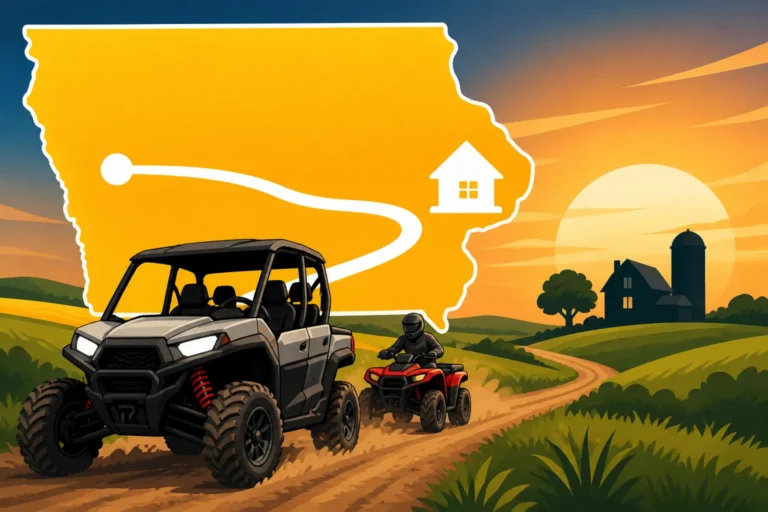
Essentially, the rule states that you can only operate your ATV or UTV on these roads if you are using the most direct route from your residence, a staging area, or public road access point, to a designated OHV park, a specific trail, or private land where you have permission to ride. Let's imagine you live two miles down a gravel road from an entrance to Bluff Creek OHV Park. Taking that two-mile stretch is perfectly acceptable under the "most direct route" rule. However, if you then decide to take a ten-mile scenic detour through neighboring gravel roads just for fun before reaching the park, you would likely be in violation. [The Most Direct Route to Bluff Creek the Short Way] The intent is not to turn every gravel road into a recreational trail. It’s about minimizing the time and distance ATVs and UTVs spend on public roads, thereby reducing potential conflicts with other vehicles and residents. This means planning your route carefully, understanding where your designated riding area begins, and making a bee-line for it. Random, circuitous riding on unpaved secondary roads, even if they are generally open to OHVs, is usually a violation of this rule.
Crossing Paved Roads and Primary Highways
While the focus of this guide is on unpaved secondary roads, it's inevitable that your journey might involve encountering, or even needing to cross, paved roads and higher-traffic highways. It’s absolutely critical to understand the rules for these interactions, as the permissions granted for unpaved secondary roads do not automatically extend to other road classifications. Misjudging these rules can lead to serious legal consequences and dangerous situations.
Legal Crossing of Paved Secondary Roads
It's a common scenario: you're enjoying a ride on a legal unpaved secondary road, and suddenly you come to an intersection with a paved secondary road. What do you do? The good news is that Iowa law generally allows ATVs and UTVs to cross paved secondary roads at intersections. This is a crucial distinction: you can cross them, but you cannot typically ride on them for any extended distance. The moment you turn onto a paved secondary road and begin traveling along it, you are likely in violation, unless that specific paved secondary road has been explicitly authorized for OHV use by a county ordinance. [Paved Secondary Roads and County Authorization]
When making these crossings, extreme caution is paramount. Treat it like any other intersection, obeying all traffic laws, stopping at stop signs, and yielding to through traffic. Remember, vehicles on paved roads, even less traveled secondary ones, are often traveling at higher speeds and may not anticipate an ATV or UTV crossing their path. Ensure you have a clear line of sight in both directions, signal your intentions if possible, and make the crossing quickly and directly. This is a brief transition, not a part of your ride. Always be prepared to stop and wait for a safe gap in traffic, as your machine's acceleration might not match that of a typical car.
Primary Highways and Interstate Closures
Now, let's talk about the big no-nos. While there are specific circumstances for riding on unpaved secondary roads and crossing paved secondary roads, the rules for primary highways and interstates are much stricter. In Iowa, ATVs and UTVs are generally strictly prohibited from operating on state and federal primary highways and interstates. Period. [Why Interstates Stay Closed in Iowa]
This prohibition applies to riding on these roads for any distance, even if you are just trying to get to another unpaved secondary road or an OHV park. The only exception, and it's a very limited one, is for direct crossings at intersections. Similar to paved secondary roads, you can cross a primary highway at an intersection, provided it is the most direct route and you do so safely and quickly. However, you cannot travel along the shoulder, or any part of the main roadway. The reasons for this strict ban are obvious: primary highways and interstates are designed for high-speed traffic, and the presence of slower-moving, less protected ATVs and UTVs would create immense safety hazards. The speed differentials are too great, and the risk of catastrophic accidents is simply too high. Violating these rules comes with severe penalties, including substantial fines, potential impoundment of your machine, and possibly even more serious charges if an accident occurs. It is crucial to plan your routes to entirely avoid riding on primary highways or interstates, relying instead on legal secondary roads or trailering your machine.
Registration, Titling, and Other Essentials
Beyond the road-specific rules, there are foundational legal requirements for owning and operating an ATV or UTV in Iowa that apply regardless of where you ride, especially if you plan to hit public land or roads. These include proper registration and titling, which are administered through your county recorder's office and are vital for proving ownership and legal operation.
Iowa Registration and Decal Requirements
Before you even think about hitting those unpaved secondary roads, or any public riding area for that matter, your ATV or UTV must be properly registered with the Iowa Department of Natural Resources (DNR) through your local county recorder's office. This isn't just a suggestion; it's a mandatory step for legal operation. Think of it as your machine's license plate. [Registering an ATV in Iowa]
The registration process involves submitting an application, providing proof of ownership (like a title or bill of sale), and paying the required fees. Once processed, you'll receive a registration certificate and a decal. This decal must be prominently displayed on your machine, typically on the rear fender or another visible spot, as specified by Iowa DNR regulations. [Where the Iowa Decal Mounts] The decal serves as visual proof that your machine is legally registered for the current year. Registrations expire annually on December 31st, regardless of when you initially registered, meaning everyone renews at the same time. Riding an unregistered machine on public land or roads is a ticketable offense, and it's easily spotted by law enforcement. It's an essential part of responsible OHV ownership in Iowa, with the fees collected from registration often going towards trail maintenance and development for all riders to enjoy.
Titling Your Machine in Iowa
Separate from registration, Iowa law also requires that most ATVs and UTVs be titled. While registration grants you permission to operate the machine for a specific period, the title is the definitive proof of ownership. It's like the deed to your house or the title to your car—it officially establishes who the legal owner of the vehicle is. [Titling an ATV in Iowa]
When you purchase a new or used ATV or UTV in Iowa, whether from a dealer or a private seller, you'll typically need to apply for a title in your name at the county recorder's office. This process ensures a clear chain of ownership and is crucial for many reasons. If you ever decide to sell your machine, you'll need a clear title to transfer ownership to the new buyer. If you finance your purchase, the lending institution will typically have their lien noted on the title until the loan is paid off. [When a Title Gets a Lien Notation] Even if you're not planning to sell anytime soon, having a properly titled machine protects your investment and simplifies any future transactions or legal dealings. It's a one-time process for as long as you own the machine (unless you need a duplicate), but it's as fundamental as registration for legal and legitimate ownership in Iowa.
Common Misconceptions and Penalties
With all these rules and nuances, it's easy for misconceptions to arise, leading well-intentioned riders down the wrong path. Understanding the common pitfalls and the potential consequences of non-compliance is just as important as knowing the rules themselves. A misunderstanding can quickly turn an enjoyable ride into a costly lesson.
The "Implement of Husbandry" Exemption vs. Road Use
One of the most frequently misunderstood areas of Iowa ATV/UTV law pertains to the "implement of husbandry" exemption. Many rural residents or those who use their machines for farm work often assume this exemption grants them carte blanche to ride their ATV or UTV on any road. However, this is a significant oversimplification and can lead to serious trouble if not properly understood.
An "implement of husbandry" is a vehicle that is primarily designed and used for agricultural purposes, like moving feed, checking fences, or towing equipment on a farm. Iowa law provides specific, limited exemptions for these machines when used directly for agricultural work. For instance, an ATV or UTV used as an implement of husbandry may be operated on public roads without registration or insurance under very specific conditions, such as traveling no more than two miles from the farm property for agricultural purposes between sunrise and sunset. [The Implement of Husbandry Exemption in Iowa] The key takeaway here is that these exemptions are tied to the use of the machine for farming, not simply its ownership by a farmer, and they are not intended for recreational riding. The moment you switch from agricultural work to a recreational ride, even if it's just a short cruise down a gravel road, the implement of husbandry exemption typically no longer applies, and all standard registration, insurance, and road-use rules kick in. Trying to claim the husbandry exemption for a pleasure ride is a common mistake that can easily lead to a citation for an unregistered or uninsured machine, among other violations.
Penalties for Non-Compliance
Ignoring Iowa's ATV and UTV road use rules, whether intentionally or due to misunderstanding, can result in a range of penalties that can quickly dampen your riding enthusiasm and empty your wallet. Law enforcement, including county sheriffs and DNR conservation officers, are authorized to enforce these regulations, and ignorance of the law is never considered a valid defense.
The specific penalties will vary depending on the nature and severity of the violation. Riding an unregistered ATV or UTV on a public road, including those unpaved secondary ones, will typically result in a fine. The same goes for operating a machine without the mandatory liability insurance—a violation that can carry even steeper fines and potentially lead to your machine being impounded. [Iowa Fines for an Unregistered ATV] If you're caught exceeding the 35 mph speed limit on an unpaved secondary road, you'll face a speeding ticket, just as you would in a car. Operating a machine without the required safety equipment—like working headlights, a mirror, or the SMV triangle—can also lead to citations. Beyond monetary fines, repeated violations or more serious offenses (like riding under the influence) can lead to loss of riding privileges, suspension of your driver's license, and even criminal charges. The cumulative effect of these penalties can be substantial, easily outweighing the cost of proper registration, insurance, and compliance with the rules. The best approach is always to err on the side of caution, ensure your machine is fully compliant, and always respect the rules of the road.
Here's a quick reference table summarizing key requirements for riding your ATV/UTV on Iowa's unpaved secondary roads:
| Requirement | Description |
|---|---|
| Operator Age | Must be 18 years old or older. |
| Driver's License | Must possess a valid driver's license. |
| Road Type | Unpaved secondary roads, unless specifically prohibited by county ordinance. |
| Route Purpose | Must be the "most direct route" to/from a designated OHV park, trail, or private property. |
| Speed Limit | Strict 35 mph maximum. |
| Headlights | Required, and must be on at all times (day and night). |
| Taillights/Brake | Required and fully functional. |
| Mirror(s) | Required for rear visibility. |
| Horn | Required and functional. |
| SMV Triangle | Slow-Moving Vehicle triangle prominently displayed on the rear. |
| Insurance | Mandatory liability insurance (20/40/15 minimums). |
| Registration | Machine must be currently registered with the Iowa DNR via the county recorder's office, with a visible decal. |
| Titling | Machine must be properly titled in the owner's name. |
| Prohibited Roads | Generally, all paved secondary roads (unless county authorized), primary highways, and interstates (except for direct intersection crossings). |
| Exceptions | "Implement of Husbandry" exemption only for specific agricultural work, not recreational use, and under strict conditions (e.g., [2 Miles From the Farm in Iowa]). |
Riding an ATV or UTV in Iowa can be an incredibly rewarding experience, offering unparalleled access to stunning landscapes and thrilling trails. However, navigating the rules for road use requires a commitment to understanding and respecting the law. By familiarizing yourself with Iowa's unpaved secondary road rule, ensuring your machine is properly equipped and insured, and staying informed about local ordinances, you can enjoy your ride safely and legally. Always prioritize safety, be courteous to other road users, and remember that responsible riding helps ensure these privileges remain available for all of us.
Disclaimer
This article is for general informational purposes only and does not constitute professional advice. Laws, prices and regulations vary by location and change over time. Consult a qualified professional for guidance on your specific situation.