Iowa Lighting Requirements for ATVs
It can be incredibly frustrating to think you've got your ATV or UTV all set up for a casual cruise down a gravel road, only to realize you might be missing critical lighting components that Iowa law actually requires. Many riders assume that because it's an off-highway vehicle, the rules for lights are lax, but when you venture onto public roads, everything changes. This guide is here to shed some light on exactly what head-scratching lighting requirements your machine needs to meet Iowa's street-legal standards, ensuring you stay safe and avoid unexpected trouble.
Understanding Iowa's Core Lighting Mandates for Road-Legal ATVs
Venturing onto Iowa's public roads with your ATV or UTV means stepping into a different set of rules than what applies on the trails. The biggest shift comes with lighting. It's not just about seeing where you're going; it's about being seen by every other vehicle out there, and the state has very specific ideas about how that needs to happen. For many riders, this can feel like a sudden leap from the wild west of the trails to the orderly world of traffic laws, and it's easy to get confused about what's truly essential.
Headlights: The Beacons of Your Journey
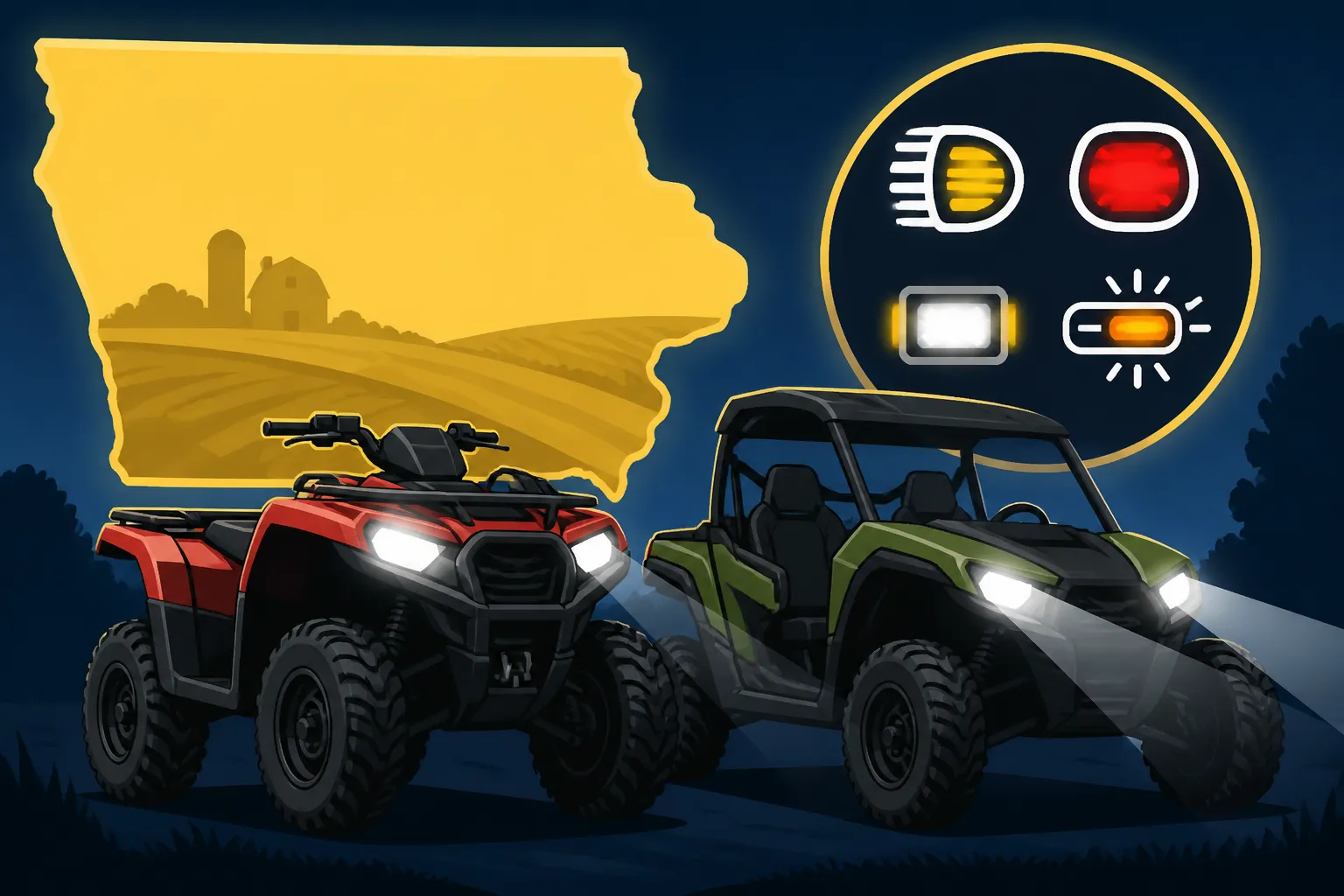
Let's start with the obvious: headlights. Iowa law is crystal clear on this point: if you're operating your ATV or UTV on any public road, your headlights must be on. This isn't just a recommendation for nighttime driving; it’s a 24/7 requirement. Yes, even on a bright, sunny afternoon in the middle of July, your headlights need to be shining. The state mandates that your machine must have at least one headlight that emits a white light, and this light needs to be visible for a significant distance down the road. This ensures that oncoming traffic, even if they're a mile away, can register your presence and adjust accordingly. Think of it less as an illumination tool and more as a crucial "I'm here!" signal to everyone else. Many aftermarket options from companies like SuperATV offer enhanced brightness and durability over stock headlights, which can be a real plus for visibility and longevity. [Headlights On All Day in Iowa]
The quality and aim of your headlights also matter. You don’t want lights that blind oncoming drivers, but they need to cut through dust, fog, or the glare of a setting sun. Stock headlights on many ATVs and UTVs are designed primarily for off-road use, where the focus is often on lighting up the immediate trail. For road use, you might find that while they technically meet the "on" requirement, they lack the spread or intensity needed for safe interaction with other vehicles at road speeds. This often leads riders to consider upgrades to ensure they not only comply with the law but also genuinely enhance their safety.
Tail Lamps: Signaling Your Presence from the Rear
Just as crucial as being seen from the front is being seen from the back. That's where tail lamps come in. Iowa law specifies that your ATV or UTV must be equipped with at least one tail lamp that emits a red light to the rear. This light must be visible from a considerable distance, particularly during low-light conditions, dusk, dawn, or nighttime. The purpose of the tail lamp is straightforward: to alert drivers approaching from behind that there's a vehicle in front of them. Without a working tail lamp, you become almost invisible in these conditions, turning a simple road ride into a perilous game of chance.
Imagine you're on a long stretch of gravel road, the sun is just dipping below the horizon, and another vehicle is coming up behind you. Their ability to see your red tail lamp is the first line of defense against a rear-end collision. Stock tail lamps usually suffice here, but just like headlights, they need to be in good working order, free of cracks, and clear enough to emit a strong, steady red light. Some riders opt for brighter LED tail lamps, often found in kits that also include brake lights and turn signals, to maximize their visibility and peace of mind.
Brake Lights: Clearly Communicating Your Intentions
Brake lights are perhaps the most direct form of communication you have with traffic behind you. Iowa law requires that your ATV or UTV, when operated on public roads, must have a brake light that emits a red light to the rear, which illuminates when the brakes are applied. This seems simple, but it's astonishing how often riders overlook ensuring their brake lights are functional, especially after a rough trail ride where wires might have jiggled loose or lenses cracked. The moment you touch those brakes, that light needs to flash bright, instantly signaling to the driver behind you that your speed is changing.
Think about pulling up to a stop sign at the end of a long gravel lane, or slowing down to make a turn onto another county road. If the driver behind you doesn't see your brake lights, they have no immediate warning that you're decelerating. This can lead to them closing the distance too quickly, forcing them to slam on their brakes, or worse, colliding with your machine. Ensuring your brake light is bright, responsive, and clearly visible is non-negotiable for road safety. It’s not just a legal formality; it’s an active safety feature that prevents accidents. Many aftermarket lighting kits, including those from SuperATV, integrate brighter LED brake lights into their tail lamp assemblies, making them a popular upgrade for enhanced safety on the road.
Beyond the Basics: Essential Ancillary Lighting for Iowa Roads
While headlights, tail lamps, and brake lights form the fundamental trinity of road-legal ATV lighting in Iowa, the state's requirements don't stop there. There are other crucial lighting components that are often overlooked by riders who are accustomed to strictly off-road adventures. These "ancillary" lights, though they might seem less critical than your main beams, play an equally vital role in ensuring your safety and compliance on public roadways. Ignoring them can lead to dangerous misunderstandings with other drivers and unwanted attention from law enforcement.
Turn Signals: Navigating Turns and Lane Changes Safely
Ah, turn signals. This is where many off-road machines fall short right out of the factory. Unlike dirt bikes or ATVs designed purely for trails, when you take your UTV or ATV onto Iowa's public roads, you absolutely need a way to clearly signal your intentions to turn or change lanes. Iowa law requires that any vehicle operating on a public road must be equipped with working turn signal lamps. These must be visible from both the front and the rear of your machine, emitting an amber or red light that flashes to indicate your direction of travel.
Trying to signal a turn with your hand while wrestling your machine on a gravel road, or in cold weather with thick gloves, is not only impractical but also incredibly unsafe. Other drivers are expecting clear, consistent signals. Without them, you become unpredictable, creating hazardous situations, especially when crossing traffic or merging. Many riders purchase aftermarket turn signal kits, which often include a combination switch, LED lights for all four corners, and the necessary wiring. This is a common upgrade for anyone serious about making their machine truly road-legal and safe. [Tail Lamps and Signal Lamps in Iowa]
License Plate Illumination: Keeping Your Registration Visible
This is one of those small details that many riders completely forget about, but it's an absolute requirement for road-legal operation in Iowa. If your ATV or UTV has a license plate (or often, in Iowa, the official registration decal is your primary identifier on the rear of the machine), it must be illuminated by a white light whenever your headlights are required to be on. Since your headlights are required to be on 24/7 on public roads, that means your rear registration decal or plate needs constant white illumination when you're out there.
The purpose is simple: law enforcement officers need to be able to easily identify your machine, day or night. A dim, unlit, or missing license plate light can draw unwanted attention and result in a citation, even if every other light on your machine is in perfect working order. This often means adding a small LED light strategically placed to shine down on your decal or plate. It's a minor addition in terms of cost and effort, but its absence can cause a major headache.
Reflectors and Side Markers: Enhanced Visibility from All Angles
While not always "lights" in the active sense, reflectors play a passive yet critical role in your visibility, especially at night or in conditions of poor visibility. Iowa law generally requires vehicles to have certain reflectors to enhance visibility from various angles. Specifically, you typically need at least one red reflector on the rear of your machine. Some machines might also benefit from amber reflectors on the sides, particularly for larger UTVs, to help other drivers gauge your length and position.
Think of reflectors as your backup visibility system. If your tail lamp or brake light fails, or if you're parked on the shoulder at night without your engine running, those reflectors are what catch the headlights of an approaching vehicle. They don't require power, so they're always working. Ensuring these are clean, securely mounted, and not cracked or faded is a simple maintenance task that greatly enhances your safety profile, particularly if your machine isn't loaded with bright aftermarket LED light bars. They make your machine a more recognizable shape on the road, adding an extra layer of protection.
Why These Lights Matter: Safety, Legality, and Avoiding Frustration
It's easy to view lighting requirements as just another set of bureaucratic hoops to jump through, especially when you’re itching to hit the trails or cruise down a quiet county road. But in reality, every single one of these lighting mandates exists for a crucial reason: safety. And beyond that, meeting these requirements is your best defense against unexpected fines, frustrating roadside stops, and the potential for a much more serious incident. The exasperation of being pulled over for a light you didn't even know you needed can truly sour an otherwise perfect ride.
The Real-World Impact of Insufficient Lighting
Let's be brutally honest: ATVs and UTVs are smaller than cars and trucks, and they're less common on public roads. This makes them inherently less noticeable. When you add insufficient lighting to that equation, you're dramatically increasing your risk. Imagine you’re on a secondary paved road, nearing dusk, and you slow down for a turn that leads to your private timberland. If your brake lights aren’t working, the pickup truck flying up behind you, perhaps distracted, won't get that crucial visual cue. The consequences, as you can imagine, could be catastrophic for everyone involved.
Or picture yourself making a left turn onto another gravel road. You glance over your shoulder, think it's clear, and start to turn, but without a working turn signal, the oncoming car simply thinks you're continuing straight. Suddenly, you're both swerving, horns are blaring, and hearts are racing. These aren't far-fetched scenarios; they happen more often than we'd like to admit. Many riders recount close calls or even minor fender-benders that could have been entirely avoided with proper, fully functional lighting. It’s not just about what the law says; it’s about making sure everyone else on the road knows exactly what your machine is doing and where it's headed.
Meeting the Letter of the Law: Avoiding Fines and Hassles
Beyond the paramount concern for safety, there's the very practical matter of legal compliance. Iowa law enforcement officers, from county deputies to DNR conservation officers, are trained to look for proper equipment when ATVs and UTVs are operating on public roads. If you get pulled over, one of the first things they'll check, especially after dark or during a turn, is your lighting system. [A Deputy at an Iowa Roadside Stop]
Getting cited for inadequate lighting isn't just a minor inconvenience; it comes with fines and can ruin your day. What might seem like a small missing reflector or a burned-out brake light can quickly escalate into a citation that costs you time and money. For instance, operating without required lighting could fall under general illegal ATV road use, which carries its own set of penalties. [Iowa Fines for Illegal ATV Road Use] Nobody wants to spend their hard-earned money paying fines when that cash could be going towards new tires or that snorkel kit you’ve been eyeing from SuperATV. A little proactive checking and maintenance of your lighting system can save you a lot of grief and expense down the road.
Upgrading Your Setup: Enhancing Your Ride's Visibility
Many stock ATV and UTV lighting systems, while adequate for off-road use, are not truly designed for the rigors and demands of public road interaction. The good news is that there's a robust aftermarket industry ready to help you upgrade. Replacing incandescent bulbs with brighter, more durable LED headlights, tail lights, and turn signals is a popular and effective way to dramatically improve your visibility. LEDs last longer, draw less power, and are significantly brighter, making you much more noticeable to other drivers.
Beyond simple bulb swaps, you can find comprehensive road-legal lighting kits that include everything you need to meet Iowa's standards: integrated turn signals, brighter brake lights, and even license plate illumination. Brands like SuperATV specialize in these types of upgrades, offering robust, weather-resistant solutions that are often a direct fit for popular machine models. Investing in these upgrades isn't just about meeting the minimum legal requirement; it's about actively choosing to make your ride as visible and safe as possible, giving you greater confidence and peace of mind when you share the road with others.
Practical Considerations and What to Look For
So, you're convinced that upgrading or at least thoroughly checking your ATV's lighting for Iowa road use is a smart move. But where do you even begin? The world of aftermarket parts can be overwhelming, and even just ensuring your existing system is up to snuff requires a bit of know-how. It’s about more than just buying the brightest lights; it's about durability, proper installation, and ongoing maintenance to keep everything shining brightly and legally.
DIY vs. Professional Installation: Weighing Your Options
When it comes to installing new lighting components, or even just troubleshooting existing ones, you generally have two paths: do it yourself (DIY) or hire a professional.
DIY Installation:
- Pros: Cost-effective (you save on labor), you learn a lot about your machine's electrical system, and you can tackle it on your own schedule. For simple bulb replacements or basic bolt-on LED strips, it's often a straightforward task with basic tools. Many aftermarket kits, including those from SuperATV, come with decent instructions, and there are tons of online tutorials.
- Cons: Can be time-consuming, especially for full turn signal kits or complex wiring. If you're not comfortable with electrical work, you risk blowing fuses, creating shorts, or damaging components. Incorrect wiring can lead to unreliable lights, which defeats the purpose of the upgrade and can be dangerous. You might also run into compatibility issues with your specific machine if you don't choose the right kit.
Professional Installation:
- Pros: Ensures correct and safe installation, often comes with a warranty on the work, saves you time and frustration, and means you can trust that your lights will be reliable. A good shop will know the intricacies of Iowa's laws and ensure full compliance.
- Cons: More expensive due to labor costs. You're reliant on the shop's schedule, and finding a reputable shop specializing in ATV/UTV electrical work can sometimes be a challenge, especially in more rural areas.
For basic upgrades like LED headlight bulbs, DIY is often manageable. For comprehensive turn signal kits, especially if you have an older machine with less standardized wiring, a professional might be worth the investment for peace of mind.
Choosing the Right Products for Iowa Conditions
Iowa's weather can be brutal, from scorching summer humidity and dusty gravel roads to freezing winter conditions with snow and ice. The lighting products you choose need to be able to withstand it all.
- Durability: Look for lights with robust housings, sealed to prevent water, mud, and dust intrusion. IP (Ingress Protection) ratings are your friend here; an IP67 or IP68 rating indicates excellent dust and water resistance. You don't want your new lights failing after one muddy weekend.
- Brightness and Beam Pattern: For headlights, you need something bright enough to illuminate the road but also with a cutoff that won't blind oncoming traffic. For tail and brake lights, sheer brightness is key to being seen. LED technology has advanced significantly, offering powerful illumination with low power draw, making them ideal for ATVs and UTVs.
- Compliance: Ensure that any aftermarket lights you purchase are explicitly designed for road use and meet DOT (Department of Transportation) standards where applicable, even if Iowa's specific wording for ATVs might be less stringent than for cars. Reputable manufacturers will typically state if their products are road-legal.
- Wiring and Connectivity: A good kit will include high-quality wiring harnesses, connectors, and a solid fuse system. Don't skimp on these components, as they are the backbone of your electrical system. Many riders find complete plug-and-play kits from manufacturers like SuperATV simplify the process significantly, as they're designed for specific models.
Maintaining Your Lighting System
Once your lighting system is installed and working, regular maintenance is key to keeping it effective and compliant.
- Regular Checks: Before every road ride, do a quick walk-around. Turn on your headlights, activate your turn signals (both directions), step on your brakes, and ensure your tail light and license plate light are all working. It takes literally 30 seconds and can save you from a ticket or an accident.
- Cleanliness: Mud, dust, and grime can drastically reduce the effectiveness of your lights. After a dusty or muddy ride, take a moment to wipe down your light lenses with a soft cloth. A clean lens allows maximum light output.
- Wiring Inspection: Periodically check your wiring for any fraying, loose connections, or signs of rodent damage. Secure any dangling wires to prevent them from getting snagged. Zip ties are your best friend here.
- Bulb Replacement: While LEDs last a long time, traditional incandescent bulbs can burn out. Always carry spare bulbs for critical lights if you're not running LEDs, or at least know where to get replacements quickly.
By considering these practical aspects, you can ensure your ATV or UTV is not only compliant with Iowa's lighting requirements but also genuinely safer and more enjoyable to ride on public roads.
| Lighting Component | Iowa Requirement (Road Use) | Purpose | Maintenance Tip |
|---|---|---|---|
| Headlights | At least one, white, 24/7 | Illumination & Front Visibility | Keep lenses clean, check aim. |
| Tail Lamp | At least one, red, to rear | Rear Visibility (low light, night) | Check for cracks, ensure steady light. |
| Brake Light | At least one, red, activates | Signals Deceleration/Stopping | Test activation, replace non-functioning. |
| Turn Signals | Front/rear, amber/red, flashing | Communicate Intentions (turns, lanes) | Test all four, ensure clear flash. |
| License Plate Light | White, illuminates rear registration | Plate/Decal Visibility for Law Enforcement | Confirm light coverage on plate/decal. |
| Rear Reflector | At least one, red | Passive Rear Visibility (no power needed) | Keep clean, ensure secure mounting. |
Disclaimer
This article is for general informational purposes only and does not constitute professional advice. Laws, prices and regulations vary by location and change over time. Consult a qualified professional for guidance on your specific situation.