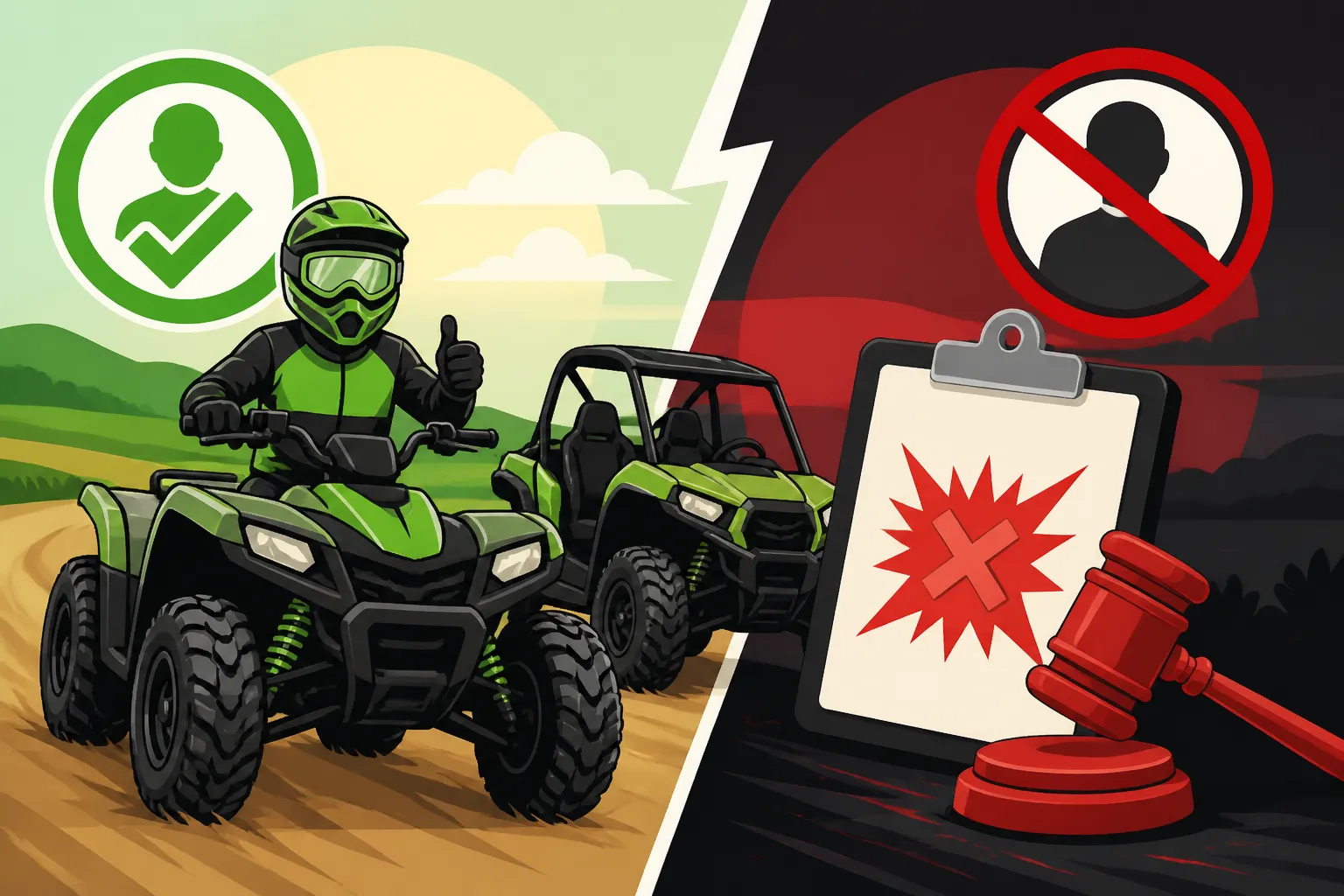
Iowa Penalties for Riding Without a Safety Certificate
Riding without the required safety certificate can turn an Iowa trail day into a roadside stop and a possible citation. The key is knowing whether the rule applies to your age, machine, and riding location. This article explains where penalties may arise, what proof to carry, and how to respond if an officer questions your certificate.
When Iowa Requires a Safety Certificate
Iowa’s safety-certificate rules are not a blanket requirement for every person who operates every off-road machine. They generally concern young ATV riders in covered riding settings. Age, machine type, and location all matter, so a rule that applies to one rider may not apply to another.
For a practical starting point, Iowa requires a safety certificate for many ATV operators aged 12 through 17 when they ride in settings covered by the state’s off-road vehicle rules. The certificate comes after completing an approved safety education course. The details of where the requirement applies matter: riding at a designated riding area is not necessarily the same as riding on private property, and rules for one kind of machine may differ from rules for another.
Before riding, check the current requirements in Iowa ATV Safety Certificate Requirements and Iowa Safety Certificate Age Range. These topics are especially useful if a rider is approaching age 12 or 18, or if the ride will take place somewhere other than a designated area.
| Rider or machine | General certificate question | What to check before riding |
|---|---|---|
| ATV operator aged 12 through 17 | A certificate may be required in covered riding settings | Confirm the rule for the specific location and keep proof available |
| ATV operator under 12 | Supervision rules apply; do not assume that supervision replaces every requirement | Review [Iowa Supervision Rules for Riders Under 12] and confirm what the supervising adult must do |
| ATV operator aged 18 or older | The youth certificate requirement generally does not apply | Check other rules for the location, registration, and machine |
| Side-by-side operator | Different rules may apply than for an ATV operator | Confirm the machine’s classification and review [Does an Iowa UTV Operator Need a Certificate?] |
| Off-road motorcycle operator | The ATV certificate rule may not apply in the same way | Check the machine-specific rule in Why an Iowa Off-Road Motorcycle Operator Is Exempt |
| Nonresident rider | Home-state paperwork does not automatically settle every Iowa requirement | Check both the Iowa certificate rule and any permit or reciprocity requirement |
The table is a starting point, not a substitute for checking the current rule for the particular ride. A machine’s marketing name is not always enough to determine its legal classification. If a vehicle is described as a side-by-side, UTV, quad, or youth machine, use its actual type and the applicable Iowa rule rather than relying only on informal labels.
A safety certificate is also different from a registration decal or a nonresident user permit. The certificate concerns rider education. Registration and permits concern whether a machine is authorized for particular use. One document does not automatically replace the others. For the separate permit rules, see Iowa ORV Permits Explained and Iowa’s Permit for a Visiting Machine.
Age is only one part of the rule
A rider’s age helps determine whether a certificate may be required, but it does not answer every question. The legal setting matters too. For example, an ATV used on a designated riding area may be subject to requirements that do not apply in the same way to a machine used on private property. A public trail, a private field, public ice, and a farm work route can all raise different questions.
That does not mean private land is automatically a free pass. The landowner’s permission, the activity taking place, and the specific law covering the machine can still matter. If the ride is on private ground, check [Iowa Rules for Riding Private Property] and Iowa Landowner Permission Requirements rather than assuming that a certificate or other rule is irrelevant.
The same care is useful when a group ride moves between locations. A rider may leave private land and enter a designated area, or a group may use several kinds of ground during one outing. Check the rules for each part of the route. A certificate requirement can arise because of where the machine is being operated, even if it was not relevant earlier in the day.
Course completion and certificate proof are separate steps
Passing an approved course and being able to show proof are related but not identical tasks. Once the rider completes the course, make sure the certificate has been issued and that the identifying details are correct. Do not plan a ride on the assumption that course enrollment, a test result that has not been recorded, or a parent’s memory of completion will satisfy an officer’s request.
If the card is lost, damaged, or left at home, use Replacing a Lost Iowa Safety Certificate for the next step. Before a ride, it is sensible to confirm that the replacement or updated proof is actually available. A certificate on a phone can be a useful backup if accepted, but do not assume a screenshot or an unfinished online record counts as official proof.
What Can Happen If a Rider Has No Certificate
If an officer determines that a rider was required to have a safety certificate and cannot show one, the rider may face enforcement action. Depending on the circumstances and applicable law, that may include a citation and a court process. The exact consequences can depend on the charged violation, the location, the rider’s age, and the facts observed during the stop.
There is no single penalty that should be assumed for every situation described as “riding without a safety certificate.” The legal issue may be whether the rider was required to complete the course, whether the rider possessed or could produce proof, or whether another rule was also violated. For a specific case, check the citation and confirm the applicable consequence with the court or a qualified professional.
A certificate-related stop can also lead to questions about other requirements. An officer may need to establish the rider’s age, identify the machine, and understand where the vehicle was being operated. The rider may also be asked about registration, a nonresident permit, or permission to use the land. That does not make those requirements part of the certificate penalty; they are separate issues that can be investigated during the same encounter.
| Issue found during a stop | Why it matters | Keep it separate from |
|---|---|---|
| Required safety certificate is missing or cannot be shown | May lead to enforcement under the applicable certificate rule | Registration and permit requirements |
| Registration is expired or absent | May create a separate registration problem | The rider’s course completion |
| Required nonresident permit is missing | May create a separate permit issue for a visiting machine | The youth safety certificate |
| Rider is on a closed or unauthorized area | May raise a location or access violation | Whether the rider has a certificate |
| Rider lacks landowner permission | May raise a trespass or access concern | Education and training records |
For example, a young ATV rider might have completed the course but be riding a machine with an expired registration. In that situation, the certificate may be in order while the registration is not. The reverse can also happen: a machine may have a valid decal, but the operator may still need a certificate. Sorting out the categories helps avoid confusion when speaking with an officer and when deciding what to fix afterward.
If a citation is issued, read it carefully. Identify the specific law or violation listed, the deadline or court information printed on the document, and any instructions for responding. Do not treat a certificate citation as if it were automatically a registration citation, or assume that paying a fine would resolve a separate permit issue.
A certificate-related citation may also affect how soon the rider can return to a particular activity. The citation itself should explain the next required step, but if it is unclear, contact the court or agency listed on the paperwork. Avoid relying on informal advice from a riding group when a formal deadline or court appearance may be involved.
A warning is not something to count on
An officer might explain a rule, but riders should not plan around receiving a warning instead of a citation. Enforcement decisions can depend on what the officer observes and the circumstances of the stop. A rider who is uncertain about the certificate requirement should resolve the question before setting out, not rely on discretion at the trailhead or roadside.
The safest practical approach is to have the rider complete the required course before operating in a covered setting and to carry proof. If the ride’s legal status is uncertain, check with the relevant Iowa agency or land manager before riding. That is less frustrating than trying to sort it out after a stop.
Other penalties are not automatically certificate penalties
A citation for an expired registration, riding in a closed area, or operating without a required permit is not the same as a certificate violation. Those issues can come up together, but they have different rules and may carry different consequences. For example, Iowa Fines for Riding Without Registration addresses a registration issue, not the safety course requirement.
This distinction matters when reviewing a citation or trying to correct a problem. A rider who fixes one item should not assume that every other concern has been resolved. Confirm each requirement separately: rider education, machine registration, any needed permit, land access, and any trail-specific conditions.
How to Avoid a Certificate-Related Stop
A few checks before leaving home can prevent most certificate-related confusion. Make them part of the pre-ride routine, especially when a young rider is using a machine owned by someone else or joining a group ride at a new location.
- Confirm the machine type. Determine whether the vehicle is legally treated as an ATV, UTV, off-road motorcycle, or another type of machine. Do not rely only on what the seller or rider calls it.
- Check the operator’s age. Review the certificate and supervision rules that apply to the rider’s age. An adult’s presence does not necessarily replace a certificate requirement.
- Identify the riding area. Establish whether the ride is on a designated area, private land, public land, public ice, or another type of location.
- Check the current rule for that setting. If it is not clear whether the certificate is needed, confirm with the relevant agency or site manager before riding.
- Complete the course early. Allow time for course completion and for the certificate to be issued. Do not wait until the day of a planned trip to discover that the rider has no proof.
- Carry the certificate. Keep the official card or other accepted proof with the rider or in a place where it can be produced promptly. For an organized outing, confirm what the site expects.
- Review the other paperwork separately. Check registration, permits, and land access too. A certificate does not authorize the machine by itself.
The certificate should be accessible, but it also needs to stay in good condition. A card kept in a damp pocket or loose in a storage compartment can become unreadable or get lost. Store it in a protective sleeve or another dry place, and keep a backup copy where it can be retrieved if the original goes missing. A backup is useful for records, but confirm what form of proof the enforcing agency accepts.
For a family outing, the adult organizing the ride can make a simple checklist for each young rider: age, machine, certificate, registration, and location. That prevents a common mix-up in which a parent checks the vehicle decal but overlooks the operator’s education requirement.
Nonresident riders should make the same checks. Having a registration document or safety card from another state does not automatically answer whether Iowa requires a permit or recognizes a particular course record for the planned use. Review Iowa ATV Registration for a Nonresident and Does Iowa Honor Out-of-State Registration? for the separate visitor questions, and verify the certificate issue as well.
What to Do If an Officer Questions the Certificate
If an officer asks about a certificate, stay calm and answer clearly. Provide accurate information about the rider’s age, machine, and riding location. Show the certificate if it is available, and avoid guessing about rules or arguing from what another rider said.
If the certificate is not available, explain truthfully whether the rider completed the course and whether proof can be retrieved. Do not present a parent’s certificate as the rider’s, alter a document, or claim that an incomplete course is finished. If the officer issues a citation, follow the instructions on the citation and keep a copy of any course record or other relevant paperwork.
It can help to write down the basic facts soon after the stop, while they are fresh. Note the date and location, the machine type, who was operating it, what documents were available, and what the officer said. Keep the citation, course completion record, registration documents, and any correspondence together. These records may be helpful if you need to understand the allegation or respond through the proper process.
Do not assume that showing a certificate after the stop will automatically cancel a citation. It may be relevant, especially if the issue is proof rather than course completion, but the outcome depends on the specific charge and process. Ask the court or agency listed on the citation what information it needs and whether there is a procedure for submitting proof.
If the rider had not completed the required course, arrange the appropriate training before riding again in a setting where it is required. Completing the course afterward may help prevent another violation, but it does not necessarily erase a citation already issued. Resolve the citation according to its instructions, and confirm the rider is eligible to return before the next outing.
When the question is about whether the certificate rule applied at all, document the details that define the situation: the exact machine, rider’s age, type of land, and activity. A disagreement about the rule is best handled through the official process, not by repeating the ride and hoping for a different result. For issues involving a court deadline or a contested charge, consider getting qualified legal advice.
Common Situations That Cause Confusion
The rider completed the course but left the card at home
Course completion does not guarantee that an officer can verify it during a stop. If the rider is required to have a certificate, keep the official proof available in a form the relevant agency accepts. If proof is missing, retrieve it as soon as possible, but do not assume that later production automatically voids an issued citation.
A parent is riding nearby
An adult riding alongside a young operator may satisfy a supervision rule in some circumstances, but supervision and certification are not interchangeable concepts. Check the exact rule for the rider’s age and location. [Iowa Supervision Rules for Riders Under 12] addresses the separate question of supervision for younger riders.
The machine is a side-by-side
A side-by-side may be treated differently from an ATV for certificate purposes. First identify the machine’s legal classification, then check the operator rule. Do not conclude that the rider needs—or does not need—a certificate solely because the vehicle has a steering wheel, seats, or a particular model name. [Does an Iowa UTV Operator Need a Certificate?] covers that distinction.
The ride is on private ground
Private land can change which requirements apply, but it does not remove every safety, access, or machine-related rule. Make sure the landowner has given permission and check whether the activity falls within a covered setting. If the route leaves private land, recheck the rules for the next area.
The rider is visiting from another state
A visitor should not assume that a home-state card or registration settles every Iowa question. Check whether Iowa recognizes the rider’s course record and whether the machine needs a nonresident permit for the planned use. Safety education and permits are separate; one document should not be treated as a substitute for the other.
Frequently Asked Questions
What is the penalty for riding an ATV in Iowa without a required safety certificate?
A rider may face a citation and the process attached to the applicable violation. The exact consequence depends on the specific rule and circumstances, so read any citation carefully and confirm the current penalty with the court or agency identified on it.
Does every Iowa ATV rider need a safety certificate?
No. The requirement depends on factors such as the rider’s age, machine type, and riding location. Young ATV operators are the group most likely to need one in covered settings; adults and operators of some other machine types may be treated differently.
Is a safety certificate the same as an Iowa registration decal?
No. A certificate shows that the rider completed safety education. A registration decal or nonresident permit concerns the machine’s authorization for use. Check each requirement separately.
Can an adult supervise a young rider instead of getting a certificate?
Do not assume that supervision replaces a certificate. Supervision rules and certificate rules are separate, and the answer can depend on the rider’s age and where the machine is operated.
What should I do if I lost the certificate?
Request a replacement through the appropriate process and make sure the proof is available before the next ride in a setting where it is required. See Replacing a Lost Iowa Safety Certificate.
Disclaimer
This article is for general informational purposes only and does not constitute professional advice. Laws, prices and regulations vary by location and change over time. Consult a qualified professional for guidance on your specific situation.