The 80 Percent Iowa Pass Mark
The 80 percent pass mark is the point where an Iowa ATV safety course stops being practice and starts counting toward certification. If you are unsure what that score applies to, what happens if you fall short, or whether the certificate matters for your machine, the key is to separate course completion from riding rules.
What the 80 percent pass mark means
The 80 percent mark is the minimum score required to pass the Iowa safety course assessment. It is a knowledge threshold: it does not mean you must complete 80 percent of a trail, ride for a set number of hours, or score 80 percent on a practical riding test.
The course is intended to check whether a rider understands safety material before operating a covered machine where Iowa requires a certificate. The assessment may ask you to apply course information to riding situations, not simply repeat isolated facts. Reading the material carefully matters more than trying to rush through it.
A passing score means you have met the course’s stated score requirement. It does not, by itself, settle every question about where you may ride, which machines are covered, or whether a visitor needs an Iowa permit. Those are separate requirements. For a broader explanation of who needs training, see Iowa ATV Safety Certificate Requirements.
| Question | What the 80 percent mark tells you | What it does not tell you |
|---|---|---|
| Is it a course score? | Yes. It is the minimum passing score for the course assessment. | It is not a riding-distance or riding-time requirement. |
| Does it prove course completion? | A passing result is part of completing the course. | The score alone may not confirm that the completion record or certificate has been issued. |
| Does it authorize every kind of riding? | No. It addresses the course’s pass standard. | It does not replace registration, permits, landowner permission, or trail rules. |
| Does every rider need it? | No. The certificate requirement depends on the rider and machine. | It is not a universal requirement for every adult or every machine. |
Keep the distinction between passing the course and being allowed to ride in a particular place. A rider may pass the course but still need the right registration or permit. Likewise, a rider who does not need the certificate may still have to follow machine, land, and age rules.
The mark is also not a measure of how safe a person will be in every real-world situation. A score shows that the course’s assessment standard has been met. Safe riding still depends on judgment: choosing suitable terrain, controlling speed, wearing appropriate protective gear, and respecting other riders and landowners.
How to prepare to pass
The most reliable way to reach the pass mark is to treat the course as training rather than a quiz to get through as quickly as possible. The material is more useful when you understand why a safety rule exists and how it applies in different situations.
Start by checking that you are taking the course intended for Iowa’s safety certificate. Course requirements can depend on the machine type and the rider’s age. If you are not sure which course applies, confirm the details before you begin with Where to Take an Iowa ATV Safety Course.
Work through the material carefully
Read each section before answering its questions. Pay special attention to topics that are easy to confuse, such as:
- How speed, terrain, and stopping distance affect control.
- Why riders need to account for changing ground conditions and obstacles.
- How to make riding decisions around other people and machines.
- What to do when a machine’s size, handling, or passenger setup changes the risk.
- The difference between a safety certificate and permission to ride somewhere.
If the course includes practice questions, use them to find gaps in your understanding. A wrong answer is useful feedback; it points to a topic worth revisiting before the assessment. Avoid relying on guessing patterns or memorizing answer positions. Those tactics can fail when the assessment asks the same principle in a different scenario.
Take the assessment when you can focus
Choose a time when you can pay attention without interruptions. Read each question and all available answers before selecting one. Some questions test whether you can distinguish between a safe choice and a choice that is merely convenient. If a question is unclear, look back at the relevant course material rather than making a hurried guess.
A practical study routine is:
- Complete the lesson material in manageable sections.
- Note topics you found difficult or unfamiliar.
- Review those sections before the assessment.
- Set aside enough uninterrupted time to read each question carefully.
- Check the provider’s completion instructions after the assessment.
That approach is more useful than trying to study only the last few minutes before a test. It also makes the course easier to apply later, when a riding decision has to be made quickly.
Don’t confuse an online course with an in-person riding test
The pass mark concerns the course assessment. It should not be read as proof that the state has evaluated your riding technique on a machine. The training is about knowledge and safety concepts; a rider still needs to operate within their ability and the machine’s limits.
If a course provider describes a particular assessment format, follow its current instructions. Course details, access procedures, and completion records can vary by provider. For example, the available course period is a separate issue from the score needed to pass; see Ninety Days to Finish the Course for that related topic.
If your score is below 80 percent
A score below the required mark means you have not yet passed the assessment. It does not mean you are permanently barred from completing the course. The next step is to follow the course provider’s instructions for reviewing the material and continuing the assessment.
Do not assume that every provider uses the same retake procedure. The course platform should explain whether you can review missed questions, revisit lessons, or make another attempt, and whether there are any limits or timing conditions. Check those instructions directly instead of relying on another rider’s experience with a different course or account.
A sensible response to a low score is to identify the weak areas rather than immediately repeating the assessment without review. Re-read the sections tied to missed questions, especially any rules or safety decisions you were uncertain about. A quick second attempt may produce a different result, but it may not leave you better prepared to ride.
Common reasons riders fall short
A score can drop for ordinary reasons that are easy to address:
- Rushing: Skimming the question can make a key condition easy to miss.
- Guessing: A choice may sound reasonable while overlooking a safety risk.
- Confusing similar rules: Terms or situations that seem alike may have different requirements.
- Multitasking: Interruptions make it harder to remember details from the lesson.
- Skipping review: Moving straight from a lesson to the assessment can leave gaps unnoticed.
If you do not pass, take a short pause and decide what needs attention. Reviewing the relevant lesson is usually more productive than repeating the same questions from memory. The goal is both to reach the required score and to understand the material well enough to use it on a ride.
Keep course access and course completion separate
Being able to open a course is not the same as having completed it. Likewise, a passing score and the later availability of a certificate or completion record are connected but distinct steps. Follow the provider’s directions through the end of the process and save or record the information it supplies.
If the system shows a passing score but you cannot locate proof of completion, first check the account, email, or course dashboard specified by the provider. If the record still appears missing, contact the provider or the appropriate Iowa agency before assuming the certificate has been issued. For a lost or unavailable certificate, see Replacing a Lost Iowa Safety Certificate.
Who needs the certificate, and what it does not replace
The 80 percent mark matters only if the course is relevant to the rider and machine. Iowa’s certificate rules are not simply “every ATV or UTV operator must pass.” Age and machine category matter, and the rules for ATV operators are not necessarily the same as those for UTV operators or off-road motorcycle riders.
Iowa’s safety certificate requirement applies to certain younger ATV riders, while adults are generally outside that age requirement. The course is also relevant to riders in the age range covered by the state’s rules, not to every person who owns or rides an off-highway machine. For a practical explanation of the point when the certificate requirement begins, read Earning a DNR Safety Certificate at Age 12. For the upper age boundary, see Why the Iowa Certificate Stops at Eighteen.
A rider should check the machine category as well as age. The rules do not treat every off-road vehicle identically. For instance, the requirements for a UTV operator may differ from the requirements for an ATV operator; [Does an Iowa UTV Operator Need a Certificate?] addresses that distinction. A rider of another machine type should not assume that an ATV rule automatically applies.
| Rider or situation | How to think about the certificate |
|---|---|
| A younger ATV rider | Check whether the rider falls within Iowa’s certificate age range and whether the riding area is covered by the rule. |
| An adult ATV rider | The safety course may still be useful, but the certificate requirement is generally age-specific. |
| A UTV operator | Check the rule for UTVs specifically rather than applying the ATV requirement automatically. |
| An off-road motorcycle rider | Check the machine-specific rule; do not assume an ATV certificate is required. |
| A visitor from another state | Check Iowa’s visitor and reciprocity rules separately from the course pass mark. |
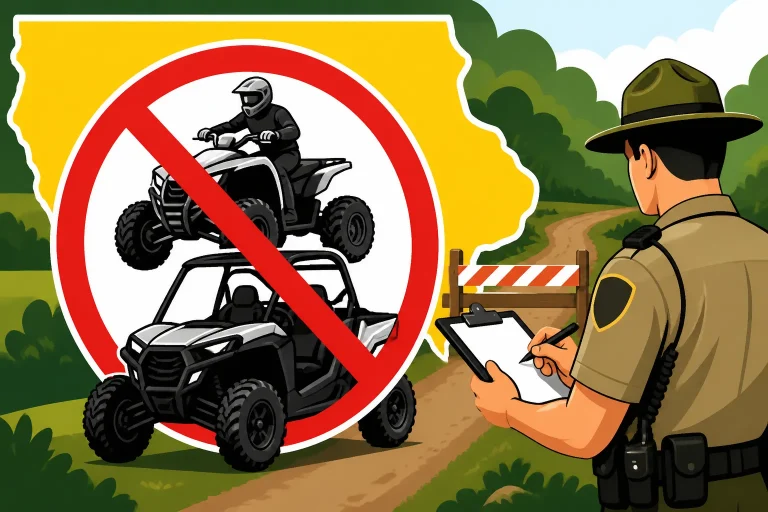
The certificate also does not replace the machine’s registration or an applicable nonresident permit. It does not grant access to private property, make a closed trail legal to ride, or override age and supervision rules. A rider may need to satisfy more than one requirement before heading out.
For example, an out-of-state rider should not treat an ATV safety certificate as proof that their home-state registration is automatically enough for every Iowa ride. Reciprocity and permit requirements are separate questions. If you are visiting from Minnesota, Iowa Reciprocity With Minnesota explains the issue for that state; visitors from other states should check the corresponding Iowa rules for their home registration.
The same separation applies to land access. A passing score does not give a rider permission to cross private ground. Check who manages the riding area, whether it is open, and what conditions apply. A course is one piece of preparation, not a substitute for checking the rules where you intend to ride.
A completion checklist before you ride
Once you have passed, take a moment to make sure the result has been recorded and that you have checked the requirements that apply to the ride itself. This can prevent a common mix-up: completing the course and assuming that every other step is automatically complete.
Use this checklist:
- Confirm the result. Make sure the course provider records a passing score and shows that the course is complete.
- Find your proof. Follow the provider’s instructions to access or retain the certificate or completion record.
- Check age and machine rules. Confirm that the certificate applies to the rider and machine in question.
- Check registration or permit requirements. The certificate does not replace the registration decal or an applicable visitor permit.
- Verify the riding location. Confirm that the area is open to the machine and that you have permission where required.
- Review supervision rules. If the rider is younger than the certificate age range, check the rules that apply to that age instead of assuming that a course card is the only requirement.
- Follow the ride-area instructions. Parks and trails can set operating conditions that are separate from course completion.
For riders younger than the certificate age range, there may be supervision requirements rather than a certificate requirement. Do not use the 80 percent threshold to infer what a younger child may do. Check Iowa Rules for Riders Under 12 and confirm the conditions for the specific riding area.
For riders who need a certificate, keeping proof accessible can make it easier to demonstrate completion if asked. Whether a rider must carry a particular document in a particular place depends on the applicable rule and circumstance, so check the current official instructions rather than relying on assumptions.
The certificate is also not a substitute for sound decisions on the trail. A rider who has passed can still be unprepared for a difficult route, poor visibility, mud, steep slopes, or a machine that is too large to manage confidently. Choose terrain that matches the rider’s ability, use appropriate protective equipment, and turn back when conditions exceed what the rider can handle.
Frequently Asked Questions
Is 80 percent the score needed to pass the Iowa ATV safety course?
Yes. The course pass mark is 80 percent on the required assessment. Follow the provider’s current instructions for the assessment and completion record.
What happens if I score below 80 percent?
You have not passed yet. Review the course provider’s instructions, revisit material you missed, and follow its process for continuing or retaking the assessment.
Does passing the course register my ATV?
No. A safety certificate does not replace ATV registration, a decal, or an applicable nonresident permit. Check those requirements separately before riding.
Does every Iowa ATV or UTV rider need the certificate?
No. The requirement depends on the rider’s age and the type of machine. Check the specific rule that applies rather than treating the ATV course requirement as universal.
Disclaimer
This article is for general informational purposes only and does not constitute professional advice. Laws, prices and regulations vary by location and change over time. Consult a qualified professional for guidance on your specific situation.