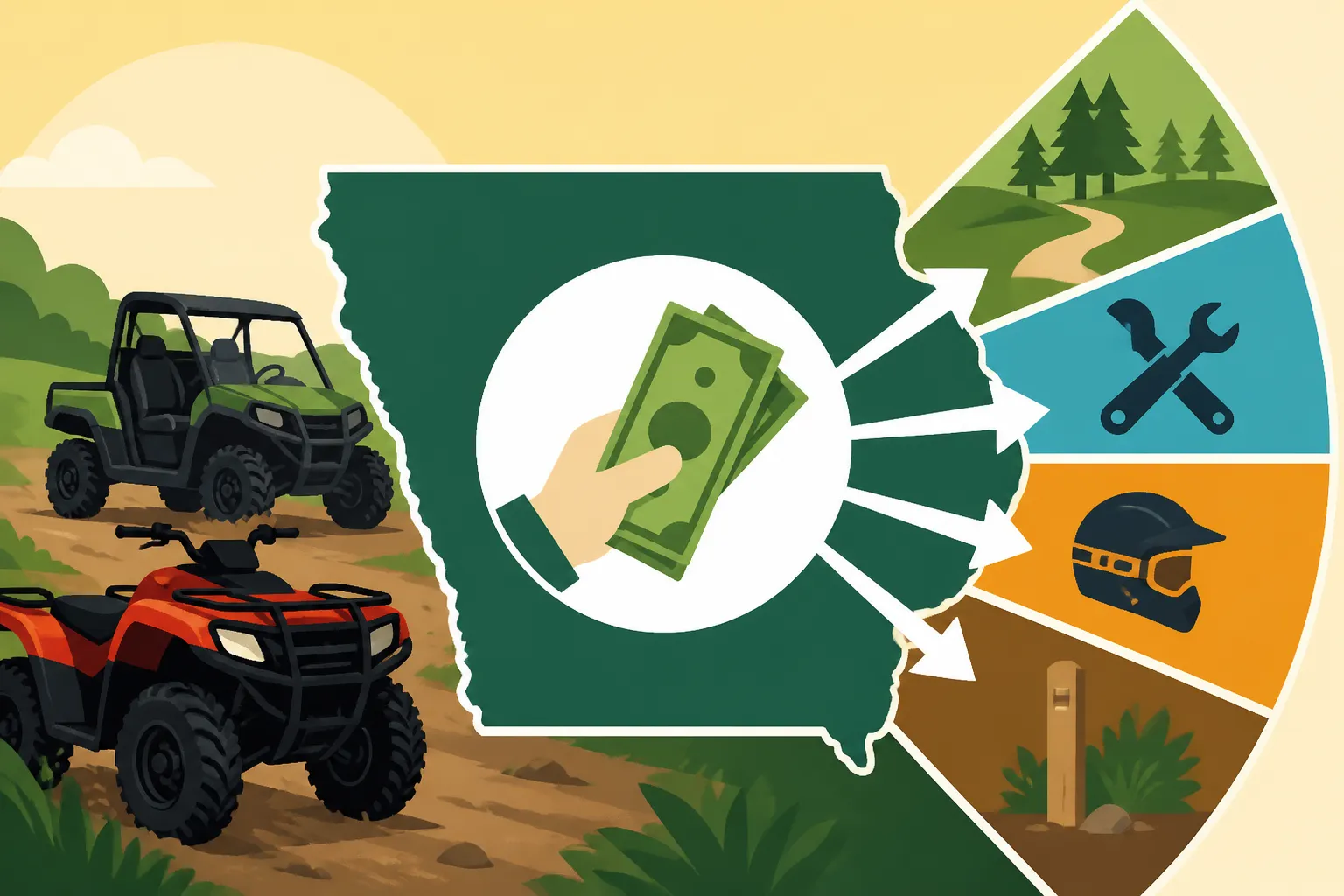
Where Iowa Permit Money Goes
Iowa riders often see a decal or permit as the price of getting through the gate, but the money is meant to support more than one ride at one park. Understanding where it goes helps explain why Iowa handles resident registrations, visitor permits, trail grants, and park access the way it does—and why a permit is not simply a day-use ticket.
First, know which Iowa payment you mean
People use “permit” loosely when talking about off-highway vehicles, but Iowa has different payments for different riders. The distinction matters because money collected for one purpose should not be confused with every other fee a rider might pay.
Iowa residents generally register qualifying machines and receive a registration decal. A nonresident may need a user permit for a machine brought into Iowa, depending on the machine and whether an exemption or reciprocity rule applies. These are separate from any fee for a safety course, a replacement document, or a transaction handled at a service counter.
For the visitor-specific rules, see Iowa’s Permit for a Visiting Machine and Iowa’s Nonresident User Permit. If you are sorting out the overall system, Iowa ORV Permits Explained covers the main categories.
| Payment or charge | What it is for | What not to assume |
|---|---|---|
| Resident registration | Registers a qualifying Iowa machine and provides the required decal and documentation | That every dollar is a direct payment to the trail you ride that day |
| Nonresident user permit | Allows a qualifying visiting machine to meet Iowa’s permit requirement | That it works like a one-day park ticket |
| Safety course or certificate charge | Relates to the course or certificate process where required | That it is the same fund as registration or permit revenue |
| Recorder or processing charge | Covers a transaction or service involved in registering or titling a machine | That it is money available for trail construction |
| Park or campground charge, where applicable | Pays for a specific service or facility if one is charged | That every Iowa riding area has the same fee arrangement |
The exact accounting treatment depends on the type of payment and the governing rules. The practical point is that a rider’s total bill may combine different charges, and those charges do not necessarily flow into one pot.
That is why a useful question is not just “How much did I pay?” but “What payment was collected, under what authority, and for what eligible uses?” A resident registration and a visitor permit may both connect to Iowa’s off-highway vehicle program, but they are not interchangeable documents. For a closer look at the resident decal, see Why the Iowa Decal Is the Only Pass.
How permit and registration revenue supports riding
At a broad level, Iowa’s off-highway vehicle revenue helps support the system that makes organized riding possible. That can include program administration, designated riding areas, trail and facility work, and grant-funded projects. It does not mean every payment is handed to the nearest park or spent immediately on a new trail.
There is a difference between collecting money and making it available for a particular project. Revenue may be handled through a designated public account or program, with rules governing which costs can be paid from it. A project then has to meet those rules, be approved through the appropriate process, and fit within available funding. The result is a chain of steps rather than a direct exchange: buy a decal, ride one loop, and have the full payment spent on that loop.
The broader funding picture is described in Where the Registration Fee Fund Spends. The key idea is that revenue helps maintain the statewide program, not just the single location a rider chooses.
Administration is part of the system
A public program has operating work behind it. Applications and registrations must be processed, records maintained, rules communicated, grants administered, and projects reviewed. These tasks are less visible than a freshly graded trail, but they are part of keeping an organized system working.
That does not mean every administrative expense should automatically be considered reasonable or that riders should stop asking questions. It means that “money spent on the program” can include work that is not a physical improvement at a riding area. If the only measure is the amount of new trail visible in a season, the accounting may seem incomplete.
Riding areas need more than trail mileage
A trail is only one part of a ride area. A site may also need signs, access routes, parking or staging space, barriers, drainage features, erosion control, maps, safety information, and ongoing inspection. Depending on the property and its management arrangement, it may also need work to address wet conditions, damaged surfaces, or visitor impacts.
Those needs vary widely. A small repair at one site may be less expensive than a major drainage or access project elsewhere. A location with a lot of trail mileage may not necessarily need the same kind of work as a compact area with heavy use or difficult terrain.
A decal payment therefore should not be treated as a personal credit balance for one park. It contributes to a larger program whose benefits may be spread across places and years.
Why grants are a major part of the story
One important way off-highway vehicle funds can support riding opportunities is through grants. Grant funding lets eligible organizations or public bodies propose a project, seek support, and complete work that benefits riders. Depending on the program rules and the approved proposal, a project may involve a riding area, trail work, facilities, access, or other eligible improvements.
Grant programs are useful because the state does not necessarily own or operate every place where people ride. A county, city, club, or other eligible organization may be responsible for a property or project. A grant can help connect program revenue to local work without requiring the state to directly manage every site.
That arrangement also creates trade-offs. A project depends on someone local being willing and able to develop an application, manage the work, meet the program’s requirements, and maintain the result. A good idea is not automatically a grant award. An applicant may need a clear scope, permission to work on the property, a realistic schedule, and any required matching resources or supporting materials. Requirements can vary, so applicants should verify current instructions before planning around an award.
For the program and project side, see Grants Paid From Registration Fund. Organizations considering a proposal should also read Applying for an ATV Grant by February and confirm current application windows and eligibility with the responsible agency. A date or deadline can change; a remembered deadline is not a substitute for checking the current program notice.
How a grant connects a rider’s payment to a project
The path usually involves several distinct decisions:
- Revenue is collected under the applicable registration or permit rules.
- Funds are handled within the public program and account structure that governs them.
- An eligible applicant identifies a project and submits the required materials.
- The proposal is reviewed against current program criteria and available funding.
- An approved project is completed and documented under the applicable conditions.
- The work is maintained and used according to the site’s rules.
The steps explain why riders may not see an immediate connection between a particular permit and a local improvement. Even if a project ultimately receives program support, it takes planning and review to turn available funds into completed work.
Grants do not guarantee every area gets equal support
A grant system is not automatically a promise of equal funding per county, per park, or per rider. Some locations may have a stronger project proposal ready. Others may lack an eligible applicant or a project that is ready to proceed. A site may have a need but not meet the program’s current criteria, or the project may cost more than available resources can cover.
This can feel uneven to riders who live near an area with limited facilities. But grant programs typically rely on applications and project readiness, not simply a formula that divides revenue evenly among every place where someone rides. If riders want a local improvement, one practical step is to ask the land manager or local riding organization who is responsible for the property and whether a project can be proposed.
Why a permit is not the same as a trail pass
It is tempting to think of a permit as a ticket: pay, enter, and the fee stays with the place you use. Iowa’s system is better understood as a compliance and funding mechanism, not necessarily a site-by-site admission charge.
A visitor permit may be required because the machine is operated in Iowa and must meet the state’s rules. The permit helps the visitor comply with those rules and may support the wider off-highway vehicle program. It does not automatically buy exclusive access to every trail, guarantee that every site is open, or replace a park’s operating rules.
Similarly, a resident decal does not grant permission to ride anywhere. Riders still need to use a lawful riding area, follow posted rules, respect closures, and comply with landowner restrictions. Registration and access are related but separate questions. The registration document establishes one part of the rider’s status; it does not create a right to cross private property or enter a closed trail.
That distinction helps explain why Why Iowa Sells No Statewide Trail Pass and Why Iowa Parks Charge No Day-Use Fee are useful companion topics. If a particular park does not collect a gate fee, the absence of a payment at the entrance does not mean the site has no operating costs. It may be supported through a different arrangement, such as public resources, local contributions, volunteers, grants, or a combination of sources. The exact arrangement can vary by site.
One payment can support more than one place
A statewide or program-level funding approach can spread support beyond the place where a rider happens to use the machine. That can help a smaller or newer riding area that cannot generate much local revenue on its own. It can also support work that benefits visitors from several counties or states.
The trade-off is less direct visibility. If riders pay at a counter or online and then ride at a location some distance away, they may not know what portion supported administration, a grant, or a particular facility. A funding system can be reasonable and still be difficult for the public to follow unless the program explains its revenue and spending clearly.
A permit does not promise an open trail
A permit cannot guarantee that a trail will be open on the day of a planned ride. Weather, surface conditions, maintenance, safety concerns, land-manager decisions, and other operational issues can affect access. Iowa areas may close temporarily when riding would damage wet trails or create unsafe conditions.
Check current conditions before loading the machine. The fact that permit revenue supports the riding program does not override a closure or authorize travel on a closed route. A closed area may need time to recover, and riding around a barrier can create damage that costs more to repair.
What permit revenue does not necessarily pay for
It is just as important to understand the limits as the benefits. A permit or registration payment should not be assumed to cover every cost associated with ATV or UTV ownership and riding.
It generally does not mean that the program will pay for:
- Your machine’s maintenance, fuel, repairs, or accessories.
- A private campground stay or a service that a particular site charges separately.
- Damage caused by a rider’s conduct.
- A trail project that has not been approved or does not meet program rules.
- Access across private land where the owner has not given permission.
- The full cost of operating every riding area in the state.
- A personal refund because you did not use a particular park.
- A guarantee that a project will be built on a specific timeline.
Some expenses may be addressed through other public budgets, local resources, volunteers, or fees. The funding mix depends on who owns and manages the site. A park operated by a local organization may have a different cost structure from one managed by a public agency. Riders should check the site’s own rules rather than assuming one statewide payment covers every service.
It is also worth keeping registration, title, permit, course, and transaction charges distinct. For example, the cost of processing paperwork is not necessarily the same thing as revenue dedicated to riding opportunities. If your bill contains several line items, ask the office handling the transaction to identify them. The fee breakdown for a resident registration is different from the rules for visitors, which is why What Iowa Charges to Register an ATV and What Visitors Pay to Ride Iowa address separate questions.
Don’t read a lack of visible work as proof that nothing is happening
Some valuable spending is not dramatic. A site may need inspection, planning, drainage work, signs, or repair before it can add new mileage. A project may be approved but not yet complete. Grant applications may be in process, or a local partner may need to secure other resources before work begins.
That said, riders are entitled to ask sensible questions. What account receives the revenue? What costs are eligible? How are grants selected? Which projects have been funded and completed? How are results reported? Those questions help distinguish a temporary delay from a structural problem.
How riders can follow the money without guessing
A rider does not need to be an accountant to get a clearer picture. The most reliable approach is to follow the program’s own public information and keep different kinds of spending separate.
Start with the right document
Look for information on the off-highway vehicle registration or permit program, the account or fund that receives related revenue, and published grant awards or project summaries. If the information is not presented in one place, check the responsible state agency’s current program materials and ask a focused question.
Useful questions include:
- Which kinds of payments are deposited into the relevant program or fund?
- Which expenses are eligible to be paid from it?
- How much is available for grants or projects during the current cycle?
- What projects have been awarded funding, and what work was completed?
- Are awards reported by location, applicant, or project type?
- Does the program publish an annual or periodic summary?
- Who is responsible for maintaining a specific riding area?
Be precise about the payment you mean. Asking about “permit money” can lead to confusion if one person is thinking of a visitor permit and another is thinking of a resident registration, a course fee, or a local campsite charge.
Separate collection, allocation, and completed work
Three different numbers can describe three different points in the funding process:
- Collected revenue: money received from registrations, permits, or other eligible sources.
- Allocated funding: money approved or set aside for particular purposes or projects.
- Completed spending: money actually paid for work, services, or administration.
Those figures may not match within a short period. A project can be awarded funding before the work is complete, and an approved project may be paid in stages. Conversely, a project may be completed using funding committed earlier. Comparing only the amount collected with the amount of visible work done in one season can produce a misleading conclusion.
Ask what period a report covers and whether it reports commitments or expenditures. If an award list shows a planned project, do not assume the project is already finished. If a financial report shows spending, do not assume all of it went to new trail construction.
Ask local managers what the state program does not show
Statewide funding information can explain the public program, but it may not show all the work done at a particular riding area. Local managers can often explain who maintains the site, whether volunteers contribute labor, what repairs are planned, and how local funding fits alongside a grant.
If you are part of a club or community group, keep notes on trail needs, site condition, and rider feedback. Photos and a clear description can help a land manager understand a problem. A useful proposal identifies the specific work, why it matters, who will carry it out, and how the result will be maintained. For a grant applicant, careful preparation is more helpful than simply pointing out that riders have paid registration fees.
Keep your own paperwork organized
Good records do not reveal a public fund’s accounting, but they make it easier to resolve your own registration and permit questions. Keep copies of the permit, registration certificate, payment confirmation, and any correspondence about the machine. Record the machine identification information separately so you can find it if paperwork is misplaced.
A small waterproof document pouch can keep ride-day papers together. If you are assembling a basic records kit, you might compare simple folders or pouches on Amazon, but the important thing is that the documents stay legible and accessible—not the brand on the pouch. Riders who prefer digital records can store scans in a secure place and still carry any physical document Iowa requires.
For a household with several machines, a basic spreadsheet or paper log can track which machine has which decal and when paperwork needs attention. Amazon also carries ordinary binders and label supplies that can help organize receipts and machine records, though a dedicated ATV product is not necessary. A third practical option is a small waterproof sleeve bought through Amazon for a towing vehicle or gear bag, so a copy of permit information is easy to locate. Avoid storing sensitive personal information in a location that is visible or accessible to others.
What to expect as a rider or a grant applicant
For a rider, the most useful expectation is modest but clear: registration or permit revenue supports a broader program, and eligible funds may help provide or improve riding opportunities. It is not a personal payment to a favorite park, an entry ticket for every trail, or a guarantee that a location will remain open in all conditions.
For a grant applicant, the expectation is different. A grant is a competitive or rules-based funding opportunity, not automatic reimbursement for an idea. Confirm who is eligible, what expenses qualify, what documents are required, whether a match is expected, and when applications must be submitted. Do not begin a project assuming that a grant will later cover it unless the program explicitly allows that sequence.
For a local riding club, land manager, or public body, the strongest case is usually a well-defined project with a clear public benefit. Explain the need, describe the work, show that the applicant has permission and capacity to complete it, and plan for maintenance afterward. A trail improvement that cannot be kept in usable condition may not serve riders well over time.
For someone trying to understand a particular charge, identify the line item first. Ask whether it is a registration or permit payment, a title-related charge, a processing fee, or a separate facility charge. If the answer is unclear, request the current official fee description before deciding what the payment supports. The rules and accounting details can change, so use current program materials rather than relying on an old receipt or an informal summary.
In short, Iowa permit money is best understood as one part of a larger support system. It can help fund administration and eligible riding-area projects, including work delivered through grants, but not every dollar goes directly to the trail a rider uses. Knowing that distinction makes the system easier to understand—and gives riders better questions to ask about how funds are collected, awarded, and spent.
Disclaimer
This article is for general informational purposes only and does not constitute professional advice. Laws, prices and regulations vary by location and change over time. Consult a qualified professional for guidance on your specific situation.