Riding After the First Frost at Tama
The first frost can make a Tama ride feel crisp and inviting, but it does not automatically mean the trails are firm or open. A frozen-looking surface may hide soft ground underneath, and a sunny afternoon can turn an easy morning route slick. This guide explains how to check conditions, prepare your ATV or UTV, and ride responsibly after frost.
What the First Frost Changes at Tama
Frost is not the same as a fully frozen trail
A light frost can coat grass and exposed soil while leaving the ground beneath it wet and soft. That matters at an off-road riding area such as Tama, where shaded stretches, low spots, and areas that hold water may thaw differently from open ground. The trail can look solid at the staging area but behave very differently a short distance in.
Temperature changes through the day can make conditions especially unpredictable. A shaded section may stay firm, while a sunlit slope softens by late morning. Tires that held their line in the early hours can begin slipping or cutting into the surface later. The key question is not simply whether frost is visible; it is whether the trail can support traffic without rutting or becoming damaged.
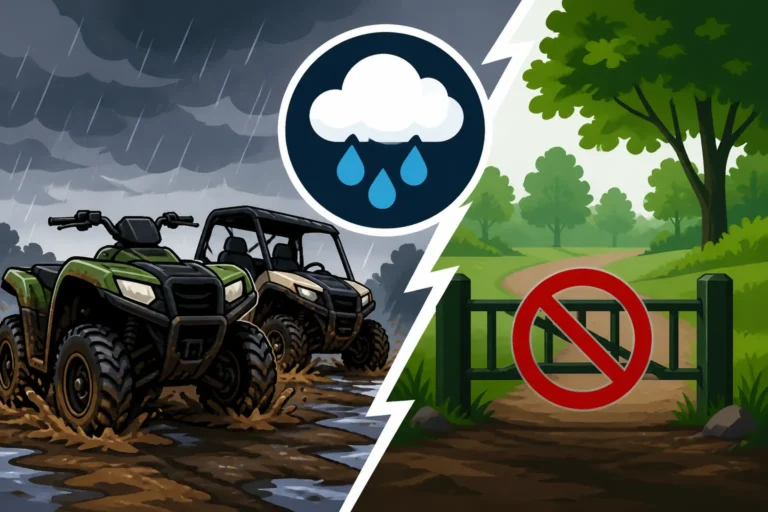
It is worth resisting the urge to test a questionable section by driving through it. A single pass can leave deep marks if the soil is soft underneath. If you see fresh ruts, water pushing up around tire tracks, or machines spinning for traction, treat those as signs that the route may be too wet to ride responsibly. For more on how wet conditions affect Iowa terrain, see Iowa Riding After Heavy Rain.
Freeze and thaw can make traction inconsistent
Frost can create a thin, slick layer on grass, leaves, and compacted soil. On a turn or slope, that surface may offer less grip than it appears to. A machine can slide even at a cautious pace, particularly if the rider turns sharply, brakes abruptly, or accelerates hard.
As the day warms, the top layer may loosen while the lower ground remains cold and damp. This combination can feel greasy under the tires: the surface gives way, but not evenly. On a UTV, the added weight can increase the consequences of losing traction, while an ATV rider may find that a quick steering correction makes the machine feel unsettled.
Give yourself extra room and use smooth inputs. Ease off the throttle before a turn, avoid sudden braking, and leave a larger gap behind other riders. If you notice your tires spinning or the machine drifting, stop somewhere safe and reassess instead of powering through. Iowa’s clay can become especially slippery when damp, as explained in Iowa Clay That Turns to Grease.
Check the Park and Trail Conditions Before You Load
Confirm access before you make the drive
A cold morning does not guarantee that Tama is open, and a prior visit is no guarantee that conditions are unchanged. Wet weather, freeze-thaw cycles, maintenance, or other local decisions can affect access. Check the relevant park or Iowa DNR information before leaving, and look for notices that specifically apply to Tama rather than relying only on a general forecast.
A quick check can save a long drive with a trailer, but it should also shape your plan for the day. If access is uncertain, identify a backup option before you leave home. Do not assume that an alternate riding area will be open just because Tama is not; check its status independently. The practical habit is simple: confirm the destination, confirm the conditions, and have a plan for turning around if the trail is not suitable.
You can also use Iowa Trail Closures to Check First as a reminder of what to verify before heading out. If you use a mapping app such as onX Offroad to plan a route or keep track of where you are, treat it as a navigation aid—not as confirmation that a trail is currently open or that riding is allowed there.
Read the terrain, not just the forecast
A forecast gives useful context, but it cannot tell you whether a particular trail is holding water or whether a shaded section has thawed. Think about recent rain, overnight temperatures, daytime sun, and the ground around the riding area. Conditions can change noticeably between the parking area and the trail.
Look for signs when you arrive, too. Standing water, deep tire impressions, fresh mud pushed to the sides of a track, or riders struggling to maintain control are reasons to slow down and reconsider. If the entrance or trail signage indicates a closure or restriction, follow it. Do not ride around a barrier or onto a closed trail to see whether the conditions improve farther in.
When available, consult an official trail map or park information alongside your own planning tools. Iowa Trail Maps From the DNR can help orient your planning, while onX Offroad may be useful as a separate navigation reference. Neither a map nor a visible track on a device overrides posted restrictions or current closure information.
| What you notice | What it may mean | A sensible response |
|---|---|---|
| Frost on grass but no visible mud | The surface may still be damp underneath | Start slowly and watch for slipping or soft spots |
| Water in low areas | The trail may be holding moisture | Avoid riding through or around it if doing so will damage the ground |
| Fresh, deep tire ruts | The soil may be too soft for traffic | Turn back and avoid adding more damage |
| Slick leaves or shaded soil | Traction may be reduced even if the route looks dry | Use smooth steering, braking, and throttle |
| Posted closure or barrier | Riding is not allowed on that route | Stop and follow the posted direction |
Prepare Your Machine and Riding Plan
Check tires, controls, and essential gear
Before you leave, inspect your tires for damage and confirm that they are appropriate for your machine and the riding conditions. There is no single tire-pressure setting that works for every ATV or UTV, so follow the manufacturer’s guidance rather than making a last-minute adjustment based on guesswork. If you are unsure how your setup performs on Iowa soil, review Tire Pressure for Iowa Clay and make changes only within the recommendations for your machine.
Give the brakes, throttle, steering, lights, and tires a quick check before unloading. Cold weather can make a ride less comfortable, and damp conditions can mean a longer stop if you need to adjust clothing or equipment. Wear layers that allow you to stay warm without restricting movement, and bring gloves that let you operate the controls confidently.
A small planning check can prevent avoidable trouble later. Make sure your phone is charged, tell someone where you plan to ride, and carry water and basic supplies suited to your outing. If you rely on onX Offroad or another navigation tool, check that your planned route is available before you arrive and consider whether you will have service in the area. Keep any required registration or permit information with you as well; Iowa ORV Permits Explained is a useful place to review the general requirements.
Choose a conservative route and pace
On a frost-affected day, the best route is often the one that lets you turn around easily. Avoid committing early to a long loop if you have not yet seen how the trails are behaving. Start with a familiar, manageable section, keep the group together, and agree on a stopping point where everyone can reassess.
Ride at a speed that leaves room to react to changing grip. A smooth, steady pace is safer than sharp bursts of acceleration or abrupt braking, especially when the surface alternates between firm ground and slick patches. In a group, leave enough space that the rider ahead does not force you into a sudden stop or a tight maneuver.
For a family or mixed-experience group, make the route decision together before setting off. A confident rider may be comfortable with a slippery section that is stressful for a beginner. Iowa Trail Difficulty Ratings can help frame the discussion, but conditions on the day still matter more than a trail’s general label. If the first stretch feels unpredictable, shortening the ride is a sound decision—not a failed outing.
Ride With Care and Know When to Turn Back
Protect the trail as well as your machine
It can be tempting to keep riding when a machine has enough power to push through soft ground. But being able to make it across does not mean the route can handle the traffic without damage. Spinning tires can dig into the surface, and repeated passes can deepen ruts that remain after the frost is gone.
If you encounter a muddy or visibly soft section, do not create a new track around it unless the park specifically directs riders to do so. Going around a wet patch can widen the damaged area and trample vegetation. If the only way forward is to churn up the ground, turn back. That protects the trail and reduces the chance of getting stuck or damaging your machine.
The same principle applies to an area that is closed. Do not assume a closure is unnecessary because the ground looks firm where you are standing. [Iowa Rules for Riding a Closed Trail] is a helpful reminder that posted access restrictions matter even when a route appears passable.
Keep the ride flexible
A good frost-season plan includes permission to change course. If conditions are worse than expected, shorten the ride, stop for the day, or choose another activity. That can be frustrating after you have loaded the machine, arranged a group outing, and driven to Tama, but it is better than turning a borderline day into a recovery effort or leaving damage behind.
Use small decisions throughout the ride to manage risk. Pause before unfamiliar sections, watch how the machine responds on turns, and check in with less experienced riders. If traction is deteriorating or the surface is becoming visibly rutted, do not wait until someone is stuck to call it.
Before you head home, check the machine for packed mud or debris and make sure everyone is accounted for. If you used a route-tracking tool such as onX Offroad, review your track as a record of where you went, not as proof that a route will be open next time. Conditions can change quickly after the first frost, so make the next trip’s decision with a fresh check of park access and trail status.
Disclaimer
This article is for general informational purposes only and does not constitute professional advice. Laws, prices and regulations vary by location and change over time. Consult a qualified professional for guidance on your specific situation.