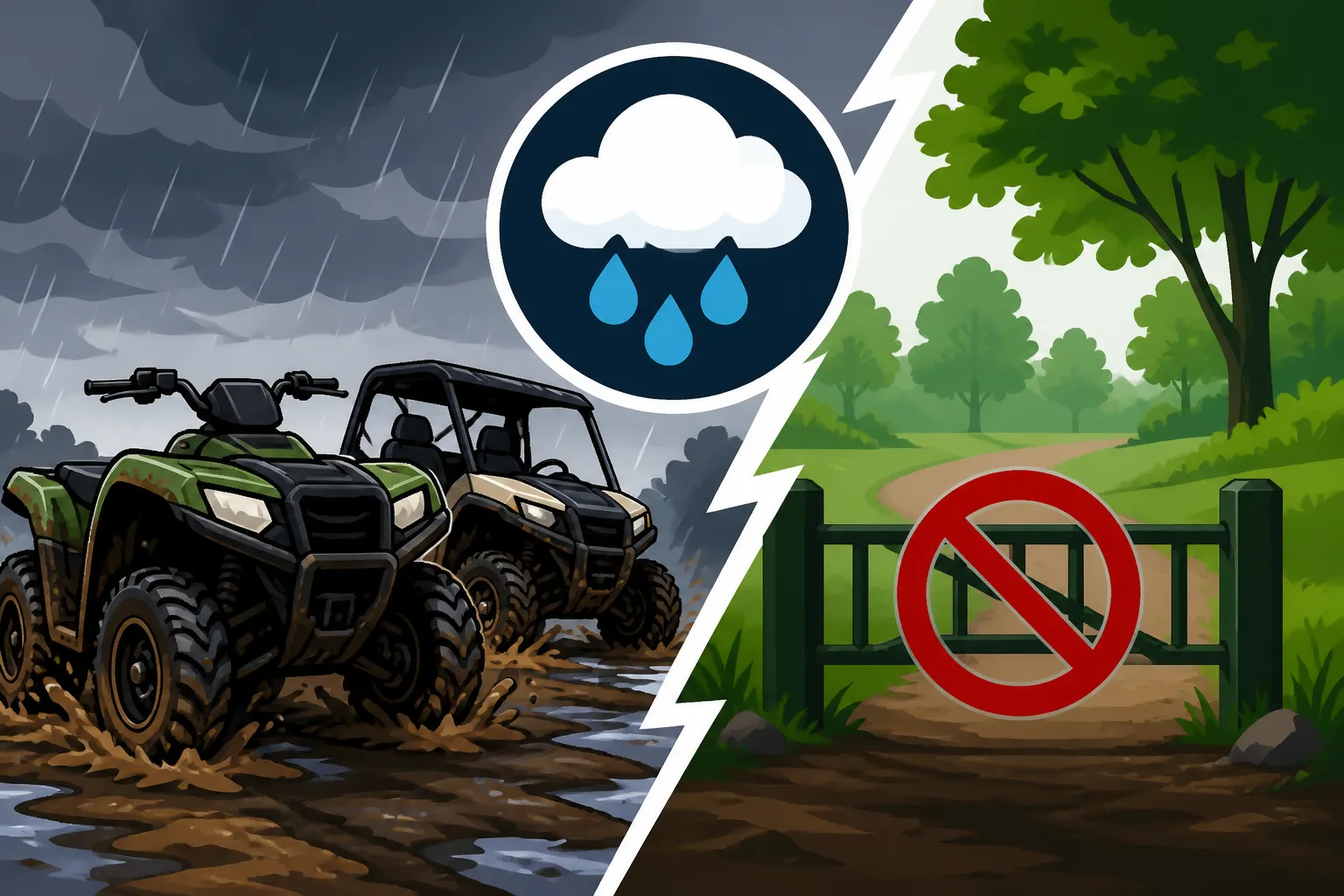
When One Wet Weekend Closes Every Park
A rainy weekend can turn a long-planned Iowa ATV trip into a frustrating morning of muddy roads, closed gates, and a trailer that never leaves the driveway. When several parks shut their trails at once, the safest response is to check official updates, understand why the closures matter, and make a backup plan before setting out.
Why one wet weekend can close several Iowa parks
Iowa soil and trail design make rain a bigger problem than it looks
A little rain on pavement may seem harmless, but off-road trails behave differently. Many Iowa riding areas include soil that becomes slick and soft when saturated. In some places, [Iowa Clay That Turns to Grease] is more than a colorful description: it signals how quickly a firm-looking surface can become slippery and vulnerable to deep ruts.
The problem is not limited to standing water. Tires can break up the trail surface even when the route looks passable from the staging area. Repeated passes push wet soil aside, deepen grooves, and leave uneven sections that can be difficult to repair. A trail that seems fine under one machine may deteriorate quickly once several groups ride it.
That is why a park may close after rain even when the parking lot is only damp. The people managing the trails are thinking about the condition underneath the surface, not just whether riders can get through today. [Why Iowa Closes Parks for Wet Trails] explains why protecting trails during wet periods can matter more than keeping them open for a single weekend.
Closures depend on local conditions, not just the rain total
Two parks can receive similar rainfall and make different decisions. Soil type, drainage, shade, trail layout, recent weather, and how much traffic an area has already seen can all affect whether a route is rideable. A low-lying trail that stays wet may need a longer recovery period than a higher, well-drained section.
The timing also matters. Rain falling on already saturated ground can create problems faster than the same amount falling after a dry stretch. A forecast that looks manageable on its own may not tell you how the trails will hold up after several days of showers.
So there is no dependable rule like “wait one day after rain and every park will be open.” Closures are often made park by park, and conditions can change after a notice is posted. For broader context, see [Iowa's Weather-Driven Trail Closures].
| What you notice | What it may mean for the trails | What to do |
|---|---|---|
| Rain in the forecast | Conditions may worsen before you arrive | Check again before loading |
| Mud in the staging area | The trail system may be soft beyond the entrance | Look for an official park update |
| A closure notice | The park is not available for riding, even if the gate looks accessible | Do not ride around barriers |
| One park closed and another open | Conditions differ by location | Confirm the second park directly |
| Ruts or standing water on an open trail | The surface may be vulnerable or changing | Follow posted rules and turn back if needed |
How to check park conditions before you leave
Start with official closure and park updates
Before heading out, check the park or managing organization’s own updates. Some Iowa riding areas are managed by clubs or local authorities, so the place you normally check for one park may not be the right source for another. The key is to find a notice from whoever is responsible for that specific property.
A general weather app can tell you what has fallen nearby, but it cannot confirm whether a trail is open. A social post from another rider can be useful as a clue, yet it may be several hours old or refer to a different entrance or trail section. Treat both as supporting information, not a substitute for a current official status.
Use [Reading the Iowa DNR Alert Feed] as a starting point for understanding how alerts can help, then check the individual park’s current information. If the update is unclear, call before you leave. [Calling a Park Before You Load] can save a long drive with a trailer, especially when rain has been moving across the state and conditions are changing quickly.
Check more than once on a changing weather weekend
A single check the night before may not be enough. A park could be open when you go to bed and close after overnight rain or a morning assessment. On a weekend with unsettled weather, check once while planning, again before loading, and once more before you commit to the drive.
When using a mapping app such as onX Offroad, use it to review your route and orient yourself to the area, not as proof that trails are open. A mapped trail line does not necessarily reflect a temporary closure, a damaged section, or a decision made by the park operator. Pair the map with the park’s own update and posted rules.
It is also worth checking nearby alternatives before you leave home. [Iowa Trail Conditions Before You Ride] and [Iowa Trail Closures to Check First] are useful reminders to confirm the actual riding status rather than relying on last weekend’s plan. If you are considering a second park, call or check its official channel separately; an open status at one location tells you nothing certain about another.
What to do when your planned park is closed
Do not treat a closed gate as a suggestion
If a park announces a closure, do not ride around the gate, use an unmarked entrance, or assume that a trail is safe because it looks firm. A closure may be in place to prevent damage that is not obvious from the parking lot. It may also apply to the entire property, not only the muddy section you can see.
Riding closed trails can create problems for other riders as well as the land managers. Deep ruts and erosion can make maintenance harder, and repeated disregard for closures can affect access for everyone. If the people maintaining the trails ask riders to stay off, respect that request. [When a Club Asks Riders to Stay Off] explains why local trail managers may need riders to wait even when the weather appears to be improving.
If a trail is open but visibly deteriorating, be willing to turn around. Avoid spinning tires to climb a muddy rise, cutting around puddles, or making a new route along the edge of a trail. Those detours can widen the damaged area. [Trail Damage From Riding Too Wet] covers why choosing not to ride can be part of responsible trail use, not a wasted trip.
Build a practical backup plan before the drive
A backup plan does not have to mean finding another park at the last minute. Choose one or two possible alternatives during the planning stage, then verify their status on the day of the ride. A park farther away may have different conditions, but the extra distance only makes sense if its operator confirms that it is open.
The list below can help keep a rain-day decision simple:
- Check the original park’s current status.
- Check the latest local weather and recent rainfall near the park, not just at home.
- Contact the park if its status is missing or unclear.
- Check one or two alternative parks individually.
- Decide whether the extra drive is worthwhile before loading or leaving.
- If every suitable park is closed, reschedule rather than searching for an unofficial place to ride.
It can help to keep a short list of options by region. Riders around central Iowa, for example, may compare possibilities based on distance, machine type, and whether the park offers the kind of riding their group wants. [Checking Two Iowa Parks Before You Drive] and [Picking a Backup Park an Hour Down the Road] offer useful planning angles for avoiding a trip that depends on only one gate being open.
onX Offroad can help you think through routes and nearby areas while you plan a backup, but it should not replace a closure check from the park itself. Make the final call using current information from the people responsible for managing the riding area.
How to make a rain-day decision without guessing
Separate weather information from trail status
Weather reports and trail updates answer different questions. A forecast tells you what may happen in the area. Recent rainfall estimates help you understand the broader conditions. A park notice tells you whether the manager has opened or closed the riding area. You need the last piece before treating a trip as confirmed.
Even a bright, sunny morning does not guarantee that a trail has dried out. Shaded sections, low spots, and compacted routes can remain wet after nearby fields or roads look dry. Conversely, rain in a nearby town does not always mean a particular park is equally affected. Local assessment matters.
When the information conflicts, do not choose the answer that lets you ride. If the park’s notice says closed, follow it. If there is no clear notice and the weather has been poor, call or wait for an update instead of assuming that the absence of a closure announcement means the trails are open.
Know when rescheduling is the better choice
It is understandable to feel disappointed when you have arranged a day off, coordinated a group, or loaded multiple machines. That effort is real. But the cost of a wasted drive is usually easier to accept than discovering that a second park is also closed, or contributing to trail damage that keeps an area shut longer.
A useful rule is to make the go-or-no-go decision before the trailer is packed. If the park has not confirmed an opening, your alternative is too far away, or conditions are changing quickly, rescheduling may be the least stressful option. You can use the extra time to inspect your machine, organize gear, or choose a more reliable date.
For future rides, make checking conditions part of the routine rather than an emergency task. Keep official park contacts handy, review [Iowa Riding After Heavy Rain] for the broader considerations, and use onX Offroad as a planning aid alongside—not instead of—park updates. That small habit can prevent a frustrating drive and help keep Iowa’s trails in better shape for the next dry weekend.
Disclaimer
This article is for general informational purposes only and does not constitute professional advice. Laws, prices and regulations vary by location and change over time. Consult a qualified professional for guidance on your specific situation.