Iowa Clay That Turns to Grease
Iowa clay can change from firm and predictable to slick, sticky, and deeply rutted after a single soaking rain. That shift can turn an enjoyable ride into a recovery job—or damage trails that need time to dry. This guide explains how to judge conditions, ride carefully when trails are open, and know when staying home is the smarter choice.
Why Iowa Clay Gets So Slick
What happens when wet clay loses traction
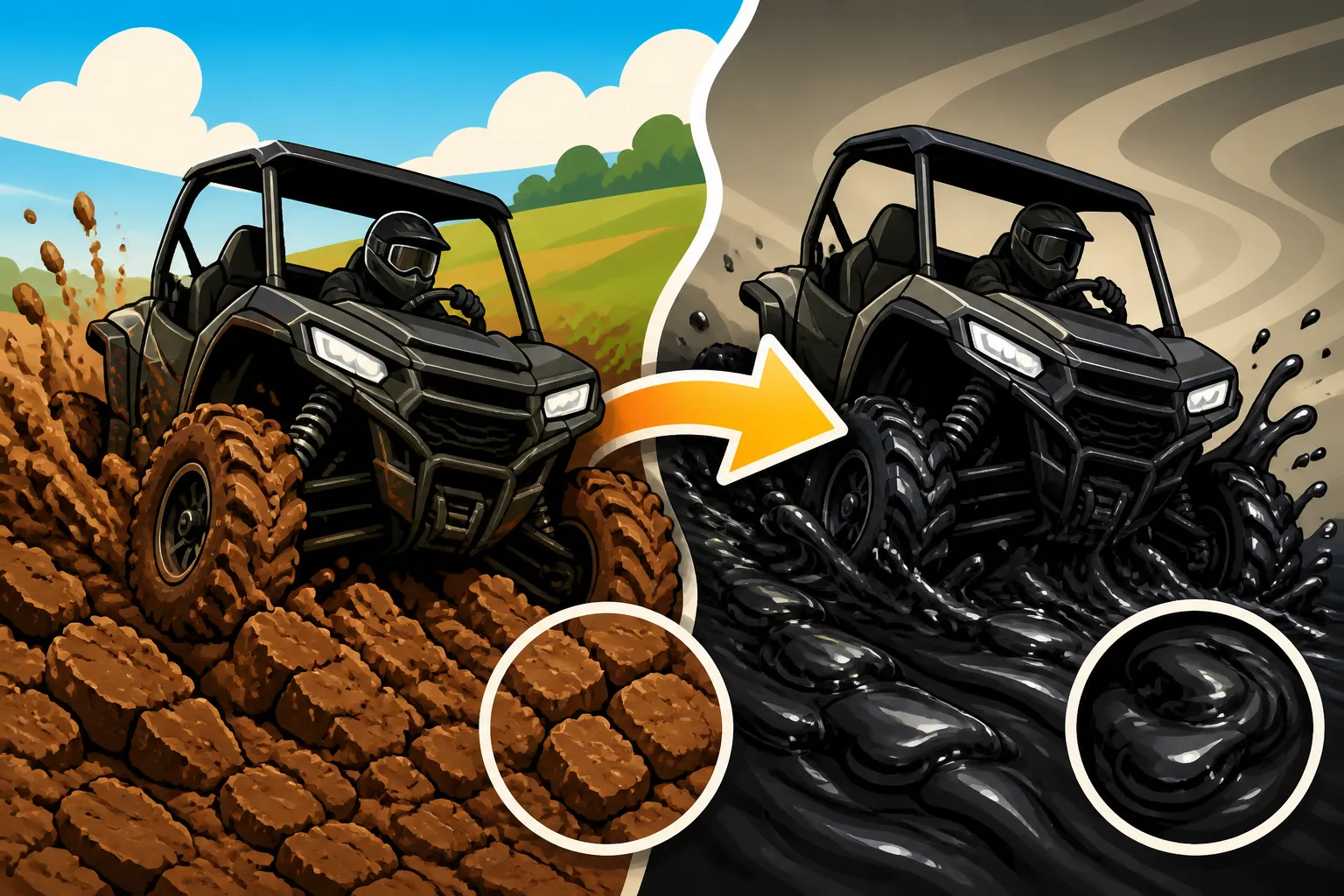
Many Iowa riding areas have clay-rich soil. When the ground is dry or only slightly damp, it can feel solid under a tire. Add enough rain, though, and water works into the soil, reducing the grip between the tire and the trail. The surface may become slick before it looks dramatically muddy.
That is why a trail can catch riders off guard. A shaded patch beneath trees, a low spot, or a slope that drains poorly may be greasy even when the staging area looks fine. Tires that feel planted on firmer ground can suddenly slide sideways, spin, or struggle to climb.
Clay also sticks. It can pack into tire tread, fill gaps around suspension parts, and build up on fenders and floorboards. As the tread fills, a tire loses some of its ability to clear mud and find grip. On a UTV, the added weight and wider footprint can make it especially tempting to keep pushing through a soft section—but extra throttle may dig deeper ruts rather than move the machine forward.
How Iowa weather changes trail conditions
A quick shower does not affect every trail equally. Recent rainfall matters, but so do soil type, shade, slope, drainage, and how much traffic the trail has already taken. A trail in open sun may dry sooner than a wooded section. A low-lying route can remain wet long after rain has stopped.
The weather can also change during a ride. You might start on firm ground and encounter slick clay after a passing shower, or find that a busy section has been churned into mud by earlier riders. Conditions around Rathbun, Mahaska County, or other clay-heavy areas can vary from one loop to the next, so a nearby trail report is more useful than assuming the whole riding area is uniformly dry or wet.
Before loading up, check for closures and recent trail-condition notices. Iowa Trail Conditions Before You Ride can help you think through what to verify, while Reading a DNR Closure Alert is useful when a closure notice affects your plans. If you use onX Offroad to look at routes and map your ride, treat the map as a planning aid—not as confirmation that a trail is open or in good condition. Check the park or land manager’s information, too.
Why riding wet trails can cause lasting damage
A tire spinning on saturated clay can cut a rut quickly. Once a rut forms, water may follow it instead of draining away, making the same spot softer and harder to pass the next time. Other riders may then steer around it, widening the damaged area and turning one narrow problem into a broader patch of torn-up trail.
This is one reason a trail can look rideable from the entrance but still be vulnerable farther in. The surface may hold together at first, then break apart under repeated passes. Riding around a muddy section can also damage vegetation or soil outside the marked route. If the trail is closed, or a club or park operator asks riders to stay off, avoid trying to find a workaround. Trail Damage From Riding Too Wet explains why a short-term decision to wait can protect a route for everyone.
How to Decide Whether to Ride
Check the trail, not just the forecast
A forecast can tell you whether rain is likely, but it cannot show exactly how each trail has drained. Look for recent notices from the park, county, or trail operator. If a closure alert is posted, do not assume it applies only to the worst-looking section. Closures are often intended to prevent damage across a larger area.
If the trail is not formally closed, consider calling the park or checking its official updates before you leave. A direct local report may clarify whether the route is open, whether particular loops are soft, or whether conditions changed after overnight rain. The post Calling a Park Before You Load offers a useful reminder: a quick check can save a long tow and an avoidable trip.
Mapping apps such as onX Offroad can help you plan a route and understand where you intend to ride, but they cannot tell you whether the clay is holding up that morning. Use onX Offroad alongside current information from the property manager, and make sure the route you are viewing is on land where riding is permitted. A visible line on a map is not the same thing as permission or an open trail.
Use a conservative go-or-no-go check
When you reach an open riding area, look at the ground before committing to a full loop. Check for standing water, fresh tire grooves, slick slopes, and mud that is already clinging heavily to tires. If the staging area is wet, deeper sections may be worse. If the trail manager says conditions are marginal, take that seriously rather than testing the entire route with your machine.
A practical decision guide can help you avoid the familiar “we drove all this way, so we might as well ride” trap:
| What you find | Safer choice |
|---|---|
| The park or trail is officially closed | Do not ride there |
| Standing water and deep, fresh ruts are common | Postpone the ride |
| The surface is damp but firm, with no closure notice | Proceed cautiously and reassess often |
| Conditions vary across loops | Stay on open, manageable routes and turn back if needed |
| Your machine is already struggling on easy ground | Stop before the trail becomes a recovery situation |
A family arriving with children, for example, may be better off changing plans than trying to manage a slick hill with a less experienced rider. Likewise, a group with a heavy UTV and a loaded trailer should be realistic about what the machine can safely handle. The right decision depends on the conditions and the riders—not just the vehicle’s advertised capability.
Build a backup plan before you leave
Wet weather can close more than one riding area, so choose a backup activity before setting out. Check more than one park, but confirm each location’s status rather than assuming it will be open because it is farther away. Checking Two Iowa Parks Before You Drive is a helpful planning topic, especially when rain has moved across the region.
onX Offroad can be useful for organizing a route or keeping your trip plan together, but avoid using a map to improvise access across private land or around a closure. If the park is shut, treat the closure as the end of that riding plan. You might reschedule, visit a different confirmed-open area, or use the day to clean and inspect your machine.
A backup plan also helps prevent rushed decisions. If you have already agreed on what to do when a park closes, nobody has to argue at the gate or pressure the group into riding questionable ground. That is particularly valuable when several families have traveled together or when a tow vehicle and trailer make a last-minute change inconvenient.
How to Ride Carefully When Trails Are Open
Adjust your pace and throttle
If a trail is open and conditions are suitable, ride smoothly. Sudden throttle, sharp turns, and abrupt braking can break traction on slick clay. A measured pace gives you more time to respond when the surface changes, and a gentle throttle makes it easier to notice when your tires begin to spin.
When a wheel starts slipping, adding more power is not always the answer. Spinning can dig into the surface and deepen a rut. Ease off, regain control, and consider whether the section is safe to continue through. If it is not, turn back by a sensible route rather than repeatedly attacking the same spot.
Keep enough distance from the rider ahead to see what the trail is doing and avoid having to stop on a slippery slope. This matters especially on blind bends, hills, and narrow sections where a sudden stop could leave you with limited room to maneuver. Leave space for other riders and do not follow so closely that a slide or stall becomes a pileup.
Choose lines carefully without leaving the trail
A firmer-looking line may offer better traction, but stay within the marked route. Cutting around a muddy patch can widen the trail, damage vegetation, or put you somewhere the land manager has not authorized riders to go. If the only way forward appears to be leaving the trail, turn around or ask the park staff for guidance.
For a UTV, remember that the machine’s width can make a narrow, rutted section more difficult than it first appears. Do not assume that a route suitable for a smaller ATV will feel equally comfortable in a wider vehicle. Keep your wheels on the established path, and do not force the machine through a section where the body, tires, or undercarriage may catch.
Mapping tools can help you keep track of a planned route, but use them in support of trail signs and local directions. If you use onX Offroad, review the route before starting and avoid treating a mapped line as permission to cross a boundary. When signs and the map seem to disagree, follow posted restrictions and ask the land manager rather than guessing.
Know when to turn around
Turning around is a riding skill, not a failure. If the trail is getting worse, your tires are packed with clay, or you are losing control on a gentle section, do not wait for a steep climb or a deep rut to make the decision for you. Stop in a safe place, communicate with the group, and choose a route back that does not require crossing closed or unmarked ground.
A group can also agree on a simple rule before riding: if a rider is uncomfortable or a machine is struggling, the group pauses and reassesses. That prevents the most confident person from setting a pace the rest cannot safely follow. Keep children and newer riders in a position where an experienced adult can monitor them without crowding or rushing them.
If you become stuck, avoid spinning the tires for a long time. A nearby rider may be able to help assess the situation, but recovery should not involve damaging the trail or putting anyone in the machine’s path. For future trips, consider what the conditions revealed about your route, equipment, and decision-making. A hard-won turnaround can make the next ride safer.
What to Do After a Muddy Ride
Clean the machine before clay hardens
Clay is easier to remove before it dries into a dense layer. Rinse the tires, wheel wells, floorboards, and underside, taking care around electrical connections, seals, bearings, and other sensitive components. Avoid directing a high-pressure stream into places where water can force dirt past seals or damage delicate parts.
Check for packed mud around the radiator area, suspension, brakes, and moving components. A machine that looks clean from the side can still hold a heavy buildup underneath. Removing it helps you spot damage and prevents the next ride from starting with blocked cooling airflow or mud interfering with parts.
After washing, take a moment to inspect the machine rather than immediately putting it away. Look for cuts, loose parts, damaged guards, or unusual noises on a brief, safe check. If you are unsure how to clean or inspect a particular component, consult the owner’s manual or a qualified repair professional.
Help the trail recover
Do not ride around a closure sign or re-enter a section that has been closed after your visit. If you notice a new hazard, washout, or badly damaged area, report it to the park or land manager using the contact method they provide. Avoid trying to repair a public trail yourself unless the operator specifically asks for help.
The best way to support a riding area after wet weather is often to let it dry. That can be frustrating when you have a free weekend, a machine ready to go, and friends already making plans. But keeping tires off fragile clay can reduce ruts, protect trail edges, and give the route a better chance of reopening in good shape.
Use Iowa Trails Closed After Rain and Iowa Riding After Heavy Rain as reminders to make trail conditions part of your trip planning—not an afterthought. When a park is open and the ground is ready, ride within the marked route, adjust to the surface, and be willing to turn back. Those habits help keep Iowa’s trails enjoyable for the next group, too.
Disclaimer
This article is for general informational purposes only and does not constitute professional advice. Laws, prices and regulations vary by location and change over time. Consult a qualified professional for guidance on your specific situation.