Iowa Rules for Crossing a Four-Lane Road
Riding your ATV or UTV across Iowa's vast landscapes offers incredible freedom, but navigating public roads, especially multi-lane highways, can feel like a minefield of confusing rules and potential fines. Many riders get frustrated trying to figure out where they can and can't go, and the thought of an expensive ticket for a simple misstep is enough to deter anyone. This guide is here to clear up the confusion, explaining Iowa's specific regulations regarding crossing four-lane roads so you can ride confidently and within the bounds of the law.
The Strict Reality of Four-Lane Roads in Iowa
Let's face it: the roar of an ATV or UTV is a familiar sound on many gravel roads and trails across Iowa, but it's a very different story when you start talking about major multi-lane highways. The rules here are significantly more restrictive, and for good reason. It's a matter of safety, pure and simple, and understanding these boundaries is crucial for every rider.
Why Four-Lane Roads Stay Closed in Iowa
Iowa's law enforcement and Department of Natural Resources (DNR) are acutely aware of the vast difference in speed, braking capability, and rider protection between an off-highway vehicle (OHV) and a typical car or truck traveling at highway speeds. Imagine your UTV, even one equipped with safety features, suddenly trying to merge into 65 mph traffic. The speed differential alone creates an enormous hazard, not just for you but for every other driver on the road. The visibility of an ATV or UTV, despite advancements in lighting like those offered by companies like SuperATV, is still much lower than a full-sized vehicle, especially in adverse weather or at night. These roads are designed for high-speed, continuous flow, and OHVs simply don't fit that design safely. This is why you'll find a blanket prohibition on sustained travel on most four-lane highways, undivided two-lane primary highways, and interstates. It's not about making things difficult; it's about preventing tragic accidents.
The legislative intent behind these rules is to protect all road users. The sheer volume of traffic on a multi-lane highway, coupled with the higher speed limits, means there's less reaction time for everyone involved if an OHV were to enter the flow of traffic unexpectedly. While the thought of a quick shortcut down a major road might be tempting, the risks involved are simply too high for the state to permit it, which is why [Why Interstates Stay Closed in Iowa] extends to most four-lane roads.
Crossing a Multi-Lane Highway at an Intersection
Here's where a small, but critical, exception comes into play. While you absolutely cannot travel down a four-lane highway, Iowa law does permit you to cross one under very specific conditions. This isn't a free pass to weave through traffic; it's a narrowly defined allowance designed to help you get from one permissible road segment to another.
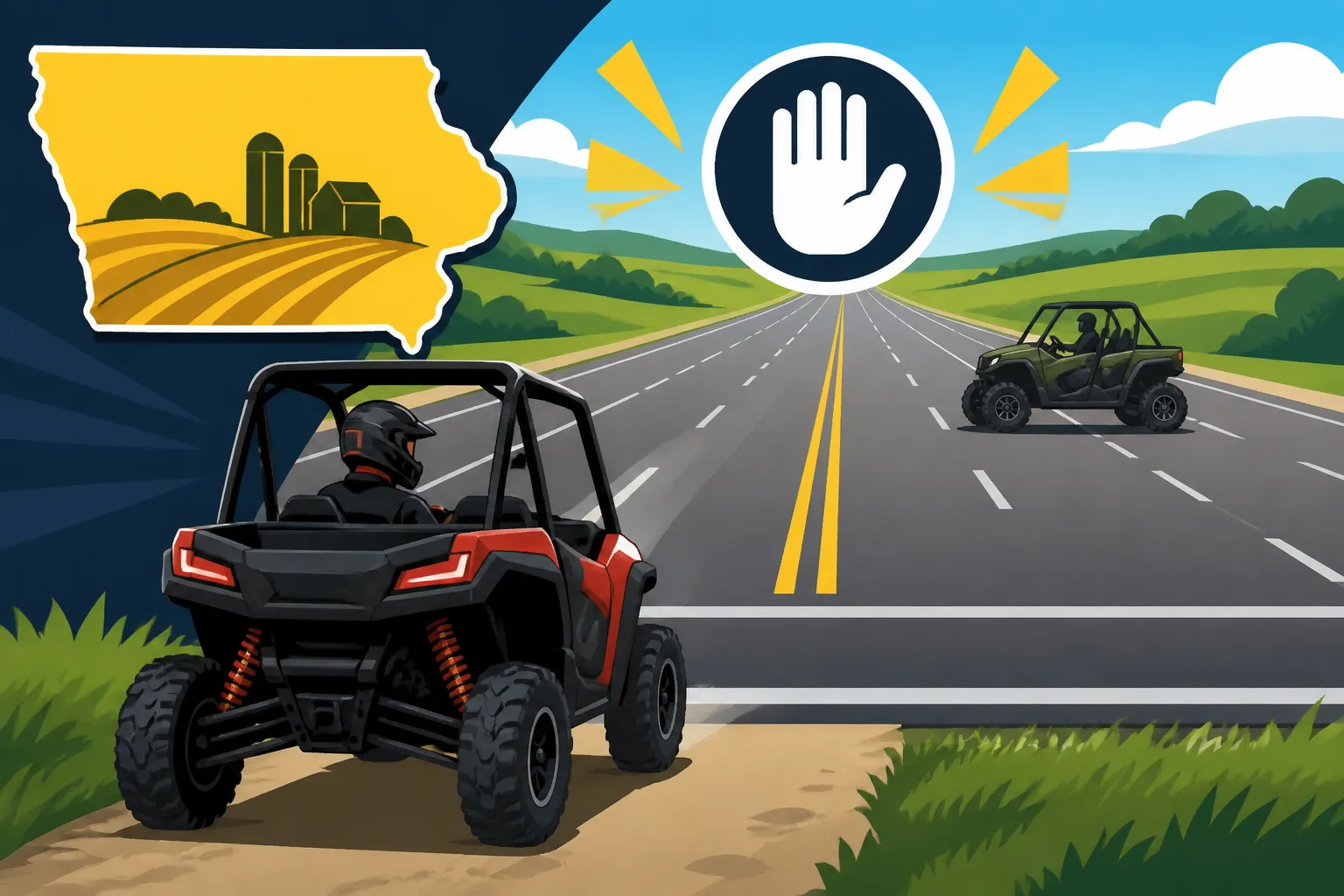
You are allowed to cross an undivided, two-lane primary highway or a four-lane highway only at an intersection, and you must do so at approximately a 90-degree angle to the highway. This means no diagonal cutting, no lingering, and certainly no turning onto the highway itself for any distance. The idea is to minimize your time on the high-speed road, getting you off it as quickly and directly as possible. Before you even think about crossing, you must yield to all through traffic. Just like with any intersection, safety is paramount. You need to be acutely aware of vehicles approaching from all directions, understanding that they might not expect an ATV or UTV to be crossing. Always err on the side of caution; if in doubt, don't go. This crossing privilege is usually exercised when you're already legally operating on an approved secondary road and need to reach another approved secondary road on the opposite side of the highway.
Navigating the "Most Direct Route" Exception
The concept of taking the "most direct route" is often misunderstood by ATV and UTV riders in Iowa, especially when they encounter multi-lane roads. It's a limited exception, not a carte blanche, and it has specific applications that rarely involve sustained travel on major highways.
Understanding the "Most Direct Route" Concept
In Iowa, the "most direct route" exception primarily comes into play when you need to travel from your residence to a designated off-highway vehicle (OHV) park or trail, or from one approved riding area to another. It can also apply when you're heading home after a day on the trails. The spirit of this rule is to allow riders to legally access designated riding areas, often via [Unpaved County Secondary Roads in Iowa] or other permissible routes, without having to trailer their machines for every short hop.
However, this exception is not a license to joyride on just any road that appears to be "direct." It specifically refers to the most efficient and practical path using approved roads. This usually means a combination of gravel roads, minor paved secondary roads where authorized by the county, and city streets where local ordinances permit OHV use. The primary goal is to provide reasonable access, not to integrate OHVs into the general flow of high-speed traffic. For instance, if you're going to [The Most Direct Route to an Iowa OHV Park] like Gypsum City, your direct route will almost certainly involve secondary county roads, not state or federal four-lane highways.
Limits on Using Four-Lane Roads for the "Direct Route"
Despite the "most direct route" language, you should almost never consider a four-lane highway as part of your permissible route for travel, even if it seems like the quickest way to your destination or [The Most Direct Route Home in Iowa]. The distinction lies between a direct crossing at an intersection (as discussed above) and actual travel along the length of a four-lane highway. The latter is generally prohibited due to the inherent safety risks.
The law is designed to allow travel on roads suitable for ATVs and UTVs, which typically excludes roads with high speed limits and heavy traffic volumes. If your "most direct route" requires you to travel any significant distance on a four-lane highway, you're likely on the wrong path according to Iowa law. In such cases, the expectation is that you would find an alternative, legally permissible route, even if it means taking a slightly longer path, or you would trailer your machine for that segment. The safety imperative always overrides the convenience of a seemingly direct, but illegal, route.
Essential Requirements for Any Permitted Road Interaction
Even when you're engaging in the limited permissible interactions with Iowa's roads – like crossing a four-lane highway at an intersection or riding on an approved secondary road – there are critical legal and safety requirements you must meet. Failing to do so can result in significant penalties and, more importantly, put you and others at risk.
Age and Licensing for Iowa Road Use
One of the most fundamental requirements for operating an ATV or UTV on any public road in Iowa, even for a brief crossing, is that the operator must be at least 18 years old. This isn't just a suggestion; it's a strict legal mandate. Furthermore, that 18-year-old operator must possess a valid driver's license. This means a learner's permit or a farm exemption for a minor does not qualify you to operate an OHV on a public road.
The reasoning behind this is straightforward: operating any vehicle on a public road, even an ATV or UTV, requires a certain level of maturity, judgment, and understanding of traffic laws that is typically associated with licensed adult drivers. This is in contrast to rules for riding on private land or designated OHV parks, where age requirements might be different and a safety certificate might be the primary credential. But for even the most fleeting interaction with a public thoroughfare, [Iowa Minimum Age to Ride a Road] is 18 with a license.
Mandatory Equipment and Speed Limits
Before you even consider putting a tire on any public road, your ATV or UTV must be equipped with specific safety features, and you must adhere to strict speed limits. First, let's talk about speed: on any road where OHVs are permitted (which, to reiterate, excludes most four-lane highways for travel), your speed is capped at 35 mph. This is a crucial limit designed to reduce the speed differential with other vehicles and give both you and other drivers more time to react. Exceeding this limit, even momentarily, is a clear violation.
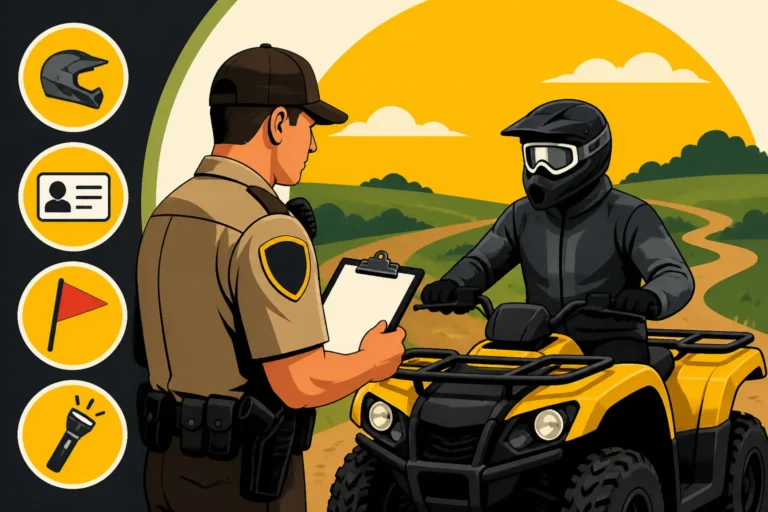
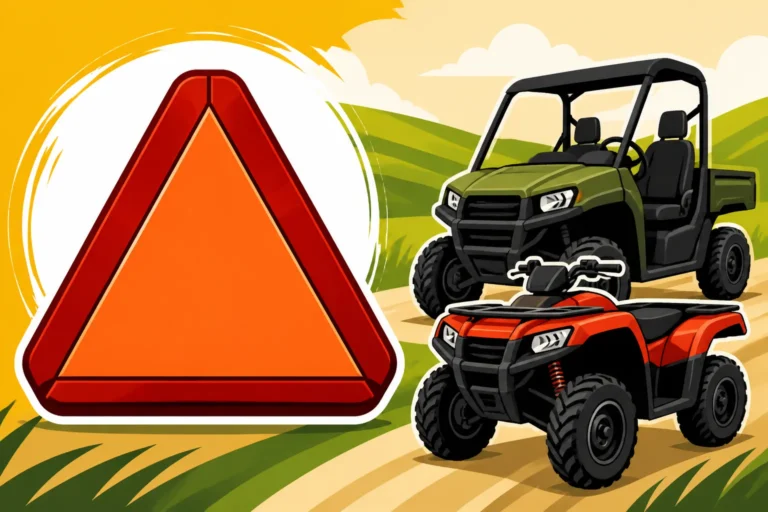
In terms of equipment, visibility and signaling are key. Your machine must have a functional headlight, which must be on at all times, day or night, when operating on a public road. You also need a taillight and a brake light to signal your presence and intentions. A horn, audible for at least 200 feet, is required for signaling other drivers or pedestrians. Finally, you must have at least one mirror, showing a view of the road for 200 feet to the rear, typically mounted on the left side. While some riders might upgrade their machines with aftermarket turn signals or more advanced lighting from brands like SuperATV, the core requirements for [Iowa Lighting Requirements for ATVs], a horn, and a mirror are non-negotiable for road use. Don't forget the slow-moving vehicle triangle, mounted on the rear, for added visibility. These simple additions can make a huge difference in how safely you interact with public roads. The [Iowa ATV Speed Limit on Roads] is there for a reason, and so are these equipment rules.
| Requirement | Detail | Notes |
|---|---|---|
| Minimum Age | 18 years old | Must possess a valid driver's license. |
| Speed Limit | Maximum 35 mph | Applies to all allowed road types. |
| Headlight | Must be on at all times | Essential for visibility, day or night. |
| Tail & Brake Light | Required | For signaling presence and stopping. |
| Mirror | At least one, showing 200 ft to the rear | Typically on the left, but two can offer enhanced safety. |
| Horn | Audible for at least 200 ft | For signaling intentions and hazards. |
| Insurance | Minimum 20/40/15 liability coverage | Proof required; significant fines for non-compliance. |
| Crossing Only | Only at 90-degree angle at an intersection | No continuous travel on four-lane highways; yield to all traffic. |
| No Interstates | Absolutely prohibited | Safety and speed differences are too great. |
| Decal | Current Iowa ATV/UTV registration decal | Mounted on the rear, proves registration. |
| SMV Triangle | Slow-Moving Vehicle sign on rear | Highly visible fluorescent orange triangle. |
The Absolute Necessity of Insurance
Beyond the equipment and age requirements, perhaps one of the most critical legal mandates for any public road interaction, including crossing a four-lane highway, is valid insurance. Just like with cars and trucks, [Iowa ATV Insurance Requirement] mandates that anyone operating an ATV or UTV on a public road must carry liability insurance. The minimum coverage limits are typically $20,000 for bodily injury to one person, $40,000 for bodily injury to two or more people, and $15,000 for property damage.
Operating without this mandatory insurance is a serious offense that can lead to substantial fines, potential impoundment of your machine, and the suspension of your driver's license. It's not just about avoiding a ticket; it's about financial protection. If you're involved in an accident, even a minor one, and you're found to be at fault without insurance, you could be personally liable for tens of thousands of dollars in damages, medical bills, and legal fees. Always carry proof of insurance with you when riding, just as you would in your car. Some riders choose to equip their machines with robust skid plates or brush guards, perhaps from a reputable company like SuperATV, to protect their investment, but nothing protects you financially on public roads quite like proper insurance.
Consequences of Non-Compliance and Best Practices
Ignoring Iowa's rules for ATVs and UTVs on public roads, especially concerning four-lane highways, can lead to serious repercussions. Understanding these consequences is just as important as knowing the rules themselves, as it reinforces why adherence is so critical.
Fines and Penalties for Illegal Road Use
The penalties for operating an ATV or UTV illegally on Iowa's public roads, particularly on restricted highways, can be quite severe. You could be facing significant [Iowa Fines for Illegal ATV Road Use], which often range into the hundreds of dollars for even a first offense. These fines can quickly accumulate if multiple violations are observed, such as lacking proper equipment, no insurance, or operating under the minimum age.
Beyond monetary fines, law enforcement, including county sheriffs and Iowa conservation officers, have the authority to impound your machine. This means not only a fine but also towing and storage fees, adding substantially to the financial burden and inconvenience. Repeated offenses can lead to more severe penalties, including potential suspension of your driver's license. These aren't just minor infractions; they are taken seriously to ensure public safety on Iowa's road network.
Prioritizing Safety and Legal Riding
Ultimately, the best way to enjoy your ATV or UTV in Iowa is to ride legally and safely. This means taking the time to understand all the regulations, not just those pertaining to four-lane roads. Always check local city and county ordinances, as these can vary widely and impact where you can legally ride, even on secondary roads or within town limits. Remember that [What Iowa Requires of an ATV on a Public Road] is a comprehensive list of rules you need to follow for any road interaction.
For riders looking for legal and extensive opportunities to explore, Iowa's eight designated OHV parks are your best bet. Places like Gypsum City, Bluff Creek, and Rathbun offer miles of trails designed specifically for off-highway vehicles, eliminating the need to navigate the complexities of public road laws for the majority of your ride. Utilizing these [Iowa's Eight Designated OHV Parks] ensures you're riding in a designated, managed environment, often with clear rules and dedicated amenities. If you must interact with public roads, always be hyper-vigilant, ensure your machine is properly equipped, you're of age with a valid license, and you carry proof of insurance. Ride smart, stay safe, and keep Iowa's trails and legal road segments open for everyone to enjoy.
Disclaimer
This article is for general informational purposes only and does not constitute professional advice. Laws, prices and regulations vary by location and change over time. Consult a qualified professional for guidance on your specific situation.