Headlights On All Day in Iowa
Many Iowa ATV and UTV enthusiasts dream of more than just dedicated trails; they envision hitting the open road, whether it's a quick trip down a gravel lane to a friend's house or navigating a paved county road to the nearest gas station. However, this dream often clashes with a complex web of regulations that can feel confusing and restrictive. This guide will cut through the misinformation, clearly explaining exactly what it takes to legally operate your off-highway vehicle on Iowa's diverse road network, focusing particularly on the crucial requirement to keep those headlights burning bright.
The Landscape of Iowa's ATV and UTV Road Laws
For many riders, the idea of taking their ATV or UTV onto public roads is fraught with questions. Is it even allowed? Are all roads fair game? The reality in Iowa is a nuanced one, a careful balance between allowing off-highway vehicle (OHV) use for specific purposes and ensuring the safety of all road users. It’s not as simple as slapping a license plate on your quad and driving wherever you please; there are strict limitations on where you can operate these machines on Iowa's roadways. Understanding these foundational rules is the first step toward responsible and legal road use.
Beyond the Trail: Where ATVs and UTVs Can Roam
Iowa law carves out specific types of roads where ATVs and UTVs may be operated, and these distinctions are crucial. Generally speaking, Iowa allows OHVs on unpaved county secondary roads. This means those picturesque gravel and dirt roads that crisscross much of rural Iowa are often open season, provided you adhere to all other operational requirements. This is a huge benefit for landowners, farmers, and recreational riders alike, offering access to rural properties or connecting segments of trails. However, the moment you encounter pavement, things get more complicated. Paved secondary roads require explicit authorization from the county board of supervisors. Without that specific county resolution, a paved secondary road is off-limits. Similarly, primary highways, which are typically multi-lane state and federal routes, are generally prohibited, with very limited exceptions for crossing at intersections. You cannot simply use a highway to get from point A to point B.
The idea here is to minimize conflict with faster-moving traffic and to keep slower-moving machines on roads where they are less likely to pose a hazard. Imagine trying to drive your UTV at 35 mph on a busy state highway where traffic routinely travels at 65 mph or more. It’s a recipe for disaster. That's why the law directs OHVs to specific types of roads. Riders often ask about city streets. Just like paved county roads, city streets and alleys require a city council ordinance to be opened for ATV and UTV use. Many towns across Iowa have indeed taken this step, especially in rural areas where OHVs are a common mode of transport for short distances. Always check with the specific city clerk or local authorities before assuming a city's streets are open. It’s important to remember that even when a road is open, you are usually expected to take [The Most Direct Route to an Iowa OHV Park] or other destination, not just joyride.
The Age and Licensing Requirements for Road Use
Operating an ATV or UTV on public roads in Iowa isn't just about the machine; it's also about the operator. There are strict age and licensing requirements in place to ensure that only qualified individuals are behind the handlebars or steering wheel. For starters, you must be at least 18 years old to operate an ATV or UTV on any public road in Iowa, regardless of whether it's paved or unpaved. This is a non-negotiable rule. There's no exception for minors, even if they possess an ATV safety certificate for trail riding. The rationale is that public roads introduce a different level of risk and require a higher degree of judgment and experience than off-road trails.
Furthermore, any person operating an ATV or UTV on an Iowa public road must possess a valid driver's license. This isn't just a suggestion; it's a legal requirement. Your driver's license demonstrates that you have passed basic driving tests and understand traffic laws. This means that if you're under 18, even if you have a permit or a junior operator's license for a car, you cannot legally drive an OHV on the road. The combination of the age limit and the driver's license requirement is designed to ensure that ATV and UTV operators on public roads are mature, trained, and accountable. If you're pulled over without a valid driver's license or if you're under 18, you could face significant fines and penalties. For more details on who can operate, see [Iowa Minimum Age to Ride a Road].
Understanding the "Implement of Husbandry" Exemption
Iowa law does provide an important exemption for ATVs and UTVs when they are used as an "implement of husbandry." This exemption is primarily designed to facilitate agricultural operations, recognizing that farmers often need to use these machines to move between fields, transport tools, or check livestock on their property and adjacent roads. When an ATV or UTV truly qualifies as an implement of husbandry, some of the stricter road-use rules, such as registration and sometimes even specific equipment requirements, can be relaxed. However, this isn't a blanket exemption for all rural use. The key is that the machine must be "used exclusively for agricultural purposes" and only when "traveling short distances for the operation of farming."
What does this mean in practice? If you're driving your UTV from one field to another, perhaps a mile down a gravel road, with a sprayer attached or tools in the bed, it likely falls under the implement of husbandry exemption. You might not need to display a registration decal or have all the standard road-legal equipment. However, the moment that UTV is used for recreational riding, hunting, or simply traveling to a friend's house, it loses its "implement of husbandry" status, and all standard road-use regulations, including registration, apply. It’s not just about the type of machine, but how and why it’s being used at that specific moment. Crossing county lines for an evening cruise, even in a farming community, would not typically qualify. This distinction is often misunderstood, leading many riders to incorrectly assume their farm quad is always exempt, which can lead to tickets.
Essential Equipment for Street-Legal Machines
Riding an ATV or UTV on Iowa roads means your machine needs to be more than just capable off-road; it needs to be visibly and safely equipped for public roadways. This isn't about personal preference; it's about meeting specific state statutes designed to protect you and other motorists. Outfitting your machine properly can feel like a chore, but it's a crucial step in ensuring your adventures don't end with a citation or, worse, an accident. Many aftermarket companies, including SuperATV, offer a wide range of accessories that can help you meet these requirements, from lighting kits to mirrors.
Lighting Up the Road: Headlights, Taillights, and Turn Signals
When it comes to road use, visibility is paramount, and your machine's lighting system is at the forefront of this. Iowa law explicitly requires ATVs and UTVs operated on public roads to have at least one headlight and one taillight. But it’s not just about having them; they must be fully functional and clearly visible. The headlight needs to cast a beam sufficient to illuminate the road ahead, while the taillight must be visible from a certain distance to warn following traffic. This is critical for safety, especially during dusk, dawn, or in adverse weather conditions.
Beyond basic headlights and taillights, turn signals are also a mandatory piece of equipment for road-legal ATVs and UTVs in Iowa. These allow you to clearly signal your intentions to other drivers, preventing confusion and potential collisions when turning or changing lanes. Many off-the-shelf ATVs and UTVs, particularly older models or those designed purely for off-road use, may not come equipped with factory turn signals. In such cases, riders must install an aftermarket turn signal kit. When sourcing these, make sure they are durable and bright enough to be seen in various conditions. Similarly, a brake light that illuminates when you apply the brakes is also essential. This system works in conjunction with your taillight but provides an additional, crucial warning to those behind you that you are slowing down or stopping. Without these essential lighting components, your machine is simply not ready for public road use, and you risk a ticket. For specific requirements, check [Iowa Lighting Requirements for ATVs].
Visibility and Safety: Mirrors, Horns, and SMV Triangles
Beyond illumination, other pieces of equipment are vital for your visibility to others and your ability to be aware of your surroundings. A working horn is a non-negotiable safety feature. Just like in a car, a horn allows you to alert pedestrians, other drivers, or even animals to your presence, helping to prevent accidents. It doesn't need to be a blaring air horn, but it must be clearly audible. A functional rearview mirror is also required. This allows you to monitor traffic behind you, which is particularly important on roads where you might be traveling slower than other vehicles. Many off-road machines only come with a small, handlebar-mounted mirror, or sometimes none at all. You may need to invest in a larger, more robust mirror, or even two, to ensure adequate rearward visibility. Companies like SuperATV offer a variety of mirrors, from side-view options to panoramic rearview mirrors, designed for the unique challenges of OHVs.
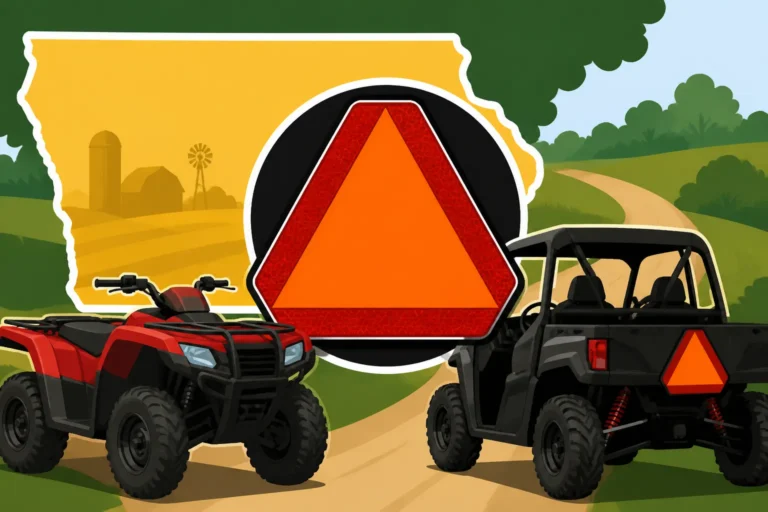
Another crucial safety device is the slow-moving vehicle (SMV) triangle. This bright orange, reflective triangle must be displayed on the rear of your ATV or UTV when operating on public roads. The SMV triangle is a universally recognized symbol that warns other drivers that your vehicle is traveling at 25 mph or less. Since ATVs and UTVs are capped at 35 mph on Iowa roads, and often travel slower, this triangle is a vital indicator to prevent rear-end collisions, especially on rural roads with higher speed limits. Without these items, you're not just risking a fine; you're putting yourself and others in danger. These aren't just arbitrary rules; they are designed to integrate your OHV safely into the flow of traffic, even if it's a slow flow. [Iowa's Slow-Moving Vehicle Triangle] is not just a suggestion; it's a mandatory warning device.
Structural Integrity and Passenger Safety
While not always explicitly listed as "equipment" in the same way as lights or mirrors, the structural integrity of your ATV or UTV and its design for carrying passengers are inherent safety considerations for road use. Generally, Iowa law intends for ATVs and UTVs to be operated as they were designed by the manufacturer. This means if your ATV is a single-rider machine, it should not be carrying a passenger on public roads. UTVs, designed with multiple seats and often seat belts, are typically suitable for carrying the number of passengers they are rated for. The key here is to stick to the manufacturer's recommendations and not overload your machine or carry passengers in unsafe ways, such as on the fenders of an ATV.
Furthermore, while Iowa does not have a mandatory helmet law for ATV or UTV operators on public roads, it is always a wise safety practice, especially considering the open nature of these vehicles. Road hazards can be unpredictable, and a helmet offers critical protection in the event of a rollover or collision. Similarly, while not legally mandated for most OHVs on roads, a windshield can significantly enhance comfort and provide a degree of protection from debris. If your machine does have a windshield, Iowa law specifies how dark it may legally be, ensuring it doesn't impair your visibility. Many riders opt for aftermarket windshields from brands like SuperATV that are designed for durability and clarity, offering protection from dust, bugs, and occasional road spray. Maintaining your machine in good working order, with proper tires, brakes, and steering, is also an implied safety requirement for any vehicle on public roads.
Operational Rules: Speed, Route, and Insurance
Beyond having the right equipment, how you operate your ATV or UTV on Iowa roads is just as critical. The state has specific rules governing everything from when your lights should be on to how fast you can travel and, crucially, what kind of financial protection you need to have in place. These aren't just suggestions; they are enforceable laws designed to ensure safety and order on public byways. Ignoring them can lead to tickets, accidents, and severe financial consequences.
The Constant Glow: Why Your Headlights Must Always Be On
This is perhaps one of the most distinctive rules for ATV and UTV operation on Iowa roads: your headlights must be on at all times, day or night. That's right, even in the brightest midday sun, you are legally required to have your headlights burning. This isn't just a quirk of Iowa law; it's a deliberate safety measure. ATVs and UTVs, by their nature, are smaller and often less visible than conventional automobiles. They can blend into the background, particularly on dusty gravel roads or when emerging from tree lines. Requiring headlights to be on during daylight hours significantly increases your machine's conspicuity to other drivers, pedestrians, and cyclists.
Think of it as a proactive measure to prevent accidents. A car driver might not immediately register a small, dark ATV approaching, but a distinct set of headlights provides an earlier visual cue, giving them more time to react. This rule removes any ambiguity about when lights are needed, simplifying enforcement and rider compliance. So, before you even pull out of your driveway onto a public road, make it a habit to switch on those headlights. It’s not just a recommendation; it's a critical legal requirement for safe operation. Without them on, even in broad daylight, you're operating illegally. For more on this, see [Headlights On All Day in Iowa].
Navigating the "Most Direct Route" and Speed Limits
Another critical operational rule for ATVs and UTVs on Iowa roads pertains to your travel path and speed. Iowa law often stipulates that when you're using public roads, you must take the "most direct route" to your destination. This means you can't simply meander aimlessly or take unnecessary detours for pleasure riding on public roads. The intent is to facilitate necessary travel, such as accessing a field, getting to a trail system, or reaching a local business, rather than encouraging recreational cruising on public roadways. While "most direct" can sometimes be open to interpretation, it generally means the shortest and most practical path. Taking a scenic route that adds significant distance would likely not qualify.
In addition to the route, speed is tightly regulated. Iowa law caps the speed for ATVs and UTVs on public roads at 35 mph. This maximum speed applies regardless of the posted speed limit for cars on that road. So, even if you're on a gravel road with a 55 mph limit, your ATV or UTV cannot exceed 35 mph. This speed restriction is in place for several reasons: the inherent design of off-highway vehicles is not typically optimized for high-speed road travel, their braking distances and handling characteristics can differ significantly from cars, and it helps to mitigate the impact of collisions. This combination of a direct route requirement and a strict speed limit aims to integrate OHVs onto roads in the safest and least disruptive manner possible. Exceeding the 35 mph cap is a ticketable offense and significantly increases your risk of an accident. You can learn more about [Iowa's 35 mph Cap] in other resources.
Mandatory Insurance: Protecting Yourself and Others
Perhaps one of the most critical, yet often overlooked, requirements for operating an ATV or UTV on Iowa public roads is mandatory liability insurance. Just like with cars, if you're going to share the road, you must be financially prepared for the possibility of an accident. Iowa law requires specific minimum coverage amounts: $20,000 for bodily injury or death of one person in an accident, $40,000 for bodily injury or death of two or more persons in an accident, and $15,000 for damage to property in an accident. These are often referred to as 20/40/15 limits. Without this coverage, you are not only breaking the law but exposing yourself to potentially devastating financial liabilities if you're involved in an incident.
Proof of insurance must be carried with you whenever you operate your ATV or UTV on public roads. A law enforcement officer can request to see it during a roadside stop. If you cannot produce proof of valid insurance that meets Iowa's minimum requirements, you face significant fines. Beyond the legal mandate, carrying insurance is simply responsible riding. Accidents happen, and even a minor fender-bender with another vehicle or damage to private property can result in substantial repair costs. If you cause an injury, medical bills can quickly escalate into the tens or hundreds of thousands of dollars. Having the right insurance protects not only the other parties involved but also your own assets. Don't let the excitement of road riding overshadow the necessity of proper financial protection. [Iowa ATV Insurance Requirement] is a serious aspect of road legality.
| Road Type | Permitted for OHVs (Generally) | Authorization Needed | Common Examples |
|---|---|---|---|
| Unpaved County Secondary Roads | Yes | None (By state law) | Gravel, dirt, unimproved rural roads |
| Paved County Secondary Roads | Yes (Conditional) | County Board Vote | Blacktop county roads |
| City Streets and Alleys | Yes (Conditional) | City Council Vote | Roads within city limits |
| Undivided Two-Lane Primary Highways | No (Generally) | None | State highways (e.g., IA-14, IA-330) |
| Multi-Lane Primary Highways/Interstates | No | None | US interstates, divided state highways |
| Level B Roads (Unmaintained) | Yes | None | Minimum maintenance, unmaintained roads |
Local Control: County and City Road Authorization
While Iowa has statewide laws governing ATV and UTV use on certain road types, a significant portion of road access comes down to local control. Counties and cities have the authority to open or close specific roads within their jurisdictions, adding another layer of complexity to understanding where you can legally ride. This decentralized approach means that what's permitted in one county or town might be strictly prohibited just a few miles down the road. It requires riders to be proactive and informed about the specific rules in the areas they plan to ride.
Paved Secondary Roads: When Counties Open the Way
As mentioned, unpaved county secondary roads are generally open to ATVs and UTVs by state law. However, the situation changes drastically when you encounter pavement. Paved secondary roads, which are often significant connectors in rural areas, can only be used by ATVs and UTVs if the county board of supervisors has passed a specific resolution authorizing their use. This isn't an automatic process; it requires action from the local government. A county might decide to open some or all of its paved secondary roads, or it might choose to keep them closed to OHVs entirely. The reasons for these decisions can vary, from concerns about traffic safety and wear and tear on roads to responding to local rider advocacy.
The challenge for riders is that there isn't a single, statewide list of which paved county roads are open. You literally have to check with each individual county's recorder's office or county engineer's office to understand their specific ordinances. For example, some counties might allow UTVs on specific paved roads during daylight hours only, while others might prohibit them outright. It's a critical step before venturing onto any paved county road. Just because you see someone else riding an ATV on a paved road doesn't mean it's legal or that the county has authorized it. Always do your homework. You can learn more about [How an Iowa County Authorizes a Paved Road].
City Streets and Alleys: The Power of Local Ordinances
Similar to paved county roads, access to city streets and alleys for ATVs and UTVs is entirely at the discretion of the local municipal government. An Iowa city council must pass an ordinance specifically allowing OHVs on certain streets, or all streets, within its city limits. This is why you'll find some towns, particularly smaller, more rural communities like Waukon, that have embraced ATV and UTV use on their streets, allowing residents to easily access local businesses or connect to nearby trails. Other cities, especially larger ones or those with heavier traffic, might choose to keep their streets entirely closed to OHVs.
Again, there's no central database for these city ordinances. If you plan to ride your ATV or UTV on the streets of a particular town, your best bet is to contact that city's clerk or police department directly to inquire about their local rules. Don't assume anything. Some city ordinances might come with specific restrictions, such as hours of operation (e.g., "no riding after midnight"), specific routes, or even additional equipment requirements beyond state law. A local ordinance might state that even if your machine meets all state requirements, you still cannot ride in city parks or on certain busy thoroughfares. It's a patchwork of regulations across the state, making local inquiry absolutely essential for legal and responsible riding. [Iowa Cities That Opened Their Streets] are often smaller communities.
What to Expect at a Roadside Checkpoint
If you operate your ATV or UTV on Iowa public roads, you should be prepared for the possibility of a roadside stop by law enforcement. Whether it's a county sheriff's deputy, a state trooper, or a conservation officer, they are all authorized to enforce ATV and UTV laws. When you're pulled over, the officer will typically be checking for several key things to ensure your compliance with state and local regulations. First and foremost, they'll verify your identity and driver's license. Remember, you must be 18 and have a valid driver's license to operate an OHV on the road.
Next, they'll check for proof of insurance. Having your insurance card readily available, either in your wallet or on the machine itself (perhaps in a waterproof pouch), will make this process smooth. They will also look for your current Iowa registration decal, which should be properly mounted on the rear of your machine, and may ask to see your registration certificate. Beyond paperwork, the officer will visually inspect your machine for the required safety equipment: functional headlights (which should be on), taillights, brake lights, turn signals, a horn, a rearview mirror, and the slow-moving vehicle triangle mounted on the rear. They might also assess whether you are carrying too many passengers or operating in an unsafe manner. If you're on a paved road or city street, they may ask if you are aware of the local ordinance authorizing use. Being prepared and compliant with all these rules will help ensure a smooth interaction and allow you to continue your ride safely. Getting cited for riding without a recorder decal or other essential items can quickly put a damper on your day.
Disclaimer
This article is for general informational purposes only and does not constitute professional advice. Laws, prices and regulations vary by location and change over time. Consult a qualified professional for guidance on your specific situation.