Finishing the Safety Course Without Ever Riding
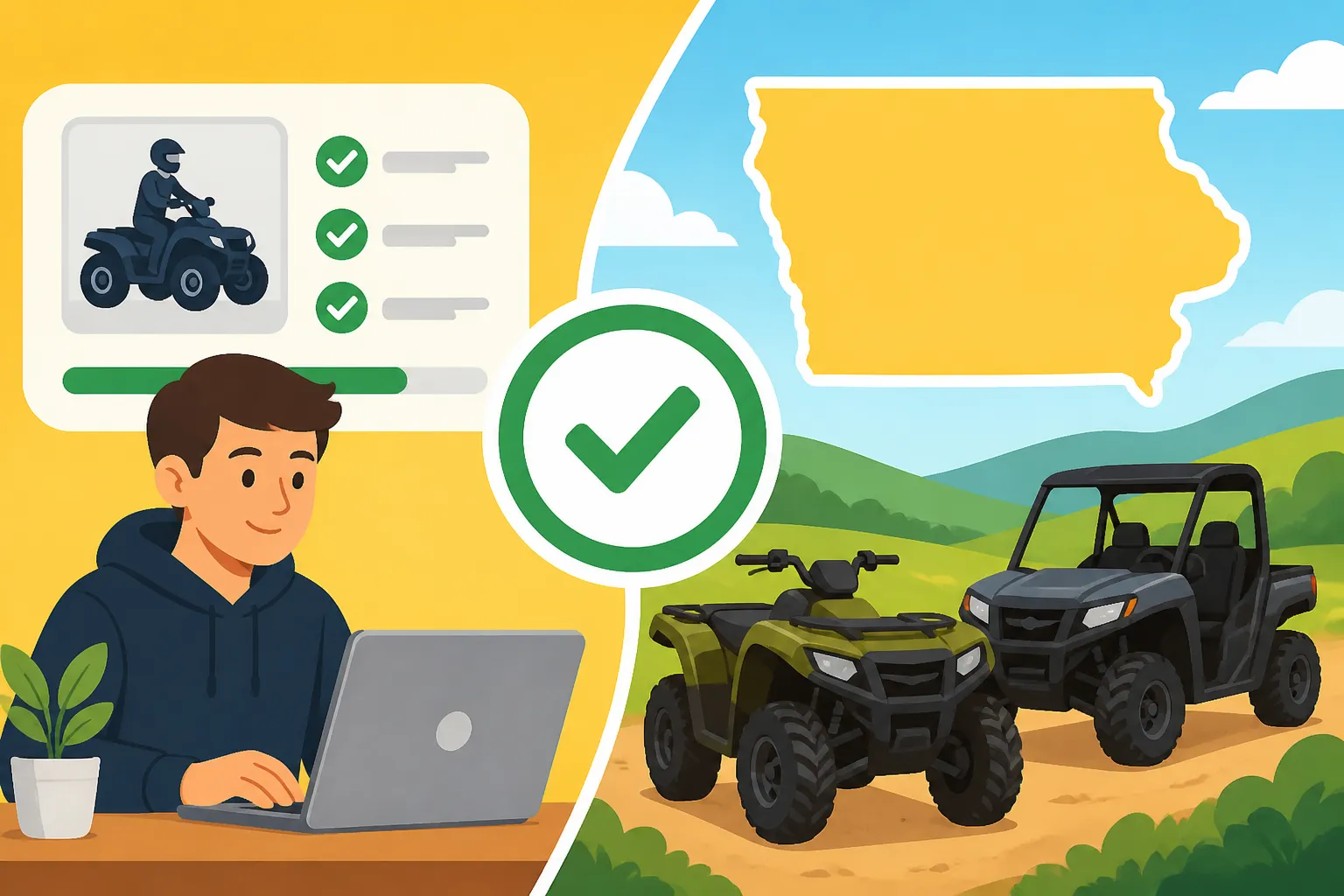
If you’re signing up for Iowa’s ATV safety course but don’t have access to a machine, that doesn’t stop you from earning a certificate. The course has no riding component: you study online and pass a final exam. Here’s what that means, who needs the certificate, how it fits with registration, and what to have ready before you ride.
What the course does and does not require
Iowa’s ATV education course is a knowledge course, not a riding lesson. The Department of Natural Resources says there is no riding component, so you do not need to bring an ATV, demonstrate that you can operate one, or complete a practical test to earn the education certificate.
That distinction matters if you’re arranging the course for a young rider or don’t own an ATV yet. The course is about learning the rules and safety information assessed by the final exam. Passing the exam earns the certificate; it does not show that a rider has practiced vehicle handling or gained experience on a trail.
The Department of Natural Resources collaborated with Fresh Air Educators to offer online certification through ATVCourse.com. A student must be at least 12 to earn an ATV education certificate through ATVCourse.com, according to the Department of Natural Resources. The Iowa ATV Safety Certificate Requirements page explains who needs the certificate and when it must be carried.
The online format removes the need to attend a riding session, but it doesn’t remove the need to understand and follow the riding rules. A certificate is one part of being prepared. It is not a substitute for learning how the particular machine handles, checking the riding area’s rules, or arranging the required registration.
According to the Department of Natural Resources, students must pass the final exam with 80% accuracy to earn the certificate. That score is the stated passing standard; it is not a practical riding assessment. For details on the exam threshold, see The 80 Percent Iowa Pass Mark.
How to complete the online certification
The basic process is straightforward: use the online course, complete its learning material, take the final exam, and earn the certificate by meeting the passing standard. The Department of Natural Resources identifies ATVCourse.com as the online certification option provided in collaboration with Fresh Air Educators.
The Department of Natural Resources lists the total course fee as $34.95, including the $5 DNR fee for the education certificate, as of November 2026. Check the course provider for current cost and enrollment details before starting. More on the price structure is covered in The $34.95 Iowa Online Safety Course.
A practical way to prepare is to set aside enough time to work through the course material without rushing. Keep track of any topics you want to review, and make sure you understand the safety information rather than trying to memorize answers. The final exam is the part that determines whether you meet the certificate requirement.
After passing, make sure you know how to access or carry the certificate. The Department of Natural Resources requires the certificate to be in the operator’s possession when riding on public land, public ice, and designated riding areas. A certificate left at home does not meet that possession requirement. If you want to understand how the course fits into the overall rules, Why the Iowa Course Has No Riding Day focuses on the difference between course completion and hands-on practice.
The certificate is separate from registration and permits
Completing the course does not register an ATV, provide a riding permit, or replace a registration decal. These are separate requirements, and it helps to check each one before heading out.
| Requirement | What it does | When it matters |
|---|---|---|
| ATV education certificate | Shows that the required course was completed and passed | For ATV operators in the required age group riding in covered public areas |
| Iowa registration | Registers a resident machine and is associated with its current decal and certificate | For covered off-highway riding on public land, public ice, or designated riding areas |
| Iowa nonresident user permit | Provides the Iowa permit for a nonresident machine | For nonresident machines riding in covered Iowa areas |
The Department of Natural Resources requires ATV operators ages 12 through 17 to take and pass an ATV education course. It also requires operators to have the education certificate in their possession when riding on public land, public ice, and designated riding areas. For a fuller explanation of where this rule applies, see Iowa ATV Safety Certificate Requirements.
Registration is a different matter. The Department of Natural Resources says off-highway vehicles used on public land, public ice, or a designated riding area must be registered with the DNR. A current registration sticker must be displayed for a registered ATV to be operated in those areas, according to the Fiscal Services Division. The operator must also have the registration certificate in the vehicle or on their person while the vehicle is in use, according to the Department of Natural Resources.
A newly owned machine, or one that has not yet been entered in the recreational vehicle and vessel registration system, must be registered through the County Recorder’s Office, according to the Department of Natural Resources. Paperwork depends on whether the machine is new or used. To review the documents involved, see Iowa ATV Registration Paperwork and Registering at an Iowa County Recorder.
Nonresidents should check permit requirements separately. The Department of Natural Resources says nonresident machines must display a valid Iowa DNR nonresident user permit on the machine. Nonresidents whose home state requires registration must also display that registration on the machine when operating on public land or a designated riding area. The Iowa’s Nonresident User Permit article explains the permit side of the process.
The certificate requirement is also distinct from road-use rules. According to the Department of Transportation, a driver operating an ATV or UTV on a public road must be at least 18 years old and hold a valid driver’s license. Completing the ATV education course does not change those road-use requirements or grant permission to use a road.
A private property ride is different again. According to the Fiscal Services Division, an ATV does not need to be registered when operated on privately owned land. That registration exemption does not change the education-certificate rule for riding in covered public areas. If your plans include public ground, public ice, or a designated area, check the requirements for the machine and operator rather than assuming a private-land rule applies everywhere.
Before you go riding
Once the course is complete, do a separate check of the rider, machine, and destination. This helps avoid arriving at a trail with a certificate but missing another required item.
- Confirm the rider’s certificate requirement. The Department of Natural Resources requires ATV operators ages 12 through 17 to have taken and passed the course, and requires the certificate to be in the operator’s possession in covered riding areas. If the rider is in that age group, make sure the certificate is accessible before leaving home.
- Check the machine’s registration status. The Department of Natural Resources requires registration for off-highway vehicles operated on public land, public ice, or designated riding areas. For a new or previously unregistered machine, check the county recorder process and required paperwork.
- Check the decal and registration certificate. The Fiscal Services Division says registered ATVs can be operated in covered areas when displaying a current registration sticker. The Department of Natural Resources says the registration certificate must be in the vehicle or on the operator.
- Check the destination’s current rules. A designated riding area may have its own operating conditions and trail information. For example, the Department of Natural Resources lists parks such as Bluff Creek OHV Park in Eddyville and Gypsum City OHV Park in Fort Dodge. Check the applicable park information before loading the machine.
- Keep course completion and riding practice separate. Because the course has no riding component, passing it does not establish hands-on experience. Arrange practice in a suitable, permitted setting and make sure the rider is comfortable with the controls before attempting unfamiliar terrain.
For a younger rider, an adult can help with planning without treating the course as a substitute for supervision or practice. The Fiscal Services Division says a person under 12 cannot operate an ATV on public land and public ice unless directly supervised by an experienced, licensed parent or guardian who is at least 18 years old. This is a separate rule from the course’s minimum age for earning a certificate through ATVCourse.com.
It’s also worth checking whether the plan involves a public road. Public-road operation is governed by separate requirements, and a safety certificate does not make an ATV road-legal by itself. The Department of Transportation lists road-use requirements including a valid driver’s license, proof of insurance, required vehicle equipment, a displayed slow-moving vehicle sign, and a maximum speed of 35 miles per hour. Local rules may be more restrictive, so confirm the road and local requirements before planning a route.
If you still need to renew a resident registration, the Department of Natural Resources allows ATV, ORV, and ORM registration renewals through the Iowa DNR Online License System. Its annual renewal period without penalty runs from September 1 through December 31. For the renewal process, see Renewing an Iowa Registration Online.
The practical takeaway is simple: you can earn Iowa’s ATV education certificate without ever riding during the course. Complete the online learning and exam, then treat the certificate, vehicle registration, permit, and any riding-area rules as separate items to verify before heading out.
Sources
- Department of Natural Resources — OHV Safety & Education | Department of Natural Resources (checked November 3, 2026)
- Fiscal Services Division — 1543036.pdf (checked November 3, 2026)
- Department of Natural Resources — OHV Dealers | Department of Natural Resources (checked November 3, 2026)
- Iowa Department of Natural Resources — Snowmobile Dealers | Department of Natural Resources (checked November 3, 2026)
- Department of Natural Resources — Snowmobile Education & Safety | Department of Natural Resources (checked November 3, 2026)
- Iowa Department of Natural Resources — download?inline (checked November 3, 2026)
Disclaimer
This article is for general informational purposes only and does not constitute professional advice. Laws, prices and regulations vary by location and change over time. Consult a qualified professional for guidance on your specific situation.